Image source: wikiart.org
Introduction
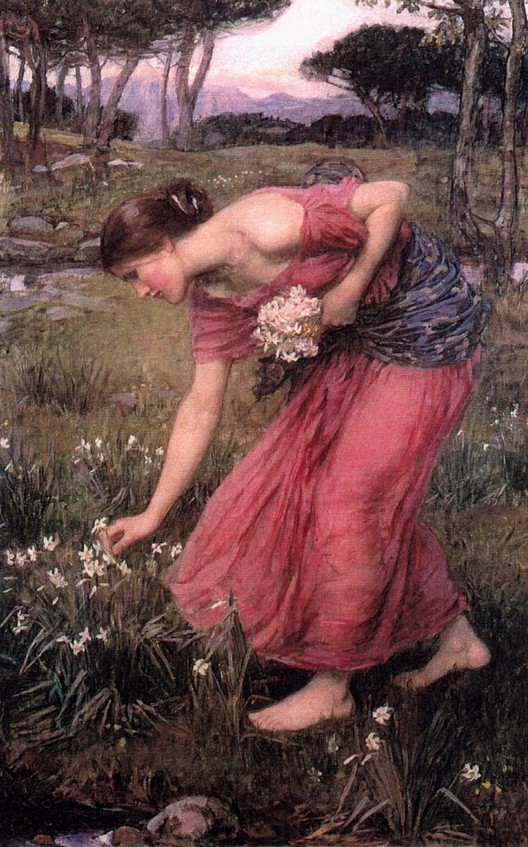
John William Waterhouse’s Persephone (1912) belongs to the painter’s late period, when myth becomes less a grand narrative and more a quiet psychological space. Rather than staging a dramatic abduction or a crowded Olympian tableau, Waterhouse narrows the myth to a single, absorbingly human moment: a young woman bent close to the earth, gathering small white flowers at the edge of a meadow. The title brings the full weight of Persephone’s story into the scene, yet the painting itself is hushed and intimate, as if myth has been translated into memory. This tension between the everyday and the legendary is one of Waterhouse’s signature strengths, and here it feels especially poignant. Persephone is not presented as an icon on a pedestal, but as a presence in a landscape, caught in a gesture that is both ordinary and fateful.
The composition asks you to read slowly. The figure’s body forms a gentle arc, her torso angled forward, her arm extending down into the flowers. The landscape behind her is subdued, with trees framing a pale sky and distant hills fading into soft, violet tones. Everything encourages quiet attention: the careful handling of fabric, the muted atmosphere, the restrained palette punctuated by the warm red of her dress. The painting does not shout its mythological content. It invites you to recognize it through mood, symbol, and the sense that something is about to change.
Myth and Meaning
Persephone’s myth is built on thresholds: girlhood and womanhood, surface and underworld, spring and winter, belonging and displacement. Waterhouse chooses not to depict the violent turning point of her abduction by Hades. Instead, he paints the moment before the rupture, when Persephone is still in the world of light, touching the fragile growth that will soon become symbolic of absence. In many versions of the myth, she is gathering flowers when she is taken. Waterhouse’s focus on that act turns flower-picking into a metaphor for the delicate way life can be interrupted.
The myth also carries a cyclical structure. Persephone’s descent and return explain the seasons, the earth’s fertility and its dormancy. Waterhouse hints at this cycle through atmosphere rather than literal narrative. The landscape has an early, cool softness, as if spring is present but not triumphant. The sky is pale, almost washed with lavender, and the distant forms blur into a gentle haze. It feels like a world held in suspension, poised between blooming and fading. Persephone’s bowed posture echoes this theme of descent. Even before the underworld appears, the body is already moving downward, as if the myth’s gravitational pull has begun.
Composition and Point of View
The painting’s structure is deceptively simple. Persephone occupies the foreground and midground, large enough to dominate the frame, yet not so large that she becomes detached from her environment. Waterhouse positions her low, with her head tilted toward the flowers, encouraging the viewer to follow her gaze and replicate her attention. This creates an unusual intimacy: you are not looking at Persephone as a distant object of admiration, but almost sharing her task.
The diagonal line of her body gives the composition motion. It begins near the upper right, where her shoulder and back catch the light, and slides downward through her arm to her hand among the flowers. This diagonal is balanced by the verticals of the trees and the calmer horizontals of the distant landscape. The result is a stable scene animated by a single purposeful gesture. Waterhouse often uses this kind of gentle choreography, letting a figure’s movement carry the emotional meaning while the landscape remains steady, like a stage set built for contemplation.
There is also a sense of enclosure. The trees frame the space and create a soft boundary, while the ground plane rises behind her, reducing the feeling of open expanse. This enclosure can be read as protective, like a sheltered meadow, but it can also feel like foreshadowing, a visual echo of the confinement that Persephone will soon experience. The painting does not need to show the underworld to suggest it. It only needs to make the world above feel suddenly precious.
Color and Atmosphere
Waterhouse’s palette here is restrained and atmospheric. The most commanding color is the deep, warm red of Persephone’s dress, a hue that carries multiple associations at once: vitality, sensuality, sacrifice, ripeness. The red is not garish. It is softened by the painter’s handling of light and by the surrounding tones of green-brown grasses, grayish stones, and the violet-pink haze of distance. This moderation keeps the scene lyrical rather than theatrical.
The landscape is painted in muted earth tones that lean cool, making Persephone’s warmth feel more alive by contrast. Her skin, softly illuminated, has a gentle glow that echoes the pale sky. The white flowers provide a delicate visual counterpoint to the red fabric, small sparks of brightness that draw the eye to the very spot where meaning concentrates. The overall atmosphere feels like late afternoon or early evening, when colors flatten and the world takes on a reflective hush. That hush becomes psychological. It is the silence before a mythic event, but also the kind of silence that accompanies private thought.
Waterhouse’s handling of distance is important. The far hills and trees blur into a tonal field that feels more like mood than geography. This makes the setting timeless. It is not a specific place on a map but a mental landscape where myth can unfold. The slight haze also creates a sense of fragility, as though the world itself is something that could be lost.
Light, Texture, and the Material World
The painting is rich in textures, and Waterhouse uses them to ground myth in sensory reality. The fabric of the dress is the most elaborate surface. It falls in soft folds, clings in places, and gathers in layers that suggest weight and movement. The red cloth is painted with a translucency that lets it feel like something you could touch, thin enough to catch light, heavy enough to pull downward.
Her hair is handled with a softer touch, dark and smooth, gathered into a modest style that reinforces the sense of a pastoral setting. The skin is modeled gently, with subtle transitions rather than sharp highlights. This softness supports the painting’s emotional tone, which is contemplative rather than dramatic.
The meadow itself is a tapestry of grasses and small plants, painted with enough detail to feel alive but not so much that it becomes botanical illustration. The white flowers are distinct, yet they remain part of a broader texture, like notes in a quiet chord. Stones and earth anchor the scene, reminding you that Persephone’s myth is ultimately about the ground itself, about what grows and what disappears beneath the surface.
Persephone as a Character
Waterhouse’s Persephone is not a triumphant goddess in regalia. She is shown as a young woman absorbed in a task. That absorption is the painting’s emotional engine. Her face is angled downward, partly in profile, with an expression that suggests focus and calm. She is not smiling. She is not performing for the viewer. She is simply present. This sense of inwardness aligns with Waterhouse’s broader interest in women as figures of psychological depth, not merely decorative symbols.
Her posture also communicates vulnerability. Bending forward exposes the back and neck, making the figure appear unguarded. The bare feet intensify this vulnerability, emphasizing contact with the earth and a kind of innocence or naturalness. Barefoot figures in pastoral settings often evoke purity, but here it can also signal exposure. Persephone is close to the ground, close to the flowers, close to the threshold where the earth might open.
At the same time, there is strength in her physicality. The body is solid and believable, and the gesture is purposeful. She is not drifting through the landscape. She is choosing, reaching, collecting. This matters for the myth, because Persephone’s story is often told as pure victimhood. Waterhouse complicates that reading by granting her a moment of agency, even if fate will soon overtake it.
Flowers as Symbol
The flowers are small, white, and numerous, scattered like quiet stars across the grass. In the myth, flowers are temptation and innocence at once: they draw Persephone’s attention, leading her to the spot of her abduction, yet they are also simply part of the living world she belongs to. Waterhouse paints them without exaggeration, which makes them more convincing as symbols. They do not announce themselves as props. They appear as natural growth, and because they are natural, they feel inevitable.
White flowers often signify purity, transition, and the fragile beauty of fleeting life. They can also suggest funerary associations, blooms placed for remembrance. In this context, the flowers become a hinge between life above and life below. Persephone picks them as if gathering a small bouquet of the world she is about to lose. The cluster in her arm reads like a private treasure, something she wants to hold onto.
The act of picking is also symbolically charged. To pick a flower is to end its life as it begins to be possessed. That paradox mirrors Persephone’s own story: she is taken, possessed, and transformed. Waterhouse’s painting invites you to feel the quiet sadness inside that paradox without spelling it out.
Landscape and the Idea of the Threshold
The setting is neither wild nor cultivated. It is a liminal space, a meadow edged by trees, open enough to suggest freedom, enclosed enough to suggest containment. Liminal landscapes are perfect for myths because they visually echo the idea of crossing from one state to another. The trees stand like sentinels, framing Persephone as she moves through her moment of ordinary time.
The background’s softness makes the foreground feel immediate, as though the present moment is all that exists. This is psychologically true to the myth. The turning point is not experienced as an epic announcement. It arrives in the middle of an everyday action. By keeping the landscape calm and slightly distant, Waterhouse heightens the sense that the world can change without warning.
The earth itself is central. Persephone’s story is the story of the earth opening, of life descending into darkness and returning. Waterhouse’s emphasis on ground texture, grasses, stones, and the low horizon gives the earth a quiet authority. You feel its presence as something ancient and inevitable.
Style and Late Waterhouse
In 1912, Waterhouse was working in a period when his approach had become more atmospheric and psychologically focused. The Pre-Raphaelite movement that shaped his early career had long since evolved, and Waterhouse’s later paintings often soften detail in favor of mood. Persephone reflects that tendency. It retains the lyrical beauty and attention to textiles associated with his earlier work, but it leans more into tonal harmony and emotional understatement.
The brushwork appears controlled but not rigid. Forms are clear, yet edges often dissolve gently into surrounding tones. This lends the painting a dreamlike quality without turning it into a fantasy spectacle. Myth becomes a kind of remembered image, vivid in feeling more than in literal narrative.
Waterhouse also continues his fascination with women in states of contemplation: figures who seem to exist at the edge of story, caught in moments that imply a larger fate. Persephone fits this lineage. She is not simply an illustration of a classical tale. She is an emblem of transition, painted with empathy rather than grandeur.
Emotional Effect and What the Painting Leaves Unsaid
The power of Persephone lies in what it withholds. There is no Hades, no chariot, no cracked earth. The absence of these elements is not a lack but a strategy. By focusing on a quiet prelude, Waterhouse makes the viewer carry the myth inside their own imagination. The painting becomes an invitation to anticipate, and anticipation is often more emotionally piercing than depiction.
This also changes the myth’s tone. The abduction becomes less a sensational event and more a sudden loss of ordinary life. Persephone’s bent posture, the fragile flowers, the subdued light all contribute to a feeling of tenderness. You are encouraged to cherish the moment because the painting itself seems to know it will not last.
At the same time, the image is not purely tragic. There is beauty in Persephone’s connection to the earth, in the calm rhythm of her gesture, in the sense of nature continuing. Because her story is cyclical, the painting can also be read as a meditation on return. Even if she descends, she will rise again. The flowers she picks might stand for spring’s promise as much as for innocence lost.
Legacy and Why Persephone Still Resonates
Persephone remains compelling because she represents a universal experience: the moment when life changes in a way you cannot fully anticipate. Waterhouse’s painting captures that feeling with rare gentleness. It is not an image of catastrophe but of the seconds before it, when the world still looks normal, when your attention is on something small and beautiful, when the future has not yet arrived.
The painting also resonates because it treats myth as psychology. Persephone is not simply a goddess explaining the seasons. She is a young woman on the verge of transformation. That transformation can be read in many ways: growing up, losing innocence, entering new roles, encountering forces beyond one’s control. Waterhouse does not force a single interpretation. He builds a quiet stage where multiple meanings can coexist.
In that sense, Persephone feels timeless. It is rooted in classical story, shaped by late nineteenth century poetic sensibility, and yet emotionally legible to modern viewers. The painting’s restraint is part of its enduring strength. It trusts the viewer to recognize that sometimes the most important moments look like nothing at all, just a hand reaching into flowers, just a breath of cool air, just a landscape holding its silence.