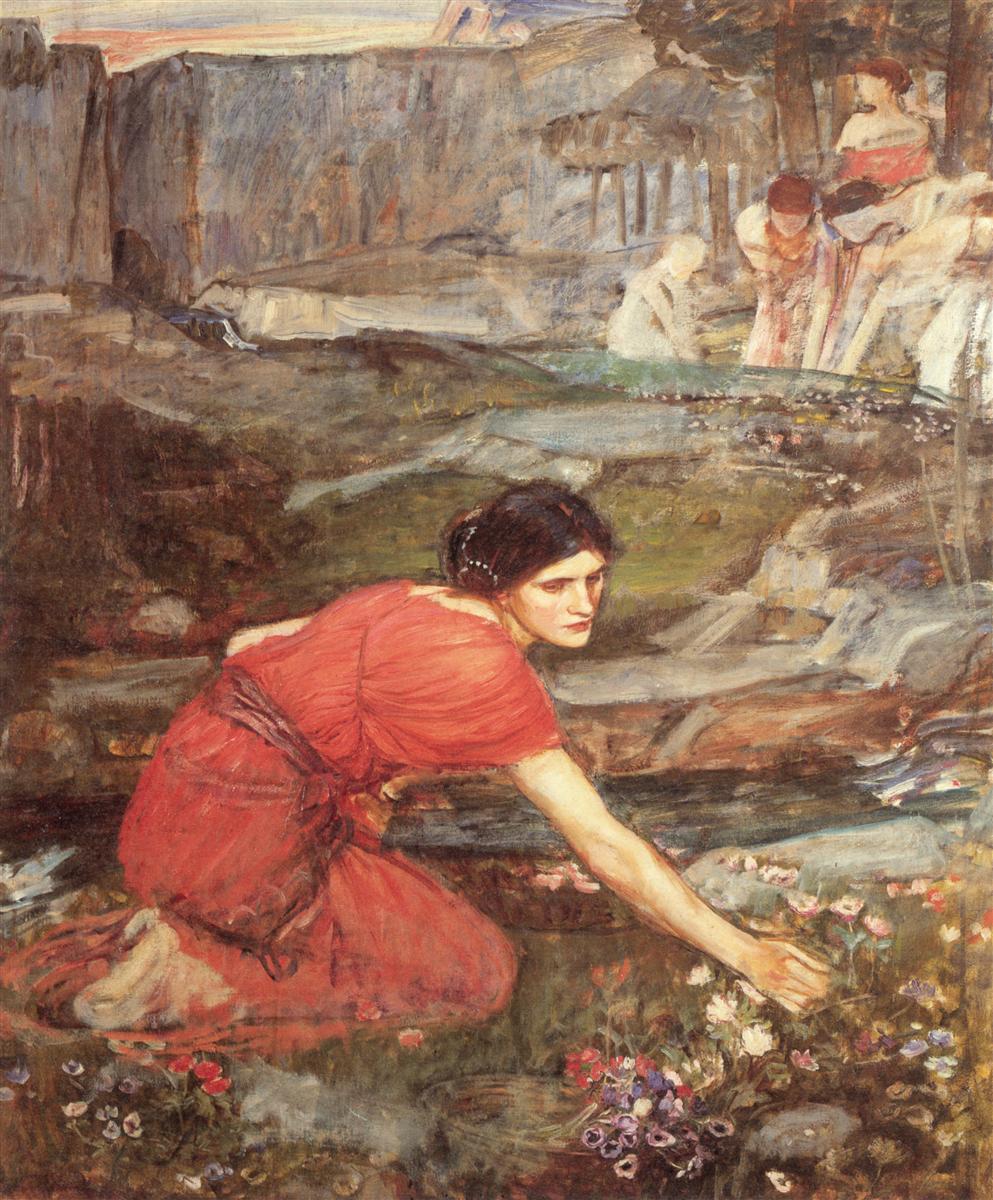
Image source: wikiart.org
Introduction
John William Waterhouse’s Maidens Picking Flowers by a Stream (1911) belongs to the late phase of an artist who never stopped believing in the emotional power of story. Painted in the early twentieth century, when many artists were pushing toward abstraction and fractured modern viewpoints, Waterhouse continued to build images that feel like remembered poems. This work centers on a simple action, the gathering of flowers beside water, yet it turns that action into a meditation on youth, longing, and the delicate line between the everyday and the enchanted. The scene appears calm at first glance, but the longer you look, the more it behaves like a threshold. The stream is not only a place in the landscape. It becomes a symbolic boundary between inner and outer worlds, between innocence and knowledge, between the present moment and a future that cannot be held.
Waterhouse often chose subjects where emotion is carried through gesture, posture, and atmosphere rather than overt drama. Here, the drama is quiet. It lives in the weight of the kneeling figure’s body, in the gravity of her gaze, in the way the background figures feel slightly removed, as if they exist in a different layer of time. The painting invites the viewer to linger with that quietness, to feel how a pastoral activity can be charged with meaning, and to recognize Waterhouse’s special skill: making a scene that looks natural while quietly insisting that it is also allegorical.
Visual Overview and Narrative Suggestion
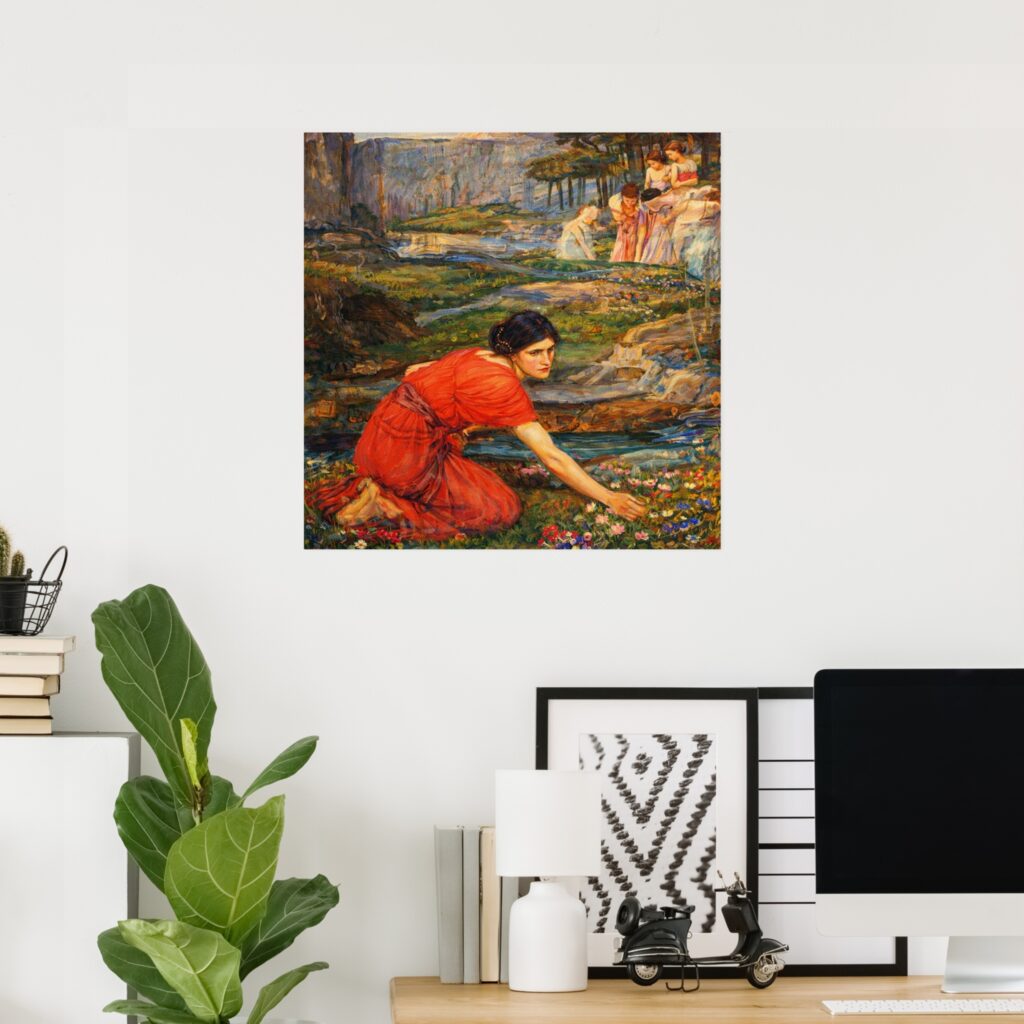
The composition is organized around a single figure in the foreground, kneeling at the water’s edge. She reaches forward with one arm extended, her hand nearing the surface where flowers and reflections mingle. Her red dress, warm and saturated, becomes the emotional center of the painting. It anchors the viewer’s attention and sets her apart from the muted earth tones and soft grays that define the wider landscape. Waterhouse uses this contrast to declare what matters most: not the geological backdrop or the distant horizon, but the human presence and the mood she carries.
Behind her, the landscape opens into a rocky valley or ravine, with a stream threading through it like a quiet ribbon. Farther back, a cluster of female figures appears near the water. Their poses suggest conversation or shared attention, perhaps also gathering flowers, yet they feel less immediate, softened by distance and by the haze of atmosphere. At the top right, another figure is positioned slightly higher, as if observing. The layering of figures creates a gentle narrative progression from foreground intimacy to background chorus, like a solo voice supported by an offstage refrain.
The title points to a collective act, maidens picking flowers, but Waterhouse gives the emotional emphasis to the solitary kneeling figure. This creates a subtle tension: the theme is communal, yet the feeling is personal. The viewer is guided to wonder what separates her from the group. Is she simply closer to us in space, or has she slipped into a more inward state than the others? Her expression, which reads as pensive and slightly burdened, suggests that this is not only a pleasant outing. Something private is happening beneath the surface.
Composition and Spatial Design
Waterhouse’s composition works by staging contrasts between closeness and distance, clarity and softness, warmth and coolness. The foreground figure is rendered with the greatest definition, particularly in the face, shoulder, and the arm reaching toward the water. Her body forms a strong diagonal from the back and shoulder down through the arm toward the stream. This diagonal acts like a directional cue, guiding the viewer’s eye toward the water and the flowers at the bottom right. The eye then circles back through the ripples and reflections, returning to the figure’s face, completing a loop that sustains attention.
The landscape is constructed with broad planes and gentle shifts rather than sharp recession. The rocky sides on the left and the more open space to the right create a shallow basin, a natural enclosure that feels both protective and isolating. The stream becomes a central pathway, leading the eye inward, but it is not a fast-moving river with obvious directional force. Instead, it reads as a slow, contemplative presence. Waterhouse often uses water in this way: not as a spectacle, but as a medium that invites reflection, literally and emotionally.
The background figures function as a secondary rhythm. They echo the theme of maidenhood and reinforce the sense that the scene is part of a shared ritual, yet their reduced detail makes them feel like memories or archetypes. This is a crucial strategy. If every figure were equally distinct, the painting might become anecdotal. By allowing the background to soften, Waterhouse keeps the image hovering between realism and reverie.
Color Palette and the Psychology of Red
The red dress is the painting’s emotional signal flare. Waterhouse chooses a hue that is warm but not flamboyant, a red that reads as earthy and human rather than theatrical. It suggests blood, warmth, vitality, and desire, but it also suggests vulnerability. In a landscape dominated by subdued browns, grays, and dusty greens, red becomes the color of life pressing against the quietness of stone and water.
This red does several things at once. It pulls the viewer into the figure’s physical presence. It marks her as the key emotional agent in the scene. And it introduces a faint sense of disturbance, because red in Waterhouse often hints at intensity beneath calm surfaces. Even when the subject is gentle, the color can imply that the moment is charged, that something significant is being felt even if nothing dramatic is happening.
The surrounding palette supports this effect. The rocks and distant landforms are rendered in cool neutrals with touches of warm undertones, suggesting a landscape that is real but slightly dreamlike. The water holds muted greens and grays, catching light without becoming reflective spectacle. Meanwhile, the small flowers near the bottom right provide tiny accents of pinks, whites, and purples, like scattered notes in a quiet melody. These delicate colors emphasize the fragility of what is being gathered. Flowers are beautiful precisely because they do not last.
Light, Atmosphere, and the Sense of Time
The light in the painting feels diffused, as if filtered through thin cloud or late-day haze. Rather than sharp sunlight, Waterhouse offers a gentle illumination that softens edges and creates an atmosphere of contemplation. This kind of light is perfect for a painting about transience. It suggests a moment that is already slipping into memory.
Waterhouse’s handling of atmosphere also affects the sense of time. The background appears slightly misted, and the figures there feel less present than the kneeling maiden. This creates a temporal layering, as if the foreground is now while the background is a recollection or a chorus from another hour. The painting becomes less about a single instant and more about the feeling of an afternoon, the emotional temperature of a place where time moves slowly.
The stream reinforces this. Water is time made visible. It flows, it changes, it reflects, it carries away. Even when painted quietly, it implies movement that cannot be stopped. The maiden’s reaching gesture, poised near the water’s surface, becomes a metaphor for trying to touch something fleeting without losing it.
Gesture, Expression, and Emotional Ambiguity
The kneeling figure’s pose is both practical and expressive. She is low to the ground, suggesting humility or closeness to nature, but her posture is not carefree. The angle of her shoulders and the tilt of her head convey weight. Her face appears thoughtful, perhaps tired, perhaps sorrowful. This ambiguity is a hallmark of Waterhouse’s late work. He often paints women not as straightforward types but as complex emotional presences, capable of carrying multiple meanings at once.
Her gesture, the arm extended, is crucial. It suggests reaching, gathering, selecting. She is not simply admiring flowers. She is actively choosing, collecting, taking something from the stream’s edge. Yet the delicacy of the flowers and the closeness of the water imply risk. To gather, you must disturb. To possess, you must touch. The painting quietly asks what is lost in the act of picking. Beauty is not only admired here. It is handled, removed, changed.
The background figures complicate the mood. Their presence suggests social context, a shared event, perhaps even safety. But the foreground maiden feels alone in her inner life. That contrast makes the painting resonate with experiences that are common and private: being surrounded by others while feeling separate, doing what everyone does while carrying a different emotion inside.
Waterhouse’s Late Style and Painterly Surface
By 1911, Waterhouse’s technique had moved toward a softer, more painterly approach compared to the crispness of some earlier works. In this painting, forms are suggested rather than tightly outlined, especially in the landscape and background figures. Brushwork appears looser in the rocks and distant areas, while the foreground figure receives more attentive modeling. This selective finish is not only a matter of technique. It is a storytelling device. The world beyond the maiden is less fixed, more atmospheric, more like a stage set for an emotional event.
The surface treatment also enhances the dreamlike quality. Details dissolve into tone. Edges blur gently. This creates a sense that the scene is half seen, half remembered. The viewer is encouraged to complete what is vague with imagination, which deepens emotional participation. Instead of delivering every fact, Waterhouse offers an invitation to feel.
His handling of fabric is especially telling. The red dress is not a rigid costume. It drapes and folds, responding to the body’s weight and the kneeling pose. This makes the figure tangible and real, which intensifies the emotional pull. Waterhouse often balances idealization with physical truth. The women may be timeless in theme, but they occupy believable bodies.
Symbolism of Flowers and the Stream
Flowers in art almost always carry the language of transience. They bloom, they fade, they are at their most beautiful at the moment they begin to disappear. In Waterhouse, flowers frequently become a way to speak about maidenhood, desire, and the fragility of innocence. To pick flowers is to participate in that fragility. It is a gentle act, yet it is also an act of ending. The bloom is removed from its root. The moment is taken from its continuity.
The stream adds a second symbolic layer. Water suggests reflection, transformation, and inevitability. It can be a site of calm, but also of danger, especially in mythic and literary contexts. In Waterhouse’s world, water often marks a boundary where ordinary life touches enchantment. Even if the scene here does not show overt myth, it carries the same atmosphere of threshold. The maiden’s hand approaches the water as if testing the border between what can be held and what will slip away.
Together, flowers and water create a symbolic pairing: the fragile object and the moving element. One is plucked, the other flows. One can be gathered, the other cannot. The painting’s emotional question seems to hover here. What are we trying to keep, and what must we let pass?
Themes of Maidenhood, Community, and Solitude
The title’s emphasis on maidens places the painting within a long tradition of associating young women with nature, purity, and seasonal cycles. Yet Waterhouse rarely treats this tradition as simple celebration. His maidens often appear at moments of transition. They are poised between states, on the edge of change, feeling more than they can say.
Community is present through the background figures, yet solitude dominates the foreground. This is not a contradiction. It is the core theme. The painting understands that the inner life is solitary even in groups. The shared activity becomes a screen behind which personal feeling intensifies. The foreground maiden may be participating in the same ritual as the others, but her expression suggests she is also elsewhere, caught in thought, memory, or anticipation.
This interplay makes the painting feel modern in a quiet way. Even though Waterhouse clings to lyrical subject matter, the psychological realism of feeling separate within the social world speaks to experiences that remain deeply recognizable.
The Landscape as Emotional Setting
The setting is not an idyllic meadow. It is a rocky, enclosed place, a kind of natural corridor. The cliffs and earth tones create a mood that is slightly somber, even if the activity is gentle. This choice matters. A brighter, open landscape would emphasize carefree pleasure. Waterhouse instead chooses a landscape that feels protective but heavy, as if the earth itself carries memory.
The stream becomes a slender relief within this rocky environment. It is the site of color, life, and softness, where flowers gather and reflections shimmer. The maiden kneels at precisely that point where the harshness of rock meets the tenderness of water plants. The setting thus becomes an emotional diagram: hardness and softness, permanence and transience, endurance and bloom.
Even the distant sky, with its subtle warmth, contributes to the mood of passing time. It feels like late afternoon or early evening, a moment associated with reflection and the quiet awareness that the day is turning. That turning mirrors the painting’s deeper sense of change.
Enduring Appeal and What the Painting Leaves Unsaid
The lasting power of Maidens Picking Flowers by a Stream lies in what it suggests without explaining. Waterhouse gives us a scene that is easy to enter, then fills it with emotional ambiguity. The kneeling maiden’s face is not a clear statement. It is a question. The background figures do not resolve the story. They deepen it. The landscape does not simply describe a place. It shapes a mood.
This is why the painting remains compelling. It is not merely decorative. It is reflective. It treats a small, familiar act as a symbol of how human beings relate to beauty, time, and change. We gather what we love. We hold what we can. We look down at the water and see something of ourselves, even if we cannot name it.
Waterhouse’s late paintings often feel like echoes from another era, yet their emotional intelligence keeps them alive. Here, he offers a vision of youth not as simple innocence, but as a moment already shadowed by awareness. The flowers are lovely. The stream is calm. The maiden is young. And yet the painting knows that loveliness is brief, calm is temporary, and youth is a passing season. That knowledge is not delivered as tragedy. It is delivered as tenderness.