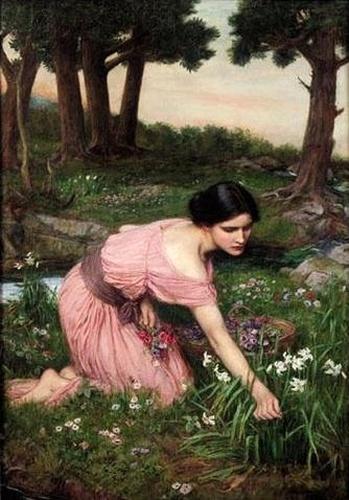
Image source: wikiart.org
Introduction
John William Waterhouse’s Spring Spreads One Green Lap of Flowers (1910) offers a quiet, concentrated vision of renewal. Rather than staging a dramatic mythological moment or a charged literary climax, Waterhouse turns to something smaller and more immediate: a young woman kneeling in fresh grass, gathering blossoms into her arms and basket. The scene feels like a pause taken mid season, as if the world has exhaled after winter and is now gently pushing life up through soil, stem, and petal. The painting invites you to notice how spring is not only a change of weather, but also a change of attention. Everything in the composition encourages a slower gaze, from the careful handling of wildflowers to the soft containment of the grove beyond.
The title frames spring as a generous presence, almost personified, spreading flowers the way a figure might gather fabric into a lap. That idea of spring as a giver aligns with the painting’s mood of quiet abundance. Yet Waterhouse does not portray spring as a triumphant allegory crowned with wreaths and surrounded by attendants. He approaches the theme through human scale and human touch, suggesting that the season’s richness is experienced most fully at ground level, where hands pick stems, knees press into earth, and a basket gradually fills with color.
Visual Overview
At the center foreground, a young woman kneels in the grass, leaning forward as she reaches to pick a cluster of pale flowers. She wears a soft pink dress with puffed sleeves and a darker sash or belt that gathers the fabric at her waist. Her dark hair is parted and drawn back, emphasizing the shape of her head and the concentration in her expression. A wicker basket sits close by, already holding a small harvest of blossoms, while more flowers appear scattered through the grass around her. Behind her, the land rises gently, and the grove of trees forms a sheltered enclosure. To the left, water glints through foliage, suggesting a stream or pond that threads quietly through the landscape.
Even in this simple description, the painting’s priorities become clear. The figure is not posed for display, but absorbed in an action. The landscape is not a grand panorama, but a curated pocket of nature. The flowers are not decorative afterthoughts, but the very purpose of the scene. Waterhouse builds a world where the act of gathering becomes a kind of seasonal ritual.
Composition and Spatial Rhythm
The composition is structured around a forward lean. The woman’s torso angles down and outward, her reaching arm extending toward the lower right area of the canvas. This movement creates a directional pull that guides the viewer’s eye from her face to her hand, then into the grasses and blossoms she is selecting. Waterhouse makes the act legible and inevitable, so you feel the logic of the gesture rather than merely observe it.
The figure is placed low, close to the ground plane, which increases intimacy. Instead of looking up at her, the viewer’s perspective meets her at a sympathetic level, as though kneeling nearby. The vertical trunks of the trees in the background counterbalance her horizontal reach, creating a stable framework that keeps the scene from tipping forward too dramatically. These trunks also function like stage wings, forming a shallow, sheltered space that contains the figure and concentrates attention.
There is also a gentle zigzag of depth. Foreground flowers and grasses establish immediacy, the kneeling figure anchors the middle foreground, the low rise of earth and tree line pushes the eye back, and the pale sky beyond opens the space again. That alternation between enclosure and opening mirrors the theme of spring, a season that both shelters new growth and invites it outward.
Color, Light, and the Feeling of the Season
The painting’s color harmony is tuned to the idea of freshness without glare. Greens dominate, but they are varied rather than monotonous, shifting from deep, shadowed tones under trees to brighter, yellow green notes in sunlit grass. The pink of the dress becomes the primary warm accent, offering a human softness against the vegetation. It is not an aggressive pink, but a muted rose that feels compatible with the natural setting, like a blossom tone translated into fabric.
Light is handled in a way that suggests mild weather and filtered sun. There is no sharp noon contrast. Instead, the shadows are gentle, the highlights restrained, and the sky softly luminous. This kind of illumination is ideal for spring as an emotional idea, because it avoids both winter’s severity and summer’s intensity. It feels like a day when warmth is present, but still tender.
Waterhouse also uses color to differentiate textures. The pale flowers near the woman’s hand pop against darker grasses, while the scattered blossoms in the foreground create a delicate pattern that reads as both botanical detail and visual music. The basket’s warm wicker tone adds an earthy note, connecting the act of gathering to craft, home, and usefulness.
The Figure as a Study of Attention
The woman’s posture communicates absorption. Kneeling is inherently a committed position, not casual and not fleeting. Her body weight rests into the ground, suggesting patience. Her face, angled downward, carries a seriousness that might be interpreted as concentration, reverence, or even a quiet melancholy. Waterhouse often painted figures whose inner lives feel present but not explained, and here that quality is expressed through restraint. The expression does not perform emotion for the viewer, it simply exists, and that makes it feel more believable.
The reaching hand is especially important. It represents choice. Spring spreads flowers everywhere, but gathering means selecting, distinguishing, deciding which stems to take, which blossoms to leave. In that sense, the painting is not only about abundance, but about discernment within abundance. The season offers, the person responds.
Her dress, too, participates in the meaning. The soft fabric and exposed neckline suggest ease and openness, as though winter’s layers have been set aside. Yet the sash cinching the waist brings structure, implying that freedom is accompanied by form. The figure is both part of nature and distinct from it, a human presence that touches the landscape without dissolving into it.
Landscape as Sanctuary
The grove behind the figure reads like a protective boundary. The trees form a semi circle, their trunks thick and steady, their foliage dark enough to create a sense of shade and shelter. This is not a wild, threatening forest. It is more like a calm edge of woodland, a place where one might wander safely and linger.
The hint of water to the left enriches the seasonal symbolism. Water in spring is associated with thaw, flow, and the return of movement. It also introduces a cool note that balances the warmer grasses and the pink dress. The stream or pond feels quiet, not turbulent, which matches the overall mood of gentle renewal.
Foreground flowers scattered across the ground make the sanctuary feel lived in by nature itself. The land is not empty. It is already in bloom, already offering. The woman’s basket becomes a continuation of that landscape, a portable piece of the meadow that will be carried away.
The Title and the Idea of Spring as a Giver
The phrase “one green lap” is an image of generosity and containment. A lap holds, gathers, and offers. By attributing a lap to spring, the title suggests that the season has a body, a nurturing presence that collects flowers and then spills them outward. Waterhouse echoes that metaphor visually. The kneeling woman’s posture resembles someone gathering into her own lap, drawing blossoms toward her body. In a subtle way, she becomes spring’s representative, or perhaps spring becomes visible through her action.
This interplay between person and season is one of the painting’s quiet achievements. Allegory is present, but it is softened into realism. Instead of symbolic props shouting their meanings, symbolism emerges from ordinary behavior. That approach keeps the painting emotionally accessible. You do not need to decode a complex myth to feel what is happening. You can simply recognize a human being responding to the season.
Waterhouse’s Late Style and Pre Raphaelite Echoes
By 1910, Waterhouse was working in a period where his earlier dramatic narratives had matured into a more contemplative lyricism. His connection to Pre Raphaelite ideals remains visible in the careful botanical detail, the clarity of forms, and the emphasis on beauty shaped by sincerity. Yet the painting also shows a softer handling of atmosphere and a more subdued palette than some of the bright, jewel like intensity associated with earlier Pre Raphaelite work.
The figure’s hair, the drape of fabric, and the fidelity to natural textures recall the movement’s love of precise observation. At the same time, the overall mood is less about spectacle and more about inwardness. This is spring seen not as pageant, but as a personal encounter. The painting feels like a poem that has chosen a single stanza and expanded it until it becomes a world.
Technique, Texture, and Surface Calm
The surface impression is one of smooth continuity. Waterhouse blends transitions in skin and fabric so that the figure feels solid and tender, with no harsh edges. The grasses and flowers are more varied in brushwork, suggesting the lively complexity of the ground. This contrast between the composed figure and the textured earth reinforces the theme: human calm meeting natural profusion.
Notice how the painting manages detail without becoming fussy. The flowers are recognizable, but not rendered as botanical illustrations. They remain painterly, arranged to convey abundance and delicacy rather than scientific cataloging. The basket, too, is described enough to feel real, but not so meticulously that it distracts. Everything serves the central experience of spring as both sensory and emotional.
Emotional Tone and the Quiet Narrative
Although the subject seems simple, the painting carries an emotional ambiguity that keeps it compelling. The woman’s downcast gaze can be read as peaceful concentration, but also as introspection. The scene might be an innocent pastime, or it might be a moment of solace, where gathering flowers becomes a gentle remedy for thought. Waterhouse leaves room for the viewer to bring their own associations.
There is also a sense of time being held. Spring is fleeting, and flowers are fragile. The act of picking them is both celebratory and slightly poignant, because it acknowledges impermanence. To gather blossoms is to accept that beauty does not last, and to respond by holding it briefly anyway. The basket becomes a symbol of that brief holding, a human attempt to keep what the season gives.
The painting does not force a story beyond this, which is precisely why it feels sincere. It offers the emotional truth of a season rather than a plotted narrative. In that way, it resembles memory: a clear image of a person, a place, and a feeling that persists even when the moment is gone.
Why the Painting Endures
Spring Spreads One Green Lap of Flowers endures because it makes renewal feel intimate. Many images of spring rely on grand symbols, overflowing gardens, or crowds of celebrants. Waterhouse instead shows one person and a patch of meadow, and by doing so he suggests that the season’s meaning is not found in spectacle but in attention. The painting rewards slow looking. The longer you stay with it, the more you sense the mild air, the softness of grass, the quiet sound of water nearby, and the careful choice of one blossom among many.
It also endures because it balances realism with lyricism. The scene could be real, yet it also feels like an ideal, a distilled moment of spring as we wish to experience it: sheltered, calm, and abundant. Waterhouse makes that ideal convincing by grounding it in a believable gesture and a believable place. The result is a painting that feels less like a performance and more like an invitation.