Image source: wikiart.org
Introduction to “Lamia” and Waterhouse’s Late Style
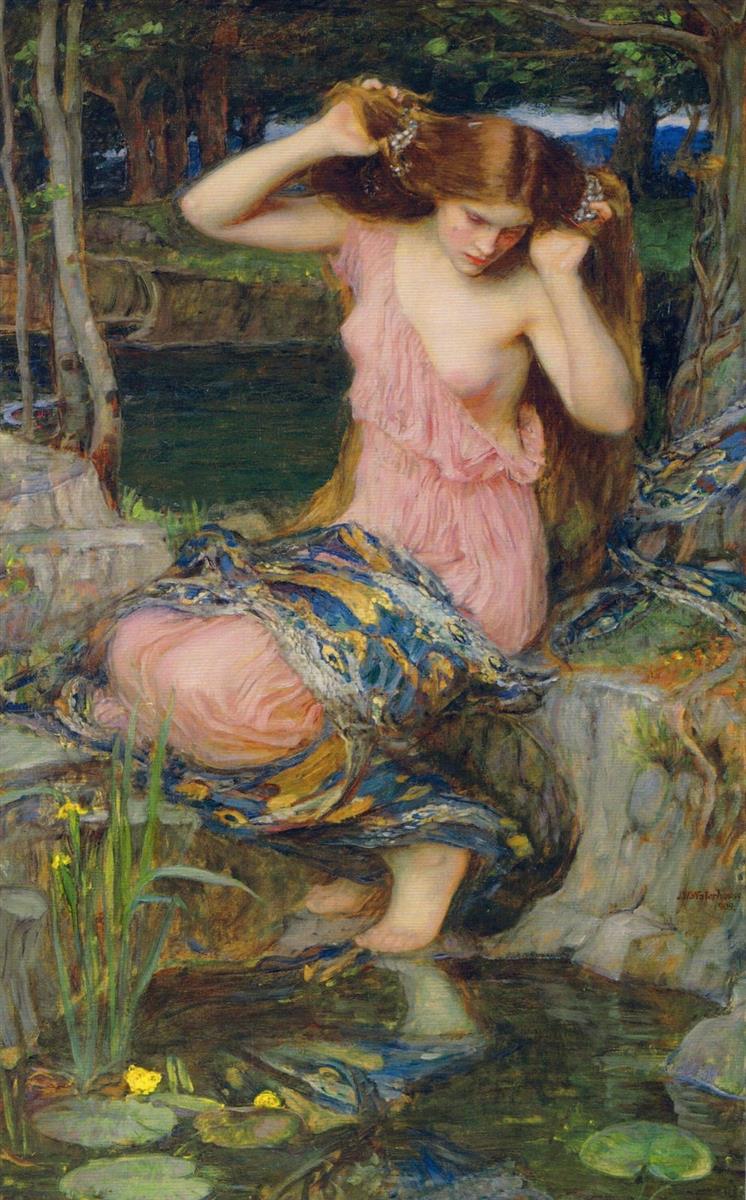
John William Waterhouse’s “Lamia” (1909) belongs to the painter’s late, dream-charged period, when myth becomes less a stage for grand narrative and more a close-up study of mood, longing, and the fragile boundary between beauty and danger. Here the subject is not presented as a triumphant femme fatale or a neatly illustrated literary heroine. Instead, Waterhouse gives us a private moment that feels overheard. Lamia, seated at the edge of a pond, gathers and lifts her long hair as if caught between preparation and hesitation. The gesture is intimate, almost ordinary, yet the title loads it with a mythic aftertaste. We are invited to read the scene on two levels at once: as a sensuous study of a figure by water and as an emblem of enchantment that is never entirely safe.
Waterhouse’s enduring power comes from this balancing act. He paints with the tenderness of a portraitist, attentive to skin, hair, and fabric, but he composes like a storyteller. The setting is not mere background; it is an atmosphere that participates in the subject’s identity. In “Lamia,” the natural world seems to watch, echo, and refract her presence, as if the pond and trees are co-conspirators in the spell implied by her name. The result is an image that feels suspended, held in a quiet present tense, where the viewer senses that something has happened or is about to happen, but the painting refuses to tell us exactly what.
The Myth of Lamia and Why It Matters Here
In classical tradition and later retellings, Lamia is bound to transformation, seduction, and tragedy. Sometimes she is cast as a monster, sometimes as a wronged woman, sometimes as a supernatural being who blurs the line between human and other. That instability is precisely what Waterhouse exploits. The painting does not need literal markers like fangs, claws, or obvious magical props. The myth functions as a psychological filter. Knowing the title changes how we interpret what we see: a woman arranging her hair becomes a figure preparing a veil, a lure, or a disguise.
Waterhouse often chose subjects whose stories pivot on thresholds: between innocence and knowledge, desire and doom, surface beauty and hidden cost. Lamia fits perfectly. She is a character who can be understood as a projection of male fear, a symbol of female autonomy, or a tragic being caught in a curse. Waterhouse does not force one reading. Instead, he builds ambiguity into pose and setting. Lamia’s face is partially turned downward, her expression not flamboyantly seductive but intent, absorbed. This restraint is crucial. It suggests a person with inner life rather than a flat archetype, which makes the myth feel less like an external label and more like a tension within her.
Composition and the Language of a Paused Gesture
The painting is structured around a single, concentrated action: Lamia lifting her hair with both hands. This creates a triangular rhythm, with her arms framing her head and drawing the eye toward her face. The movement is upward and inward, as if she is gathering herself. At the same time, the cascade of hair flows down in a countercurrent, spilling along her shoulder and into the surrounding space. Waterhouse uses this opposition, lift versus fall, to make the scene feel alive.
Her body is angled in a way that compresses time. The pose is neither a posed studio stillness nor a dramatic gesture frozen mid-theater. It is the kind of motion that could continue in the next second: she could braid her hair, let it drop, stand, or lean closer to the water. This open-endedness is one of Waterhouse’s best narrative strategies. Instead of illustrating a climax, he paints the moment just before the story locks into one outcome. The viewer’s imagination completes the narrative, which is exactly how enchantment works: it suggests more than it reveals.
The landscape is arranged to support this pause. Trees form a dark canopy that encloses the scene, like a chamber made of leaves. The water provides a lower boundary, both reflective and unknowable. Stones and reeds create a threshold zone between solid ground and liquid depth. Lamia sits exactly at that boundary, positioned as a creature of the in-between.
Color, Light, and the Emotional Temperature of the Scene
Waterhouse’s palette here is quietly theatrical. The surrounding greens and earth tones are deep and cool, creating a shaded, almost secretive environment. Against that, the pink drapery and warm flesh tones glow like a small flame sheltered from wind. This contrast sets the emotional temperature: the world is damp, shadowed, and still, while Lamia feels warm, immediate, and intensely present.
Light does not flood the scene; it seems filtered through foliage, landing selectively on shoulder, arm, cheek, and fabric. This selective illumination makes Lamia appear as if she is being revealed in fragments rather than fully displayed. The effect is intimate rather than exhibitionist. It encourages close looking, as if the viewer must adjust their eyes to the shade. That slow looking is part of the painting’s spell. Instead of a bright spectacle, Waterhouse offers a hush.
The pink garment is especially important. Pink can suggest softness, vulnerability, and bodily warmth, but it can also feel like a blush, a sign of heightened sensation. Waterhouse lets it operate on both registers. The drapery clings and folds, hinting at movement and touch, yet it also reads as delicate and human, not armored. This pushes the myth away from monstrous caricature and toward a tragic, sensual humanity.
Texture and Material: Hair, Fabric, Stone, and Water
Few painters used hair as poetically as Waterhouse. In “Lamia,” the hair is not simply an attribute; it is a visual force. It has weight and volume, and it occupies a significant share of the canvas. Its rich brown tone bridges figure and environment, echoing tree trunks and shadowed earth. This makes Lamia feel rooted in the landscape, as if she belongs to this place in a way that is both natural and uncanny.
The fabric is painted with a different kind of sensuality. Where hair is dense and flowing, the drapery is thin, crumpled, and softly reflective. Waterhouse uses folds to indicate both gravity and touch, as if the cloth remembers the shape of her body. Importantly, the garment’s looseness contributes to the sense of vulnerability. It is a costume that feels like a half-finished act of dressing or undressing, reinforcing the theme of transition.
Stone and water complete the quartet of textures. The stones are firm, cool, and irregular, offering stability but also a sense of the primitive and the ancient. The water is the most ambiguous surface: it reflects, distorts, and conceals. Waterhouse paints it with a quiet complexity, suggesting depth without turning it into a mirror-polished spectacle. It remains a threshold, a place where forms can be lost, transformed, or reborn.
The Setting as a Psychological Space
This is not a generic outdoor scene. It feels like a chosen site, a secluded pool that functions as a private stage. The trees form a protective darkness, while the pond opens a space of vulnerability. In mythic terms, water often represents transformation, revelation, and danger. It is where nymphs bathe, where spells are cast, where reflections offer truth or deception. By placing Lamia at the pond’s edge, Waterhouse aligns her with that symbolic tradition.
The lilies and reeds are not merely decorative. They suggest a slow ecosystem, a place where time thickens. Lilies float on the surface like quiet witnesses, while reeds mark the boundary between water and land. These details create an environment that feels alive but patient, as if it has always been there and will remain after the human moment passes. That timelessness is crucial for myth painting. Myth must feel both immediate and ancient, and Waterhouse achieves that by letting nature hold the scene in a steady, enduring silence.
Femininity, Agency, and the Question of the Viewer
Because “Lamia” involves partial nudity and intimate gesture, it invites questions about gaze. Waterhouse’s approach is more complex than simple display. Lamia is not meeting the viewer’s eyes with a confident invitation. Her attention is turned inward, toward her hair and her own body. This matters because it implies agency. She is occupied with herself, not performing for an audience.
At the same time, the painting acknowledges the tension of being seen. The title primes the viewer to look for danger or deceit, and that expectation can shape the gaze into something suspicious. Waterhouse seems to anticipate this, giving Lamia an expression that resists easy categorization. She does not look triumphant, predatory, or purely innocent. She looks concentrated, perhaps troubled, as if she carries knowledge the viewer does not have.
This ambiguity can be read as a critique of the myth itself. Lamia’s story has often been used to frame female desire as threatening. By painting her in a quiet, human moment, Waterhouse complicates that framing. He suggests that the “monster” label may be an external projection, while the person remains tender and real.
Narrative Suggestion Without Illustration
Waterhouse was associated with subjects drawn from literature, and “Lamia” benefits from literary pacing. The painting feels like a passage rather than a summary. Instead of showing a dramatic event, it offers an interlude where meaning gathers slowly. The viewer senses narrative pressure beneath the surface, like water moving under lily pads.
There are multiple possible story beats implied. Is Lamia preparing herself before encountering someone? Is she recovering from an encounter? Is she contemplating her reflection, measuring her own appearance as a kind of spell? Or is the gesture protective, a way of covering or gathering herself against an unseen presence? Waterhouse leaves these questions open, and that openness is not a lack. It is the painting’s method. Enchantment in art is often created by withholding the key that would lock interpretation into one meaning.
Waterhouse in 1909: Late Pre-Raphaelite Echoes and Modern Sensibility
By 1909, Waterhouse was working in a world where art was changing rapidly. Yet he continued to return to mythic and poetic subjects, not as an escape into old formulas, but as a way to intensify emotion and atmosphere. “Lamia” shows the lingering influence of the Pre-Raphaelite tradition in its attention to natural detail and its love of literary themes, but it also feels looser, more painterly, and more psychological than the movement’s earlier, sharper clarity.
This late style is about sensation and mood. Edges soften into the environment, and the background does not insist on equal focus everywhere. That selective focus mimics human perception, how we notice a face, a hand, a fold of fabric, while the rest of the world becomes peripheral. In “Lamia,” the periphery is not empty; it is charged with shadow and stillness. The painting becomes a kind of mental space, a scene shaped by feeling as much as by geography.
Why “Lamia” Still Feels Contemporary
Even without knowing the myth, the painting speaks to experiences that remain familiar: self-awareness, private ritual, the feeling of being on the verge of a decision, the mix of vulnerability and control in how one presents oneself. Lamia’s act of gathering her hair can be read as preparation, self-soothing, or transformation. In each case, the gesture suggests a self in process rather than a fixed identity.
That idea of identity in motion is one reason the painting resonates today. Lamia is not reduced to a single moral label. She is held in tension between meanings. Waterhouse’s romantic moodiness might seem old-fashioned at first glance, but the psychological ambiguity feels modern. It refuses certainty. It invites empathy and suspicion at the same time, forcing the viewer to recognize how quickly we turn stories into judgments.
The pond, too, feels contemporary in its symbolic openness. It can be a mirror, a threshold, a hiding place, or a place of cleansing. Waterhouse does not tell us which. He lets it remain what water always is in myth and in life: a surface that reflects what we bring to it.