Image source: wikiart.org
Introduction
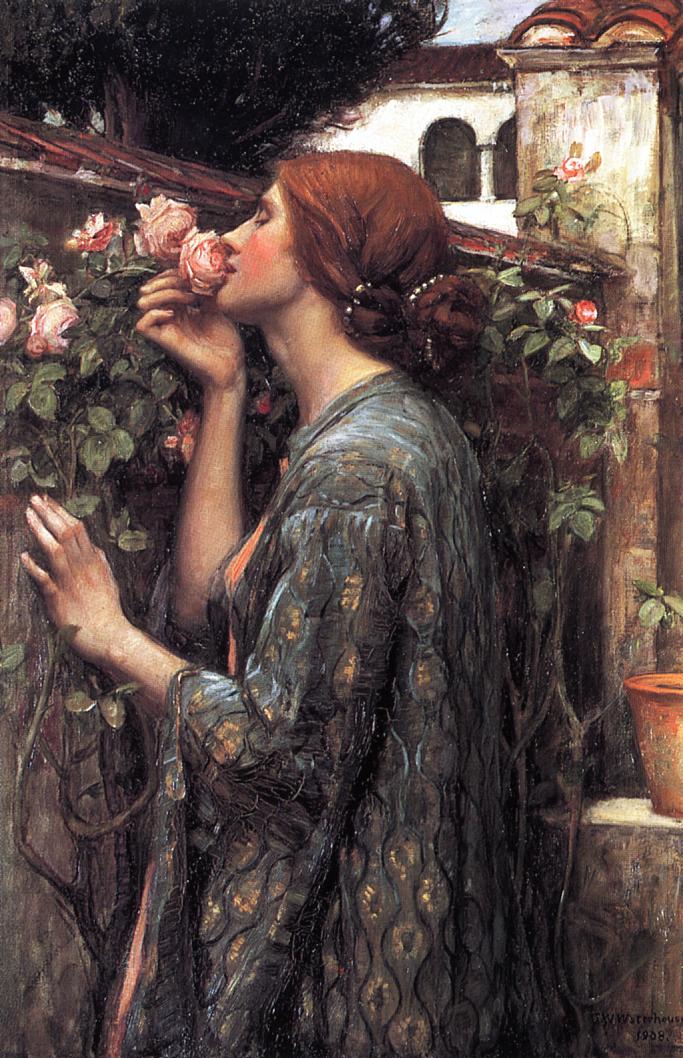
John William Waterhouse’s The Soul of the Rose (1908) offers a quiet scene that feels almost ceremonial. A young woman leans toward a blooming rose, closing the distance until fragrance and thought seem to merge. Nothing dramatic happens, yet the image feels charged, as if a single breath contains a whole inner life. Waterhouse builds that intensity through restraint: a limited action, a carefully controlled setting, and a pose that turns ordinary smelling into something like listening. The result is a painting that reads as both a portrait of sensory pleasure and a meditation on memory, desire, and the way beauty can suspend time.
The title frames the experience as more than botanical. A rose is already a common emblem of love, transience, and longing, but Waterhouse pushes beyond symbolism into psychology. “Soul” suggests an essence that cannot be grasped directly, only approached through sensation. The woman does not pluck the flower or claim it. She leans in, attentive and receptive, as if the rose is speaking in a language made of scent and silence. In that simple exchange, Waterhouse places the viewer in an intimate space where physical perception becomes a doorway into feeling.
Waterhouse in 1908
By 1908, Waterhouse had long been associated with subjects drawn from poetry, myth, and legend, yet his late works often feel more inward than theatrical. Instead of grand narratives, he frequently paints moments of pause: a figure alone with water, flowers, letters, or music. These scenes are not empty of story, but they keep the story implied rather than shown. The Soul of the Rose belongs to that late tendency. It does not illustrate a specific plot so much as a state of mind. The painting still carries the Pre Raphaelite love of detail and sensuous surface, but its emotional pitch is quieter and more concentrated.
Waterhouse also paints at a time when the cultural mood around femininity and nature was shifting. The Victorian ideal of the moralizing allegory had loosened, and images of women could become more ambiguous, more about mood than message. Here, the woman is neither a cautionary tale nor a heroine in peril. She is a presence, absorbed in her own perception. That absorption is central: it makes the scene feel private, as if the viewer has come upon a moment that is not meant for an audience.
The Figure as a Vessel of Feeling
The woman’s pose is the painting’s emotional engine. Her body forms a gentle diagonal that leads toward the rose, while her head tilts slightly forward in a gesture of concentration. Her eyes appear softened or partially closed, reducing visual engagement so that smell and thought take over. Waterhouse emphasizes the delicacy of the action by focusing on the face, the curve of the neck, and the hand that brings her close to the bloom. It is an action that is almost weightless, like a careful approach to a secret.
Her expression is not overtly joyous or sorrowful. It is contemplative, even reverent. That ambiguity allows multiple readings. She could be savoring simple pleasure. She could be recalling someone, because scent is famously tied to memory. She could be longing for a person absent from the scene, with the rose standing in as a proxy. Waterhouse does not force a single interpretation. Instead, he makes the woman’s inwardness the subject. The painting becomes a study of attention, of how a person looks when they are fully inside a sensation.
Composition and the Geometry of Intimacy
Waterhouse constructs the composition around a close, enclosed space. The wall, trellis, and dense foliage create a sheltered garden corner that feels like a private alcove. This containment matters. A rose garden can be expansive, but Waterhouse chooses a compressed view so the scene reads as intimate rather than scenic. The architecture behind the figure, with its pale surfaces and arched openings, adds depth without distracting from the central encounter. It also provides a gentle contrast of hard and soft: stone and plaster versus leaves and petals.
The figure occupies most of the vertical space, giving her presence and calm authority. The rose itself is positioned near her face, creating a focal knot where skin and petals almost touch. Waterhouse guides the eye in a loop: from the roses on the left, to her face, down along the patterned sleeve, and back through the foliage. The arrangement mimics the way scent works, circling and lingering rather than moving in a straight line. Even the empty areas are controlled. There is little open sky. The painting breathes through textures, not through space.
The Rose as Symbol and Sensation
The rose in this painting is not merely decorative. It is a hinge between the material and the imagined. Waterhouse paints it with enough specificity to feel real, yet it also holds the weight of centuries of poetic meaning. Roses suggest beauty that fades, love that wounds, secrecy, and devotion. By focusing on smelling rather than looking, Waterhouse subtly shifts the symbolism. Sight can be possessive. Smell is intimate but fleeting. You cannot hold a fragrance the way you can hold a flower. You can only experience it in time, breath by breath.
That temporal quality makes the rose a perfect symbol for memory and longing. A scent can summon a past so vividly it feels present, and then vanish. The woman’s stillness suggests she is trying to keep the moment from passing, not by grabbing it, but by attending to it completely. The title, The Soul of the Rose, implies that the “true” rose is not the petals but the invisible presence released into the air. Waterhouse paints an invisible thing by showing its effect on a human face.
Color and Atmosphere
The palette is one of Waterhouse’s most persuasive tools here. He balances warm and cool tones in a way that supports the painting’s emotional quiet. The woman’s auburn hair and the pink roses bring warmth, while the greens of the leaves and the muted grays and blues of her garment temper that warmth with calm. The background architecture introduces pale creams and off whites that keep the scene from becoming too dark or too saturated. Everything feels slightly softened, as if the air is thick with garden shade and late light.
Waterhouse avoids harsh contrasts. Instead, he uses a gentle range of values, letting the figure emerge from the foliage like a thought forming out of silence. The roses are brighter, but not aggressively so. They glow with a lived-in delicacy, like something that has already begun to soften at the edges. That softness aligns with the theme of impermanence. The painting feels like a moment that cannot last, and the color is part of how that feeling is delivered.
Texture, Pattern, and the Tactile World
One of the pleasures of The Soul of the Rose is the way Waterhouse treats surfaces. The leaves have a varied, lively texture, painted with enough differentiation to suggest depth and density. The roses have a layered delicacy, their petals curling and catching light. The woman’s skin is rendered with smooth transitions that emphasize softness and vulnerability. Against these natural forms, her garment becomes a world of pattern and fabric weight.
The dress, with its repeating motifs, functions almost like a decorative screen. It links the figure to the garden by echoing organic shapes, yet it also marks her as a composed, cultivated presence. Pattern becomes a metaphor for interior life: complex, repeating, and not fully readable at a glance. Waterhouse’s brushwork shifts depending on the material. Leaves receive more broken, varied strokes. Skin is smoother. Fabric sits between, carrying both flow and structure. This variety makes the painting feel sensuous without being showy, as if the viewer can almost feel the coolness of shaded stone and the softness of petals.
Garden Architecture and the Sense of Place
The setting is more than a backdrop. The wall and architectural elements suggest a Mediterranean or classical atmosphere, a place associated with romance, retreat, and antiquity. Arches in the distance hint at passageways and hidden spaces, reinforcing the idea that the garden is a threshold between public life and private feeling. The terracotta pot and stone ledge add everyday reality, grounding the image so it does not float away into pure allegory.
At the same time, the garden is curated rather than wild. This is not nature as wilderness. It is nature arranged, tended, and made into a space for reflection. That choice matches the painting’s mood. The woman is not overwhelmed by the natural world. She is in dialogue with it. The rose is cultivated, and so is the feeling it stirs. The scene suggests that beauty can be a discipline of attention, something you enter deliberately, like stepping into a quiet room.
The Psychology of Stillness
What makes the painting memorable is its stillness. Waterhouse turns a small action into a full emotional event by slowing everything down. The woman’s posture is poised, neither stiff nor loose. The leaves do not whip in wind. The background remains calm. This creates a suspended atmosphere, like a held breath. In that suspension, the viewer becomes aware of their own attention. You find yourself looking more closely, lingering, and imagining what the woman is thinking.
Stillness also creates ambiguity. Without movement, the moment could belong to many possible stories. Is she waiting for someone? Has she just received news? Is she remembering a past love? The painting does not answer. It invites. This invitation is part of its power, because it allows the viewer’s own experiences of scent, memory, and longing to fill the space. Waterhouse paints a universal human mechanism: the way a sensory detail can open an inner world.
Femininity, Agency, and the Gaze
Waterhouse often painted women, and discussions of his work frequently circle around ideals of beauty and the role of the female figure. In The Soul of the Rose, the woman is undeniably presented as beautiful, but she is not arranged primarily for the viewer’s consumption. Her attention is not directed outward. She is turned toward the rose, not toward us. That shift matters. It gives her a form of agency rooted in interiority. She is the subject of her own experience.
The viewer becomes an observer of a private act, which can feel tender or intrusive depending on how you approach it. Waterhouse softens the potential intrusion by making the scene contemplative rather than provocative. The woman’s body is covered, the mood is restrained, and the focus is on the face and gesture rather than on display. Beauty here becomes a vehicle for mood. The painting suggests that femininity can be aligned with perception, sensitivity, and depth, not merely with ornament.
Literary Echoes and Poetic Mood
Even if the painting is not tied to a single poem, it feels saturated with poetic thinking. The title alone sounds like a line from verse, and the scene resembles the kind of moment poets love: a quiet encounter with nature that becomes a mirror for emotion. The rose has been a central poetic symbol for centuries, and Waterhouse taps into that tradition without illustrating a specific text. He paints the kind of image that could be a stanza: an instant of sensory experience charged with meaning.
The woman’s posture reads like reading or listening, as if the rose contains a message. This aligns with a broader artistic idea that nature can speak in symbols, and that sensitive minds can receive those symbols. Waterhouse does not moralize that idea. He romanticizes it, gently. The painting becomes a space where beauty is not trivial, but spiritually resonant.
Light, Time, and the Fleeting Moment
Light in the painting is soft, filtered, and shaded. It does not announce a specific hour with dramatic sunset colors, but it implies a temperate moment when heat is muted and air is calm. That vagueness helps the painting feel timeless, yet the subject insists on time. A rose blooms and fades. A scent appears and dissipates. A moment of attention passes. Waterhouse binds these truths together. The woman’s act of smelling becomes a quiet resistance to passing time, not by stopping it, but by fully inhabiting it.
There is also a subtle emotional tension between permanence and impermanence. The stone wall and architecture suggest durability. The rose suggests fragility. The woman stands between them, a living being who can remember, desire, and mourn. In that balance, the painting hints at the bittersweet core of romantic beauty: it matters because it does not last.
Why the Painting Endures
The Soul of the Rose endures because it makes a universal experience feel singular. Most people know the sensation of leaning into a flower, of letting fragrance trigger a feeling that words cannot quite name. Waterhouse captures that wordless shift, the way the mind moves when sensation becomes memory or longing. He does it with compositional clarity, atmospheric color, and a figure rendered with empathy.
The painting also offers a kind of refuge. Its world is quiet, sheltered, and focused on simple beauty. In a noisy environment, that quiet can feel precious. Yet the painting is not escapist in a shallow way. It acknowledges time, loss, and desire through the very choice of subject. It suggests that attention itself is meaningful, that a small moment with a rose can contain the complexity of a life.