Image source: wikiart.org
First Impressions and the Painting’s Quiet Command
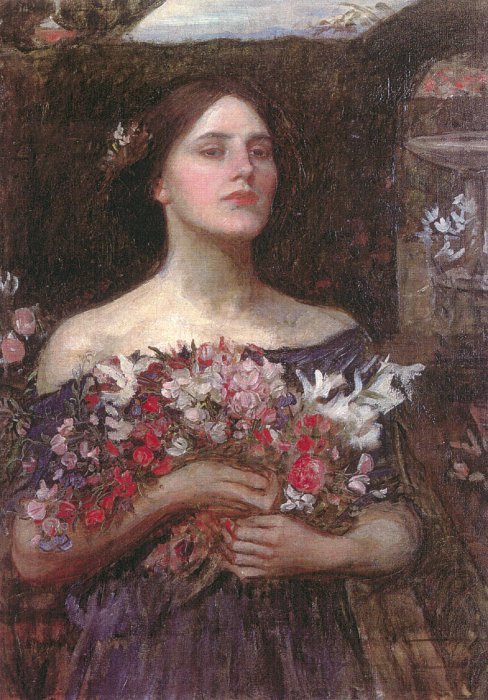
“Gather Ye Rosebuds” (1908) feels like a painting that has already decided not to hurry. Waterhouse places a young woman close to the picture plane, letting her fill the frame with a calm presence that reads as both intimate and distant. The bouquet she holds is abundant, almost overflowing, and it immediately sets up the central contradiction of the image. Flowers are the classic emblem of freshness and immediacy, yet they are also one of the clearest reminders that beauty is brief. The figure’s expression intensifies that tension. She does not smile, and she does not perform emotion for the viewer. Instead, her gaze drifts slightly away, as if she is listening inwardly or looking past the present moment.
The first impression, then, is not simply “a beautiful woman holding flowers.” It is a pause, a held breath. The painting invites the viewer to remain in that pause long enough for meaning to thicken. Waterhouse creates a scene that feels suspended between two times: the moment when the flowers were gathered and the later moment when they will wilt. The woman stands precisely in that interval, and the viewer is asked to consider what it means to hold something at its peak.
The Title and the Carpe Diem Tradition Behind It
The phrase “Gather ye rosebuds” carries centuries of association, most famously through Robert Herrick’s carpe diem poem urging the young to seize opportunity while they can. The title alone brings a moral, emotional, and cultural framework into the room. It speaks about youth, time, choice, and the bittersweet awareness that anything beautiful is also vulnerable. Waterhouse does not paint a literal illustration of a poem’s scene. Instead, he paints the emotional aftertaste of the poem’s idea.
This is a crucial distinction. A literal carpe diem image might show laughter, flirtation, movement, or social ritual. Waterhouse gives us stillness. That stillness transforms the phrase from a cheerful instruction into a quiet meditation. The painting does not shout “enjoy life.” It suggests that enjoyment and awareness are tangled together. The act of gathering is both celebratory and slightly mournful, because it implies that the flowers are not infinite, that the season will change, and that the gathered bloom is already on its way to fading.
By choosing this title, Waterhouse primes the viewer to read the bouquet as more than decoration. The flowers become a condensed metaphor: the present in your hands, and the future moving toward it.
Waterhouse in 1908 and the Mood of His Late Work
By 1908, Waterhouse was working in a mature, late style that often favors atmosphere and psychological tone over crisp, jewel like detail. While he remains linked to Pre Raphaelite themes and a love of literary subjects, his brushwork and surface handling increasingly embrace softness, suggestion, and mood. “Gather Ye Rosebuds” sits comfortably in that evolution. It retains the romantic intensity and feminine focus that define so much of his art, but it speaks with a quieter voice.
This late approach suits the subject. A carpe diem theme can easily slip into sentimentality or theatrical symbolism. Waterhouse avoids that by making the painting feel human rather than allegorical. The figure does not appear as a personification of Youth or Spring, even though she could be read that way. She feels like an individual caught in a private moment, and that sense of inner life is one of Waterhouse’s most enduring strengths.
The work also shows how Waterhouse could modernize a traditional theme. The phrase is old, the symbolism is familiar, and the format resembles portraiture. Yet the emotional atmosphere feels subtle, almost contemporary, because it depends on understatement rather than spectacle.
The Figure as Presence Rather Than Story
One of the most striking aspects of the painting is how it resists a clear narrative. Waterhouse often painted scenes tied to myth, legend, or literature, where the viewer can identify a specific story moment. Here, the figure is less a character in action and more a presence in contemplation. That choice shifts the viewer’s role. Instead of “recognizing” a story, the viewer interprets a mood.
Her expression is not blank. It is composed, slightly distant, and quietly serious. The lips are softly set, the eyes are relaxed but focused somewhere beyond the immediate. That combination creates ambiguity. Is she thinking about love, about memory, about time, about a decision just made? Waterhouse gives enough emotional information to spark interpretation, but not enough to pin down a single answer. This openness is why the painting can feel personal to different viewers. Many people recognize the sensation of holding something precious while feeling its fragility.
The pose is also important. The woman’s shoulders are open, the neckline is low and off the shoulder, and the bouquet is held close to the chest, almost like a shield and a treasure at once. This creates an intimacy that feels tender rather than provocative. Waterhouse is not painting a dramatic seduction. He is painting the quiet sensuality of youth in a state of reflection.
Composition and the Painting’s Balanced Structure
The painting’s composition is deceptively simple and carefully engineered. The figure is centered and close, creating an immediate encounter. Yet Waterhouse avoids stiffness through subtle diagonals and layered forms. The head tilts slightly, the bouquet sits at a gentle angle, and the arms create curved lines that soften the frontal arrangement.
The overall structure can be read as a stable triangle: the head forms the apex, and the shoulders and bouquet create a wide base. This triangular arrangement is a classic method for lending dignity and calm to a figure. It is often used in devotional images and formal portraiture because it suggests stability, coherence, and presence. Waterhouse borrows that visual language to give the young woman a quiet authority.
At the same time, the bouquet interrupts any sense of formal distance. Its clustered blossoms create a complex texture field, a rich surface of petals, colors, and small highlights that pull the eye downward. The viewer’s gaze tends to move from the face to the bouquet and back again, tracing a gentle loop between expression and symbol. This eye movement keeps the painting alive, because the viewer never settles into a single focal point. The face asks for psychological reading, and the bouquet asks for symbolic reading. Together they form a conversation.
The Bouquet as the Painting’s Emotional Engine
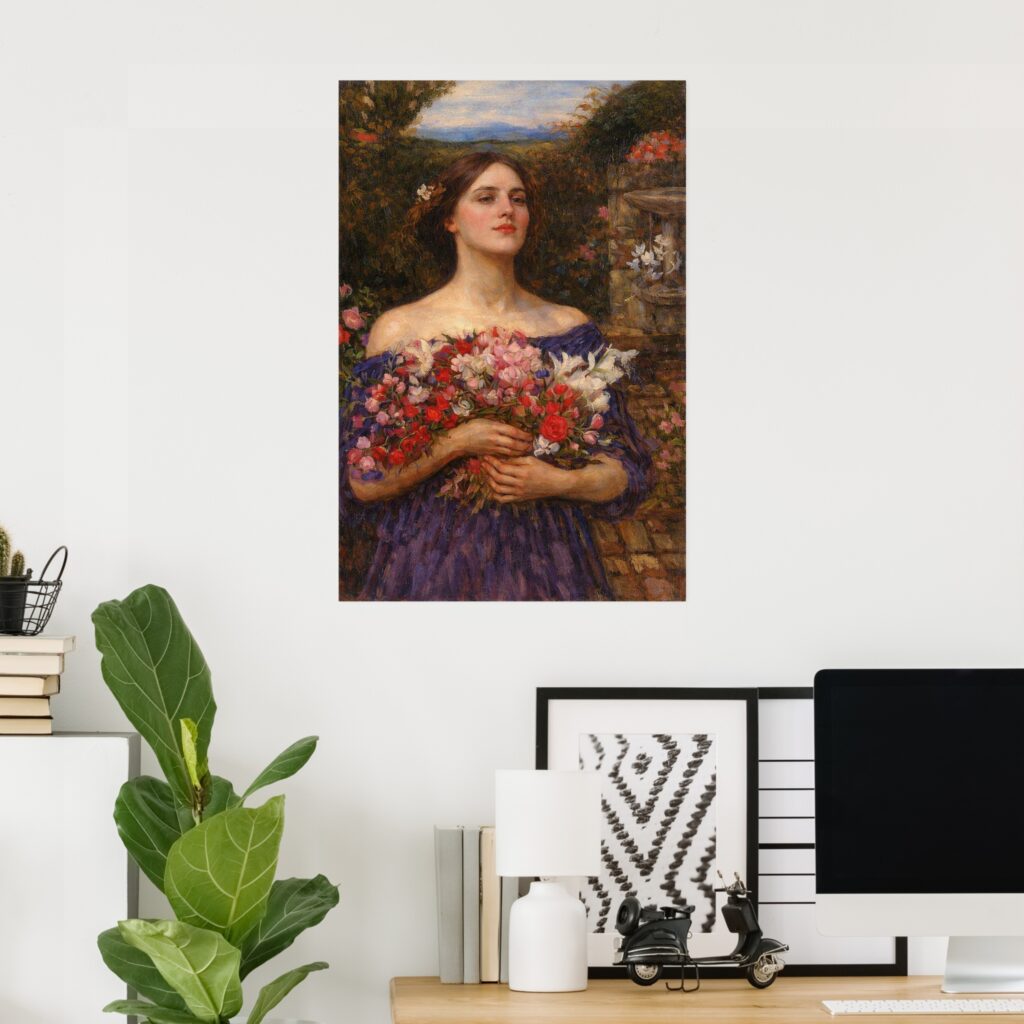
The bouquet is not a simple accessory. It is the painting’s emotional engine, the place where Waterhouse concentrates color, texture, and thematic meaning. Flowers can carry many messages, and Waterhouse leaves their meaning open enough to remain active. They can be read as an emblem of youth, a gift from a lover, a harvest of a garden, or a ritual gathering for some private or social event.
What matters is that the bouquet is abundant. It suggests that the moment is full. This fullness makes the title more poignant. To “gather” rosebuds implies selection, action, and urgency. The bouquet shows the result of that action. The figure is not depicted picking; she is depicted holding. That shifts the theme from desire to possession, from anticipation to the delicate responsibility of holding something that will not last.
The way the bouquet is positioned also matters. It sits close to her body, almost pressed against the heart area, so that the symbol of transience becomes physically intimate. The flowers are not distant objects in a vase. They are gathered into her hands, into her space, into the immediate circle of her being. This makes the metaphor feel personal rather than decorative.
Color Palette and the Dialogue Between Warmth and Shadow
Waterhouse builds the painting’s mood through a dialogue between warmth and shadow. The background is dark and muted, full of browns and deep, earthy tones that create a quiet enclosure. Against that enclosure, the woman’s skin glows softly. The flesh tones are not harshly lit. They are modeled with gentle transitions, giving the face and shoulders a tender, almost breathed quality.
The bouquet introduces a richer spectrum: reds, pinks, whites, and touches of cooler notes. These colors carry emotional weight. Reds often suggest vitality, passion, or the pulse of life. Pinks can suggest tenderness and youth. Whites can suggest fragility, innocence, or the thin line between bloom and decay. The mixture of colors creates complexity rather than a single emotional note. It implies that youth is not only joy, but also vulnerability and seriousness.
The dress, rendered in darker purples and muted tones, anchors the palette and prevents the bouquet from becoming too bright. The garment’s subdued color suggests depth and maturity, a counterpoint to the fresh blossoms. In this way, Waterhouse uses color to enact the painting’s theme: brightness held within shadow, bloom held within time.
Light and the Softness of Waterhouse’s Illumination
Light in “Gather Ye Rosebuds” is not dramatic. It does not carve the figure out with sharp contrast. Instead, it acts like a soft veil, illuminating skin and flowers without turning them into spectacle. This softness supports the painting’s contemplative tone. A harsh spotlight would imply performance or theatrical revelation. Waterhouse’s light implies quiet presence.
Notice how the face is lit with a gentle clarity that keeps features readable, while the hair and background remain darker and more diffuse. This creates a natural focal emphasis: the viewer is drawn to the face, then down to the flowers. The shoulders, exposed at the neckline, catch light in a way that emphasizes vulnerability and softness. The illumination makes the figure feel physically present, yet the overall mood remains dreamlike because edges are not sharply defined.
This kind of lighting also intensifies the theme of fleetingness. Soft light can feel like morning, like a brief calm before change. It makes the scene feel temporary, as if the moment could drift away with a shift of air.
Brushwork, Surface, and the Feeling of Suggestion
Waterhouse’s brushwork here contributes strongly to the painting’s emotional effect. The face and hands are carefully modeled, but the background and parts of the clothing are treated with more suggestion than detail. This selective focus mimics how memory works: we recall a face clearly, but surroundings blur into atmosphere. That resemblance to memory aligns beautifully with the carpe diem theme, because it makes the painting feel like a preserved moment already turning into recollection.
The bouquet is rendered with energetic clustering rather than botanical precision. Petals are suggested through strokes that capture color relationships and the sensation of blossoms. This painterly approach makes the flowers feel alive, not frozen. It also hints at movement, even though the figure is still. The flowers seem to vibrate slightly against the darker tones, as if they contain the last concentrated energy of a season.
Surface texture matters too. The contrast between soft skin, heavy fabric, and busy floral texture gives the painting tactile variety. Waterhouse creates sensual richness without needing overt action. The viewer feels the softness of petals, the weight of stems, the smoothness of skin, and the drape of cloth, all through paint handling.
The Hands and the Subtle Language of Holding
Hands are often where a painter reveals psychological truth. In this painting, the hands hold the bouquet firmly but not tightly. There is care, but not desperation. This is a very specific emotional register. The figure seems aware of what she holds, yet she does not clutch. That nuance keeps the painting from becoming melodramatic.
The act of holding is also symbolic. To gather is to take something from the world and make it yours, even briefly. Holding suggests possession, but it also suggests responsibility. A bouquet can be cherished, offered, protected, or mourned. Waterhouse leaves those possibilities open. The hands become the hinge between the outer world of flowers and the inner world of feeling.
Because the bouquet covers much of the torso, the hands also guide the viewer’s attention. They lead the eye into the floral mass, then back out toward the arms and face. This creates a gentle rhythm, reinforcing the painting’s calm tempo.
Background, Space, and the Sense of an Enclosed Moment
The background in “Gather Ye Rosebuds” does not describe a fully legible place. It hints at architecture, perhaps a garden wall or a sheltered space, with soft suggestions of forms rather than crisp lines. This ambiguity is purposeful. A clearly described setting would anchor the painting to a specific narrative context. Waterhouse instead creates a psychological space, a stage of mood.
The dark background frames the figure’s head and hair, intensifying the sense of presence. It also contributes to the feeling that the moment is enclosed, protected from the noise of the world. The painting feels like a private scene, even though the figure faces outward. This privacy heightens intimacy. The viewer is allowed close, but not fully admitted. The woman’s gaze remains slightly elsewhere, keeping a boundary that makes the encounter more compelling.
The background also functions symbolically as time itself: a dark field against which bright life briefly appears. The bouquet and skin tones feel like illumination against a deeper, older atmosphere.
Femininity, Youth, and Waterhouse’s Tender Ambivalence
Waterhouse’s women often embody a mixture of strength and vulnerability. In “Gather Ye Rosebuds,” femininity is not presented as frivolous or merely decorative. It is presented as thoughtful and quietly commanding. The figure’s calm gaze and composed posture suggest self possession. Yet the exposed shoulders and the fragile bouquet remind the viewer of vulnerability.
This ambivalence is the emotional core of the work. Youth is beautiful, but it is also precarious. To be young is to be full of possibility, but also to be subject to time’s swift movement. Waterhouse does not simplify this into a cheerful image of springtime. He paints youth as a state of awareness, a moment when beauty is felt as both gift and question.
The painting also avoids cynicism. It does not suggest that beauty is meaningless because it fades. Instead, it suggests that beauty matters precisely because it is temporary. The bouquet is valuable because it will not last. The moment is precious because it cannot be held forever.
Connections to Ophelia and the Pre Raphaelite Mood of Poised Tragedy
Many viewers associate Waterhouse with images of Ophelia and other tragic heroines, and it is easy to see why this painting can evoke that emotional world. The woman’s distant gaze, the subdued palette, and the theme of fleeting bloom all resonate with the Pre Raphaelite fascination with beauty touched by melancholy.
Whether or not the figure is meant to be Ophelia, the painting shares the broader Waterhouse atmosphere: a young woman poised on the edge of change. Waterhouse often captures women at thresholds, moments when inner feeling is deep and the future is uncertain. Here, the threshold is not a specific plot point but the universal threshold of time passing.
This connection to poised tragedy is subtle. There is no visible danger, no dramatic event. The tragedy, if it exists, is simply the human condition of impermanence. The painting’s sadness is not despair, but awareness.
The Painting as a Meditation on Time Rather Than a Command to Act
The carpe diem tradition can be interpreted as a command: seize the day, do not delay. Waterhouse reframes it as a meditation. The figure does not look like someone rushing to gather more. She looks like someone who has gathered and is now feeling what that means.
This shift is important. It makes the painting less about youthful impulsiveness and more about mature reflection. It suggests that the deepest way to “gather” the present is not frantic consumption but attentive presence. The bouquet is held as if it deserves contemplation. The woman’s gaze suggests she is measuring the moment, storing it, understanding it.
That interpretation aligns with Waterhouse’s broader strength as a painter of psychological states. He is interested in the inner life, in the way emotion can be shown through quiet choices: a tilt of the head, a softness of mouth, a stillness of posture.
Why the Painting Feels Intimate and Universal at Once
One reason “Gather Ye Rosebuds” remains compelling is that it balances specificity and universality. The figure is specific enough to feel like a person: her features are individual, her expression is nuanced, her presence is immediate. Yet the situation is universal: holding flowers at their peak, existing in a moment that will pass. Almost anyone can relate to the sensation of seeing something beautiful and feeling, at the same time, the shadow of time behind it.
The painting’s intimacy comes from proximity. The figure is close, the bouquet is close, the scene is enclosed. The viewer is not watching from afar; the viewer is standing in front of her. The universality comes from the lack of specific narrative. Because there is no fixed story, the painting becomes a vessel for many stories.
It can be read as a moment before a meeting, after receiving a gift, after picking flowers alone, or simply as an emblem of youth itself. That openness is not vagueness. It is a deliberate generosity.
The Enduring Appeal of Waterhouse’s Quiet Romanticism
Waterhouse’s romanticism is often misunderstood as merely decorative, but this painting shows how psychological his beauty can be. The romance here is not about grand gestures. It is about the tenderness of attention, the way a face can hold a thought, the way flowers can carry time inside them.
The painting also demonstrates Waterhouse’s ability to create atmosphere without losing clarity. The face remains readable and emotionally present. The bouquet remains vibrant and complex. The background supports rather than distracts. Every element works toward a single mood: the sweetness of bloom, the stillness of awareness, the hush of time moving forward.
That mood is the painting’s true subject. The figure is the carrier of the mood, and the bouquet is its symbol. Together they create a quiet image that feels like a memory you can almost touch.