Image source: wikiart.org
Introduction: A Myth Reimagined in a Single, Breathless Moment
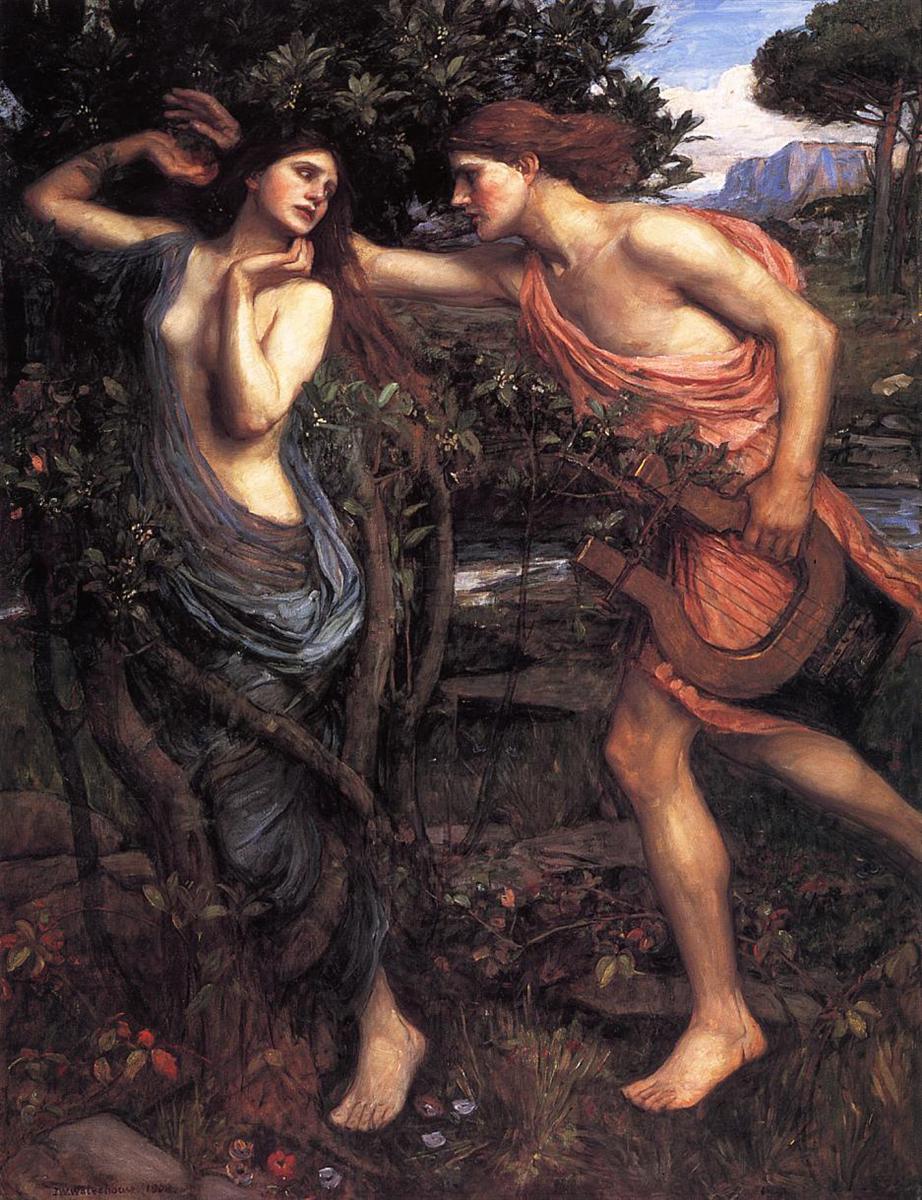
John William Waterhouse’s Apollo and Daphne (1908) takes one of classical mythology’s most famous chases and recasts it as a concentrated psychological drama. The story, best known through Ovid’s Metamorphoses, is full of motion: pursuit, refusal, panic, transformation. Waterhouse chooses not to show the final metamorphosis in full, nor does he settle for a purely decorative mythological tableau. Instead, he fixes the scene at the instant where desire, fear, and inevitability collide. The result is not simply narrative illustration but a painting about thresholds: the thin line between admiration and possession, between flight and capture, between flesh and the first hint of something other than flesh.
What makes the painting feel immediate is how Waterhouse translates myth into body language. Apollo is not distant, godlike, or serenely triumphant. He is urgent, leaning forward, reaching out, his whole posture angled into the act of closing distance. Daphne is not posed as a calm emblem of chastity; she is recoiling and twisting away, her hands raised as if to ward off touch and also as if caught mid thought. Their faces do not meet in romance but in conflict. The myth becomes readable without any external text because Waterhouse gives the viewer a clear emotional grammar: pursuit presses in, refusal pulls back, and the world around them seems to hold its breath.
Waterhouse and the Late Pre-Raphaelite Sensibility
By 1908, Waterhouse was working in a cultural moment that looked back to the ideals of Pre-Raphaelitism while also absorbing the softer tonalities and symbolism of the fin de siècle. His paintings often return to literary and mythological subjects, but what distinguishes him is his focus on interior states. Even when he paints a “scene,” the scene is really a vessel for psychological intensity: longing, hesitation, enchantment, dread, devotion. In Apollo and Daphne, the familiar myth is less about divine power than about an emotional imbalance. One figure advances with certainty, the other retreats with alarm. That imbalance becomes the engine of the composition.
Waterhouse also treats antiquity as a living theater rather than a museum reconstruction. He does not overwhelm the viewer with archaeological detail. Instead, he uses drapery, landscape, and gesture to build a mood that feels timeless and plausible. The mythic setting is suggested through natural forms, classicizing garments, and the presence of Apollo’s lyre, but the emotional stakes feel close to modern: unwanted attention, a demand posed as desire, the panic of being cornered. Waterhouse’s classicism, in other words, is not cold. It is romantic in the sense that it privileges feeling, and it is narrative in the sense that every formal choice nudges the viewer toward reading an unfolding crisis.
The Composition: Diagonal Force and the Geometry of Pursuit
The painting is structured around a strong diagonal that runs through Apollo’s forward thrust and into Daphne’s recoiling body. Apollo’s movement is not casual; it is an angled drive from right to left, a sweeping line that makes him feel like a force rather than a presence. Daphne’s posture responds by bending away from that force. She turns her torso, lifts her arms, and pulls her head back, creating a counter diagonal that resists and redirects. These opposing directions create tension in the simplest, most legible way: one line pushes, one line withdraws.
Waterhouse heightens the sense of pursuit by staging the figures close enough that touch is imminent but not yet complete. That gap between Apollo’s reaching arm and Daphne’s body is the painting’s electric center. It is the distance where consent, refusal, and consequence hang suspended. The viewer is placed as a witness to the split second before contact becomes capture, before flight becomes helplessness, before myth takes its irreversible turn.
The environment is not neutral. Dark foliage frames Daphne, almost engulfing her, while the open air and lighter distance appear behind Apollo. This contrast can be read as symbolic as well as practical. Daphne is visually absorbed into nature, as if the landscape is already beginning to claim her. Apollo remains in clearer space, marked as the intruder into that refuge. The painting’s geometry thus supports the myth’s logic: Daphne moves toward becoming part of the natural world, while Apollo arrives as an external pressure that triggers transformation.
Gesture and Expression: Two Different Realities in One Space
The drama of Apollo and Daphne lives most strongly in the figures’ expressions and hands. Apollo’s face, intent and focused, suggests certainty and entitlement rather than tenderness. His gaze locks on Daphne as if she is the goal that will complete his desire. Daphne’s expression is different in kind. She does not simply look frightened; she looks startled and internally divided, as if she is both reacting to Apollo and listening for something beyond him. Her raised hands do double duty. They communicate defense, but they also resemble the beginnings of a metamorphic gesture, fingers splayed and lifted like branches testing the air.
Waterhouse’s portrayal of Apollo’s reach is important because it carries narrative meaning. The arm is extended, but the hand is not gentle. It reads as grasping, the physical translation of pursuit into possession. Daphne’s twist away from the hand is equally crucial. She is not merely stepping back. She is turning her entire being away from the possibility of being taken. The body says no before the story forces a different kind of answer.
The emotional asymmetry is the painting’s moral atmosphere. Apollo occupies the role of the pursuer who cannot imagine refusal as final. Daphne occupies the role of the pursued who knows refusal might not be enough. Waterhouse does not need to show violence to communicate threat. The tension of near touch, the urgency of Apollo’s motion, and the defensive lift of Daphne’s arms build a clear sense of danger through restraint.
The Lyre: Music as Identity and as Irony
Apollo’s lyre is more than a prop. It identifies him immediately as the god of music and art, a figure often associated with harmony, beauty, and divine order. Yet Waterhouse places that emblem of harmony in a moment of disharmony. The instrument rests against Apollo’s body as he lunges forward, suggesting that even art and refinement can coexist with coercion. That contrast is quietly unsettling, and it deepens the painting beyond simple mythic romance.
The lyre also complicates Apollo’s characterization. He is not a brute; he is cultured, radiant, and gifted. Waterhouse recognizes the seductive power of that image, and he uses it to explain why the myth has endured. The pursuer is not monstrous at first glance. He is attractive, even luminous, and his pursuit could be misread as passion. But the painting insists that beauty does not cancel force. The lyre becomes an ironic badge: the god of harmony is the source of Daphne’s panic.
At the same time, the lyre hints at what Apollo loses. In Ovid’s telling, Daphne’s transformation is a refusal that Apollo cannot undo, and he must redirect desire into possession of a different kind, sanctifying the laurel. Waterhouse’s inclusion of the lyre anticipates that shift from bodily chase to symbolic claim. Apollo will turn the story into a cultural object, a mythic trophy, much as art turns pain into meaning. The painting sits at the edge of that conversion.
Landscape and Color: Nature as Refuge, Witness, and Fate
The palette leans toward earthy browns, deep greens, and muted sky tones, creating an atmosphere that feels dusk like even if the scene is not explicitly nocturnal. This subdued color world makes the flesh tones of the figures stand out, but it also wraps everything in a seriousness that resists playful mythological fantasy. The land is not a stage set. It feels dense, tangled, and alive, especially around Daphne.
Waterhouse uses the surrounding foliage as a kind of visual prophecy. Daphne is pressed against a dark mass of leaves and branches, and her drapery seems to merge with the shadows. The idea of her becoming a tree is thus prepared visually before it happens narratively. Nature is not merely background; it is already participating. The plants around her appear like a wall, and yet that wall is porous, ready to absorb her. This ambiguity is central to the myth: the refuge that saves Daphne is also the force that transforms her.
The distant landscape offers a contrasting calm. A patch of sky and far terrain opens behind Apollo, providing depth and a sense of space that Daphne lacks. This makes Daphne’s predicament feel more confined. The world behind her is thick and close, as if there is no room left to run. The painting becomes a map of emotional space: openness for the pursuer, narrowing for the pursued. That spatial psychology is one reason the scene feels so tense.
Drapery and Flesh: The Ethics of Looking
Waterhouse’s drapery is one of his signature tools, and here it serves narrative and emotional ends. Apollo’s garment flows in warm, reddish tones, amplifying his vitality and motion. The fabric clings and streams, reinforcing the forward surge of his body. Daphne’s drapery, cooler and darker, appears more like shadow and concealment. It wraps her, but it also slips, suggesting vulnerability and the loss of control that accompanies being chased.
This raises a complicated question that Waterhouse seems aware of: the viewer’s position as an observer. Mythological painting has a long tradition of using classical subjects to legitimize the nude or semi nude figure as “high art.” Waterhouse works within that tradition, but he also introduces discomfort by making Daphne’s exposure part of a moment of fear rather than a moment of invitation. The painting does not ask the viewer to celebrate conquest. It asks the viewer to feel the tension of intrusion.
Because Daphne’s body is presented in a state of recoil, the painting shifts the usual mythic gaze. The viewer is not offered a calm, idealized nude at rest; the viewer is given a body in motion, signaling refusal. That changes the ethical temperature of the image. Beauty is still present, but it is not uncomplicated. The scene suggests that looking can be bound up with power, and that is one of the reasons the myth continues to resonate.
Myth and Metamorphosis: The Threshold of Becoming
The heart of the Apollo and Daphne myth is metamorphosis as escape. Daphne cannot outpace a god, so her deliverance must come from a transformation that removes her from the category of the pursuable. Waterhouse paints the moment before that transformation becomes visible as bark and leaves. He concentrates on the psychological prelude: the instant when the mind realizes that ordinary means will not work.
In this sense, the painting is about desperation turning into prayer. Even if the viewer does not remember the exact myth, the scene communicates that Daphne is not merely frightened; she is reaching for something beyond the human. Her hands lift as if calling to the natural world. The foliage behind her feels like an answering presence. The painting hints that salvation is near, but it will cost her her human form.
This is what gives the story its tragic paradox. Daphne is saved, but she is also lost. Apollo fails to possess her as a woman, but he will possess her as a symbol. Waterhouse’s choice to pause the narrative here allows the viewer to feel both outcomes at once. The chase has not ended, and yet the ending is already in the air. The painting becomes a meditation on what it means to escape, and on how escape can require a kind of self erasure.
Power and Consent: A Modern Reading of an Ancient Story
It is difficult to look at Apollo and Daphne today without sensing how sharply it speaks to issues of pursuit and refusal. The myth is ancient, but its emotional structure is recognizable: someone insists, someone resists, and the imbalance of power makes resistance precarious. Waterhouse does not sanitize that imbalance. He makes it visible through Apollo’s certainty and Daphne’s alarm.
At the same time, the painting shows how myths can transform coercion into cultural meaning. Apollo’s eventual adoption of the laurel is often told as a poetic consolation, a way for the god to honor what he cannot have. But Waterhouse’s tense moment invites a harder thought: the consolation still centers Apollo. The story becomes his symbol, his wreath, his victory over loss. Daphne’s agency appears only in the form of a transformation that ends her life as she knew it.
This does not mean the painting is merely moralizing. Waterhouse is too committed to beauty and ambiguity to reduce the scene to a single lesson. Instead, he creates a space where multiple reactions can coexist: sympathy for Daphne, fascination with Apollo’s mythic aura, sadness at the cost of escape, and unease at the romantic framing that myth can impose on force. The painting’s strength is that it holds these reactions together without collapsing them.
Waterhouse’s Emotional Realism: Why the Scene Feels Alive
One reason Waterhouse remains so compelling is his ability to make myth feel like lived emotion. In Apollo and Daphne, the figures do not behave like statues reenacting a legend. They behave like people caught in an urgent moment. The faces are individualized, the muscles and posture communicate strain, and the environment feels tactile and close. Even the brushwork contributes to the sense of immediacy, with softer transitions in flesh and more textured, shadowed handling in the surrounding vegetation.
Waterhouse also understands pacing. He does not show the beginning of the chase or the final transformation. He shows the hinge. That narrative choice mirrors how memory and trauma often work: not as complete stories but as vivid flashes, a moment that seems to hold everything. The painting therefore feels emotionally realistic even if the subject is mythological. It presents an instant that could expand into a whole life of consequences.
This emotional realism is also why the painting can be read as both romantic and tragic. The closeness of the figures has intensity, but the intensity is not mutual. The imbalance turns what could be sensual into something sharp and anxious. Waterhouse’s genius here is restraint. He makes the scene powerful without theatrical exaggeration, and he makes it beautiful without making it comfortable.
Legacy and Appeal: Why This Painting Still Captures Viewers
Apollo and Daphne continues to attract viewers because it unites narrative clarity with emotional complexity. It is instantly readable as a chase, yet it rewards slow looking with layers of symbolism. The lyre speaks of art and identity. The foliage anticipates metamorphosis. The contrast between open distance and close enclosure maps power onto space. The drapery becomes a language of heat and shadow. And the faces, above all, stage two incompatible realities: pursuit as desire, pursuit as threat.
Waterhouse’s painting also fits into a broader fascination with myth as a mirror for human experience. Myths survive because they offer shapes that can be refilled by each era’s concerns. In the early twentieth century, this story could be read through romance and ideal beauty. Today, it can also be read through the lens of autonomy and boundaries. Waterhouse does not lock the viewer into one interpretation. He gives a moment charged enough to hold many.
In the end, the painting’s lasting power comes from the way it captures the tragic brilliance of the myth itself. Daphne’s escape is not a triumph in the ordinary sense. It is a transformation that saves her from one fate by delivering her into another. Apollo’s desire does not end; it changes form, turning a person into a symbol. Waterhouse paints the instant where that shift begins, where the world tilts, and where the viewer can feel, in a single glance, the cost of being pursued and the strange, irreversible mercy of becoming something ungraspable.