Image source: wikiart.org
First Impressions and Narrative Tension
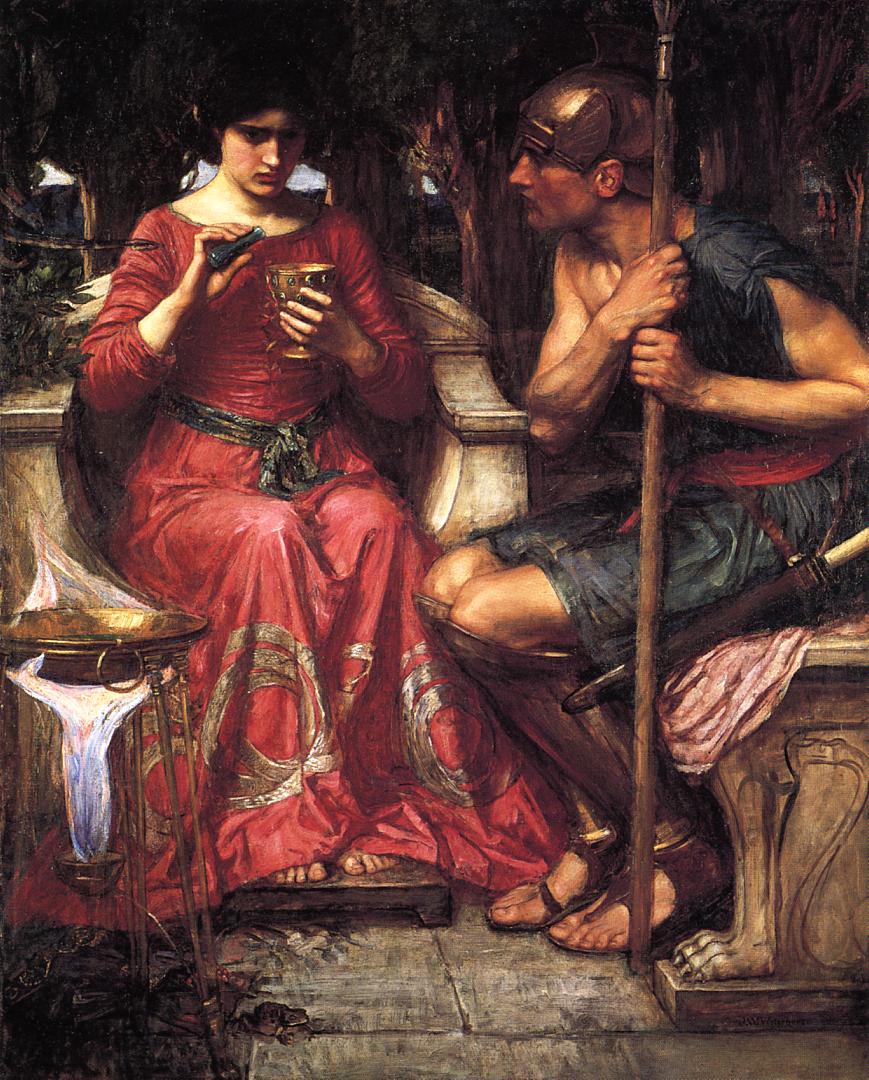
John William Waterhouse’s Jason and Medea (1907) captures a moment that feels both hushed and electrically charged, as if the air itself is holding its breath. The scene appears calm at first glance: a woman seated in a deep red gown, a man leaning in close, a small ritualistic setup at the left with pale, curling flame. Yet everything in the painting suggests that this quiet is not peace, it is suspense. Waterhouse chooses not to show an action at its climax, but the instant just before commitment, when persuasion has almost finished its work and choice has not yet become fate.
The composition is built around an exchange, not of words, but of intention. Jason’s body is angled toward Medea with an urgency that feels physical, even though he remains still. Medea, in contrast, concentrates on a small object in her hand and a goblet she holds like a measured promise. This difference matters: he looks to her, she looks to the thing that will decide what happens next. The painting becomes an image of dependence. The heroic quest, so often told as a story of masculine daring, is reframed here as something that requires another kind of power, knowledge, and risk, one that sits quietly, weighs consequences, and understands what is being asked.
Waterhouse’s most striking choice is to make the psychological event visible. The drama is not outside them, it is inside the space between them. The viewer is pulled into that space, asked to read the posture of the bodies, the direction of the eyes, and the stillness of hands. The result is a myth painted as a negotiation, where seduction, desperation, and calculation share the same breath.
Waterhouse and the Late Pre-Raphaelite Imagination
By 1907, Waterhouse was working in a world that had already absorbed the earlier Pre-Raphaelite revolution. He inherits their devotion to clarity, to rich color, to literary subject matter, and to the moral and emotional seriousness of beauty. At the same time, his own voice leans toward atmosphere and psychology. In many of his mythological and literary scenes, the figures are not simply illustrating a story, they are embodying a mood. Here, the mood is dangerous intimacy, the sense that the room, the garden, or the shadowed grove is a stage for irreversible decisions.
Waterhouse often returns to women who are not passive muses but active agents: sorceresses, prophetesses, nymphs, tragic lovers, and figures who contain both tenderness and threat. Medea, in particular, is ideal for this interest because her power is not decorative. It changes outcomes. It is feared, desired, and morally complicated. Waterhouse’s painting does not demand that the viewer condemn her or praise her. Instead, it invites us to witness how power operates when it is intimate, when it sits beside you, when it is held in a small object between fingers, when it is offered as help but may also be a trap.
The late Pre-Raphaelite sensibility also appears in the tactile pleasure of surfaces. The folds of Medea’s red dress, the gleam of metal, the polished stone, and the soft darkness behind the figures create a world that feels luxuriously real. Waterhouse uses that sensuous realism to make the myth emotionally immediate, as if it could be happening now, not in a distant heroic age.
The Myth of Jason and Medea and the Moment Chosen
The story of Jason and Medea is one of pursuit, betrayal, and catastrophic consequence, but Waterhouse chooses the story’s hinge point, not its aftermath. Jason seeks the Golden Fleece, a symbol of legitimate power and rightful kingship, and Medea, a sorceress and princess, becomes essential to his success. The myth asks uncomfortable questions: what does a hero owe the person who makes his triumph possible, and what happens when gratitude turns into exploitation.
In the painting, the narrative seems to center on Medea’s preparation of a charm or potion, implied by the goblet and the burning brazier. It is a scene of assistance, but assistance that carries a price. Medea’s focus suggests knowledge and seriousness, as if she understands the magnitude of what she is about to do. Jason’s posture suggests insistence, perhaps even impatience, a hero’s hunger for the tool that will guarantee victory. The tension comes from the imbalance in what each risks. Jason risks the quest, Medea risks herself, her family, her homeland, and her moral boundary.
Waterhouse heightens this by making the moment feel private. This is not a public ritual witnessed by priests or warriors. It is an intimate exchange, like a secret being handed across a narrow table. The myth becomes personal. The viewer does not see the Golden Fleece or the dragon, they see the conditions that make those spectacle moments possible. By painting the preparation, Waterhouse suggests that the true turning points of epic stories are often made in silence.
Composition, Staging, and the Space Between Figures
The composition is arranged like a dialogue. Medea sits left of center, her red dress occupying much of the canvas and anchoring the image with its weight and warmth. Jason is to the right, leaning forward, his body angled toward her, creating a diagonal line of attention that lands on her hands. That line is crucial: the painting’s real focal point is the small object Medea holds and the cup she steadies. Waterhouse is telling us, without saying it, that the future depends on what happens in that tiny space.
The stone bench and architectural elements create an enclosed arena, a controlled environment where emotions become more intense because there is nowhere for them to disperse. The background is dark and wooded, offering a thick, almost velvety shadow that isolates the figures and makes their interaction feel sealed off from the world. This darkness is not simply a backdrop. It functions like secrecy itself, the sense that what is being decided here is not for daylight.
The brazier at the left introduces a vertical counterpoint, its pale flame rising like a ghostly presence. It breaks the stillness with movement, but the movement is slow, curling, delicate. It suggests ritual, transformation, and something not entirely natural. Because the flame is pale and luminous against the darker tones, it also becomes a visual signal of the uncanny. We are meant to feel that the laws governing this scene are not only human.
Characterization of Medea as Power and Precision
Medea’s expression and posture are masterpieces of restraint. Waterhouse does not paint her as a theatrical witch. He paints her as someone exacting. Her gaze is lowered toward the object in her hand, and the slight tension in her features suggests concentration rather than rage. This characterization matters because it frames her power as intelligence and control. She is not merely emotional, she is deliberate.
Her red garment amplifies the emotional stakes. Red can suggest passion, danger, sacrifice, or royalty. Here, it reads as all of these at once. The dress is not a simple costume, it becomes a field of meaning. It surrounds Medea like a mantle, making her seem both grounded and monumental. The intricate bands near the hem and the careful rendering of the fabric imply status and tradition, as if Medea’s identity is tied to a world of inherited power that she is about to rupture.
The goblet in her hand is equally significant. It is a vessel, and vessels in art often symbolize the act of containing, holding, offering. Medea holds it with a steady grip that suggests she understands what it will contain, and what it will do. Her other hand, poised over it, implies the act of adding something, a final ingredient or charm. The quietness of this gesture makes it more unsettling. Waterhouse makes the act of magic look almost like a refined domestic task, which is precisely what makes it feel dangerous. When the extraordinary appears ordinary, it becomes harder to resist.
Jason as the Hero Recast as Petitioning Figure
Jason, traditionally the questing hero, appears here in a posture closer to pleading than commanding. He leans in, his face turned toward Medea, his arm braced as if he has to hold himself back from interfering. His clothing and equipment signal the martial world, yet he is not acting, he is waiting. The spear, the helmet, and the exposed muscularity suggest strength, but the narrative role he occupies is dependence.
Waterhouse emphasizes this dependence by making Jason’s attention almost single minded. He is not looking outward toward the quest. He is looking at Medea, and by extension, at her hands. The hero’s future is in the sorceress’s control. The painting becomes a subtle critique of heroic mythmaking. It suggests that what is called bravery is often backed by unseen labor, by knowledge coded as foreign, feminine, or forbidden.
There is also an emotional complexity in Jason’s proximity. He is close enough for intimacy, close enough for persuasion. The myth is filled with the question of whether Jason’s affection is genuine or instrumental. Waterhouse does not answer, but he paints the ambiguity. Jason’s gaze could be admiration, need, manipulation, or all at once. This uncertainty is part of the painting’s tension. It forces the viewer to consider how often desire and strategy intertwine, especially when power is unevenly distributed.
Color, Light, and the Painting’s Emotional Temperature
The painting’s color structure is dominated by the red of Medea’s dress and the earthy, shadowed tones surrounding it. This red is not bright in a cheerful way, it is deep, weighty, and slightly muted, as if it has absorbed the darkness around it. Waterhouse uses it as the emotional heart of the scene. Everything else seems to orbit it, the stone, the skin tones, the darker blues and browns of Jason’s clothing, the pale flame.
Light is handled with subtlety. There is no theatrical spotlight. Instead, Waterhouse creates a soft illumination that finds the faces, hands, and key objects, while allowing the background to remain dense and mysterious. The effect is intimate, like candlelight or late afternoon filtered through trees. This kind of light is psychologically charged because it suggests secrecy and closeness. It also makes the act at the center, the poised gesture above the goblet, feel like the only truly important thing in the world.
The pale flame introduces a cooler, almost spectral note into the palette. It contrasts with the warmth of the red and skin, creating a visual reminder that something unnatural is present. This interplay of warm and cool tones mirrors the thematic interplay of love and danger, human desire and supernatural consequence.
Symbolic Objects and the Language of Ritual
The scene includes a handful of objects that function like symbols without becoming obvious. The brazier is the clearest sign of ritual. Fire is transformation, sacrifice, and passage. Here, it suggests that the help Medea offers is not merely practical, it is metaphysical. It implies a crossing of boundaries. The goblet suggests offering and ingestion, the idea that whatever Medea prepares is meant to enter the body or enter the world, changing what is possible.
Jason’s spear and helmet carry their own symbolism. They represent the public story of heroism, the visible, celebrated side of the myth. In contrast, Medea’s tools represent the private story, the hidden mechanisms of success. The painting’s deeper argument emerges from this contrast: civilization celebrates the spear, but it relies on the cup.
Even the stone setting has symbolic weight. Stone is permanence, tradition, law, the structures of society. Medea and Jason are seated within these structures, but what is happening between them threatens to undermine them. Waterhouse places a disruptive act inside a stable environment, intensifying the sense of impending fracture. It is as if the world of order is being quietly infiltrated by something that order cannot control.
Gender, Agency, and Moral Ambiguity
One of the most compelling aspects of the painting is how it handles agency. Medea is not a victim in this moment. She is the one who knows. She is the one who decides. Jason’s physical strength, his heroic equipment, and his forward lean do not translate into control. The power in this scene is intellectual and ritual, and it belongs to Medea.
Yet Waterhouse does not present this agency as simple empowerment. Medea’s power is morally complicated. It is bound up with love, betrayal, revenge, and the willingness to break social and familial bonds. The painting’s tension is partly the tension of consent and consequence. Medea is choosing, but what kind of choice is it when desire, manipulation, and longing are all present. Jason is asking, but what kind of asking is it when he benefits disproportionately from the outcome.
This is where Waterhouse’s restraint becomes powerful. He does not moralize with exaggerated expressions. He paints the moment as believable, almost quiet enough to be ordinary, and that ordinariness makes the moral questions feel closer to the viewer’s world. People make life altering decisions not only in grand gestures, but in small, private moments, with hands hovering over a metaphorical cup.
Waterhouse’s Emotional Realism and the Viewer’s Role
The painting’s realism is not only in its textures, it is in its emotional readability. The scene invites the viewer to become a witness, almost an intruder. We are positioned close enough to see the details of Medea’s hands, the concentration in her face, the intensity of Jason’s attention. This closeness creates complicity. We are not watching from afar like an audience at a play. We are near enough to feel the intimacy, and therefore near enough to feel uncomfortable.
Waterhouse also leaves narrative space for the viewer to fill. We do not know exactly what Medea is holding, exactly what she is preparing, or exactly what Jason has said. The ambiguity is intentional. It forces the viewer to project knowledge of the myth, or to invent a plausible emotional script. In either case, the painting becomes active, it generates interpretation.
The emotional realism also lies in how Waterhouse balances attraction and unease. The scene is beautiful, richly colored, sensuously painted, yet it is also foreboding. This combination mirrors the myth itself, which begins with romance and partnership but ends in devastation. The painting feels like the calm surface of a deep, dark water. You sense the depth even if you cannot see it.
Legacy of the Painting and Why It Still Grips
Jason and Medea endures because it captures a universal pattern inside a specific myth. It is about the moment when someone asks for help that cannot be given innocently, and when another person realizes that to give that help is to change themselves. It is about desire becoming transaction, and transaction becoming destiny. Waterhouse paints myth as psychology, and psychology is always current.
The painting also challenges the typical hierarchy of epic storytelling. It insists that the most powerful figure in the room is not necessarily the one with weapons, but the one with knowledge and resolve. It invites viewers to reconsider what heroism costs, and who pays that cost. In doing so, it turns a famous legend into a portrait of negotiation, persuasion, and the dangerous tenderness of dependence.
Ultimately, Waterhouse’s achievement here is to make the supernatural feel plausible, not because he proves it, but because he shows why people would reach for it. Medea’s poised hands, Jason’s insistent lean, the pale flame, and the heavy red dress all come together to create a scene where the viewer can almost feel the pressure of the decision. The painting becomes less about ancient Greece and more about the timeless moment when someone’s future is held in a small object, and the hand that holds it must decide whether love is worth the ruin that may follow.