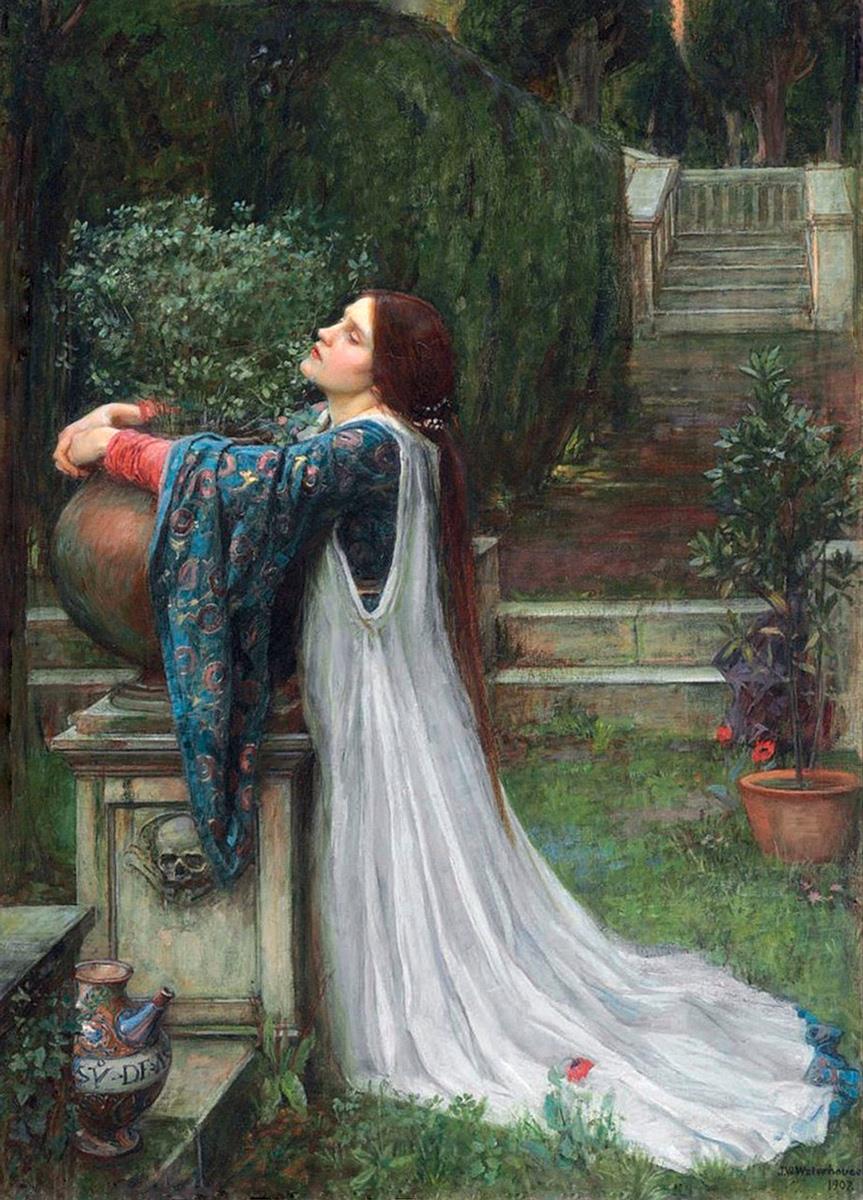
Image source: wikiart.org
Introduction to Isabella and the Pot of Basil
John William Waterhouse’s Isabella and the Pot of Basil (1907) is a late, quiet masterpiece that turns a dramatic literary tragedy into an image of suspended time. At first glance, the scene feels hushed and tender: a young woman leans against a large terracotta pot, her eyes closed, her cheek tilted upward as if listening for something beyond the garden’s walls. But the title immediately changes the temperature of what you are seeing. This is not simply a moment of rest. It is a moment of devotion shaped by grief, a love story that has crossed into obsession, and a private ritual taking place in plain daylight.
Waterhouse was drawn repeatedly to stories where beauty and sorrow are inseparable, and where a single figure can carry the emotional weight of an entire narrative. Here he chooses a theme that had already echoed through centuries of European art and poetry, yet he does not illustrate the tale with theatrical violence or explicit plot. Instead, he distills it into one iconic object and one body language: Isabella’s embrace of the basil pot. The painting becomes less about what happened and more about what remains, the afterlife of a love that cannot be publicly acknowledged.
The Story Behind Isabella and Why It Matters
The subject comes from a well known tragic tale most commonly linked to Boccaccio’s Decameron and later reimagined by John Keats. Isabella, a young woman of gentle nature, falls in love with Lorenzo, a man beneath her brothers’ social ambitions. Her brothers murder Lorenzo to end the relationship. Isabella, discovering the truth, retrieves Lorenzo’s head and buries it in a pot of basil, watering the plant with her tears. The basil flourishes, becoming both a living memorial and a secret proof of her loss. When the brothers discover the pot’s significance, they take it away, and Isabella wastes away in grief.
Waterhouse’s image lives inside the emotional core of that story, not its action. The brothers are absent. Lorenzo is absent. Even the basil itself, while implied, is not aggressively showcased as narrative evidence. What dominates is Isabella’s relation to the pot, her physical closeness and the way her posture suggests a life turned inward. The painting is about mourning as a daily practice, something repeated and private, something that clings to objects because the beloved person is gone.
Isabella as a Figure of Stillness and Pressure
Isabella’s pose is one of the painting’s most expressive elements. She leans forward, resting her forearms along the pot’s rounded rim. The gesture reads as both embrace and surrender. Her head tilts back, eyes closed, mouth slightly parted, as if she is breathing through a wave of feeling. This is not the neat sorrow of a formal memorial portrait. It is the bodily fatigue of grief, the kind that makes the spine soften and the limbs seek support from whatever is near.
Waterhouse gives her a profile that feels sculptural and luminous against the darker greenery. Her closed eyes withdraw her from the viewer, creating the sense that we are witnessing an intimate moment we were not meant to interrupt. The painting does not ask us to meet her gaze; it asks us to notice how she has left the world of conversation and entered the world of remembrance.
There is also a subtle tension in the way she presses against the pot. The pot is heavy, stable, and earthbound. Isabella is soft, living, and vulnerable. Their contact becomes symbolic: she clings to the weight of the earth because the person she loved has returned to earth. Even the curve of the pot mirrors the curve of her arms, making the object feel almost like a body she can hold.
Costume and Fabric as Emotional Language
One of Waterhouse’s great gifts was his ability to make fabric communicate mood. Isabella’s clothing is a study in contrasts. The long white dress falls in a broad sweep to the grass, catching light and creating a soft halo around her lower body. White often suggests purity, but here it also reads as a kind of spectral calm, as if her life is draining of ordinary color. The dress feels both bridal and funerary, hinting at a future that should have been a marriage but has become a prolonged mourning.
Over her arms and shoulders lies a richly patterned blue drapery. Its deep tone and intricate motifs bring a pulse of beauty into the scene, yet it is not cheerful. It looks like a precious textile carried into the garden like a mantle of memory. Blue has long associations with faithfulness and longing, and Waterhouse uses it to bind Isabella to the object she holds. The fabric pools and hangs, adding weight to the composition, as if grief itself has become a physical garment.
Her red sleeves introduce a sharper emotional note. Red can suggest love, life, and blood, and in this context it quietly recalls violence without depicting it. The red is controlled and localized, not splashed across the canvas, which makes it feel like a contained wound. It is the color of feeling that cannot be spoken aloud.
The Pot of Basil as Object, Reliquary, and Secret
The pot is the painting’s true anchor. It is large, rounded, and tactile, its clay surface rendered with care. Waterhouse makes it undeniably real, an object you can imagine touching. In the story, the pot becomes a hidden reliquary, a vessel that contains what cannot be kept. That double identity, ordinary garden container and sacred container, is crucial to the painting’s emotional charge.
The pot sits atop a stone structure that resembles a small pedestal or garden feature. On the stone base appears a carved skull, a direct memento mori. This detail turns the entire arrangement into a symbolic shrine. It suggests death is not simply part of the story but part of Isabella’s daily environment now. The skull is not sensational; it is integrated into the garden’s architecture, as if mortality is built into the world she inhabits.
The basil plant itself is not loudly displayed, which is a fascinating choice. Rather than relying on a clear botanical sign, Waterhouse trusts the title and the viewer’s understanding. This restraint makes the embrace more haunting. Isabella is not showing us proof. She is acting out a relationship with an object that only she fully understands. The pot becomes a private altar that the viewer can see but not truly enter.
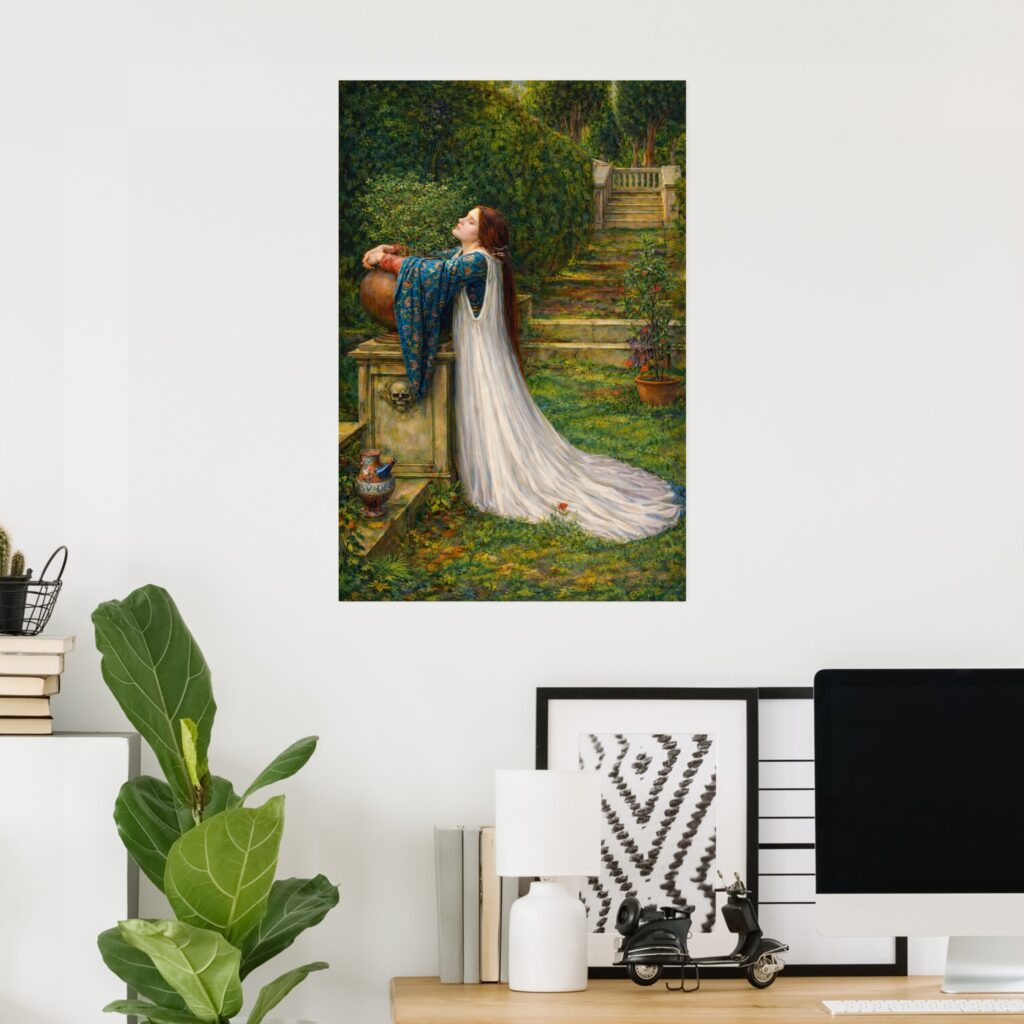
The Garden Setting and the Feeling of Enclosure
The setting is a garden with stone steps and dense foliage. Gardens often symbolize growth, sensuality, and life, but this one feels enclosed and shadowed. The greenery forms a dark wall behind Isabella, which pushes her pale dress forward and gives the composition a sense of staged intimacy. Yet it is not theatrical. It feels like a secluded corner where a private ritual can take place unseen.
The stone steps in the background suggest movement and transition, but no one is ascending or descending. The staircase becomes a silent metaphor for a path Isabella cannot take. The story has cut off her future, and the architecture reflects that pause. Even the garden’s depth feels limited, as if the space folds back in on itself. It is an outdoor space that behaves emotionally like a room.
Small details, like the terracotta pot with painted decoration near the lower left and the potted plant at the right, reinforce the domestic quality of the scene. This is not a wild landscape. It is cultivated and arranged. That matters because Isabella’s grief is likewise cultivated: tended, watered, repeated, protected. The garden becomes a mirror of the basil pot, another container for controlled life.
Color, Light, and the Painting’s Quiet Drama
The palette is dominated by greens, muted earth tones, and the stark white of Isabella’s dress. Waterhouse uses the surrounding darkness to create a soft spotlight effect without harsh contrast. The light seems to fall gently across Isabella’s face and fabric, emphasizing her as the emotional center while keeping the background subdued.
Green, in this context, becomes complex. It can symbolize life and renewal, but also envy, secrecy, and the persistence of memory. The basil in the story is a plant fed by tears, life nourished by sorrow. The green wall behind Isabella suggests a living presence that is also oppressive, as if nature is both witness and prison.
The white dress carries a luminous stillness that feels almost separate from the rest of the world, like a patch of moonlight in daytime. It is a visual embodiment of withdrawal. The blue drapery, richly patterned, offers the painting’s most ornate color statement, yet it remains harmonized with the overall hush. Nothing screams. Everything murmurs.
Composition and the Viewer’s Position
Waterhouse places Isabella slightly off center, allowing the pot and its stone support to share the foreground with her body. This compositional choice matters because it prevents the painting from becoming simply a portrait. The object is equally important. The viewer’s eye moves from her face to her arms to the pot’s curve, then down to the skull and across the trailing white fabric. The path is circular, mirroring the cycle of mourning.
The long sweep of Isabella’s dress across the grass creates a sense of time stretching out. It feels like an extension of her body, a visual echo of how grief can expand to fill space. The trailing hem also increases the painting’s intimacy, making the scene feel close and touchable.
The background steps and foliage provide structure but do not distract. They frame Isabella like a stage set built out of stone and leaves. Yet Waterhouse avoids obvious narrative props like blood, weapons, or figures in the distance. The drama is internal, and the composition supports that by limiting external interruption.
Symbolism of Death and Devotion
The carved skull is the most explicit symbol of death, but the painting offers subtler signs. Isabella’s closed eyes imply a turning away from the visible world. Her upward tilt suggests longing, prayer, or a kind of surrender to memory. The pot itself, as vessel, symbolizes containment, secrecy, and the transformation of a lover into an object of ritual.
There is also symbolism in textures. Stone, clay, and fabric create a triad: permanence, earth, and fragility. Stone is what remains. Clay is what holds. Fabric is what touches and comforts. Isabella is surrounded by materials that echo the human cycle: we live softly, we are held by earth, we become memory carved into stone.
The garden setting adds another symbolic layer. Plants grow, but they also wither. A garden requires care, but it cannot guarantee permanence. Isabella’s story is about love that cannot survive social power, and the garden becomes a stage where natural tenderness is hemmed in by constructed boundaries.
Waterhouse’s Late Style and Emotional Restraint
Painted in 1907, this work belongs to Waterhouse’s later period, when his approach often became softer, more reflective, and less interested in overt spectacle. The brushwork suggests careful attention to face and fabric, while the background remains painterly and atmospheric. This combination allows Isabella to feel vividly present while the world around her becomes a mood.
The painting also shows Waterhouse’s continued attachment to poetic subjects and female protagonists, but here the heroine is not an enchantress or mythic force. She is a grieving person. That shift matters. The power in the painting does not come from magic or seduction. It comes from endurance, from the way grief makes a person faithful to what is gone.
There is also a modern psychological sensitivity to the scene. Isabella’s posture reads like a believable human response, not a posed allegory. Waterhouse is not merely illustrating Keats or Boccaccio; he is painting a state of mind. The story provides the framework, but the painting’s true subject is the intimacy between a person and the object that holds her secret.
Why the Painting Still Resonates
Isabella and the Pot of Basil continues to resonate because it captures a recognizable human experience: the way grief attaches itself to objects. Many people understand the strange holiness of ordinary things after loss, a piece of clothing, a letter, a room, a favorite mug. Waterhouse gives that phenomenon a visual form that feels both specific and universal.
The painting also speaks to love constrained by power, by social rules, by the authority of family and class. Isabella’s brothers are not shown, but their control is everywhere in the story, and it haunts the image by absence. The viewer senses that Isabella’s solitude is not chosen; it is imposed. Her tenderness becomes a quiet rebellion.
Finally, the work endures because it balances beauty with unease. The colors are rich but subdued. The figure is graceful but weighed down. The garden is alive but shadowed. Waterhouse creates a scene that invites prolonged looking, not because it is complicated in plot, but because it is profound in feeling. The painting becomes a meditation on devotion that has nowhere to go except inward, and on memory that turns the simplest vessel into a sacred container.