Image source: wikiart.org
Introduction
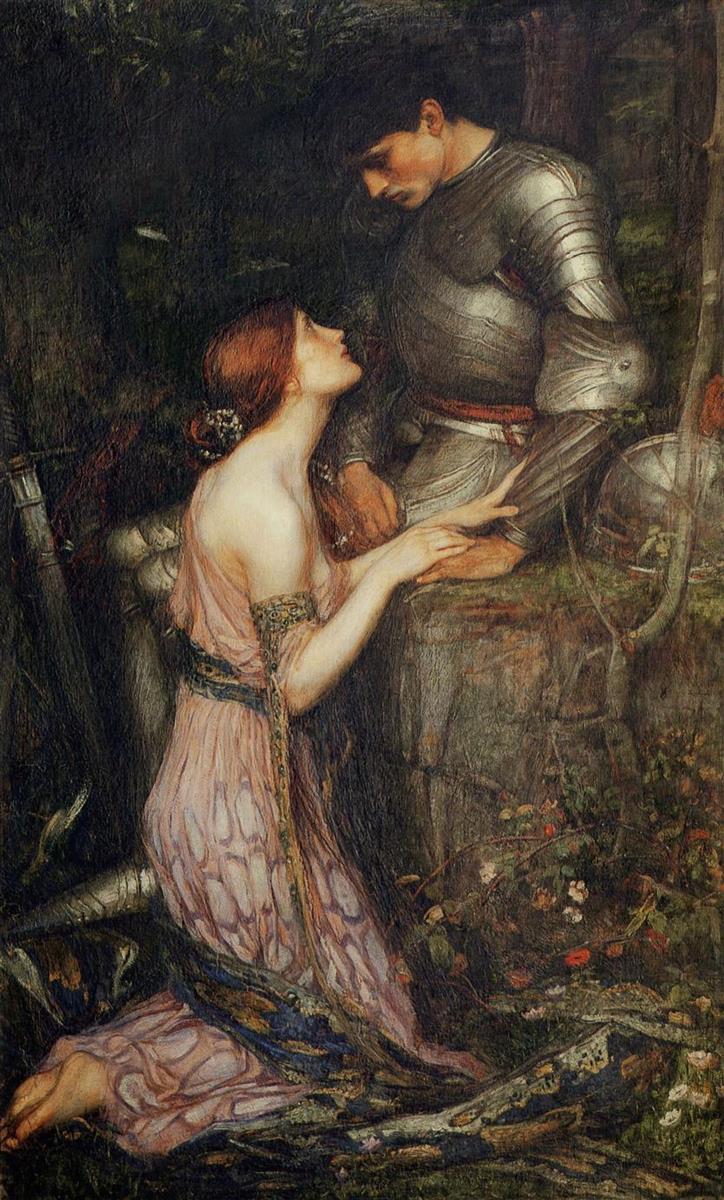
John William Waterhouse’s Lamia and the Soldier (1905) stages a private encounter that feels both intimate and perilous. A young woman kneels in a shadowed woodland clearing, her pale shoulders and soft rose dress catching what little light filters through the trees. Above her, a soldier in gleaming armor leans in, his posture protective yet uncertain. Their eyes meet at close range, and their hands almost interlace at the edge of a stone barrier. The painting offers the viewer a moment suspended between tenderness and surrender, as if one more breath could tip the scene into confession, spell, or betrayal.
Waterhouse rarely paints pure serenity. Even when his subjects appear calm, the air around them seems to hum with story. Here, the title provides the key: Lamia is not merely a beautiful figure from a romantic tale, but a mythic presence associated with enchantment, appetite, and danger. The soldier, for all his metal strength, becomes the vulnerable one, poised at the threshold of a choice he may already have made.
The Myth of Lamia and Why It Matters Here
In classical tradition, Lamia is bound to transformation and predation. She appears in later retellings as a being who shifts between monstrous and alluring forms, a figure who lures, consumes, and unsettles the boundary between desire and fear. By Waterhouse’s time, Lamia had also become a romantic-literary subject, shaped by Victorian and Edwardian tastes for tragic femme fatales drawn from myth and poetry.
That dual identity is crucial to how the painting works. Waterhouse does not show overt monstrosity. Instead, he paints Lamia’s danger as a question, not a spectacle. She looks human, vulnerable, and pleading, yet her name loads the scene with foreboding. The viewer reads her softness against the knowledge that softness can be a lure. The soldier’s armor becomes less a guarantee of safety and more a symbol of how easily a person can mistake defense for immunity.
A Moment of Encounter, Not a Climax
Rather than illustrating a dramatic event, Waterhouse chooses a threshold moment. Lamia kneels, which could signal supplication, seduction, or sorrow. The soldier stands, but he does not tower with domination. He bends toward her, his head inclined, his attention narrowed to her face. Their proximity suggests a conversation the viewer cannot hear, one that may be tender, urgent, or manipulative, depending on how you read Lamia.
The painting’s power lies in what it withholds. There is no explicit violence, no revealed consequence. The narrative is compressed into posture and touch. That restraint makes the scene feel psychologically modern: it is about consent, fascination, and the quiet momentum of temptation. Waterhouse turns myth into a study of a choice forming in real time.
Composition and the Architecture of Intimacy
The composition is built around a diagonal current that runs from Lamia’s kneeling body up through her face and into the soldier’s bowed head. This diagonal creates a visual climb, as if desire itself is a force pulling upward. At the same time, a stone structure cuts across the center right, acting like a boundary between them. That barrier is not a wall in the defensive sense, but a ledge where their hands meet and where decision seems to rest.
Waterhouse places the couple close to the picture plane, reducing the sense of distance between viewer and subject. The background foliage is dark, dense, and softly described, functioning almost like a curtain. This shallow, enclosed space heightens intimacy and makes the encounter feel hidden from the world. The scene becomes a pocket of secrecy, where private emotions outweigh public roles.
Gesture and Touch as Narrative Language
The hands tell the story as much as the faces do. Lamia’s arm extends toward the soldier with an openness that reads as appeal. Her fingers rest lightly, not grasping, but offering contact. The soldier’s hand, partially shadowed, hovers near hers, a gesture that suggests hesitation rather than refusal. Waterhouse paints the almost-touch as a charged pause, the exact second before a boundary is crossed.
Lamia’s kneeling posture intensifies the emotional asymmetry, yet Waterhouse complicates it by making her gaze upward steady and direct. She is not simply passive. Her expression implies intent, as though she is asking for something specific, or reminding him of something already promised. The soldier, armored and upright, should be the figure of certainty, but his angled head and softened attention suggest susceptibility. In this reversal, the myth’s core idea emerges: power does not always look like strength.
The Soldier as Symbol and Human Figure
The soldier’s armor is rendered with silvery highlights that catch the dim light. It signals duty, protection, and the public world of conflict and rules. Yet in this woodland setting, the armor looks slightly out of place, too rigid for the organic surroundings. This contrast makes him feel like an intruder in a realm governed by older laws: the laws of the forest, of myth, of instinct.
Waterhouse’s soldier is not presented as a triumphant hero. His stance is braced, but not aggressive. The tilt of his body toward Lamia suggests that his defenses are emotional rather than physical, and that they are failing. The armor becomes a metaphor for the ways people protect themselves with identity and status, only to find that desire slips through the seams.

Lamia’s Appearance and the Strategy of Softness
Lamia is painted with luminous skin, warm auburn hair, and a flowing dress in rose and mauve tones. The fabric clings and pools, emphasizing softness and the weight of her presence on the ground. Waterhouse often uses drapery to communicate mood: here it suggests both romance and vulnerability, like a garment that could be bridal or funerary depending on the outcome.
Importantly, Lamia is not eroticized through overt display. Her beauty is quiet, almost devotional in tone, and that restraint makes her more persuasive. The danger, if danger exists, is not in obvious temptation but in emotional appeal. Waterhouse paints her as someone who could be loved and trusted. The mythic threat is disguised as human longing, which is precisely what makes the story unsettling.
Setting, Vegetation, and the Emotional Climate
The woodland background is deep and shadowy, with leaves and branches forming a textured darkness behind the figures. This darkness does not read as empty; it feels thick, like a living presence that watches and encloses. Waterhouse uses the natural world as atmosphere, turning foliage into a psychological field where ordinary morality blurs.
Near the bottom right, small flowers and ground growth appear, delicate touches of color against the dim earth. These details suggest life and beauty, but also the quiet persistence of nature, indifferent to human vows. The ground is strewn with organic forms, and the forest feels like a place where stories older than the soldier’s code still operate. The setting becomes a silent collaborator in Lamia’s allure, offering concealment and a sense of inevitability.
Color, Light, and the Painting’s Mood
The palette is subdued and earthy: deep greens, browns, and smoky blacks wrap around the figures. Against this, Lamia’s pale skin and pink dress become the painting’s emotional light source. The soldier’s armor provides a colder brightness, reflective rather than radiant. This contrast creates a dialogue between warmth and chill, flesh and metal, invitation and restraint.
Waterhouse’s light is not dramatic sunlight but a filtered glow, as though the scene takes place at dusk or under a canopy that prevents clarity. This kind of light suits a narrative about uncertainty. It also makes the painting feel like memory or dream, a moment half-hidden even as it is revealed. The overall mood is hushed, as if the forest has absorbed sound and left only the intensity of looking.
Texture and Brushwork as Storytelling
Waterhouse modulates texture carefully. The soldier’s armor is described with smooth, controlled highlights that suggest hardness and weight. Lamia’s dress, by contrast, is painted with softer transitions, emphasizing folds and the gentle pull of fabric. The surrounding vegetation is handled more loosely, with dark strokes that blur into each other, creating a sense of depth without crisp detail.
This hierarchy of finish matters. Waterhouse sharpens what is emotionally central and lets the rest dissolve into atmosphere. The effect is cinematic: the figures are the focus, the world around them becomes a shadowed stage. The viewer’s attention is guided to faces and hands, to the grammar of intimacy that the myth will later translate into consequence.
Psychological Tension and the Theme of Choice
At its heart, Lamia and the Soldier is about the vulnerability of the will. The soldier is armed and armored, yet he appears emotionally unguarded. Lamia is physically lower, yet her gaze and poise grant her an authority that does not depend on force. The painting suggests that surrender often happens quietly, through attention, empathy, and the desire to believe.
The stone ledge between them functions like a moral threshold. It is where their hands hover, where the story becomes personal. Waterhouse invites the viewer to ask: is Lamia pleading for love, or casting a spell that takes the shape of need? Is the soldier rescuing her, or abandoning his duty? The painting does not answer. It turns uncertainty into its main emotional note, and that ambiguity is what keeps the image alive in the mind.
Waterhouse in 1905 and the Late Romantic Spell
By 1905, Waterhouse was working in a period often described as late Pre-Raphaelite in spirit, even as art was shifting rapidly around him. Instead of chasing modernist fracture, he deepened his commitment to myth, mood, and the psychological power of narrative. Lamia and the Soldier reflects that maturity. The scene is quieter than some of his more theatrical compositions, yet it is arguably more intense because it concentrates on the moment where fate is chosen rather than the moment where fate strikes.
Waterhouse’s fascination with mythic women is not simply decorative. In many of his paintings, the female figure becomes the point where nature, desire, and destiny converge. Lamia fits this pattern, but Waterhouse treats her with an unusual softness that complicates any simple reading of her as villain. The soldier’s tenderness makes her seem almost humanly tragic. The myth becomes less a moral warning and more a portrait of how longing can wear many faces.
Symbolic Contrasts: Metal and Flesh, Duty and Desire
The painting is built on contrasts that feel symbolic without becoming rigid. Metal and flesh is the most immediate: the soldier’s polished armor beside Lamia’s exposed skin. Duty and desire follows naturally: the soldier’s role as protector, and the private pull of the moment. There is also the contrast between the structured and the wild: the stonework and weaponry against the tangled forest.
These contrasts create a moral pressure cooker. The soldier’s armor suggests an identity he carries from the outside world, while the forest suggests a realm where identities loosen. Lamia, positioned between these forces, can be read as the embodiment of that loosening. She is the invitation to step out of role and into impulse, whether that impulse leads to love, ruin, or both.
Why the Painting Feels So Haunting
The haunting quality of Lamia and the Soldier comes from its refusal to resolve the myth into a single image of monstrosity. Waterhouse places the viewer in the soldier’s position: close enough to be moved, informed enough to fear, and unable to know which feeling should win. The painting suggests that danger can be tender and that tenderness can be dangerous, not because affection is evil, but because affection can blind.
The scene is also haunting because it is intensely private. There is no crowd, no court, no battlefield. The soldier’s greatest conflict is internal. Lamia’s greatest weapon, if she is weaponized at all, is not claws or fangs but the human ability to be seen and to make someone feel chosen. Waterhouse turns myth into a psychological trap that still feels familiar: the moment when someone’s gaze makes you forget your own rules.