Image source: wikiart.org
Introduction to “Psyche Opening the Golden Box”
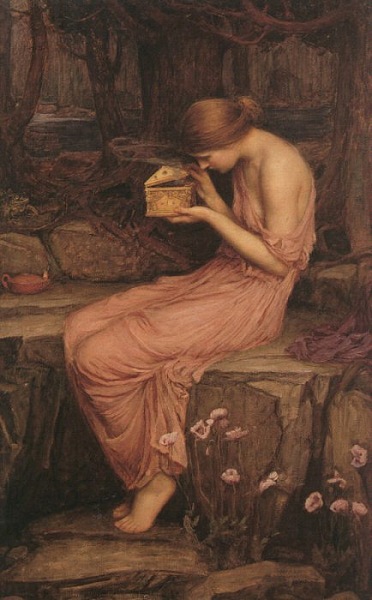
John William Waterhouse’s Psyche Opening the Golden Box (1903) captures a moment of quiet risk. Nothing explodes, nobody rushes in, and yet the whole painting feels balanced on a single decision. Psyche, alone and absorbed, bends toward a small casket that glows against a dim, earthy world. Waterhouse turns a mythic episode into something intensely human: the hush before a mistake, the pull of curiosity, the soft confidence that you can handle what you were warned not to touch.
The scene is intimate rather than theatrical. Psyche does not stand in triumph or collapse in despair. She sits, almost as if she has found a private corner to do something she knows she should not do. Waterhouse builds the tension through restraint. The figure’s posture, the proximity of her face to the lid, and the careful cradling of the box all suggest a choice made slowly, with a mind already half persuaded.
The Myth Behind the Moment
In Apuleius’s tale, Psyche is tasked with impossible labors, and one of them sends her to the underworld. She is instructed to carry a box back unopened, a container associated with beauty, sleep, and forbidden knowledge depending on the retelling. The point is not simply obedience. The myth tests the boundary between desire and discipline, between what is promised and what is demanded.
Waterhouse selects the instant when Psyche crosses that boundary. This is not the underworld itself, nor the aftermath. By choosing the opening, he centers the psychological pivot: the temptation to secure something extra, to peek, to make the reward safer, fuller, more certain. In that sense, the painting is less about mythology than about a familiar thought pattern. Psyche does not look reckless. She looks convinced. That is what makes the moment dangerous.
Composition and the Architecture of Stillness
The composition is built around a gentle diagonal that runs from Psyche’s bowed head to the golden box, then down along her draped arms and flowing dress toward her feet. This diagonal creates a visual path that feels like a slow descent into the act itself. Waterhouse keeps the figure compact and enclosed within the frame, emphasizing privacy and concentration.
Psyche sits on a stone ledge that functions like a stage, but the stage is rough and natural, not ceremonial. The surrounding space presses in. Dark trunks and tangled branches form a backdrop that reads as both forest and threshold, a place where myth can happen without a crowd. The box becomes the brightest, most assertive object, so the entire composition effectively points to it. The painting’s “plot” is an arrangement of shapes that makes it hard for the eye to go anywhere else for long.
Psyche’s Pose as a Psychological Portrait
Psyche’s posture communicates more than facial expression could. She leans forward, shoulders curved inward, as if shielding the act from judgment. Her hands hold the box with care, not greed. The delicacy of her grip suggests reverence and fear at once. She is not rummaging. She is attending.
Her head tilts down, and her attention narrows to a single point. This narrowed focus is one of Waterhouse’s most effective tools here. Psyche’s world becomes small: the box, her breath, the thin line of the lid. That shrinking of the world is exactly how temptation often feels, like a private logic that overrides broader consequences.
Even her bare feet matter. They ground her in the physical world, reminding us that this is not an abstract allegory. This is a body on stone, a person in a place, a choice in time.
Color, Light, and the Heat of the Gold
Waterhouse sets up a striking contrast between the muted, shadowed environment and the warm notes of Psyche’s dress and hair, then intensifies it with the golden box. The setting is full of browns, dark greens, and smoke-like grays, colors that absorb light rather than reflect it. Against this, Psyche’s rose-pink drapery looks like a living ember.
The gold of the box is not just decorative. It functions like a visual magnet, a source of promise. It is the brightest note in the painting, but not a harsh brightness. It glows with a soft, antique warmth, suggesting something precious and old, something that should be handled with ceremony. The lid’s edge and the small architectural details on the box catch highlights that make it feel solid and real, a tangible object with weight and consequences.
Light falls gently across Psyche’s shoulder and upper back, revealing the softness of skin and the curve of form without turning the figure into spectacle. The illumination feels private, like a lantern of attention rather than a spotlight.
Texture and the Language of Materials
One of the painting’s quiet pleasures is its sensitivity to textures. The stone ledge looks cold and uneven, its edges chipped and layered. The background reads as dense and fibrous, with branches and bark forming a kind of tangled tapestry. In contrast, Psyche’s garment appears thin and flowing, a fabric that slides and gathers in soft folds.
This contrast between rough and delicate amplifies the narrative. Psyche is a vulnerable presence in an indifferent world. The delicate cloth drapes over rock, and the softness of her body leans into a hard environment. The gold box sits between these worlds: crafted, refined, and unnatural compared to stone and bark. It belongs to the realm of gods and tasks, not to the natural setting. In a single arrangement, Waterhouse sets the human against nature and both against the supernatural artifact.
The Golden Box as Symbol and Story Device
The box is the painting’s moral center. It is small, but it dominates, because it holds more than an object. It holds a command. It holds a boundary. The act of opening it becomes a symbol for crossing a line that was drawn for Psyche’s protection.
Waterhouse depicts Psyche as careful and almost tender with the box, which complicates any easy judgment. The painting does not frame her as foolish. Instead, it frames the temptation as understandable. The box is beautiful, and beauty is persuasive. It is also closed, and closure invites curiosity. The lid becomes a metaphor for the thinness of restraint, for how small a physical action can be and how large its consequences can feel afterward.
The box also represents the promise of transformation. Psyche’s myth is fundamentally about change: from mortal to immortal, from trial to union, from suffering to reward. The box seems to offer a shortcut, a way to secure the outcome. That is why it is irresistible. It stands for the fantasy that you can control the terms of your destiny if you only look inside.
Setting, Atmosphere, and the Edge of the Otherworld
The environment feels like a threshold space rather than a specific location. There is water or dampness suggested behind the figure, and the background vegetation is dense, dark, and slightly unreal. The branches arc above Psyche like a canopy, turning the scene into a secluded pocket. This is the kind of place where myth happens quietly, away from the ordinary world.
The atmosphere is heavy with dusk-like tones. The painting does not clearly declare whether it is day or evening. That ambiguity adds to the mood. Psyche’s action feels timeless, suspended. The muted palette and enclosed space make the scene feel almost soundless. You can imagine the smallest noises: the shift of fabric, the faint scrape of wood or metal, the subtle click of a lid.
Waterhouse often uses nature as a psychological mirror, and here the surroundings seem to echo the moral tangle of the moment. The background is not a welcoming garden. It is complicated, shadowed, and thick with forms that are hard to untangle, much like Psyche’s reasoning as she leans closer.
Waterhouse’s Vision of Myth and Womanhood
Waterhouse was drawn repeatedly to stories of women at decisive moments: enchantresses, heroines, victims, and seekers. What unites many of these figures is not simply beauty, but inner intensity. They are often shown in a pause that contains a future.
In Psyche Opening the Golden Box, Psyche is neither seductress nor spectacle. She is a protagonist of interior life. Her beauty is present, but the painting prioritizes attention and emotion over display. That choice matters. It allows the myth to feel like a study of thought rather than a lesson imposed from above.
The figure’s self-contained focus suggests a modern psychological realism within a mythic framework. Waterhouse makes the ancient story feel contemporary by stressing the recognizable human feeling: the sense that you deserve to know, that you need to know, that the warning cannot possibly apply to you in the same way it applied to others.
Pre-Raphaelite Echoes and a Late Style
Although Waterhouse is often associated with the Pre-Raphaelite orbit, this work shows a softer, later mood. The detailed attention to hair, fabric, and natural setting recalls Pre-Raphaelite priorities, but the overall handling feels subdued and tonal. The background is not a crisp inventory of botanical facts. It is an enveloping atmosphere. The painting leans toward mood and harmony more than bright, jewel-like precision.
The color scheme is restrained, with the pink dress serving as the main chromatic flourish and the gold box acting as a focal spark. This restraint strengthens the narrative. A more flamboyant palette might have turned the scene into pure romance. Instead, Waterhouse gives it a quiet severity. The painting feels like a memory or a confession, something half hidden.
The emotional temperature is controlled. There is no melodrama in the pose. The drama is in the inevitability implied by the act. The viewer knows, or senses, that opening the box changes everything, and Waterhouse trusts that knowledge enough to keep the surface calm.
Themes of Curiosity, Obedience, and Self-Justification
At the heart of the painting is a tension that reaches beyond myth: the conflict between instruction and impulse. Psyche’s task requires trust, patience, and submission to a process she did not choose. The box tempts her with autonomy. By opening it, she asserts her right to verify, to claim certainty, to take what is not offered.
The painting also explores self-justification. Psyche’s careful tenderness suggests she believes she has good reasons. Perhaps she thinks the contents will help her complete the trials. Perhaps she thinks she has earned a reward. Perhaps she fears being tricked. Waterhouse leaves space for all these interpretations. That openness makes the painting psychologically rich. It does not simply say, “Do not disobey.” It asks, “What does disobedience feel like from the inside?”
Curiosity here is not cartoonish. It is quiet and almost sacred. That is why it resonates. The painting recognizes that the most consequential mistakes are often made gently, with steady hands and a calm heart.
Why the Painting Still Feels Immediate
The scene remains powerful because it is built on a universal experience: the moment you lean closer to something you should leave alone. Waterhouse captures the texture of that moment, how it can feel like solitude, like concentration, like destiny narrowing to a single action.
The painting’s stillness invites the viewer to participate. Your eye moves toward the box with Psyche. You share her focus. The longer you look, the more you feel the tension between the softness of her form and the hardness of the world around her, between the warmth of the gold and the cool shadow of the setting.
In the end, Psyche Opening the Golden Box is less a depiction of myth than a portrait of a human threshold. The painting does not need spectacle. It has a quieter force: the recognition that a single small decision can carry the weight of a whole story.