Image source: wikiart.org
Introduction
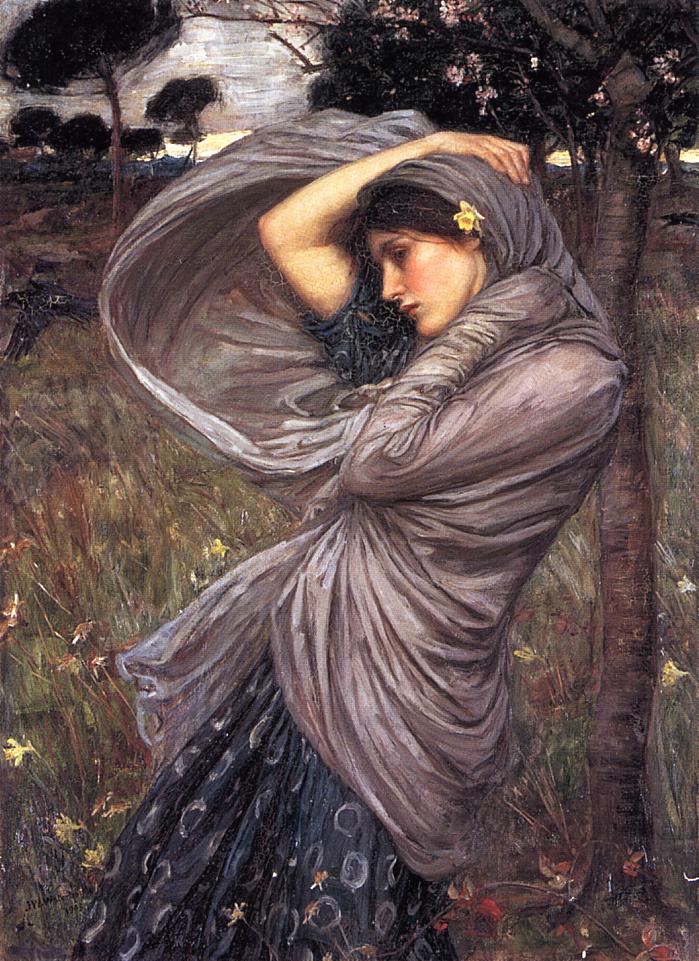
John William Waterhouse’s Boreas (1903) captures a single, charged moment where weather feels almost human. The painting presents a young woman caught in a sudden gust, her garments and veil swept outward as if the air itself has hands. Waterhouse turns an everyday experience, bracing wind on open ground, into myth. The title points to Boreas, the Greek personification of the North Wind, a force associated with cold, speed, and abruptness. Yet Waterhouse does not paint a god in bodily form. Instead, he paints the god’s presence as an invisible pressure that shapes everything we can see: fabric, posture, hair, and even expression. The result is both intimate and theatrical, a scene that reads like a private struggle staged on a wide outdoor set.
What makes the image so compelling is its balance between clarity and ambiguity. The figure is crisply observed, her face modeled with careful attention, while the wind remains unseen, known only by its effects. Waterhouse invites the viewer to supply what the painting refuses to depict directly. In doing so, he creates a drama of sensation. We feel the chill through the tightened shoulders, the defensive angle of the head, the way cloth presses and lifts. This is a painting that turns atmosphere into narrative, and that transformation is at the heart of its lasting appeal.
Waterhouse in 1903 and the Late Pre-Raphaelite Mood
By 1903, Waterhouse was working in a cultural moment that looked both backward and forward. The Pre-Raphaelite circle had reshaped British painting in the mid nineteenth century with an emphasis on detail, luminous color, and literary subject matter. Waterhouse emerged later, often grouped with the movement because of his mythic and poetic themes, as well as his love of striking female protagonists. Yet his handling is distinct. He tends to soften the sharp linearity associated with early Pre-Raphaelite work, blending forms into a more atmospheric finish. In Boreas, this approach is especially evident. The background is suggestive rather than meticulously described, while the central figure commands attention with a combination of solidity and softness.
The early twentieth century also brought new sensitivities to the depiction of emotion and the body in space. Rather than presenting a static emblem, Waterhouse gives us a figure reacting to an external force. This sense of immediacy aligns with broader changes in art, where momentary perception and lived experience became increasingly important. Still, Waterhouse retains a classical and literary frame. He does not simply paint a woman in the wind. He gives that wind a name and a mythic charge, allowing the painting to operate simultaneously as a realistic study and as an allegory of intrusion, desire, or fate.
The Myth of Boreas and Waterhouse’s Interpretation
In Greek mythology, Boreas is not merely a breeze. He is a powerful, sometimes violent presence, famously associated with the abduction of Oreithyia. Many artists and writers have treated Boreas as a symbol of sudden compulsion, the kind of force that interrupts ordinary life and carries someone away. Waterhouse’s painting approaches that tradition indirectly. There is no literal kidnapping, no winged god, no overt violence. Instead, the myth becomes psychological and physical sensation. The wind’s aggression is expressed through the figure’s defensive pose and the tugging fabric that seems to pull her sideways.
This choice matters. By keeping Boreas invisible, Waterhouse shifts the focus from spectacle to vulnerability. The viewer is placed in a strange position: we witness the wind’s effect, and we may even enjoy the beauty of the swirling cloth, but we also see the woman’s resistance. The painting can be read as a meditation on external pressures that act upon the self, whether those pressures are natural, social, or emotional. Myth provides the language for that pressure. Boreas becomes a metaphor for the forces that arrive without permission.
Composition and the Drama of a Single Gust
The composition is built around a strong diagonal movement. The figure is angled, her upper body turning into the wind while the veil and outer garment sweep in the opposite direction. This creates a visual tension that feels like a struggle between two vectors: the woman’s attempt to hold herself together and the wind’s attempt to unwrap her. Waterhouse stages the action so that the viewer’s eye travels along the arc of the billowing fabric, then returns to the face. The curve of the veil functions almost like a halo made of air and cloth, framing the head while also emphasizing the wind’s force.
The setting supports this drama without competing with it. Trees and distant landscape provide a muted stage, offering vertical anchors that contrast with the horizontal rush of fabric. The nearest tree trunk stands like a witness, steady and indifferent, while the figure’s clothing behaves like a living thing. Waterhouse uses this contrast to heighten the sense of suddenness. Nature is present, but in two modes: the stable, rooted world of trunks and ground, and the unstable, kinetic world of air. The woman is caught between them.
The Figure as Heroine and Human Weather Vane
Waterhouse’s protagonist is neither posed for admiration nor reduced to a generic symbol. She appears actively engaged in surviving the gust. Her arm lifts over her head, not as a graceful flourish but as a practical response, as if trying to secure the veil or protect her hair and face. Her other arm draws inward, compressing the body, suggesting cold and defense. The head turns down and away, eyes not meeting the viewer, which intensifies the sense that we are observing a private moment.
Her expression is crucial. It is not a dramatic scream or a theatrical swoon. It is a concentrated, slightly pained focus, the look of someone enduring discomfort. This restraint makes the painting feel true. Wind can be humiliating, disruptive, and intimate in the wrong way. It invades personal space. Waterhouse captures that invasion while maintaining the dignity of his subject. She is a heroine of sensation, defined by reaction rather than action, and in that reaction she becomes the painting’s narrative engine.
Fabric, Motion, and the Language of Touch
Few painters render fabric with such persuasive weight and movement. In Boreas, cloth is both costume and storyteller. The veil arcs outward in a broad sweep that reads as pure momentum. The outer garment clings and gathers in folds that suggest both the body’s structure and the wind’s grip. Waterhouse uses the folds to indicate pressure points, where gust and gravity compete. Some folds tighten around the torso, while others balloon away, creating a rhythm of compression and release.
This fabric also acts like a surrogate for touch. Because the wind is invisible, the painting needs a visible proxy that makes the force believable. Cloth becomes that proxy. It shows where the wind catches, how it pulls, and how the figure responds. The viewer almost feels the texture: the thin veil that would snap and flutter, the heavier wrap that would drag and slap against the body. Waterhouse turns the tactile into the visible, and that translation is one of the painting’s greatest achievements.
Color and Atmosphere: Cool Neutrals with Hidden Heat
The palette of Boreas is dominated by cool neutrals, grays, mauves, smoky violets, and muted earth tones. This chromatic restraint serves the theme. We read cold in the colors before we register it in the pose. Yet Waterhouse prevents the painting from becoming monotone by introducing subtle warmth. The skin has a living glow, the cheeks carry a flush that suggests chill, and small accents, like the yellow flower near the hair, punctuate the subdued field.
The background is painted in a darker, duskier register, which pushes the figure forward. The landscape is not a bright pastoral scene. It is more like a threshold between day and night, or between seasons. This ambiguity supports the mythic title. Boreas belongs to the edge of comfort, to the moment when weather turns. The atmosphere feels unsettled, as if the wind is the leading edge of something larger. Waterhouse’s colors communicate not just temperature but mood, a quiet foreboding that makes the gust feel significant.
Light, Modeling, and the Focus on the Face
Waterhouse uses light selectively. The figure’s face and arms are modeled with care, drawing the viewer into the most human part of the scene. The light is soft rather than harsh, which allows subtle transitions in skin tone and gives the face a sculptural presence. This soft light also harmonizes with the fabric’s folds, which rely on gentle gradations rather than sharp highlights.
The face becomes the painting’s emotional center. Even though the cloth is dramatic, Waterhouse ensures that we return to the expression. The angle of the head, the downcast eyes, and the concentrated mouth create a feeling of inwardness. The woman is not performing for us. She is enduring something. That choice makes the painting feel modern in spirit, focused on interior response rather than exterior spectacle.
Nature as Stage: Trees, Field, and the Suggestion of Sound
The environment in Boreas is understated but carefully tuned. The trees form a dark canopy and a set of vertical lines that frame the figure. Their branches and leaves are suggested with painterly economy, enough to convey texture and depth without stealing attention. The field in the foreground contains scattered small flowers and grasses that bend, echoing the wind’s presence on a smaller scale. This repetition of bending forms strengthens the illusion. The gust is not confined to the veil. It moves through the entire space.
The painting also suggests sound. Although silent, it evokes the rush and hiss of wind through leaves, the snap of fabric, the low roar of air moving across open ground. Waterhouse’s ability to imply sound through visual cues is part of what makes the scene immersive. We do not simply see wind, we imagine it, and the painting’s realism depends on that imaginative participation.
Psychological Readings: Vulnerability, Resistance, and the Unseen Force
Because Boreas is invisible, the painting invites metaphor. The wind can be read as nature’s indifference, an external reality that does not care about comfort. It can also be read as a psychological force, anxiety, desire, memory, or social pressure, something that arrives suddenly and rearranges the self. The figure’s posture suggests both resistance and inevitability. She cannot stop the gust. She can only brace herself and hold on.
There is also a tension between exposure and concealment. The wind threatens to reveal, to pull away coverings, while the woman counters with gesture and grip. This dynamic has long been part of mythic imagery, where gods and natural forces test human boundaries. Waterhouse’s handling is subtle enough that the painting can remain simply a scene of weather, yet charged enough that viewers often sense a deeper drama. The genius lies in how naturally these layers coexist.
Waterhouse’s Craft: Between Detail and Dream
Waterhouse’s technique in Boreas shows a painter comfortable with both observation and invention. The figure is believable in anatomy and weight. The fabric is rendered with knowledge of how material behaves. At the same time, the scene carries a dreamlike coherence, where everything serves the central idea of wind as character. The background is not overly specific because it does not need to be. It exists to support the figure’s experience.
This balance helps explain Waterhouse’s enduring popularity. He offers narrative without heavy explanation, beauty without emptiness, and symbolism without rigidity. Boreas feels complete even if you know nothing of Greek myth. But if you do know the myth, the painting deepens, becoming a meditation on power, intrusion, and the vulnerability of the human body in a world of larger forces.
Legacy and Why Boreas Still Captivates
Boreas remains captivating because it turns an invisible phenomenon into a vivid presence. It is a lesson in how painting can represent what cannot be directly seen. Wind becomes legible through movement, posture, and fabric. The painting also captures an emotional truth: the way sudden weather can feel personal, as if the world has singled you out. That sensation is universal, and Waterhouse elevates it into myth without losing its everyday authenticity.
The painting’s heroine is memorable because she is not idealized into passivity. She is active in her resistance, even if the resistance is quiet. Her strength is not triumphant. It is the strength of endurance. In this way, Boreas belongs to Waterhouse’s broader gallery of women poised at the edge of change, encountering forces that reshape them. Here, the force is air itself, and that choice makes the work feel elemental, timeless, and immediately felt.