Image source: wikiart.org
Introduction to “The Missal”
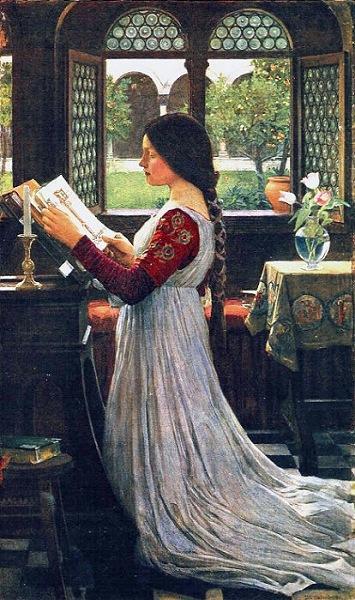
John William Waterhouse’s “The Missal” (1902) presents a moment that feels both private and ceremonial. A young woman stands in profile, absorbed in a large illuminated book, her attention so complete that the rest of the room seems to quiet itself around her. At first glance, the painting reads as a simple scene of devotion, yet Waterhouse builds it with the same narrative sensitivity he brings to his mythic heroines. Instead of drama, he chooses concentration. Instead of spectacle, he gives us ritual, texture, and a carefully framed window onto another world.
The title steers the reading toward religious practice, since a missal is a liturgical book used for prayers and the order of Mass. But Waterhouse does not stage a church interior. He places devotion in a domestic space, where faith, memory, and daily life can overlap. This shift matters. It suggests that sanctity is not confined to public architecture. It can unfold beside a table, a candle, and an open window, with garden light drifting in like a second form of prayer.
The Scene at a Glance
The composition centers on a standing figure reading at a lectern or music stand. To the left, a tall candle rises beside her, its flame small but steadfast. Behind her, a broad window opens to greenery and a courtyard with arches. The interior is dark, built from heavy wood and shadow, yet it is not oppressive. It functions as a shelter, a quiet chamber where the mind can settle. On the right, a table holds a glass vase with pale blossoms, and a patterned cloth hangs over the edge, adding softness and domestic warmth.
Waterhouse balances the scene through a series of rectangles and curves. The window is a bright frame, the tabletop another, the stand another, and the woman’s figure becomes the linking curve that humanizes all that structure. Her pale dress falls in long, gentle folds, pooling behind her like a train. This flowing shape counters the room’s firm geometry, so the painting feels composed rather than rigid.
Composition and the Power of the Profile
Waterhouse chooses the profile view with intention. Profile portraits have a long history of suggesting clarity, character, and classical restraint. Here, the profile also signals inwardness. The woman’s face is not offered as a display for the viewer’s gaze. It is turned toward the book, angled away from us, as if the painting is granting us permission to witness without interrupting.
The profile becomes a hinge between inner and outer worlds. On one side is the book, dense with text and images, a world of prescribed words and structured belief. On the other side is the open window, with trees and architecture, a world of air and growth. The woman stands precisely between them, as if her reading is a bridge that connects interior life to the living landscape.
Waterhouse strengthens this idea by placing the figure almost exactly at the boundary between shadow and light. Her hair and bodice sit nearer the darker interior, while the pale skirt catches more of the ambient brightness. The effect is subtle, but it turns the act of reading into a visual transition, from darkness toward illumination.
Setting and Architecture as Emotional Tone
The room feels like an enclosed alcove or a small pavilion, framed by dark wood and arched forms. The upper window panels contain circular leaded glass patterns, decorative yet orderly, like a repeated prayer. The open shutters create a sense of invitation. The painting does not shut the world out. It lets the outside presence enter, not as distraction, but as atmosphere.
The architecture outside appears calm and stable, with arches that echo the interior’s curved shapes. This repetition creates harmony between the private room and the courtyard beyond. It suggests continuity, as if the woman’s devotion belongs to a larger tradition that extends outside the frame. Yet Waterhouse keeps that exterior quiet and slightly distant. The real drama remains inside, in the focused stillness of the reader.
The Figure and the Language of Dress
Waterhouse is attentive to how clothing communicates. The woman wears a deep red embroidered bodice beneath a pale, flowing dress. Red and white, or red and pale blue gray, can carry religious associations of sacrifice, purity, and contemplation, but Waterhouse does not push the symbolism too loudly. Instead, the colors work emotionally. The red brings warmth and life to the figure’s upper body, near the heart and breath. The pale skirt extends that warmth into a soft, luminous presence, as if her concentration has a visible aura.
The embroidery on the sleeves reads as carefully worked, suggesting patience and craft. That detail aligns with the act of reading a missal, which is itself a kind of disciplined attention. Even if the woman is not shown sewing, her clothing evokes the world of careful making. Waterhouse often treats fabric as a narrative surface, and here the garment’s textures speak of gentleness, tradition, and quiet refinement.
The long fall of the skirt is especially important. It creates a path across the floor, guiding the eye from the book down through the figure and back into the room. It also introduces time into the image. A garment that pools like this implies lingering. The woman is not rushing. She is dwelling, and her posture confirms it.
Gesture, Attention, and the Psychology of Reading
The woman holds the book with a steady, practiced touch, neither tentative nor theatrical. Her hands support the pages as if she knows their weight and meaning. This is not casual browsing. It is attentive reading, possibly recitation. The angle of her head suggests she is following the lines closely, perhaps moving silently through familiar prayers.
Waterhouse gives the viewer a rare subject: concentration itself. Many paintings show action or emotion, but fewer show sustained attention as a meaningful event. Here, the stillness becomes expressive. The woman’s absorption implies sincerity, and sincerity is the quiet engine of the painting. We do not need to see her eyes in detail to understand her state. Her whole body tells the story, upright spine, forward tilt, gentle containment.
This containment creates a respectful distance. The painting does not sensationalize devotion. It simply insists that devotion can be beautiful, not because it is dramatic, but because it is real.
Light, Color, and Controlled Radiance
The lighting in “The Missal” is restrained. Waterhouse avoids harsh contrasts and instead builds a soft gradient from the darker interior to the brighter outdoors. The window supplies cool daylight, while the candle introduces a warmer note that feels intimate rather than dominant. Even if the flame is small, its presence matters. A candle in a quiet room is a symbol of watchfulness and continuity, but it is also simply a practical companion to reading, a small technology of focus.
Color is organized around a calm, balanced palette. Deep browns and near blacks anchor the space. Greens outside offer freshness and relief. The figure provides the main chromatic interest, with the red bodice and pale skirt creating a gentle focal contrast. Waterhouse’s color choices do not shout. They hum. They support the idea that spiritual life is not always ecstatic. Sometimes it is steady.
The glass vase with flowers adds a note of delicacy, introducing transparent highlights that echo the window’s luminous openings. The flowers also add a faint sense of fragrance and season, pulling the outside world into the room in another way, through nature arranged by human hands.
Objects and Their Quiet Symbolism
The objects in the painting are few, but each feels deliberate. The missal itself is large and illustrated, linking faith to artistry. A missal is not only a text. It is a physical vessel of tradition, often ornate because it carries communal meaning. Waterhouse shows it as something worthy of careful handling, a book that commands attention through its beauty as well as its content.
The candle suggests vigilance and reverence. It also creates a vertical counterpoint to the woman’s posture, like a second figure standing beside her. The table and cloth on the right suggest domestic life continuing alongside devotion. The cloth’s patterned border introduces a decorative language that feels adjacent to the manuscript’s illumination, as if ornament is part of the environment’s spirituality.
The flowers, pale and freshly cut, can imply purity, transience, and care. They are not wild blooms left to chance. They are selected, placed, and tended. That act parallels the woman’s reading. Both are forms of attention given to something valued.
Waterhouse and the Pre-Raphaelite Echo
Although Waterhouse is often associated with the later Pre-Raphaelite spirit, “The Missal” shows how he adapts that inheritance into something quieter and more modern in mood. The Pre-Raphaelites prized clarity, symbolism, medieval references, and a devotion to carefully rendered detail. Waterhouse keeps the love of rich surfaces and the fascination with earlier worlds, but he softens the moral intensity into a lyrical interiority.
The medievalizing note is present in the manuscript, the arched architecture, and the sense of ritual. Yet the painting does not feel like costume theater. It feels like a sincere meditation on what it means to be absorbed by sacred words. Waterhouse’s women are often caught at thresholds, between innocence and knowledge, desire and duty, enchantment and consequence. Here, the threshold is between worldly quiet and spiritual focus.
Instead of a mythic trap, the scene offers a gentle refuge. The woman is not endangered. She is anchored.
Narrative Without Drama
Waterhouse often hints at a larger story beyond the frame. In “The Missal,” the narrative is minimal, but it is still present. Who is she? Why is she reading here, at this hour? Is she preparing for a service, remembering someone, seeking comfort, or fulfilling a daily practice? The painting refuses to answer directly, and that refusal is part of its power.
By leaving the story open, Waterhouse lets the viewer bring their own associations to the act of reading sacred text. The scene can evoke childhood memory, private grief, quiet gratitude, or a disciplined routine. The painting becomes a mirror for inner life, not through abstract symbolism, but through a relatable human posture: someone standing still with a book that matters.
The garden view complicates the mood. It reminds us that life continues outside, green and sunlit. The woman chooses the book anyway. That choice gives the painting its emotional center.
Texture, Craft, and the Pleasure of Looking
One of the joys of “The Missal” is how it celebrates materials. The dark wood seems solid and worn, as if polished by years of use. The fabric of the dress carries fine variations in tone, with folds that feel weighted and believable. The glass vase catches light in small, crisp accents. The open shutters, with their patterned panes, add a layer of decorative rhythm.
This attention to texture is not merely technical. It reinforces the painting’s theme. Devotion is shown as embodied practice. It happens in rooms, with objects, with clothing, with the feel of paper and the presence of flame. Waterhouse makes faith tactile. Even the outside world appears through the tangible shape of trees and stone arches. Nothing is vague. Everything is placed.
That sense of placement also creates trust. The viewer feels the painter’s patience, and patience is the spiritual cousin of attention. The act of looking becomes parallel to the act of reading. Both require time, and the painting rewards it.
The Emotional Atmosphere of Stillness
The dominant emotion in “The Missal” is quiet. Not emptiness, but calm fullness. The room is inhabited by intention. Stillness here is not a lack of action. It is the presence of focus. Waterhouse captures a state many people recognize but rarely see honored in art: the moment when the mind narrows to one meaningful thing.
This atmosphere can feel restorative. The painting does not ask the viewer to solve a puzzle or brace for tragedy. It invites a slower pace. In a sense, it models contemplation. You look at someone who is absorbed, and you become absorbed as well, following lines of light, cloth, and wood until your own attention steadies.
That is a remarkable achievement for a figurative painting. It turns composition into experience.
Interpreting the Painting Today
Viewed today, “The Missal” can be read in several ways. As a religious image, it honors private devotion and the beauty of sacred tradition. As a psychological image, it honors concentration and the dignity of inward life. As a cultural image, it reflects a longing for order, ritual, and continuity at the turn of the twentieth century, when modernity was accelerating and older forms of meaning were being reexamined.
It also speaks to the enduring appeal of Waterhouse’s work. He could paint drama, enchantment, and myth, but he could also paint the simple gravity of a person reading. In “The Missal,” he suggests that the sacred may be found not only in miraculous events, but in the steady act of turning toward something enduring.
The painting ultimately offers a gentle paradox. It is quiet, yet it holds attention. It is simple, yet it feels layered. It depicts a private moment, yet it becomes shared through art. That transformation, from solitary devotion to communal viewing, is one of painting’s oldest gifts.