Image source: wikiart.org
First Impressions and the Portrait’s Quiet Challenge
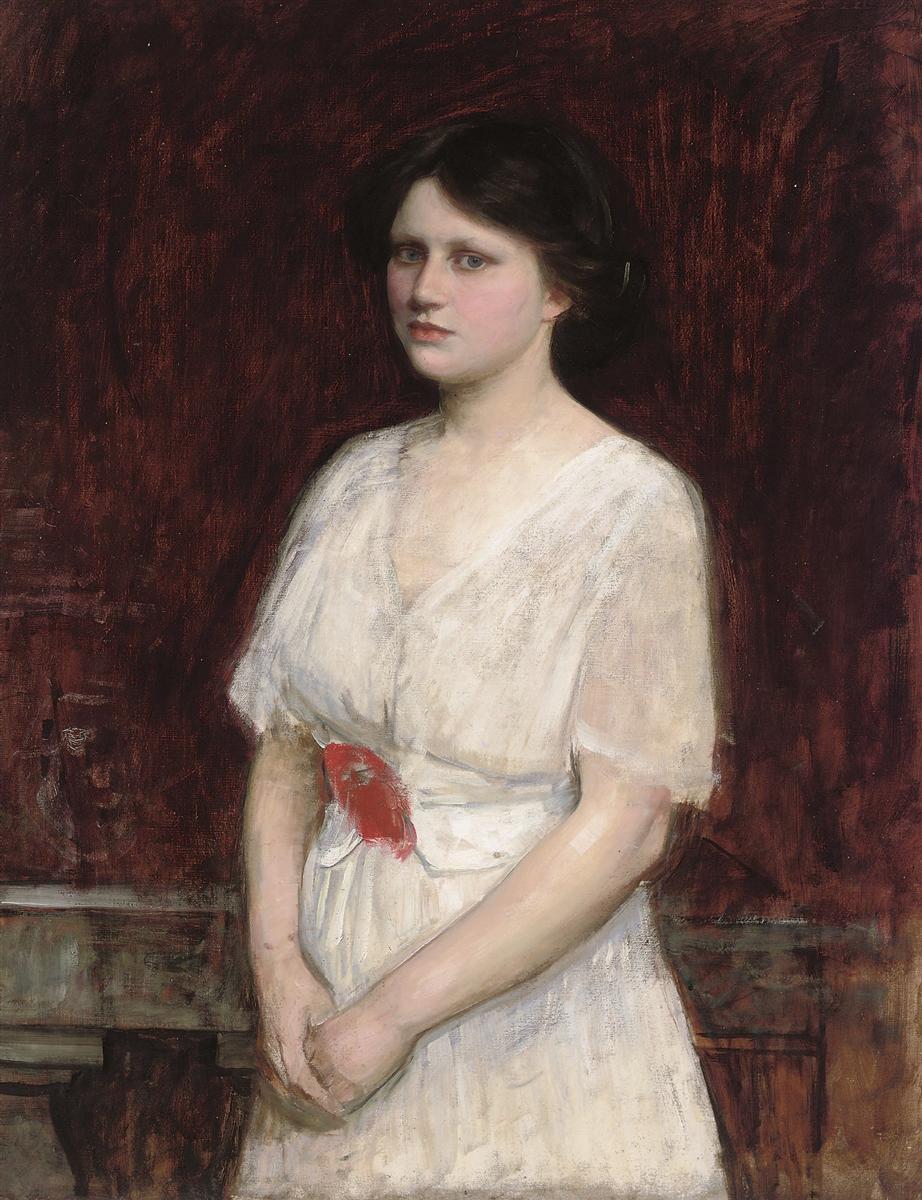
John William Waterhouse’s Portrait of Miss Claire Kenworthy (1900) feels, at first glance, almost disarmingly simple. A young woman stands before a dark, wine-colored interior, dressed in pale fabric that gathers softly around her shoulders and waist. Yet the longer you look, the more the painting reveals itself as a study in controlled tension. Waterhouse is not offering a theatrical story, as he often does in his mythological and literary scenes. Instead, he creates drama through restraint: a limited palette, a still pose, and a gaze that meets the viewer without surrendering much in return.
The sitter’s presence is built from contrasts. Her dress is light, almost luminous, but the background absorbs light rather than reflecting it. Her expression is calm, yet not open. Her hands are clasped, suggesting composure, but the way her fingers fold and rest hints at nervous energy, or at least a self-conscious awareness of being watched. This balance between poise and inwardness becomes the painting’s central theme. The portrait does not ask us to decode a plot. It asks us to interpret a person, and it does so by making us feel how carefully a public image can be constructed.
Waterhouse in 1900 and the Meaning of a Portrait
By 1900, Waterhouse was well established, celebrated for figures drawn from poetry, legend, and classical narrative. A portrait, then, can feel like a pause in his usual repertoire, but it also makes sense as an extension of his lifelong interest: the human figure as a vessel for mood. Even when he paints a recognizable individual rather than a fictional heroine, Waterhouse still thinks like a narrative painter. He builds atmosphere first, and he lets psychological suggestion do the heavy lifting.
In this work, the narrative is quiet and modern. This is not a medieval maiden beside a stream, not a sorceress mid-incantation. Miss Claire Kenworthy stands in a space that reads as contemporary to Waterhouse’s audience, an interior with hints of woodwork and furnishing. The year 1900 places the portrait at a cultural hinge, suspended between late Victorian sensibilities and the new confidence of the early twentieth century. The painting captures that transitional mood. It holds onto romantic softness in the handling of paint, but it also embraces a more direct, pared-down presentation of the sitter. The result feels intimate without being sentimental.
Composition and the Art of Controlled Stillness
The composition is built to keep the viewer close. The figure is placed slightly off-center, with her head and shoulders occupying the upper portion of the canvas while her clasped hands settle into the lower third. This arrangement guides the eye in a slow descent: face, neckline, waist, hands. The pose is not dynamic, but it is not inert either. The slight turn of the shoulders and the subtle angle of the head create a gentle asymmetry that prevents the portrait from becoming stiff.
Waterhouse also uses the background as a compositional counterweight. The deep reddish-brown field behind her acts like a curtain, not literally but emotionally. It frames the sitter, isolates her, and keeps our attention from drifting outward. At the same time, the faint suggestion of an interior ledge or bench introduces a horizontal line that stabilizes the scene. That line anchors the figure in a plausible room, but it stays understated enough that it does not compete with her presence.
The portrait’s stillness, then, is deliberate. Waterhouse composes quiet the way other artists compose action. He makes restraint feel like an event, and he makes the act of standing and looking become the whole subject.
Color, Contrast, and the Emotional Temperature of the Painting
The palette is one of the portrait’s most persuasive strategies. The white dress, painted with soft grays and creamy highlights, becomes a source of light in a space dominated by dark reds, browns, and muted blacks. This contrast is not merely visual. It carries emotional weight. The sitter appears luminous, but not glowing with joy. Instead, she is lit as if by attention itself, as if the portrait is acknowledging the pressure that visibility places upon a person.
The red accent at the waist is crucial. It is the painting’s sharpest note, a concentrated patch of color that draws the eye and subtly changes how we read the figure. Without it, the dress might feel purely ethereal, almost bridal in its pallor. With it, the figure becomes more grounded, more human, and more specific. The red reads as a sash or ornament, but it also reads symbolically as a pulse, a mark of vitality, or even a controlled flare of individuality within an otherwise subdued presentation.
Waterhouse keeps the flesh tones equally restrained. The face carries a delicate pinkness, particularly in the cheeks, but it is not rosy in a cheerful way. It feels like warmth held under control, a blush that suggests interior life without revealing its cause. The overall effect is a carefully moderated emotional temperature: neither cold nor welcoming, neither theatrical nor blank.
Brushwork, Texture, and the Tension Between Finish and Freedom
One of Waterhouse’s strengths is his ability to balance polish with painterly openness, and this portrait thrives on that balance. The face is treated with relative care, its transitions smoothed enough to sustain a believable likeness and a readable expression. The eyes, lips, and the soft modeling of the cheeks are handled with attentive restraint. Yet the painting does not chase photographic exactness. Instead, it uses softness as a form of interpretation.
By contrast, the dress and background show a freer approach. The fabric is suggested through broad, feathery strokes that describe folds without over-defining them. The background is even more expressive, built from layered, scrubbed pigments that create a velvety depth. This looseness gives the painting air and immediacy. It reminds us that we are looking at paint, not a window into a room.
That tension between finish and freedom becomes psychological as well as technical. The more carefully rendered face functions like a public mask, the part of the sitter most demanded by social scrutiny. The looser areas, especially the background’s restless textures, feel like the atmosphere around her, alive with the painter’s gestures and the unspoken complexity that surrounds any attempt at presenting oneself.
The Sitter’s Gaze and the Psychology of Withheld Access
The emotional center of the portrait is the sitter’s gaze. She looks outward, meeting the viewer, but the expression is guarded. It is not hostile. It is simply not yielding. The mouth is set with a softness that stops short of a smile. The eyes are clear yet distant, as if the sitter is present for the sitting but not fully present for us.
This kind of expression is difficult to paint convincingly because it depends on subtle calibration. Too blank, and it becomes lifeless. Too expressive, and it becomes melodramatic. Waterhouse achieves a middle ground that feels psychologically credible. The sitter appears aware of being observed, aware of being represented, and perhaps aware of the social expectations that come with portraiture. The painting invites interpretation but does not reward certainty.
The clasped hands reinforce this reading. Hands often reveal what faces conceal, and here they communicate self-control. They are held together in a manner that suggests composure, but also containment. The pose feels like a chosen posture rather than a relaxed habit, which intensifies the sense that this portrait is about presentation as much as personality.
Clothing, Modernity, and the Performance of Elegance
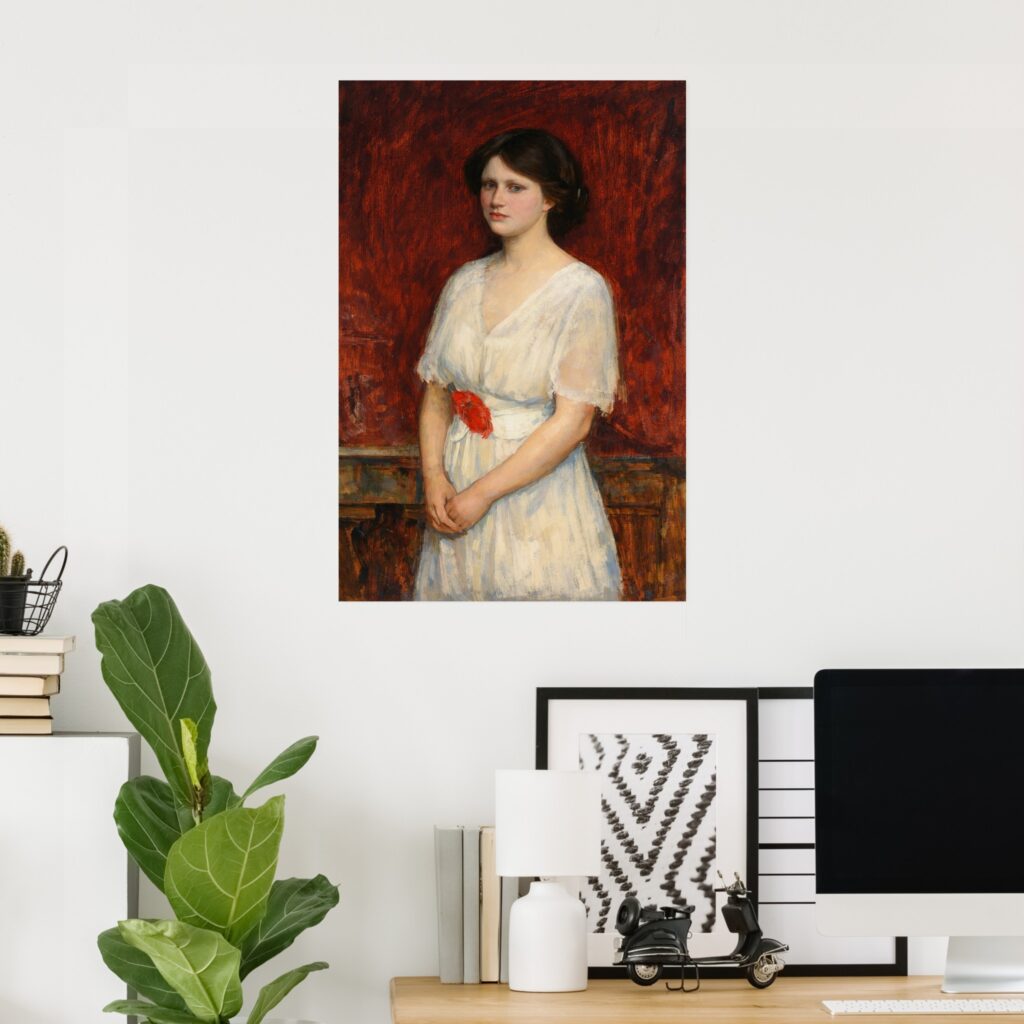
The white dress is central to the portrait’s meaning. It conveys youth, refinement, and a sense of ceremonial simplicity. Its lightness also creates a near-sculptural silhouette against the dark ground, allowing Waterhouse to build the sitter as a clear form rather than dissolving her into decorative surroundings.
The dress is not overloaded with ornament. That simplicity reads as modern for the turn of the century, especially in contrast to more elaborate Victorian fashion imagery. The red accent at the waist becomes the single decisive flourish, suggesting a controlled individuality. It feels like a visual signature, the one place where the sitter’s presentation allows intensity to break through.
Clothing in portraiture always operates on two levels: it is what the sitter wore, and it is what the sitter wished to communicate. Here the communication is subtle but strong. The overall effect is elegance without ostentation, a social identity expressed through restraint. The portrait suggests a person who understands how to be seen, and how to keep something private while being fully on display.
Space, Interior Atmosphere, and the Sense of a Private Room
Although the background is largely abstracted into dark tones, it still reads as an interior. A faint ledge, a suggestion of wood, and the overall enclosed feeling imply a room rather than an outdoor setting. This matters because it shifts the portrait’s emotional resonance. Outdoors, a figure can feel part of a broader world. Indoors, the figure feels enclosed, surrounded by social space, domestic expectation, and intimate scrutiny.
Waterhouse keeps the room indistinct, which prevents it from becoming a distraction and also prevents it from telling us too much about the sitter’s wealth or lifestyle. Instead, the interior becomes a mood. The dark red-brown tones create an atmosphere that feels hushed, like heavy fabric, old wood, and low light. Against that atmosphere, the sitter’s pale figure becomes both the focus and the interruption, as if her presence is what brightens the room.
This approach also heightens the portrait’s intimacy. The setting does not provide narrative clues; it provides emotional pressure. It is a space made for looking, and the sitter’s posture suggests she understands that fully.
Beauty Without Sentimentality
Waterhouse often paints beauty with a lyrical sensibility, but in this portrait he avoids turning beauty into a simple aesthetic offering. The sitter is presented with tenderness, yet the painting does not flatter through exaggeration or romantic haze. Instead, it treats beauty as part of personhood, inseparable from mood, attitude, and self-awareness.
The face is softly modeled, the hair dark and thick, framing the head in a way that amplifies the sitter’s presence. Yet the expression resists sweetness. This refusal of easy sentimentality is part of what makes the portrait feel modern. It does not insist that the sitter be charming for the viewer. It allows her to be serious, contained, and perhaps slightly weary of attention.
That seriousness also deepens the portrait’s emotional reach. The painting becomes less about admiration and more about encounter. We are not simply invited to look; we are made aware that we are looking, and that the sitter is aware too.
Waterhouse’s Portraiture and His Broader Artistic Language
Even without mythological props, Waterhouse’s signature concerns are present. He is still a painter of mood, of quiet emotional drama, and of figures who occupy the border between accessibility and mystery. In many of his narrative works, the female figure is caught at a threshold moment, a pause before action, a gaze that suggests thought rather than declaration. Miss Claire Kenworthy is treated with the same sensibility. She stands in a moment of stillness that feels like a threshold, not in a story, but in the act of self-presentation.
The portrait also reflects Waterhouse’s ability to orchestrate color and tone to produce feeling. The limited palette is not a constraint; it is an instrument. The red-brown background, the pale dress, and the small red accent create a triad that feels inevitable, as if the painting could not exist in any other key.
In this way, the portrait becomes a distilled example of Waterhouse’s craft. It shows how he can create intensity without spectacle. It shows how he can make a single figure carry an entire atmosphere.
Why the Painting Lingers
What lingers after viewing Portrait of Miss Claire Kenworthy is not a story, but a presence. The sitter remains slightly beyond our grasp, and that distance becomes the painting’s power. The portrait captures something deeply recognizable: the experience of being seen and measured, and the decision to reveal only what one chooses.
The painting also lingers because it is built from quiet decisions that accumulate into emotional complexity. The clasped hands, the turned shoulders, the controlled mouth, the pale dress against the dark room, the single red accent, and the textured background all work together to create a portrait that feels both personal and guarded. It is intimate without confession, elegant without theatricality, and psychologically charged without overt drama.
In the end, Waterhouse offers a portrait that functions like a conversation with pauses. We stand before Miss Claire Kenworthy, and she stands before us, and the space between becomes the real subject: a space filled with dignity, restraint, and the unspoken depth of a life that remains her own.