Image source: wikiart.org
Pandora at the Threshold
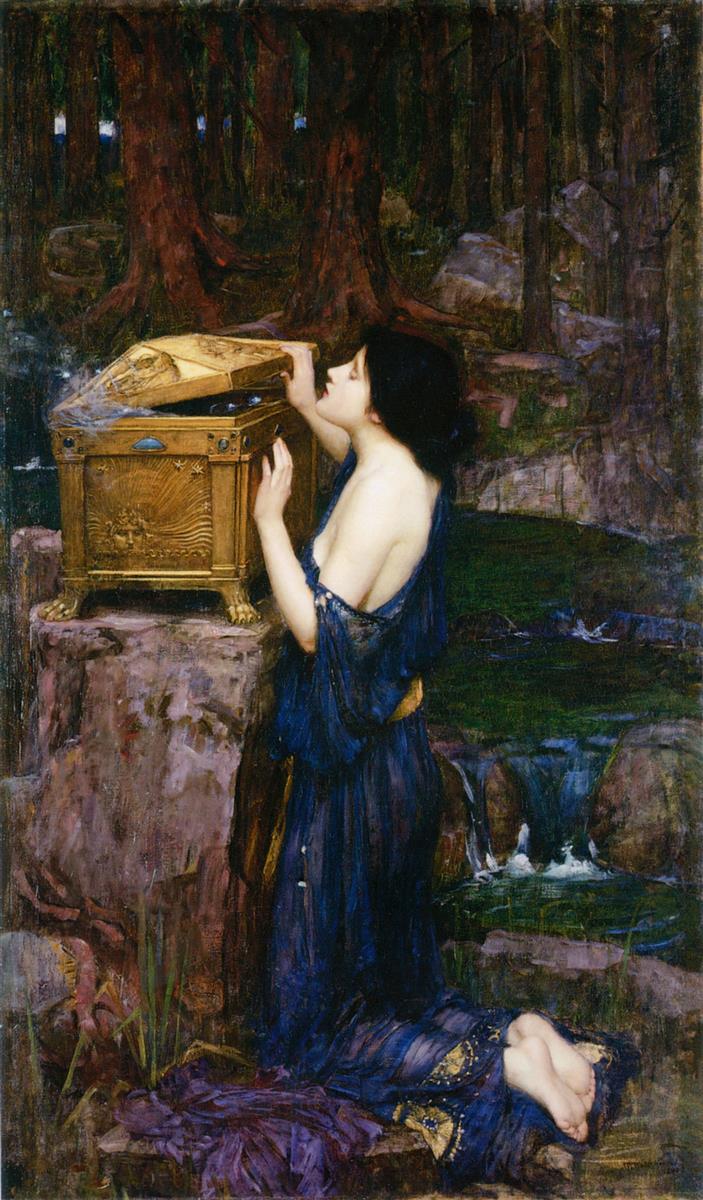
In Pandora (1898), John William Waterhouse stages a moment that feels both intimate and irreversible. The scene is quiet, even hushed, yet everything in the image points to consequence. A young woman kneels beside an ornate chest set on a rock ledge. Her hand lifts the lid with a careful, almost reverent slowness. Wisps of pale vapor curl outward, as if the object is exhaling. Behind her, a dark woodland and a stream form a cool, shadowed enclosure, turning the act of opening into a private ritual performed at the edge of nature.
Waterhouse’s power here comes from restraint. Instead of depicting chaos, monsters, or overt catastrophe, he paints the instant when curiosity becomes action. The painting is less about the explosion of misfortune than about the psychology of “just one look.” That choice makes the myth feel modern and personal: the drama is not thunder from the gods, but the human hand on the hinge, the human face angled toward what should have stayed hidden.
The Myth Behind the Chest
Pandora’s story is most familiar through Hesiod, especially Works and Days, where the first woman is fashioned as part of a divine response to human defiance. In many later retellings, she is given a sealed container, often called “Pandora’s box,” though older versions suggest a jar. When it is opened, troubles spill into the world, leaving only hope behind.
Waterhouse does not need to illustrate every detail of the narrative for the painting to work. He leans on what the myth already provides: a charged object, a prohibition, and a temptation that will not let go. The chest becomes a symbol for knowledge that is both alluring and dangerous, the kind that cannot be unknown once revealed. It also becomes a symbol of inheritance, something handed down with instructions that almost guarantee they will be broken.
What is especially sharp about Waterhouse’s approach is how he places responsibility and sympathy in the same frame. Pandora is not painted as a villain. She appears absorbed, delicate, and uncertain, as if even she understands the weight of the lid. The myth turns, in his hands, into a study of human limits: not simply wrongdoing, but the hunger to understand what has been kept from you.
Composition and the Theatre of Nearness
The composition is built around proximity. Pandora and the chest occupy the foreground so fully that the viewer feels close enough to hear the lid’s faint scrape. Waterhouse positions her body in profile, creating a clean silhouette that emphasizes the line from her face to the opening. That profile has the clarity of a cameo, a classical device that gives her the presence of a figure in relief, a “type” of mythic heroine, while still remaining emotionally specific.
The chest sits like an altar on a stone plinth. Its squared, architectural solidity contrasts with Pandora’s soft curves and the fluid drapery of her garment. This contrast does more than create visual interest. It turns the chest into a fixed moral fact, a boundary object, while Pandora reads as changeable, living, persuadable. The lid forms a diagonal that points inward to the dark interior, while the pale vapor pulls outward and upward, making the opening feel like a mouth or a wound in the world.
Waterhouse also uses the surrounding rocks as compositional brackets. The stone ledge on the left anchors the chest and keeps it stable, while the lower right gives space for Pandora’s kneeling posture and bare feet. The stream behind her acts as a horizontal band that separates foreground action from background forest, like a stage line dividing actor from scenery. Even in nature, the painting feels arranged for a single act.
Color, Light, and the Emotional Temperature
The palette is a careful negotiation between cool and warm. Pandora’s deep blue drapery dominates the figure, pooling around her knees and flowing down toward the lower edge of the canvas. Blue here reads as night, depth, and inwardness. It links Pandora to the stream and the shadowed greens, making her feel as if she belongs to the forest’s quiet. Yet her skin is lit with a soft warmth that sets her apart from the surrounding darkness, giving her a vulnerable presence, almost like a candle flame in a grotto.
The chest is painted in luminous golds and bronzes, and it catches light in a way that suggests both luxury and sacredness. Waterhouse emphasizes carved details and reflective surfaces so that the object appears precious, crafted, and ancient. In color terms, the gold opposes the blue as temptation opposes caution. The eye cannot help moving between the cool garment and the warm metal, between Pandora’s body and the object that draws her.
The vapor is crucial as a color event. Pale, milky, and faintly bluish, it becomes the only element that truly breaks the painting’s dark containment. It is as if the painting has been holding its breath, and the vapor is the first visible sign of release. Importantly, the vapor is not painted as fire or violence. It is beautiful, almost delicate. That beauty is part of the danger. It suggests that harm does not always arrive as ugliness. Sometimes it arrives as a soft, persuasive mist.
Pandora’s Body Language and the Psychology of Curiosity
Pandora’s posture is a portrait of hesitation. One hand lifts the lid, the other steadies the chest, not gripping it aggressively but touching it with careful fingertips. Her head tilts upward and slightly forward, as if she is listening as much as looking. The expression reads as absorbed, intent, and quietly anxious. Waterhouse captures the peculiar mental state of temptation, where the mind narrows to a single action and everything else fades.
Her kneeling position is also psychologically loaded. Kneeling can signal devotion, pleading, or submission. Here it feels like submission to the question itself. Pandora is not dominating the chest, she is attending to it. The viewer may sense that she has already crossed a line, even before anything “happens,” because the act has become ritualized. Curiosity is no longer a passing thought. It has become a ceremony with a beginning and an end.
Even the direction of her gaze matters. She is not looking outward toward us, asking for complicity or approval. She is turned away, enclosed in her own decision. That privacy makes the moment feel inevitable. We are witnesses, not participants, and that helplessness echoes the myth’s logic: once the lid rises, there is no negotiation with what escapes.
The Chest as Object, Relic, and Symbol
Waterhouse lavishes attention on the chest, treating it less like a prop and more like a character. Its decorative panels, corner supports, and heavy lid suggest craftsmanship associated with treasure, temples, or royal storage. The chest’s weight is emphasized by how it sits firmly on the stone and by how Pandora approaches it with measured care. This is not a flimsy container, it is an institution of secrecy.
The box is also a paradox. It is richly ornamented, implying it was meant to be seen, yet it is meant to remain closed. That contradiction mirrors the myth’s moral tension: the thing that must not be opened is also the thing designed to attract attention. Waterhouse heightens this by placing the chest in the light while leaving the forest subdued. The object looks important because the painting makes it important.
Symbolically, the chest can stand for knowledge, desire, and the consequences of transgression. But it can also stand for the way societies package prohibitions. “Do not open” becomes part of the object’s identity. In that sense, the chest is not only Pandora’s test, it is the gods’ instrument. The painting invites the uncomfortable thought that the trap is built into the gift.
Nature as Enclosure and Mirror
The setting is not a neutral backdrop. The forest reads as thick, aged, and watchful, with tall trunks rising into darkness. The stream behind Pandora suggests continuous movement, time flowing forward regardless of individual choices. Small cascades or ripples are visible in the water, adding a gentle sound to the imagined atmosphere. Everything feels cool, damp, and shadowed, like a hidden place where secrets are kept.
Nature also mirrors Pandora’s psychological state. The darkness around her creates the sense of a mind narrowing, a world dimming to the single bright thing in front of her. The rocks, irregular and worn, imply long history, as if this scene is part of a cycle repeated across ages. The forest becomes a kind of moral wilderness: a place where rules are less clear, where ancient forces and human impulses meet without witnesses.
At the same time, the natural setting softens the myth into something elegiac. Rather than a domestic interior or a divine palace, Waterhouse chooses an outdoor, near-sacred grove. That choice makes the event feel timeless and archetypal, not a single historical moment but a recurring human situation: the hidden thing, the forbidden knowledge, the hand that reaches anyway.
Waterhouse’s Mythic Women and Late Victorian Mood
Waterhouse repeatedly returned to myth and legend as vehicles for mood and moral ambiguity. His heroines often exist in moments of heightened inwardness, poised between choice and fate. Pandora belongs to this lineage: she is not painted as a caricature of guilt, but as a figure of tragic agency, someone whose action matters even if the narrative seems designed to corner her.
In the cultural atmosphere of the late nineteenth century, stories like Pandora’s could resonate with anxieties about modernity, knowledge, and the costs of crossing boundaries. Scientific progress, shifting social roles, and changing moral landscapes all made the theme of “opening what should stay closed” feel urgent. Waterhouse translates that urgency into a single, quiet image. Instead of illustrating a sermon, he paints an atmosphere of suspense.
This also helps explain why the painting remains compelling. It does not demand a simplistic judgment. It offers a charged scene and trusts the viewer to feel the contradiction: curiosity is a human virtue, yet it can also be a doorway to harm. Pandora becomes the face of that contradiction, neither purely innocent nor purely culpable, but recognizably human.
The Moment After the Moment
One of the most haunting aspects of Pandora is that it lives in the tense grammar of “almost.” The lid is open, but the world has not visibly changed yet. The vapor escapes, but it has not formed into specific horrors. Hope is not shown, and neither are the evils, only their first breath. This delay is emotionally powerful because it makes us supply what comes next.
The painting therefore becomes a meditation on anticipation and regret. It captures the split second when you realize the action cannot be undone, even if the consequences have not arrived. In that sense, Waterhouse paints the birth of regret rather than its aftermath. The tragedy is not only that suffering enters the world, but that Pandora is aware, at least intuitively, that she is ushering something irreversible into being.
That is why the painting feels so psychologically precise. The most consequential choices often do not feel dramatic while we make them. They feel quiet, private, and strangely beautiful. The world does not shatter instantly, it exhales. Waterhouse makes that exhale visible.
Why Pandora Still Speaks to Modern Viewers
Today, “Pandora’s box” is a phrase used for consequences that spiral beyond control, especially when knowledge, technology, or secrets are involved. Waterhouse’s image offers a deeper reading than the cliché. It reminds us that the box is not only about what escapes, but about the human impulse that opens it. Curiosity, longing, pride, boredom, the need to know, all can be present at once.
The painting also speaks because it treats myth as a mirror, not a museum piece. Pandora is not distant. She is close, believable, and emotionally legible. The forest could be any place of solitude, the chest could be any sealed promise, the vapor could be any chain reaction beginning softly. Waterhouse turns a familiar story into a visual meditation on thresholds: the line between restraint and action, between ignorance and knowledge, between safety and risk.
Ultimately, Pandora endures because it captures the strange beauty of the forbidden. The chest gleams. The vapor curls like silk. The moment looks almost tender. And that is exactly the point: the most dangerous doors are often the ones that seem, at first glance, the most inviting.