Image source: wikiart.org
The Painting and Its Mythic Moment
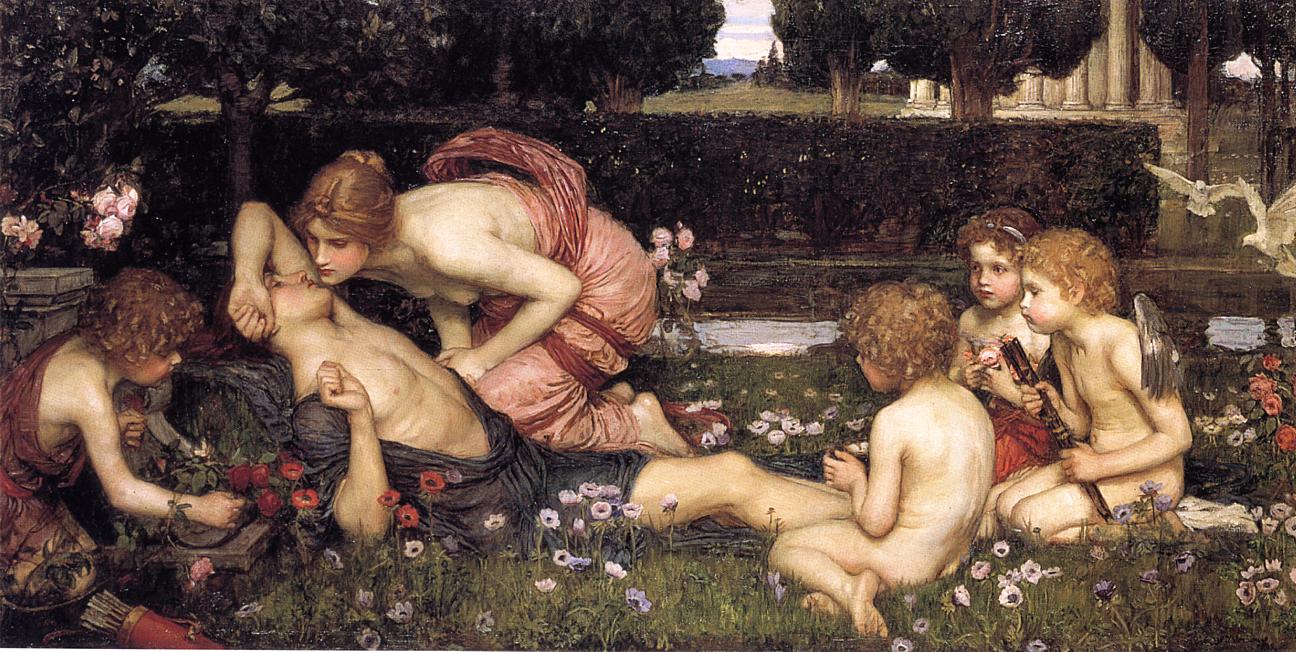
In “The Awakening of Adonis” (1899), John William Waterhouse stages a quiet miracle in a garden that feels both earthly and enchanted. The scene is intimate and still, yet charged with a sense of change about to happen. A pale young man reclines on the grass, his body stretched across the foreground like a fallen statue brought to life. Leaning over him is a woman in rose colored drapery, poised in a gesture that reads as both tenderness and command. Around them, winged children gather with the solemn focus of attendants at a rite. Everything in the painting suggests a threshold moment, the breath before waking, the pause between harm and healing, the instant when myth turns.
The Adonis story is built from contrasts. Adonis is beauty that does not last, desire shadowed by loss, springtime haunted by winter. In many tellings, Adonis is mortally wounded while hunting, and his death becomes a seasonal symbol as well as a romantic tragedy. Waterhouse does not depict the boar, the hunt, or the violence. Instead, he chooses the softer drama of return. The title directs us toward revival, not catastrophe. The garden becomes a stage for restoration, and the act of awakening becomes the emotional climax. By focusing on recovery rather than injury, Waterhouse transforms the myth into an image of love as a sustaining force, one that can hold the fragile human body in defiance of time.
Composition and the Power of the Reclining Figure
The composition is anchored by Adonis’ extended body, which runs diagonally across the lower half of the painting. This diagonal does more than organize space. It sets up a visual tension between horizontal stillness and the vertical, leaning motion of the woman above him. Adonis lies low, close to the earth and the flowers, as if he belongs to the ground that receives him. The woman, by contrast, gathers energy as she bends forward, her torso and arms forming a concentrated arc. The viewer’s eye travels from her head down to his face, then along his body toward the cluster of cupids on the right. That movement feels like a narrative path: touch, breath, circulation, return.
Waterhouse arranges the figures so that the scene reads as a closed circle of attention. Everyone’s gaze and posture is directed toward Adonis. Even when faces are turned slightly away, their bodies remain oriented inward. This creates a sense of ritual focus, as if awakening is not a casual event but a sacred action requiring witnesses. The garden hedge behind them acts like a dark backdrop in a theater, separating the intimate foreground from the distant architecture and water beyond. It compresses the space and makes the group feel secluded, protected, and intensely present.
The scale of the figures also matters. Adonis is large and prominent, his body occupying substantial visual territory, yet he is passive. The winged children are smaller but active, leaning, kneeling, holding objects, watching closely. The woman in rose drapery dominates through movement rather than size. This balance gives the scene a paradoxical authority: the one who appears strongest is the one who lies unconscious, while power belongs to the one who leans in and initiates change.
Aphrodite’s Gesture: Tenderness as Agency
The central action is the woman’s lean toward Adonis’ face, her lips close to his, her hand gently supporting or turning his head. The gesture can be read as a kiss, a breath, or a command to return to life. Waterhouse keeps it ambiguous enough to feel mythic rather than literal. What matters is the combination of closeness and intent. She is not simply mourning. She is acting.
Her rose colored garment is crucial to that impression. It wraps around her body in folds that feel heavy and sculptural, and the warm hue stands out against the dark greens and browns of the garden. The color carries associations of flesh, dawn, and flowering, all fitting for a figure linked to love and vitality. At the same time, the drapery is not flamboyant. It gathers like a concentrated flame, suggesting controlled intensity rather than spectacle.
Her posture is also telling. She kneels, which implies humility, yet her forward lean is decisive. The angle of her shoulders and the line of her arm create a sense of protective enclosure over Adonis. She becomes a shelter and a catalyst at once. In many classical myths, women are framed as spectators of male fate. Here, Waterhouse gives her agency by making her the source of transformation. The awakening is not merely something that happens. It is something she brings about.
The Cupids as Witnesses and Instruments of Love
To the right, three winged children gather in a tight group, while another sits nearer to Adonis’ legs with his back turned to us. Their presence gives the painting a ceremonial quality. They are not playful putti tossed into a decorative corner. They behave like attendants in a serious drama, watching, holding, and waiting.
One cupid holds a set of pipes, a detail that introduces sound into a silent image. Music is often associated with enchantment, persuasion, and the soft force that moves the soul. Even if the pipes are not being played, they suggest that awakening could be coaxed, not forced. Another cupid appears to cradle flowers, linking love to the garden’s blooming life. Their wings, pale against the darker background, read like small flashes of light, reinforcing the theme of revival.
On the left, a cupid bends close to the flowers with careful attention. Near him are signs of love’s equipment: a quiver and what appears to be a bow or related gear. These are not merely props. They remind the viewer that love in myth is both sweet and wounding, capable of piercing as well as healing. In the context of Adonis, that double nature feels essential. The story is about desire’s intensity and the vulnerability it creates. Waterhouse suggests that the forces that cause pain and the forces that restore life are intertwined, part of the same mythic system.
Garden Setting: A Place Where Time Slows
The garden is more than a background. It is a symbolic environment designed to make awakening feel plausible. Waterhouse places the figures in a space enclosed by hedges, bordered by water, and punctuated by distant classical forms. This kind of setting carries the aura of an ancient sanctuary. It is not wild nature. It is nature arranged, tended, cultivated, made into a site for reflection and ritual.
The hedge forms a dark horizontal band behind the figures, creating a strong contrast with the pale bodies and bright blossoms. It also functions like a visual pause. Beyond it, the scene opens to a reflective surface of water and hints of architecture. That layered depth creates a feeling of worlds within worlds: the immediate foreground of touch and breath, the midground of containment, and the background of distance where time resumes its ordinary pace.
Water, in particular, supports the painting’s theme. A pond or canal suggests reflection, transition, and renewal. It is a surface that holds images, much like memory holds the past, and it is also a source of life in a garden. In the Adonis myth, where cycles of death and return are central, water becomes an implied partner to the act of awakening. It is as if the environment itself participates, offering coolness, continuity, and the promise that life can begin again.

Flowers and Color: The Language of Revival
The ground is scattered with blossoms in reds, pinks, and soft purples. These flowers are not incidental decoration. They create a field of life around Adonis’ body, turning the grass into a bed of renewal. Red flowers near his torso add a pulse of color at the heart of the composition, visually echoing the idea of blood transformed into bloom, a motif often associated with the Adonis story. Waterhouse does not show gore or injury, but he allows color to carry the myth’s emotional memory. The reds suggest what has been survived. The pinks and purples suggest what returns after crisis.
The palette is carefully balanced between darkness and warmth. The background is dominated by deep greens, browns, and shadowed foliage. Against this, skin tones and rose drapery glow. This contrast amplifies the feeling of emergence, as if figures are being lifted out of dusk into a softer light. The woman’s garment acts like a sunrise note within the garden’s twilight hues, reinforcing the title’s promise of awakening.
Waterhouse’s handling of paint also contributes to the theme. The foliage and hedge are worked with dense, textured marks that feel thick and weighty. The figures, by contrast, are smoother and more luminous. That difference makes the bodies seem almost unreal, like apparitions or ideals, while the garden feels tangible and enduring. In mythic terms, it suggests that human beauty is fleeting, while nature persists, but also that nature can cradle and restore the fleeting.
Light, Texture, and the Atmosphere of a Late Pre-Raphaelite Dream
Although Waterhouse is often grouped with the Pre-Raphaelite tradition, his late work has its own atmosphere, softer and more psychologically charged than strict botanical realism. In this painting, detail is present but not clinical. The flowers are recognizable as flowers, not scientific specimens. The hedge is richly dark, but it does not demand that we count leaves. The overall effect is dreamlike, as though the scene is remembered rather than witnessed.
Light appears gentle and indirect. There is no harsh spotlight. Instead, illumination seems to seep across surfaces, catching on shoulders, cheeks, wings, and folds of cloth. This type of light is ideal for a subject about returning consciousness. It resembles the experience of waking, when perception arrives gradually and the world gathers definition over time.
Texture guides emotion. The grass and blossoms form a soft cushion, the drapery folds carry weight and warmth, and the wings provide a feathery counterpoint that hints at the supernatural. The painting invites the viewer to feel the scene as much as to read it. That sensuality remains within the realm of classical art, focused on atmosphere and symbolism rather than explicitness. The bodies are idealized, and the mood is reverent, not provocative.
Themes of Love, Mortality, and Seasonal Cycles
At its core, “The Awakening of Adonis” is about love confronting mortality. The reclining body represents vulnerability, the truth that beauty can be struck down. The leaning woman represents love as an active force, not merely a feeling but a will. The cupids represent love’s mechanisms, its tools, its rituals, and its consequences. The garden represents the seasonal world that repeats, renews, and absorbs human stories into larger cycles.
Awakening here is not only literal. It can also be read as emotional or spiritual return. Adonis’ closed eyes and relaxed posture evoke sleep, but also a passage through danger or absence. The woman’s closeness suggests devotion that refuses to accept the ending. In myth, the Adonis story does not resolve into permanent victory. Death remains part of the cycle. Yet Waterhouse chooses the moment that affirms connection, implying that even if loss is inevitable, love creates meaning in the interval.
The painting also explores the boundary between human and divine. The woman’s calm intensity and the presence of winged children place the scene beyond ordinary life, yet the emotions are familiar. That combination is one reason classical myth remains compelling. It gives human experience a grand frame without stripping it of intimacy. Waterhouse excels at this balance. He lets myth speak in quiet gestures rather than heroic spectacle.
Waterhouse in 1899: Myth as Modern Emotion
By 1899, Waterhouse was working in a cultural moment fascinated by the past but also preoccupied with psychology, desire, and the fragility of experience. Mythological subjects offered him a way to explore contemporary feeling through timeless narratives. “The Awakening of Adonis” fits alongside his many depictions of women and mythic encounters, where the central drama often lies in a single charged instant. The emphasis is rarely on action in the external world. It is on the inner pivot, the moment when fate turns through touch, gaze, or choice.
This painting also shows Waterhouse’s preference for staging myth in lush settings that feel like theaters of emotion. The figures are arranged like actors in a carefully composed tableau. The garden functions as both a real place and a mental space, a landscape of desire and memory. The result is a work that can be approached as narrative, symbol, and mood all at once.
The choice to depict awakening rather than death is especially significant. It suggests a desire, at the end of the nineteenth century, to find images of restoration amid anxieties about change and decline. Without becoming sentimental, Waterhouse offers a visual argument that tenderness can be powerful. The myth is not denied, but it is momentarily suspended, held in a garden where love bends close enough to call the beloved back.