Image source: wikiart.org
Opening the Scene: A Myth Held in a Single Breath
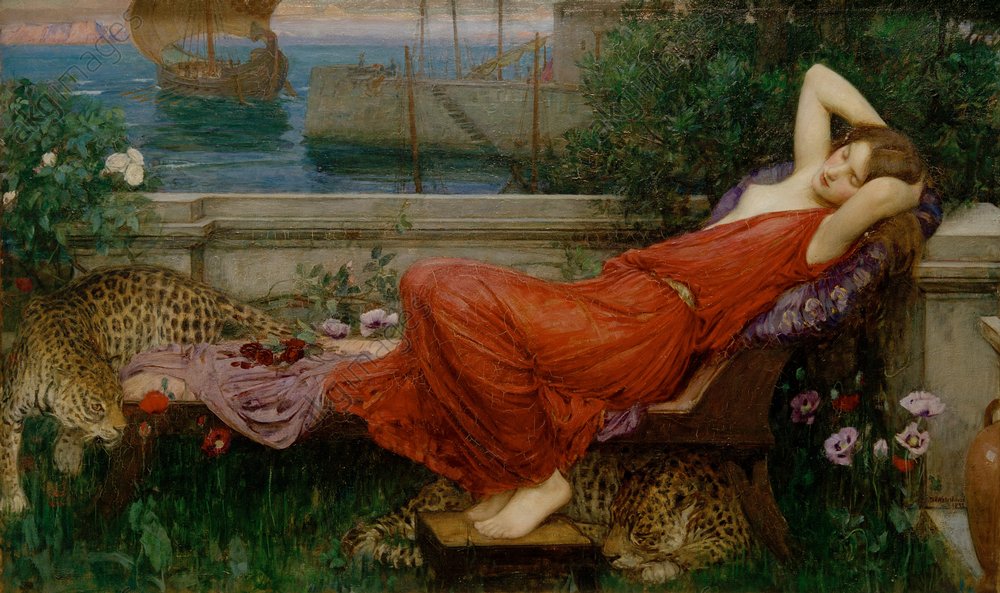
Waterhouse’s Ariadne (1898) gives you a moment that feels suspended between comfort and shock, like waking up and not yet remembering what changed. The setting looks luxurious and calm: a marble balustrade, a soft patch of grass studded with flowers, and the sea stretching out behind it. Yet the calm is sharply challenged by one small detail in the distance: a ship edging away across the water. That retreating sail quietly rewrites everything you thought you were seeing.
Ariadne reclines on a low bench or couch, her body angled diagonally so that she seems to drift across the picture plane. Her arms are lifted and folded behind her head in a pose associated with rest, ease, even sensual languor. But Waterhouse makes that familiar pose feel newly vulnerable, because her eyes are closed and her head tips gently to one side, suggesting sleep or exhaustion rather than control. In myth, Ariadne’s story turns on abandonment, and the painting compresses that turning point into a visual contradiction: she appears safe, yet the world behind her is already leaving.
The Mythic Backstory: Abandonment and the Edge of Fate
Ariadne is most commonly linked to the tale of Theseus and the labyrinth. She aids him, helps him survive, and then is left behind, most famously on Naxos. Waterhouse does not depict the labyrinth, the thread, or the heroic climax. Instead, he chooses the aftermath, the emotional residue after action, when the “story” has moved on for everyone except the person who paid the deepest cost.
What makes the painting compelling is that it refuses to lock you into a single emotional temperature. If you know the myth, the departing ship hits like a betrayal. If you do not, it still reads as loss, because the ship is placed so that it feels connected to Ariadne’s stillness, as though her closed eyes are the reason she cannot stop what is happening. Waterhouse’s gift here is narrative economy: one distant vessel becomes an entire moral judgment.
Composition and Viewpoint: A Stage Built for Stillness
The composition is structured like a theatre set. The foreground is intimate and tactile: grass blades, blossoms, animal fur, rumpled cloth. The middle ground is architectural: the stone rail and terrace elements provide firm horizontals that steady the scene. The background opens into sea and sky, a cooler, more fluid space where the ship slips away.
This layered construction does two things at once. It creates depth and it creates emotional pacing. Your eye begins with Ariadne’s bright red drapery, travels along her reclining form, and then is pulled outward to the sea, where the story’s betrayal is taking place at a remove. That distance matters. The ship is not close enough for confrontation. It cannot be chased. It is already part of the past, even while Ariadne remains present.
Waterhouse also places Ariadne to the right, leaving the left side as a corridor for narrative information. The left is where the ship appears, where the water opens, where one of the great cats lowers its head toward the ground. The right is where the body rests, cushioned by deep foliage and a violet textile. The painting is balanced, but not symmetrically. It is balanced the way real life can be balanced: one side heavy with the body’s immediacy, the other heavy with what you cannot change.
Ariadne’s Pose: Sensuality Without Triumph
Ariadne’s posture could easily become a cheap symbol of availability in less careful hands, but Waterhouse treats it with restraint. Her raised arms create a frame around her head, drawing attention to her face and hair, yet her expression reads as unguarded rather than performative. The closed eyes are crucial. They suggest that whatever sensuality exists here is not staged for the viewer inside the painting. It belongs to her private state, which makes it feel more human and more exposed.
Her red garment drapes in long, heavy folds, gathering in creases that echo the curve of her body. The fabric is not crisp like ceremonial clothing. It is softened, lived in, pulled and pressed by gravity. This tactile realism shifts the meaning of the myth away from distant legend and toward bodily experience: fatigue, warmth, the weight of cloth on skin, the way sleep can leave you defenseless.
Waterhouse also keeps Ariadne’s figure idealized without making it cold. Her skin is luminous but not porcelain. Her hair is abundant but not overly decorative. The result is a heroine who feels touchable and real, which is precisely why the abandonment implied by the ship feels so sharp.
Color and Light: Red as Presence, Blue as Departure
The painting’s color drama is built on a tension between warm and cool. Ariadne’s dress dominates as a saturated red, a color of blood, passion, and vital presence. It anchors her to the here and now. Against it, the sea and distant sky sit in cooler blues and blue greens. Those cool tones describe a world that is moving on, indifferent, expansive, and slippery.
Waterhouse intensifies the emotional split by using the stone terrace as a neutral buffer. The marble and pale masonry are neither warm nor cool in an emphatic way. They behave like fate itself, impassive and hard, separating Ariadne from the sea while still allowing the sea to be visible. The light is gentle, not blazing, as though it is early or late in the day, a time when forms soften and everything feels slightly provisional. That softness supports the theme: abandonment is not shown as a dramatic rupture, but as something that can happen quietly while you sleep.
The violet cushion behind Ariadne adds another layer. Purple has long carried associations of luxury and devotion, but here it also acts as a duskier counterpoint to the red, deepening the mood and suggesting the emotional bruise beneath the surface calm.
The Leopards: Power, Protection, and a Second Story
One of the most striking elements is the presence of two large spotted cats, visually consistent with leopards or panthers. One rests beneath the bench, its body a living shadow under Ariadne’s feet. The other is to the left, head lowered toward the ground near the scattered objects. These animals immediately complicate the narrative, because they do not belong to Theseus. They point instead toward Dionysus, who is often associated with panthers and with the rescue and marriage of Ariadne after her abandonment.
Waterhouse uses the cats like foreshadowing made flesh. They are physically present, not distant like the ship, and they occupy the same tactile world as Ariadne’s body and the flowers. That closeness makes them feel like an approaching future, even if the god himself is not shown. The animal under the bench reads as protection, a guardian shape that turns the space beneath her into a den. The animal to the left reads as appetite and instinct, a reminder that life continues, that desire is not extinguished by betrayal.
There is also a quieter psychological reading available. The cats can be seen as externalizations of Ariadne’s situation: power present but unclaimed, danger close but not attacking, a life force beside her that she does not yet recognize. Waterhouse leaves room for both the mythic and the emotional interpretation, letting symbolism operate without locking the painting into a single “answer.”
Still Life Details: Grapes, Cloth, Flowers, and the Language of Touch
Near the left side, you see a small cluster of objects that behave like a miniature still life: draped fabric, what appears to be grapes or fruit, and scattered blossoms. These are not random decorations. Grapes and wine themes naturally echo Dionysus, reinforcing the idea that a second narrative is already arriving even as the first one retreats on the sea.
The draped purple cloth near the left, separate from the violet cushion behind Ariadne, also matters. It looks rumpled, left behind, as if it has been handled recently. That sense of recent use intensifies the feeling that we have entered the scene after an unseen event. The painting becomes a room after someone has left, where objects retain the memory of touch.
The flowers, especially the soft purples and pinks blooming in the grass, add tenderness that almost feels cruel. Flowers are often symbols of beauty and ephemerality, but here they also become witnesses. They insist on the continuation of natural cycles in the face of human betrayal. The world remains lovely even when someone’s life is being fractured, and Waterhouse leans into that uncomfortable truth.
Water and Distance: The Sea as Emotional Space
The sea in the background is not merely a setting. It is the painting’s emotional engine. Water creates distance, and distance creates irreversibility. The ship is not leaving along a road where it could be followed. It is gliding over a surface that erases tracks. That sense of vanishing, of a clean getaway, amplifies the moral sting of abandonment.
At the same time, water is also associated with transformation, passage, and the threshold between states. Ariadne is on a border: between sleep and waking, between being chosen and being discarded, between one mythic destiny and another. The sea becomes the visual equivalent of that liminal condition. It holds the ship that represents what has been lost, but it also opens outward, implying that her story is not finished.
Waterhouse’s handling of the distant boats and rigging is delicate enough that they feel real, but not so sharp that they become the painting’s main spectacle. This is important. The betrayal is present, but it is not sensationalized. The true drama is internal, carried by stillness rather than action.
Waterhouse and the Late Victorian Imagination
By 1898, Waterhouse was working within a cultural climate fascinated by classical subjects, poetic melancholy, and psychologically charged femininity. While the Pre-Raphaelite Brotherhood began decades earlier, its influence persisted in the love of luminous detail, literary themes, and the idea that a painting could be both beautiful and narratively suggestive.
In Ariadne, Waterhouse merges that heritage with a more modern sensitivity to mood. The painting does not feel like a historical reconstruction. It feels like a dream of antiquity shaped by Victorian taste: marble terraces that resemble a cultivated garden, a heroine styled with romantic richness, and a narrative moment chosen for its emotional resonance rather than its heroic triumph.
This is also part of why the painting remains popular. It offers myth without homework. You can sense the story even if you cannot name it, because the visual cues are so readable: the sleeping figure, the departing ship, the watchful animals, the fruit and flowers, the terrace like a sheltered world that cannot fully protect her.
Meaning and Mood: Betrayal Framed by the Promise of Renewal
The most powerful achievement of Waterhouse’s Ariadne is that it holds two emotional truths at once. The ship makes the abandonment undeniable. Yet the leopards and grapes propose that something else is arriving, something wilder, more devoted, and more dangerous. Ariadne is not merely a victim in this telling. She is a threshold figure, poised at the moment when one life collapses and another becomes possible.
That doubleness is expressed in every major contrast the painting offers: warmth against coolness, softness against stone, intimacy against distance, sleep against departure, human vulnerability against animal power. Even Ariadne’s red dress participates in the theme. Red can be the color of passion and celebration, but it can also be the color of exposure, as if her presence is too vivid for the indifferent world behind her.
In the end, Waterhouse persuades you that the myth is not just an old story about gods and heroes. It is a story about the terrifying gap between what you believe you are to someone and what they decide to do when you are not looking. And it is also, quietly, a story about survival, about the possibility that the next chapter may not look like justice, but might still look like life.