Image source: wikiart.org
Introduction
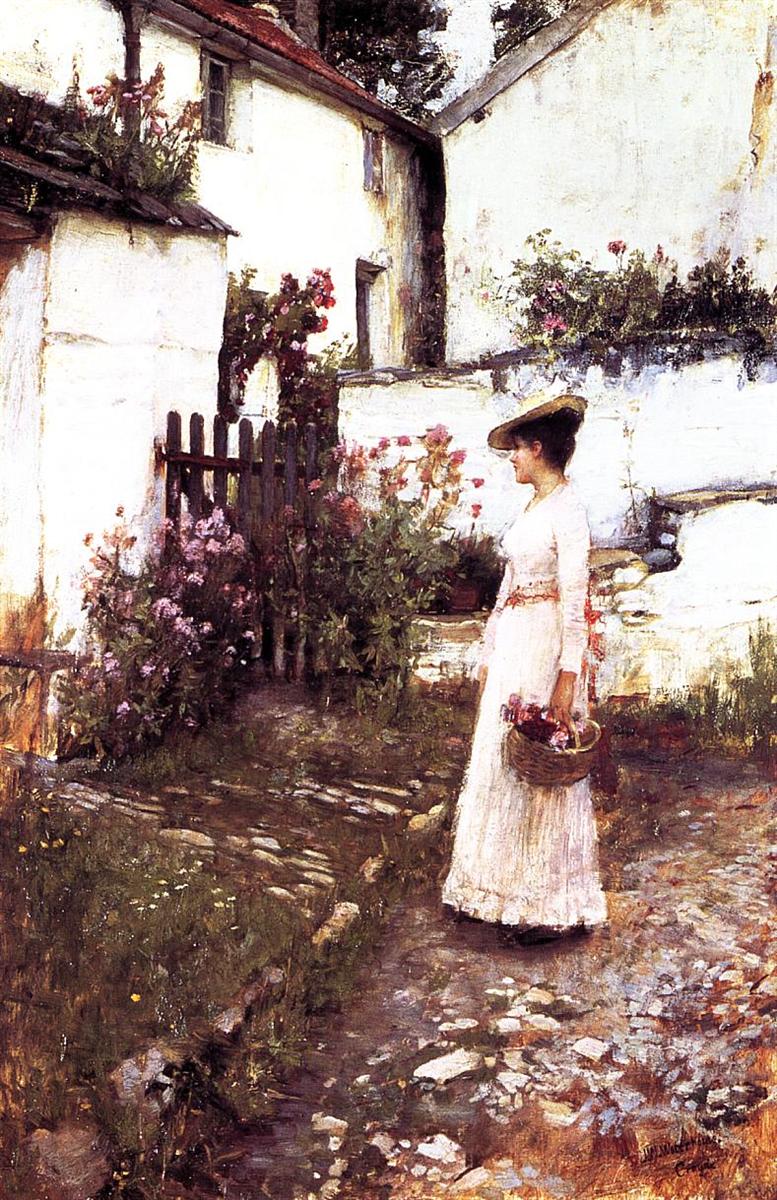
In Gathering Summer Flowers in a Devonshire Garden (1893), John William Waterhouse turns away from spectacle and mythic drama to find intensity in the everyday. A single figure, a modest garden path, whitewashed walls, and a hush of summer light become enough to carry the painting’s emotional weight. What makes the work linger is not a plot twist, but the sensation of being paused in time, as if the air has stopped moving for one attentive breath. Waterhouse stages the scene so simply that it feels accidental, yet everything has been quietly arranged to guide the eye and to shape a mood of calm, reflection, and gentle enclosure.
This is a painting about looking and about the small rituals that structure a season. The woman stands with a basket in hand, the evidence of her work gathered but not emphasized. Instead, Waterhouse centers the act of noticing: noticing flowers, the texture of a path, the turn of sunlight along a wall, the soft boundary between cultivated nature and domestic shelter. The picture invites you to slow down, to let your attention travel across surfaces, and to feel how a garden can become both a physical place and a kind of inner room.
The first impression and the painting’s quiet drama
At first glance, the composition reads like a memory. The palette is warm and pale, dominated by whites, creams, and sunlit stone, with deep accents of garden greens and scattered blooms. The scene appears unforced, but it is carefully balanced between openness and confinement. The tall walls and buildings protect the garden from the wider world, while the path leads forward and downward, suggesting movement, time passing, and the continuation of daily life beyond the frame.
The “drama” here is deliberately softened. There is no overt gesture, no theatrical expression, no stormy sky. Instead, the drama lives in subtle contrasts: bright wall against dark foliage, smooth plaster against rough cobbles, still posture against the suggestion that she has been walking and will walk again. The figure is both present and self contained, set apart from us by the angle of her body and the gentle privacy of the courtyard.
Composition and the path as a visual guide
Waterhouse builds the painting around a strong, practical structure: the garden path. It is more than a piece of scenery. The path is the painting’s main visual current, carrying the viewer from the lower foreground up toward the figure and then into the clustered flowers and the gate. Its irregular stones catch highlights and shadows like small flashes of time, each one a tiny note in a larger rhythm.
The figure is placed slightly to the right, not centered, which gives the environment room to speak. The left side is dense with plant life and the vertical punctuation of a dark gate or fence. The right side opens into the pale wall and a sense of space, but that space is not expansive. It is an interior outdoors, bounded and sheltered. The architecture forms a calm geometry of angles and planes that frame the organic shapes of stems and blossoms. This interplay between straight lines and living growth becomes one of the painting’s key pleasures.
Light and atmosphere in a Devonshire summer
The light in this scene is not harsh midday glare, but a softened brightness, as if filtered by thin cloud or reflected off pale walls. Waterhouse uses that light to unify the setting. The white surfaces are not flat; they are stained with warmth, age, and subtle shifts in tone. You can sense the thickness of plaster, the way it absorbs sunlight and releases it gently, making the whole courtyard feel luminous.
The atmosphere is also created through restraint. There is no attempt to render every leaf with crisp botanical precision. Instead, Waterhouse suggests textures and forms through broken, lively brushwork, letting the eye assemble the garden from flickers of paint. That choice makes the air feel present. The garden becomes a place you can almost smell, with the sweetness of flowers and the damp mineral scent of stone after morning shade.
Color relationships and the language of white
White is the painting’s dominant note, but Waterhouse treats white as a living color rather than an absence. The walls are layered with creams, pale greys, hints of ochre, and cool touches that imply shadow. The woman’s dress echoes those whites, tying her to the architecture, as if she belongs to the house and the garden equally.
Against this quiet field, the flowers become concentrated points of color. Pinks, reds, and purples rise out of the greenery with a kind of restrained celebration. The plants are not arranged like a bouquet for display. They feel like they are growing where they want, pressing toward light, leaning into the courtyard’s edges. Because the overall palette is controlled, every small bloom feels meaningful. Color becomes a measure of season and vitality, a way of letting summer announce itself without shouting.
The figure as presence rather than portrait
The woman is not presented as a formal portrait subject. Her face is turned in profile, offering a glimpse rather than a full confrontation. This partial view keeps the focus on her action and her state of mind. She stands as a presence, a person absorbed in a task, not performing for the viewer. That choice creates intimacy without intrusion. We feel close enough to share the space, but we are not invited to interrupt.
Her posture is relaxed, with a stillness that suggests she has paused to consider what to pick next, or perhaps to admire what she has already gathered. The basket at her side is modest, practical, and real. It anchors her in the physical world of work and touch, even as the painting’s mood tends toward reverie. Waterhouse often explored women as figures of interior life, and here that interiority is expressed through quiet attention rather than dramatic narrative.
Clothing, texture, and the sense of season
The dress is long, pale, and light, suited to warm weather. Waterhouse uses fabric to convey weight and movement subtly. The hem meets the uneven stones, and the folds catch small shadows that help model her form without turning her into a sculptural monument. The hat, broad and soft, adds a dark accent that balances the darker tones of the gate and foliage. It also signals practicality, protection from sun, a real accessory for a summer garden.
Texture matters throughout the painting. The cobbles are rough and varied, the walls are weathered, the plants are thick and alive. By setting smooth fabric against rugged ground and abundant growth, Waterhouse makes the figure feel vulnerable in a gentle way, not endangered, but human, temporary, and tender within a larger cycle of seasons.
The garden as sanctuary and threshold
The enclosed garden reads as a sanctuary, but it also functions as a threshold. The gate suggests an opening to elsewhere, to lanes and fields beyond the courtyard. The architecture shelters the scene, but it does not imprison it. There is a sense that the outside world exists just beyond the fence, yet the painting chooses to remain inside this calm perimeter.
That tension between inside and outside gives the scene psychological depth. A garden is cultivated nature, shaped by human hands, but still subject to time, weather, and growth. The woman’s act of gathering flowers becomes an act of participating in that balance. She takes from the garden, but gently, selectively, and with care. The painting implies a respectful relationship between person and place, one built on attention and routine.
Brushwork and the meeting of realism and softness
Waterhouse’s handling here feels intentionally flexible. Some areas, like the path and the edges of buildings, carry clearer structure, while the foliage and blossoms dissolve into energetic touches. This creates a hierarchy of focus that feels like human vision. We notice the figure, the path, the bright wall. The garden becomes a surrounding impression, rich but not itemized.
This approach also creates a sensation of time. The brushwork suggests that the scene is fleeting, that light is shifting, that the moment could change if a breeze moved the flowers or if the woman took another step. The painting holds that fleeting quality still, which is one of its quiet achievements. It captures not a single frozen instant, but the feeling of a short pause within an ongoing summer day.
Mood, symbolism, and the poetry of ordinary acts
Gathering flowers is an action loaded with cultural associations: beauty, transience, memory, and the desire to hold onto a season. Waterhouse does not force symbolism, but he allows it to hover naturally. Flowers bloom, are picked, fade, and are replaced. The basket suggests selection and care, but also the inevitability that what is gathered will not last.
The woman’s pause can be read as contemplation. She is surrounded by signs of life and color, yet her posture is quiet, almost thoughtful. This is not the triumphant harvest of abundance, but a gentle, personal harvest, measured in handfuls. The painting becomes a meditation on how people make meaning out of small acts, how they gather beauty in modest ways, and how domestic spaces can become sites of inner calm.
Waterhouse in 1893 and the appeal of the pastoral
By the 1890s, Waterhouse was working in a cultural moment that valued both narrative painting and new explorations of light and color. In this work, you can sense him leaning toward a more immediate, atmospheric observation while maintaining his preference for poetic subject matter. The scene feels rooted in real place and real season, yet it is also idealized. The garden is tidy in its own way, not because it is sterile, but because it has been curated into harmony.
The pastoral element is important. Devonshire, invoked in the title, signals a specific English landscape tradition associated with rural calm and continuity. Even if the viewer has never been there, the name evokes a kind of imagined countryside, a place where time feels slower. Waterhouse taps into that cultural longing without turning it into nostalgia that collapses into sentimentality. He keeps the scene grounded in textures, edges, and practical details.
Space, silence, and what the viewer brings to the scene
One reason this painting works so well is that it leaves space for the viewer’s own emotions. Because the narrative is minimal, the viewer supplies the rest. What is she thinking. Is she alone. Is this her home or a place she visits. Is she gathering flowers for a table, for a gift, for an arrangement that will brighten an interior room.
The silence is part of the design. The courtyard walls dampen sound in the imagination. The figure does not speak. The garden does not perform. This hush creates a container for thought. The painting becomes less about telling you a story and more about offering a state of mind, a gentle attentiveness that feels restorative. In a world full of motion, Waterhouse offers stillness that is not empty, but full.
The painting’s lasting strength
Gathering Summer Flowers in a Devonshire Garden endures because it makes the ordinary feel luminous. Waterhouse finds grandeur in modesty, not by exaggerating the scene, but by honoring it. The path, the plaster, the blooms, and the quiet figure are treated with the same seriousness that many paintings reserve for myth or history. That seriousness does not feel heavy. It feels tender.
The work also shows how Waterhouse could shift his gifts to a different scale. Instead of a dramatic heroine framed by legend, we get a woman framed by walls and flowers, and the result is just as affecting. The painting’s strength lies in its gentle control, its sophisticated handling of light and surface, and its ability to evoke summer not as a cliché, but as a lived, intimate experience that you can almost step into.