Image source: wikiart.org
First impressions and the quiet drama
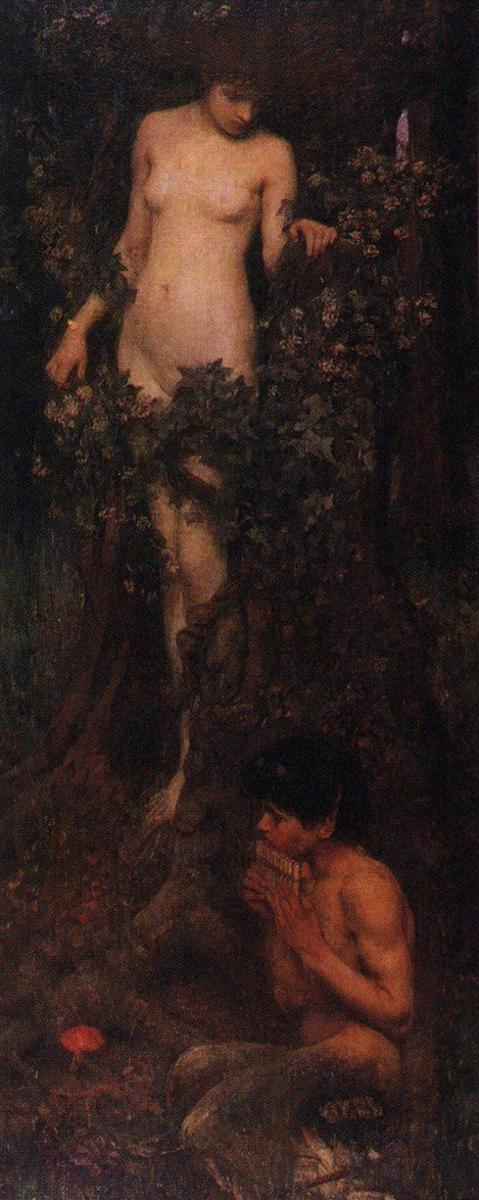
In A Hamadryad (1893), John William Waterhouse builds a scene that feels half discovered, half dreamed. The painting is tall and narrow, like a slit opening into a shaded woodland. A pale female figure appears as if she is emerging from the tree itself, while below her a youthful male musician kneels or sits close to the ground, absorbed in the sound of his own pipes. Nothing in the setting is grand or panoramic. Instead, Waterhouse compresses the world into bark, ivy, shadow, and skin, making the encounter feel intimate and private, as though we have wandered in at the exact moment myth becomes visible.
The first emotional note is stillness. Even the musician’s action reads as gentle rather than energetic. The atmosphere is hushed, with deep browns and greens swallowing the edges of the figures. Waterhouse uses that darkness like a curtain, so the bodies and the small highlights in the foliage glow softly without turning theatrical. The result is a kind of suspense that does not rely on obvious movement. It relies on attention. We are invited to look closely, to sense the boundary between the human world and the living presence of the forest.
The hamadryad in Greek myth and why it matters here
A hamadryad is a tree nymph in Greek mythology, a nature spirit whose life is bound to a specific tree. That idea changes how the scene reads. The nude figure is not simply standing beside a trunk, she belongs to it, like a soul made visible. Waterhouse often returns to myths where the supernatural is not distant but near, brushing against ordinary perception. Here, the hamadryad is neither stormy nor triumphant. She is quiet, watchful, and half concealed, as if her existence depends on remaining within the shelter of leaves.
This myth carries a built in tension between permanence and fragility. A tree seems enduring, yet it can be cut down. A spirit tied to one tree is powerful in its own realm but vulnerable to human intrusion. Waterhouse does not need to show an axe or a threat to make that vulnerability present. He suggests it through the figure’s partial concealment and through the way the surrounding darkness presses in. The hamadryad’s body is lit like a living clearing inside the forest. That glow feels precious, as if it could vanish if the spell is broken.
A vertical stage set for an encounter
The composition is arranged like a two level stage. The hamadryad occupies the upper portion, rising from the tree’s mass, while the musician sits below, close to the forest floor. The distance between them is not huge, yet it feels like a different world separates them. Waterhouse uses the tree trunk and the heavy ivy as a visual barrier, creating a sense that the nymph is both present and withheld. The eye travels up the pale column of her body, then is pulled back down to the warm tones of the musician’s skin, then back up again, repeating the motion like a refrain.
This up and down rhythm mirrors the scene’s emotional logic. The musician’s sound seems to lift toward the nymph, while the nymph’s attention seems to drift downward in response. The painting becomes a conversation without words. Even the narrow format helps. It prevents us from escaping sideways into landscape. We are held inside the relationship between figure, tree, and listener. Waterhouse turns the woodland into an enclosing chamber, making myth feel immediate rather than far away.
The hamadryad’s pose, presence, and ambiguity
Waterhouse paints the hamadryad with a pose that is both calm and uncertain. Her head tilts downward, and her gaze is lowered rather than direct. That choice makes her feel inward, as if she is listening as much as she is being seen. One hand is near the foliage, fingers poised with delicate restraint, not grasping or pointing, simply hovering. It is a gesture that suggests curiosity and caution at once.
Her body is partially veiled by leaves and shadow, which keeps the image from feeling like a straightforward display. The concealment also reinforces the myth. If she is bound to the tree, then foliage is not clothing added from outside, it is part of her natural envelope. Waterhouse often paints women who hover between states, between human and otherworldly, between decision and reverie. In A Hamadryad, that threshold quality is the subject. The nymph is not arriving dramatically. She is becoming visible, as if the forest has briefly allowed its inner life to surface.
The musician and the spell of sound
Below, the musician plays a set of pipes, an instrument closely tied to rustic and pastoral myth. The act of playing matters more than the player’s identity. Waterhouse paints him absorbed, shoulders slightly hunched, hands gathered around the instrument, face turned toward the sound. He appears unaware of any viewer. That absorption makes the scene feel sincere. The music is not a performance for an audience, it is an offering or an instinct, something that calls to the woods without demanding an answer.
The relationship between sound and revelation is central. In many myths, music draws out hidden beings, softens boundaries, or invites the supernatural into contact. Waterhouse captures that idea visually by making the musician’s form warmer and earthier, as if he belongs to the ground, while the hamadryad’s paleness reads like moonlit bark. The music becomes the bridge between those worlds. We cannot hear it, yet the whole image is organized as if around an invisible melody.
Light and color in a nearly nocturnal woodland
The palette is restrained and dark, dominated by deep browns, muted greens, and shadowy violets. Waterhouse lets the background sink into near black, but not flat black. It is textured, layered, and alive with subtle changes, like the forest is breathing. Against that darkness, the hamadryad’s skin reads as softly luminous. The light does not feel like harsh sunlight. It feels like filtered woodland light, or even an internal glow, which strengthens the sense of enchantment.
Waterhouse’s use of color also keeps the mood serious and contemplative. There are no bright flowers, no sparkling stream, no decorative distractions. The forest is heavy, damp, and quiet. A small red mushroom near the lower edge becomes striking because the rest of the scene is so subdued. That tiny accent feels like a whisper of danger or oddness, a reminder that the forest floor is a place of transformation, decay, and strange life. The painting’s beauty is not the beauty of a garden. It is the beauty of deep shade where myths might still survive.
The forest as a living body
The tree trunk is not just a prop. It has weight and character. Its bark, its twist, and the way ivy climbs and spreads all contribute to the feeling that the hamadryad is rooted, not merely posed. Waterhouse aligns the vertical thrust of the nymph’s body with the trunk’s rising form, making them echo each other. The eye begins to read the tree as an extension of her, or her as the tree’s spirit made flesh.
This is where the idea of the hamadryad becomes painterly rather than merely literary. Waterhouse does not need explicit supernatural effects. He merges anatomy with botany through visual parallels: pale skin against pale bark, the curve of a limb against the curve of a branch, the dark ivy acting like a natural veil. The forest is not scenery. It is the nymph’s domain, almost her skin in another texture. That approach makes the myth feel plausible inside the painting’s logic.
Symbolic details that deepen the story
Waterhouse includes small, potent details that reward slow looking. Ivy is one of the most important. Ivy clings, climbs, and persists, often associated with attachment and endurance. In this context it suggests the binding nature of the hamadryad’s life to her tree, and the way nature holds what belongs to it. The dense leaves that cross the nymph’s body also imply that the forest decides what can be revealed and what must remain concealed.
The pipes connect the musician to pastoral myth and to the idea of wild, untamed feeling. They also imply breath, and breath implies life. The scene becomes a meeting between the life of the forest and the life of a human body expressed through music. Even the mushroom, small as it is, carries associations with the hidden chemistry of the woods, with the uncanny, with things that appear overnight. Waterhouse does not label these symbols. He places them like quiet clues, allowing the viewer to sense that this is not ordinary time.
Waterhouse’s technique and Pre-Raphaelite inheritance
Although Waterhouse is often linked with the Pre-Raphaelites and their circle, his handling here feels softer and more atmospheric than the sharp, jewel like clarity people sometimes associate with early Pre-Raphaelite detail. In A Hamadryad, edges dissolve into shadow. Forms emerge gradually. This is a mature Waterhouse mood, where suggestion can be more powerful than description.
He still shares key Pre-Raphaelite concerns: mythic subject matter, emotional seriousness, and the presence of nature as more than backdrop. Yet he balances those concerns with a tonal unity that creates a dreamlike continuity across the canvas. The figures are modeled with care, but the surrounding woodland is painted to envelop them, not to catalog every leaf. That choice makes the supernatural feel integrated rather than pasted on. The magic is in the atmosphere, in the sense that the forest has depth and memory, and that something ancient is listening.
Themes in Waterhouse’s 1890s paintings
Waterhouse in the 1890s often paints moments of pause where a figure’s inner state becomes the real narrative. Even when the subject is mythological, the feeling is psychological. In A Hamadryad, the nymph’s downward gaze suggests contemplation or wary interest, while the musician’s closed focus suggests devotion or longing. The scene is not about conquest or spectacle. It is about attraction that remains unspoken, and about the ethical boundary of approaching something sacred to nature.
This fits Waterhouse’s larger fascination with liminal women and enchanted spaces. His heroines and supernatural figures frequently inhabit thresholds: shorelines, gardens at dusk, riverbanks, shadowed interiors. The hamadryad is a literal threshold being, a spirit tied to a living tree. Waterhouse treats that idea with tenderness, not with shock. The painting becomes an image of encounter where the most important action is listening.
Why the painting still captivates
A Hamadryad lingers because it offers a rare kind of mystery. It is clear enough to be readable and ambiguous enough to feel alive. The scene does not tell you exactly what happens next. Will the nymph retreat fully into bark and leaves, leaving only the memory of pale light? Will the musician look up and realize he has been answered? Waterhouse leaves the story suspended, which is often the most haunting choice. A finished narrative can be satisfying, but an unfinished moment can be unforgettable.
The painting also resonates because it treats nature as sacred without turning it into a lecture. It does not argue. It suggests. By binding the nymph to the tree, the myth becomes a visual reminder that nature is not an object but a living presence with its own dignity. The viewer is placed in a position similar to the musician’s: drawn in, quieted, and made attentive. In that sense, the painting is not only an illustration of myth. It is an experience of reverence, staged in shadow and softened light, where the forest seems to watch back.