Image source: wikiart.org
Introduction to “The Naiad”
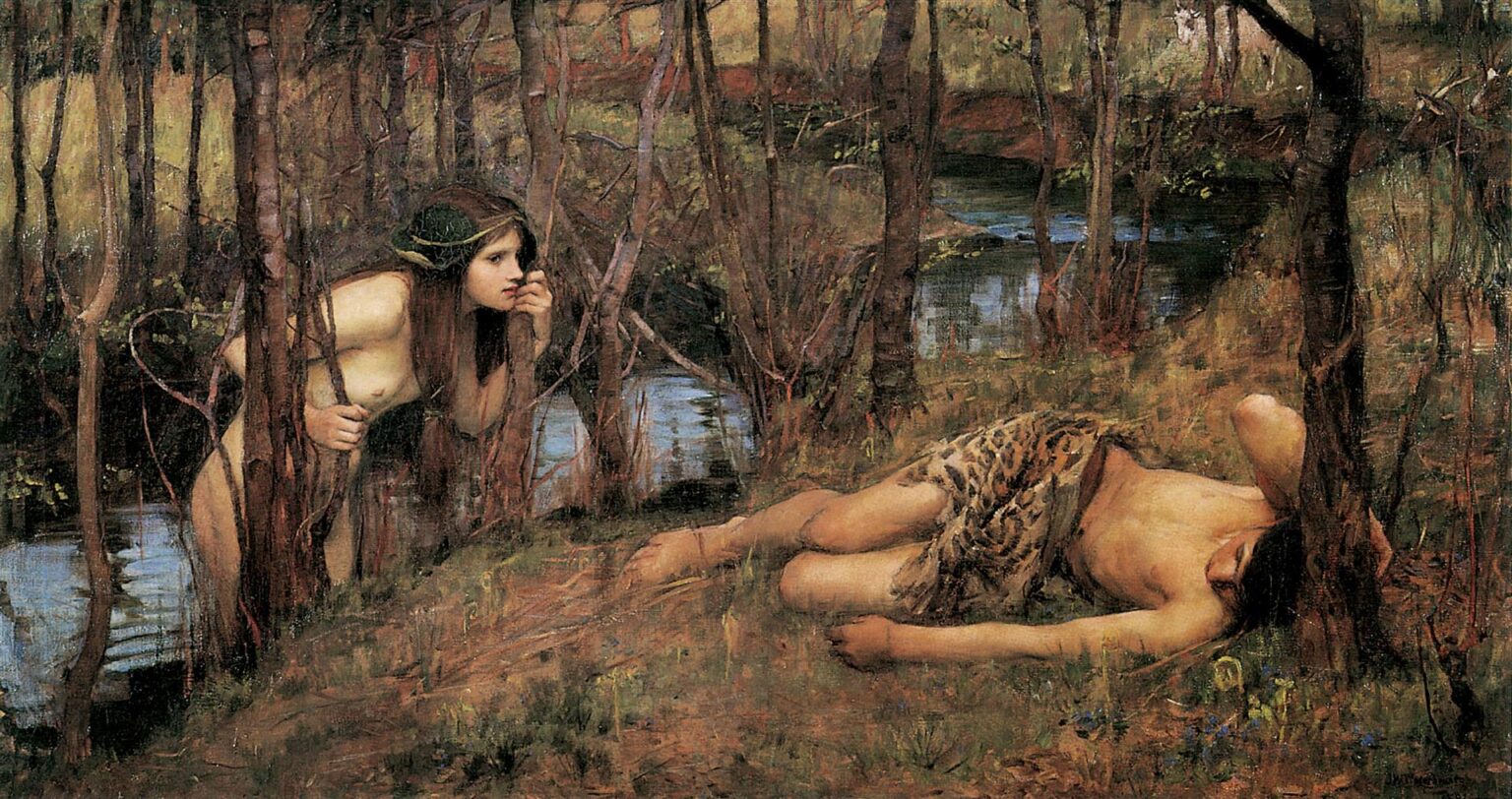
In “The Naiad” (1893), John William Waterhouse places a mythic encounter inside a landscape that feels more like a remembered sensation than a mapped location. At first glance, the subject seems straightforward: a water nymph in a marshy woodland, a vulnerable figure nearby, and a hush of dusk or early morning settling over the reeds and trunks. Yet the longer you stay with the painting, the more it behaves like a secret overheard. Waterhouse does not offer a clear beginning or ending. Instead, he suspends a moment of discovery, the instant when curiosity becomes fate and when the natural world, usually a refuge, turns into a threshold.
A naiad, in classical mythology, is a female spirit of fresh water: springs, streams, and secluded pools. Waterhouse often returned to such figures because they let him combine narrative tension with atmosphere. Myth gives him an excuse to paint the human form in dialogue with nature, but also to explore the psychological drama of temptation, fear, compassion, and predation. Here, the naiad is not presented as a decorative emblem. She is an active presence, alert and assessing, a living intelligence within the wetland.
The Scene and Its Quiet Shock
The composition is split into two emphatic zones. On the left, the naiad emerges from shallow water and tangled branches. On the right, a human figure lies on the ground, partially clothed, turned away, exposed to the damp grass and the encroaching trees. Between them is a narrow corridor of water and muddy bank, a space that reads like a pause in conversation. That gap becomes the painting’s emotional engine. It is small, but it feels charged, as if crossing it would change everything.
Waterhouse orchestrates the scene so that the viewer experiences it as a discovery too. We arrive at the same time as the naiad’s attention lands on the sleeper. The marsh is dense with vertical lines, thin tree trunks and reeds that form a kind of cage. They do not merely describe a place. They create a feeling of being watched, of being caught, of having moved into territory where ordinary rules do not apply.
The right side is quieter in gesture but louder in implication. The reclining figure is still, heavy with sleep or exhaustion. Their posture suggests helplessness, a surrender to gravity and to the ground. The naiad, by contrast, is held in a poised crouch, leaning forward, one hand near her face as though measuring breath or scent, the other holding a branch as if parting the wilderness like a curtain. That small action, pushing aside the thicket, makes her the initiator. She is the one who chooses to see.
Mythic Identity and Narrative Ambiguity
Although titled “The Naiad”, the scene invites association with broader mythic stories, especially those where water spirits lure, rescue, or doom mortals. Waterhouse’s mythological paintings frequently focus on the instant before the legend becomes irreversible. The viewer may not need to identify a specific tale to feel the stakes. The language of myth is present in the archetypes: the spirit of the water, the vulnerable traveler, the liminal setting where land and water mix.
This ambiguity is not a weakness but a strategy. By refusing to spell out the plot, Waterhouse shifts the emphasis from “what happens next” to “what it feels like right now.” The naiad’s expression is not theatrical. It is concentrated, almost practical. She looks less like a performer on a stage and more like an animal or hunter pausing to decide. That decision can be read in multiple ways: tenderness, curiosity, hunger, or even a kind of moral test. Myth becomes psychological rather than merely literary.
The setting reinforces this. Naiads belong to places that are not fully domesticated, water that slips between categories, neither river nor pond, neither safe shore nor open depth. The marsh is a perfect habitat for uncertainty. It is beautiful, but it is also where you can lose your footing. In such a place, the supernatural does not need a dramatic entrance. It can simply lean in from behind the reeds.
Composition, Space, and the Feeling of Entrapment
Waterhouse builds the painting with a strong horizontal pull from left to right, linking the naiad’s gaze to the sleeper’s body. Yet he simultaneously interrupts that movement with repeated verticals: trunks, reeds, and thin branches that slice the scene into narrow compartments. This creates a paradox. The story seems to move forward, but the space seems to tighten. It is as if the forest itself is narrowing around the figures, closing the possibility of escape.
The naiad is placed just off the left edge of center, a position that makes her feel like an intruder into the viewer’s space. She is close enough that her presence is immediate, but partly masked by vegetation, as though she belongs to the background even while she dominates the foreground. The sleeping figure is pushed toward the right side, nearly pinned against a tree trunk and the frame edge. This placement intensifies vulnerability. The body reads as cornered, not by action, but by composition.
The water in the middle distance offers a thin suggestion of openness, a reflective ribbon threading through the trunks. But it is not a clear path. It is broken by banks, reeds, and shadows. Even the light on the water feels hesitant, a glimmer rather than a promise. Space in this painting does not liberate. It encloses.
The Naiad’s Presence and the Language of Gesture
The naiad’s posture is the painting’s most expressive element. She bends forward with the cautious intensity of someone approaching a sleeping animal or listening for a sound. One hand rises near her mouth, a gesture that can imply surprise, restraint, or contemplation. It is not a melodramatic hand-to-heart gesture. It reads like a pause. The other hand grips a slender branch, both for balance and for concealment, as if she is parting the marsh to enter the human world for a moment.
Her face is painted with clarity compared to the restless textures around her. Waterhouse makes us linger on her concentration. The expression is alert, but not exaggerated. This is important, because it keeps the supernatural grounded. The naiad is not a symbol floating above the scene. She is physically present, responding to a real body on the ground, in real damp air.
The vegetation around her also functions like an extension of her agency. The reeds and thin trunks frame her as if they are allied with her, hiding her until she chooses to reveal herself. That relationship between figure and environment is central to Waterhouse’s mythological world. Nature is not neutral scenery. It participates in the drama.
Vulnerability, Sleep, and the Human Figure
The reclining figure is rendered with a heaviness that contrasts sharply with the naiad’s alertness. The body sinks into the ground, limbs relaxed, head turned away, as though consciousness has withdrawn. The partial covering, patterned and earthy, belongs more to the wilderness than to civilization. It suggests a traveler, a hunter, or a figure from antiquity, someone who has strayed into the wrong place.
What matters most is the absence of control. Sleep is one of the most vulnerable human states, and Waterhouse uses it as a narrative shortcut. The viewer immediately understands that the sleeper cannot negotiate, cannot flee, cannot even recognize danger. That creates tension without movement. The scene is still, but the situation is unstable.
Because this is myth, vulnerability also carries symbolic weight. The human figure represents the mortal world: time-bound, easily wounded, and unaware of the forces that exist beyond ordinary perception. In many legends, the supernatural does not need to overpower a person physically. It only needs a moment when the person’s guard is down. Waterhouse captures exactly that kind of moment.
Color, Light, and the Marsh’s Strange Beauty
The palette is dominated by browns, mossy greens, muted golds, and smoky grays. These are not the jewel-tones of a celebratory myth. They are the colors of damp earth, decaying leaves, bark, and stagnant water. The effect is autumnal, but it can also feel like twilight, a time when forms lose certainty.
Waterhouse uses light sparingly. The brightest passages sit on skin and on small reflective patches of water. Everything else is subdued, as though the scene is filtered through humidity and shadow. This restrained lighting makes the human bodies feel almost like intrusions into the environment, luminous forms caught in a net of branches.
There is also a psychological function to this color choice. Warm browns and ochres can feel comforting, but here they also suggest rot and sinking ground. Greens feel alive, but here they can imply concealment. The marsh is beautiful, but it is not safe. Waterhouse paints the landscape so that it seduces the viewer even as it warns them.
Texture, Brushwork, and the Sense of Touch
One of the painting’s most powerful qualities is its texture. The reeds and trunks are built with a restless, layered handling that suggests growth and decay at once. Thin strokes and scumbled passages create the impression of surfaces that snag and scrape. You can almost imagine the resistance of the undergrowth against skin.
Against this, the figures are painted more smoothly, with transitions that make skin feel soft and vulnerable. The contrast creates a tactile drama: softness exposed to roughness, living flesh against abrasive nature. Even without overt action, the viewer senses what it would mean to move through this place. Every step would be a struggle. Every sound would carry.
Waterhouse also uses texture to control attention. The thicket is busy enough to hide details, while the faces and key anatomical forms are clarified. This is how the painter creates suspense. The eye keeps searching the dark reeds, half-expecting something else to be there, another watcher, another presence, another pair of eyes. The landscape becomes psychologically active.
Nature as Threshold: Water, Trees, and the Liminal World
A naiad belongs to fresh water, and water in the painting is not merely a setting. It is a boundary. The naiad’s body rises from the shallow pool as if she is crossing from one realm to another. Water is the medium of transformation, the place where identities blur. It distorts reflections, muffles sound, and hides depth. In myth, it often marks the edge between human life and the unknown.
The trees, thin and crowded, work like guardians. They are not noble, open-trunked forest giants. They are narrow, tense, and numerous, more like bars than columns. This makes the setting feel claustrophobic, a place where you cannot see far and cannot trust what you cannot see.
The ground itself is ambiguous. It is not dry land, but not fully water. This in-between terrain matches the in-between nature of the myth. The naiad is not human, but she takes on human shape. The sleeper is human, but in sleep becomes almost object-like, a body rather than a person. Everything in the painting exists on a threshold.
Themes of Desire, Danger, and Moral Uncertainty
What makes “The Naiad” compelling is that it refuses to tell you how to feel. The naiad is not clearly villain or savior. Her gaze could be predatory, but it could also be fascinated or even sorrowful. The painting lives in that uncertainty, and that uncertainty is deeply human. We recognize the tension between curiosity and harm, between attraction and threat.
Mythological paintings often dramatize the consequences of looking, longing, and approaching what is not meant for us. Here, the naiad’s act of looking is central. The sleeper is being seen without consenting, without knowing. That imbalance of awareness creates ethical tension. At the same time, the naiad herself is also exposed. She has stepped out of her element enough to be visible, to be readable, to be judged by the viewer.
Waterhouse seems interested in the way myth lets us explore these complicated emotions safely. The supernatural figure becomes a mirror for human impulses that are hard to admit: the desire to possess, the temptation to cross boundaries, the fascination with someone powerless, the fear of being overpowered by forces we do not understand. The painting does not resolve these themes. It holds them in suspension.
Waterhouse’s Mythic Realism and Pre-Raphaelite Echoes
Waterhouse is often associated with the later phase of Pre-Raphaelite sensibility, especially in his love of literary and mythic subjects, his careful attention to natural detail, and his ability to make narrative feel intimate. In “The Naiad,” the landscape is not a generic stage set. It feels observed, specific, and texturally convincing, even as it hosts something unreal.
This blend is crucial: myth becomes believable because the environment is believable. The naiad’s supernatural identity is not expressed through glowing halos or magical effects. It is expressed through her belonging. She looks at home in the water and reeds in a way the sleeper does not. That difference of belonging is the painting’s quiet magic.
Waterhouse also uses the romantic tradition of the enchanted female figure, but he complicates it. The naiad is not simply an object of beauty framed for admiration. She is an agent within the scene. The viewer is asked to interpret her, not just to look at her. That shift from ornament to psychology is part of what gives the painting its lingering power.
The Viewer’s Role: Watching the Watcher
As you look at the naiad watching the sleeper, you become aware of your own position. The painting subtly turns the viewer into another hidden presence among the trees. We are also observing someone who is vulnerable, and we are also separated by distance and silence. That creates a layered tension: the naiad’s gaze, the viewer’s gaze, the sleeper’s unseeing body.
This structure makes the painting feel modern in its psychological self-awareness. It is not only a myth scene. It is a meditation on observation, on the imbalance between the one who knows and the one who does not. The marsh becomes a theater of perception.
The dense framing strengthens this effect. The branches act like curtains, but also like barriers. We are allowed to see, but not to intervene. That helplessness parallels the sleeper’s helplessness. Even if the viewer feels alarm, there is nothing to do but keep looking, to wait for the moment to tip into action that the painting withholds.
Conclusion: A Myth Held in a Breath
“The Naiad” is powerful because it is quiet. Waterhouse stages myth not as spectacle but as encounter: two beings on the edge of contact, separated by a strip of water and by an abyss of understanding. The painting’s beauty is inseparable from its unease. The marsh glows with earthy color, but it also feels like a trap. The naiad is graceful, but her intention is unreadable. The sleeper is peaceful, but that peace is the calm of vulnerability.
By choosing this suspended instant, Waterhouse turns a mythological subject into a psychological one. The painting asks what it means to cross boundaries, to be seen, to be powerless, and to be tempted by what lives just beyond the familiar. In the end, the naiad remains a figure of the threshold: neither purely monstrous nor purely benevolent, but as complex as the water she inhabits, reflecting whatever the viewer brings to it.