Image Source: wikiart.org
The scene Waterhouse invites you to witness
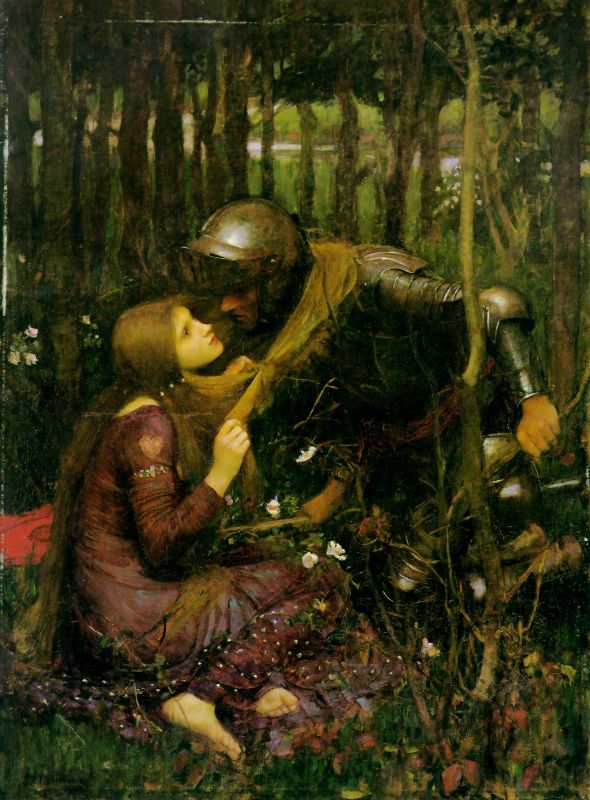
In The Beautiful Lady Without Pity (1893), John William Waterhouse stages a moment that feels both private and perilous. A young woman sits low in the grass of a shadowed wood, her long hair flowing over a deep mauve dress. She is barefoot, grounded, and strangely calm. A knight in polished armor leans toward her, his body angled down as if drawn by gravity. Between them is a soft strip of fabric, a scarf or veil, which she lightly grips and seems to guide across his chest and neck. Their faces are close enough to suggest intimacy, yet the forest around them presses in like a silent audience.
What makes the encounter unsettling is its imbalance. The knight, built of metal and purpose, appears physically powerful, yet he is the one bending, hovering, yielding. The woman, unarmored and seated, seems to control the tempo. Waterhouse does not show an obvious struggle. Instead, he paints a kind of surrender that looks voluntary, and that ambiguity is the painting’s engine. It is less about an action completed than a choice being made in real time.
The title and the legend behind it
The title points straight to the famous ballad-like poem La Belle Dame sans Merci by John Keats, where a mysterious, beautiful woman enchants a knight and leaves him drained and desolate. Waterhouse often returned to literary sources, especially those steeped in medieval romance, tragic love, and supernatural suggestion. By naming the work “without pity,” he signals that beauty here is not simply decorative. It is consequential. It can be an instrument, a test, or a trap.
Yet Waterhouse does not paint the poem as a straightforward illustration. He isolates a single charged instant, before any clear aftermath. That choice matters because it makes the story psychological rather than purely narrative. Instead of showing the knight abandoned on a cold hillside, he shows the seduction itself, the turning point where fascination overtakes caution.
A Pre-Raphaelite mood, revisited in the 1890s
Although Waterhouse is often associated with the Pre-Raphaelite look, he arrived after the original wave and worked in a period when its ideals had become part of broader visual culture. The meticulous natural setting, the medieval subject, the emphasis on beauty and moral tension, all echo the aesthetic associated with the Pre-Raphaelite Brotherhood. But Waterhouse’s handling is less hard-edged than early Pre-Raphaelite detail. Here the atmosphere is softer, duskier, more lyrical. The forest is not a catalog of botany so much as a living veil.
In the 1890s, viewers were steeped in stories of enchantresses, fatal attractions, and dreamlike states, themes that also align with Symbolism and late Victorian fascination with psychology. Waterhouse uses medieval clothing and armor as a kind of mythic costume, a timeless stage on which modern anxieties about desire and agency can play out safely.
Composition and the choreography of power
The painting is built on a quiet diagonal. The woman’s seated figure forms a stable base on the left, while the knight’s armored torso slopes in from the right, creating a triangle of attention that points directly to their faces and the strip of cloth between them. Their proximity is the focal point, but the real hinge is the woman’s hand. Her fingers lightly pinch the fabric, a small gesture that reads as gentle, yet decisive. Waterhouse makes that touch feel like a switch that can change the knight’s fate.
The knight’s posture is complicated. He does not tower. He folds. His helmet and shoulder plates catch dim light, but his face is partly obscured, making him feel less like a conquering hero and more like someone caught in a trance. One arm braces, the other bends, as if he is trying to balance between approach and collapse. The woman’s face tilts upward, offering him her gaze with a calm that borders on inevitability. The emotional direction is clear: he is drawn in, she receives him, and the forest closes around their pact.
Light, color, and the sense of spellbound twilight
Waterhouse keeps the palette low and earthy: greens, browns, and deep wine tones. The forest is painted in vertical strokes and dark trunks, creating a barred rhythm behind the figures, like a natural enclosure. Against this, the woman’s skin glows softly, her cheek and forehead catching warm light. Her hair, a coppery stream, functions almost like a halo, a natural radiance in an otherwise muted world.
The knight’s armor reflects faint highlights, not bright enough to read as triumphant. Instead, the metal looks heavy and tired, as though it cannot protect him from what is happening. The contrast between matte fabric and reflective steel becomes a metaphor. Fabric suggests intimacy, warmth, and persuasion. Steel suggests duty, defense, and distance. In this meeting, fabric wins.
Costume, armor, and what each body represents
Waterhouse is unusually precise about texture. The woman’s dress gathers and pools, absorbing the forest’s shadows. It makes her look like part of the ground itself, rooted, patient, and difficult to dislodge. Her bare feet reinforce that impression. She belongs to this place, or perhaps she is the place, a personification of the wood’s allure.
The knight’s armor, by contrast, reads as a shell brought from elsewhere. He is a visitor, a traveler, someone with a mission that now seems irrelevant. The scarf or veil bridging them is crucial because it is neither metal nor flesh. It is a threshold material, something that can bind without bruising, lead without force, and conceal while appearing gentle. If this is an enchantment, it is not cast with lightning. It is cast with softness.
The forest as a character, not a backdrop
In Waterhouse, nature is rarely neutral. Here the trees rise like witnesses, their thin trunks forming a cage of vertical lines. The deeper background opens to a pale strip that could be water or distant light, but it is far away and partially blocked, like an escape route that is visible yet unreachable. The setting suggests a liminal place, neither safe domestic space nor open battlefield, but an in-between zone where ordinary rules loosen.
Small white flowers dot the ground near the figures, bright flecks against dark grass. They add delicacy, but also irony. White blossoms can suggest innocence, yet placed at the site of seduction, they feel like a costume innocence wears in order to be convincing. Waterhouse loves that kind of symbolic double meaning: beauty that can be read as pure or dangerous, depending on what you believe about the story.
The “beautiful lady” and the late Victorian femme fatale
The phrase “without pity” aligns the woman with the idea of the femme fatale, a figure who captivates and destroys, not always through overt cruelty, but through irresistible attraction. Late nineteenth-century art often returns to this archetype as a way of exploring power dynamics and social change. The fear is not simply that love hurts. It is that desire can rearrange a person’s priorities, making them betray their vows, their identity, or their sense of control.
Waterhouse paints her not as a monster, but as mesmerizingly human. Her expression is composed, almost tender. That tenderness is what sharpens the threat. If she looked obviously villainous, the knight’s fall would feel foolish. Instead, she looks believable. The danger becomes internal: the knight is undone not by an enemy, but by the part of himself that wants to be undone.
The knight’s vulnerability and the tragedy of choosing
The knight’s armor usually symbolizes protection, honor, and moral clarity. Here it becomes a heavy costume that cannot help him. His closeness to the ground, his bowed head, and his partial concealment suggest fatigue, or surrender, or a dawning realization that he is outmatched in a realm where swords do not matter.
This is where Waterhouse’s storytelling is most effective. He does not need to show harm. He only needs to show the instant when the knight’s agency begins to slip. The painting captures that frighteningly ordinary moment when a person knows better and still leans in. The tragedy is not only what the beautiful lady might do, but what the knight willingly gives away.
Ambiguity as the painting’s main suspense
One reason this image stays in the mind is that it refuses to resolve its own moral question. Is she cruel, or simply indifferent? Is she supernatural, or merely a woman in a story built by male fantasy and fear? Is the knight a victim, or a participant who craves escape from duty? Waterhouse offers evidence for multiple interpretations and lets the viewer complete the narrative.
That ambiguity also changes the emotional tone. The closeness of their faces can read as romantic. The darkness of the wood can read as ominous. The gentle hand on the cloth can read as affectionate, or controlling, or both. Rather than choosing one, Waterhouse layers them, which creates a tension that feels modern: attraction and alarm occupying the same breath.
Waterhouse’s craft: softness, focus, and controlled detail
Technically, Waterhouse manages attention through selective clarity. The faces and the connecting cloth are the most legible elements. The forest is richly painted but less defined, a textured atmosphere that supports the drama without distracting from it. This approach mimics the way memory works: we remember the intensity of an encounter more sharply than the exact shapes of trees behind it.
He also uses the vertical rhythm of the background to keep the composition from dissolving into pure intimacy. The trees act like a visual restraint, a reminder of consequence. Even as the figures draw close, the world around them remains firm and watchful. The painting becomes a balance of softness and structure, seduction and boundary.
Why this painting still resonates now
The Beautiful Lady Without Pity endures because it dramatizes a familiar human experience in mythic form: the moment when longing challenges self-preservation. It speaks to the fear of losing oneself in another person, but also to the secret desire for that loss, the wish to step outside obligation and be carried by feeling.
At the same time, modern viewers may read the scene with new questions about narrative framing and agency. The “fatal woman” trope can be understood as a projection, a story that turns feminine autonomy into danger. Waterhouse’s painting does not solve that tension, but it makes it visible. The woman’s calm gaze and grounded posture can be read as power, but also as a refusal to be simplified into either saint or villain.
In that way, the work is not only a romantic fantasy. It is an image about storytelling itself, about how beauty becomes meaning, and how meaning becomes fate.