Image source: wikiart.org
Circe as a figure of jealousy and intention
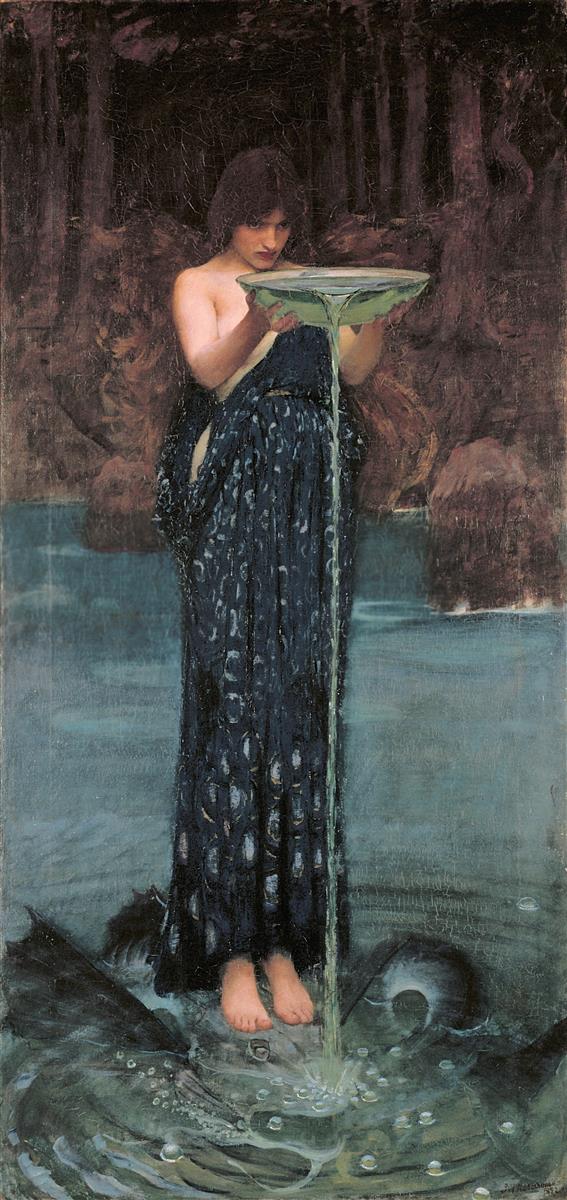
In Circe Invidiosa (1892), John William Waterhouse turns a mythic enchantress into something sharper than a stock “sorceress” stereotype. This is not a scene of theatrical spellcasting for an audience. It feels private, concentrated, and quietly ruthless. Circe stands alone at the edge of a cold pool, barefoot on dark rock, cradling a shallow bowl as if it were both offering and weapon. Her posture is steady, her expression focused, and the act is already underway. Waterhouse does not ask you to wonder whether magic will happen. He shows you the moment when envy becomes action.
The title matters. “Invidiosa” points to jealousy that corrodes, not merely desire. Circe is presented less as a romantic temptress than as a mind set on consequence. In classical myth, she is often powerful and articulate, an agent rather than a victim. Waterhouse leans into that agency, but he complicates it. The painting does not celebrate her power, and it does not excuse her. Instead, it studies the emotional temperature of revenge, a cold intensity that travels down that pale stream of poison toward the water below.
The myth behind the image and what Waterhouse chooses to show
The story most associated with Circe Invidiosa comes from Ovid’s Metamorphoses. Circe, jealous of Scylla, prepares a poisonous mixture and pours it into the waters where Scylla bathes. The result is transformation, a monstrous change that permanently marks the rival. This is a myth about desire turning predatory and about femininity framed as dangerous when it refuses to be passive.
Waterhouse’s choice is telling: he does not paint Scylla at all. He withholds the victim and focuses on the perpetrator at the instant of cause. That decision shifts the drama inward. The horror is not the spectacle of metamorphosis, but the calm determination that triggers it. By keeping the narrative on the brink, Waterhouse heightens tension. The viewer becomes a witness to intent, watching a choice solidify into irreversible outcome.
This also makes the scene psychologically modern. Instead of a myth illustrated like a stage tableau, it becomes a portrait of a mental state. The painting asks you to sit with the feeling that precedes cruelty, and to notice how ordinary it can look when it is dressed in composure.
Composition and the power of a single vertical act
The painting is built on a strong vertical structure. Circe’s body forms a central pillar, and the thin stream of liquid becomes an even stricter line, falling from the bowl to the pool like a verdict. This vertical drop is the painting’s main event. Waterhouse uses it to connect thought, hand, and consequence in a single unbroken path.
Around this axis, the composition is quiet but tense. Circe’s head is slightly bowed, her gaze angled toward the vessel and the falling liquid, as if she is monitoring precision. The bowl is held at chest height, close enough to feel intimate, far enough to emphasize control. The pool below ripples outward in circles, so the painting includes both the straight line of intent and the widening rings of impact. Cause is narrow. Effect spreads.
The setting reinforces this compression. The backdrop is a dim, wooded rock face, almost closing in behind her. It reads like a secluded grotto or forest pool, a place chosen for secrecy. Waterhouse avoids distracting elements, so the viewer’s eye is guided again and again from Circe’s face to the stream to the disturbed water.
Color, temperature, and the painting’s poisonous beauty
Waterhouse’s palette is one of the painting’s most persuasive storytellers. The scene is dominated by cool, damp blues and greenish tones in the water, set against the muted purples and browns of rock and forest. It feels nocturnal even if it is not literally night. The air seems heavy, as if sound would be swallowed by the trees.
Against this subdued world, the poison stands out. The liquid has an unnatural, milky green cast, neither fully transparent nor fully opaque. It looks viscous, like something brewed rather than drawn from nature. The color suggests alchemy, a substance that does not belong in the pool. In a painting where much is subdued, that pale stream becomes a visual warning sign.
Circe’s skin also plays a role in the temperature of the image. Her bare shoulder and arms glow softly against the dark background, giving her a sculptural clarity. This contrast makes her feel present and physical, not ghostly. The magic does not erase her humanity. If anything, it makes her more responsible, because she is clearly embodied, making a deliberate choice with her hands.
Light, surface, and Waterhouse’s handling of texture
The painting’s light is restrained. There is no dramatic spotlight, no lightning flash, no flaming brazier. Instead, illumination is diffused, like overcast light reflected by water. That restraint allows Waterhouse to emphasize surfaces: wet rock, rippling pool, the soft sheen of cloth, the strange gloss of the poison.
Circe’s dress is especially important. It is a dark, deep blue, and Waterhouse gives it a broken pattern that reads like reflections or scattered highlights. The fabric feels heavy, dampened by proximity to water, and it clings in places while falling in long folds. This dress is not decorative fluff. It anchors her to the physical world and makes her look weighted, deliberate, grounded.
The water at her feet is painted with careful attention to movement. Ripples, bubbles, and pale froth gather where the poison strikes, implying chemical disturbance. Waterhouse makes the surface beautiful enough to lure the eye, then unsettles it with signs of contamination. The painting’s tactile realism becomes a moral device: you can almost feel the chill of the pool, which makes the intrusion of poison feel more invasive.
Circe’s expression and the portrait of controlled malice
Circe’s face is the emotional center of the work. She does not grin. She does not perform. Her eyes are narrowed with concentration and something like simmering contempt. There is an inwardness to her, as if she is not thinking of how she appears, only of what will happen next. That lack of theatricality is precisely what makes her frightening.
Waterhouse also avoids reducing her to pure monster. Her expression suggests emotion under pressure: jealousy, pride, wounded desire, and anger disciplined into action. This is envy that has become method. The calmness is not peace, it is restraint used as a tool.
That tension between beauty and cruelty is a recurring fascination in Waterhouse’s mythological women. He repeatedly paints figures whose allure does not soften their danger. Here, he makes the danger feel chillingly rational. Circe’s magic is not chaotic, it is measured, poured like a dose.
The symbolism of the bowl, the stream, and the contaminated pool
Objects in this painting behave like symbols without losing their physical credibility. The bowl is wide and shallow, reminiscent of a ritual vessel, but it also resembles a domestic dish. That ambiguity matters. It suggests that vengeance can be prepared with the same hands that might otherwise hold water, food, or perfume. The ordinary becomes the instrument of harm.
The stream of poison is the painting’s most symbolic element because it is literally visible causality. Waterhouse makes the invisible nature of envy visible. Jealousy is often imagined as something internal, a private corrosion. Here it becomes a substance that can be poured, that can enter shared water, that can infect an innocent space.
The pool itself is more than setting. In myth, bathing water suggests vulnerability, cleansing, and exposure. By poisoning it, Circe turns a place of refreshment into a trap. The circular ripples read like consequences spreading beyond their target, implying that acts of spite rarely remain contained. The rings expand outward, visually predicting a story that cannot be undone.
Pre-Raphaelite echoes and Waterhouse’s late Victorian mood
Waterhouse is often linked with the Pre-Raphaelite tradition, and you can feel those echoes in the clarity of the figure, the devotion to natural detail, and the choice of literary or mythological subject. Yet this is not the bright, jewel-like naturalism associated with early Pre-Raphaelitism. The mood is darker, quieter, more psychological.
By the 1890s, Victorian myth painting often carries a sense of ambiguity and unease. Instead of moral clarity, it offers fascination with desire, transgression, and the hidden costs of passion. Waterhouse fits that mood. He paints myth not as comforting heritage but as a mirror for impulses that polite society pretends to control.
In Circe Invidiosa, the forest is not a lush paradise. It is a shadowed enclosure. The color harmonies are not celebratory. They are suffocating. The painting feels like a late Victorian meditation on emotional extremes, where the myth becomes a language for taboo feelings: jealousy, revenge, the wish to destroy a rival, the thrill of power.
Femininity, power, and the painting’s uneasy gaze
It is impossible to ignore how this painting participates in a long tradition of depicting powerful women as dangerous. Circe is a figure who refuses submission, and myth often punishes such figures by casting them as threats to men or to social order. Waterhouse’s Circe can be read through that lens, especially given the era’s fascination with the “fatal woman” as an image of fear and desire.
At the same time, the painting is more complex than a simple warning tale. Waterhouse does not show Circe in a moment of sexual seduction. He shows her alone, working, intent on consequence. That choice shifts the focus from her body as spectacle to her will as force. The painting’s unease comes from recognizing her competence.
This creates a tension in the viewer’s position. You are drawn to her beauty, but the narrative context turns that beauty into a mask over violence. You are invited to admire the painting’s elegance while also confronting its subject’s cruelty. The work is compelling because it refuses to let aesthetic pleasure remain innocent.
Water as a stage for metamorphosis and moral change
Waterhouse often uses water as a symbolic environment, a place where boundaries blur. Water can reflect, conceal, cleanse, or drown. It is perfect for myths of transformation because it is always shifting. In Circe Invidiosa, water becomes the site where identity is altered by someone else’s desire.
The poison striking the pool functions like a visual prophecy. Even before the myth’s transformation occurs, the water is already different. The ripples and pale disturbance suggest that nature itself registers moral violation. The pool becomes an unwilling participant, forced to carry harm to an unseen body.
This makes the painting resonate beyond its myth. Many people recognize the feeling of a shared space turning unsafe due to someone’s spite. Waterhouse renders that shift with haunting simplicity: a quiet place, a solitary figure, and a stream that changes everything.
Why Circe Invidiosa still feels modern
Part of the painting’s enduring power lies in how it handles time. It captures the instant when a private emotion becomes a public outcome. That transition is the core of many tragedies, ancient and contemporary. The image lingers because it is about decision, not accident.
It also feels modern because it treats myth as psychology. Circe is not merely a character from a story. She is an embodiment of a feeling that can take hold of anyone: the conviction that someone else’s happiness is an insult, and that retaliation will restore balance. Waterhouse shows how that conviction can look like calm.
Finally, the painting remains vivid because of its contradictions. It is beautiful but poisonous. It is quiet but violent in its implications. It centers a woman as an agent of power, yet frames that power through jealousy and harm. Those tensions keep the viewer returning, trying to decide whether they are witnessing villainy, tragedy, or an uncomfortable mixture of both.