Image source: wikiart.org
First impressions and the quiet drama of stillness
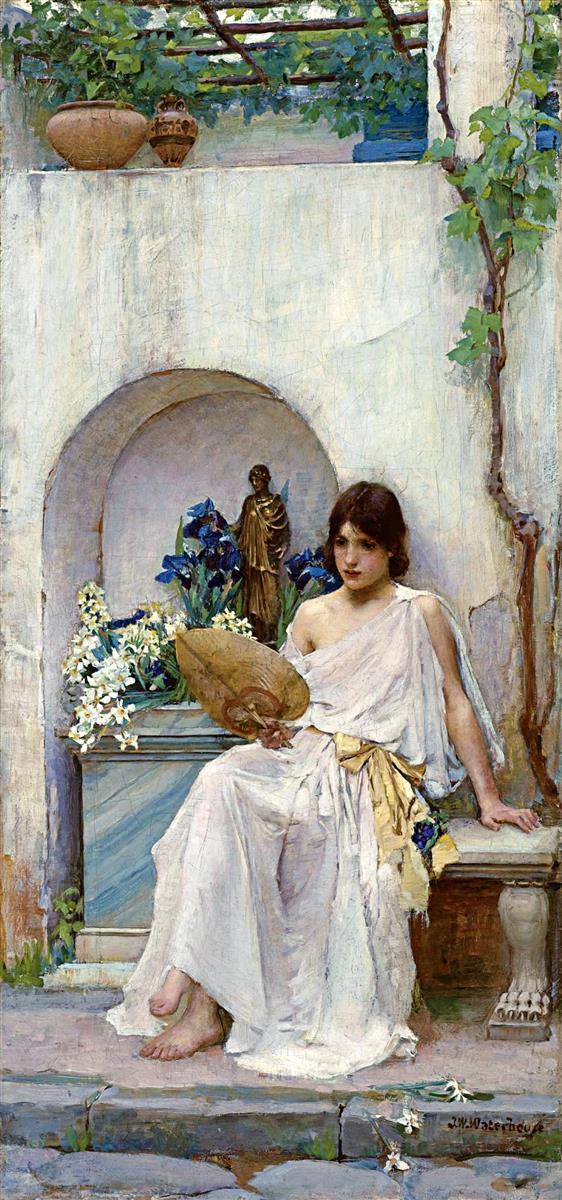
In Flora (1890), John William Waterhouse stages a moment that feels both intimate and ceremonial. A young woman sits at the threshold of a white-walled garden court, relaxed yet self-contained, as if she has paused mid-thought. The scene does not announce itself with narrative action. Instead, it persuades through atmosphere: sunlit plaster, cool shadow, trailing vine, and a dense pocket of flowers gathered behind her like a private altar. Even before you attach the title, the painting reads as an offering to calm, to fragrance, to the slow unfolding of a season.
That calm is carefully constructed. Waterhouse places the figure on a stone bench at the right, but surrounds her with cues that gently elevate her from a modern sitter to a mythic presence. The draped white garment suggests classical antiquity. The restrained setting implies a cultivated, almost sacred enclosure. The overall mood is one of suspended time, where the visible world is reduced to essentials: light, stone, leaves, blossoms, and a human presence that seems to embody them.
Waterhouse in 1890 and the allure of the classical ideal
By 1890, Waterhouse was deep into the mode that defines much of his most recognizable work: myth and poetry treated with a Victorian sense of psychology. Although he is often grouped with Pre-Raphaelite painters, his relationship to that movement is best understood as inheritance rather than strict membership. In Flora, you can feel the Pre-Raphaelite love of natural detail and luminous color, but also the later Aesthetic preference for harmony, surface beauty, and the musical arrangement of tones.
The classical world offered Waterhouse a flexible stage. It let him explore themes like desire, devotion, solitude, and transformation without pinning them to a single modern storyline. Here, antiquity is not presented as grand history, but as an everyday ritual of beauty: sitting in a courtyard, holding a fan, listening to silence. The painting’s classicism is therefore less about archaeology and more about mood. It imagines the ancient as a place where beauty has the clarity of a law, and where even a quiet pause can feel like worship.
Flora as goddess, season, and state of mind
Flora, in Roman tradition, is the goddess of flowers and the flowering of spring. Waterhouse’s Flora does not depict a dramatic myth. Instead, it treats Flora as an idea made visible. The woman’s white drapery suggests purity and light, but it also functions like a blank field on which color, shadow, and texture can bloom. Her presence near blossoms and vine implies that she belongs to the same cycle as the plants, not as a gardener but as a personification.
The title encourages you to read every botanical element as symbolic. The vine climbing the wall becomes more than decoration. It becomes time itself, advancing upward with patient inevitability. The flowers behind her become more than a bouquet. They resemble a clustered emblem of fertility and abundance, a concentrated burst of life set into a cool architectural niche. Waterhouse’s approach to myth is subtle: he suggests divinity by arrangement, by atmosphere, and by the sense that nature is not merely surrounding the figure but answering to her.
Composition and the architecture of a private sanctuary
The painting’s structure is built on simple, strong geometry. A tall vertical format emphasizes the figure’s quiet monumentality. Behind her, a shallow arch niche creates a secondary frame within the frame, like a stage set into the wall. This arch anchors the center-left of the composition while the seated woman anchors the lower-right. The balance is asymmetrical but stable, which keeps the scene from feeling posed. It feels discovered.
Architecture does important emotional work here. The white plaster wall acts like a reflective screen, catching light and diffusing it across the surface. It also establishes an enclosed world, a sanctuary removed from public bustle. Above, a pergola with trailing greenery forms a canopy, softening the hard lines of the wall and hinting at shade, scent, and temperature. A pair of pots rests on the upper ledge, introducing a domestic note that makes the mythic feel lived-in. Waterhouse uses these architectural elements to suggest that Flora’s realm is not wild nature but cultivated nature, an ordered paradise shaped for contemplation.
The figure’s pose and the psychology of pause
Flora’s pose is one of relaxed control. She leans slightly back, one arm extended to the bench for support, the other holding a leaf-like fan across her lap. Her bare feet rest on the stone step, grounding her in the tactile reality of the courtyard. This barefoot detail matters: it keeps the image from becoming purely decorative. You can almost feel the coolness of stone under skin, the small grit between toes, the faint chill of shade.
Her expression is restrained, even inward. She is not smiling, not performing for a viewer, not caught in melodrama. She looks slightly downward and outward, as if listening. This ambiguity is central to Waterhouse’s power. He often paints women who feel psychologically present, not as symbols alone but as people with private interior lives. In Flora, that interiority aligns perfectly with the theme. Spring is not only a public spectacle of flowers. It is also an inward sensation, a softening, a quiet return of feeling. The figure becomes the human equivalent of that shift.
Drapery, texture, and the language of touch
The white garment dominates the lower half of the painting, and Waterhouse turns it into a study of touch and gravity. The fabric gathers, folds, and pools in a way that communicates weight and softness. Some passages are painted with smooth transitions that suggest thin cloth catching light. Other passages show more visible brushwork, implying thicker folds or areas where the material doubles over itself.
A gold sash cinches the drapery and becomes the painting’s warm accent, a sunlit note against the cool whites and blues. That sash feels ceremonial, like a token of role or identity. It also creates a visual rhythm: warm skin, warm sash, warm pottery above, each echoing the others gently. Waterhouse’s mastery here lies in control of contrast. White cloth could flatten a figure into a bright shape, but he avoids that by modulating the whites into a range of cream, pearl, lavender-gray, and cool blue shadow. The result is a garment that feels alive, changing minute by minute with the angle of light.
Flowers, vine, and the symbolism of cultivated abundance
The floral arrangement behind Flora is one of the painting’s key symbolic engines. The clustered blue blooms and the white blossoms read as a concentrated celebration of growth. Blue flowers often carry associations of depth, longing, or the contemplative side of beauty, while white blossoms suggest freshness and the clean promise of renewal. Whether or not you assign fixed meanings, the color pairing is unmistakably intentional: vivid blue against pale architecture, white petals echoing the figure’s dress, green leaves binding the whole palette together.
The vine climbing the wall at the right provides a second kind of floral symbolism. Unlike cut blossoms gathered in a niche, the vine is living and continuous. It grows upward, clinging and branching, turning the wall into a surface that nature can reclaim. This tension between arranged flowers and climbing vine mirrors the broader tension between order and vitality. Flora presides over both. She belongs to the garden that is planned and tended, and to the growth that exceeds plans. Waterhouse suggests that spring is at once civilized and unstoppable.
The niche, the small statue, and the idea of devotion
Inside the arched niche, Waterhouse places a small statue that reads like a domestic shrine. Its metallic warmth stands out amid cool tones, and its upright stillness echoes the figure’s composed presence. This statue introduces the idea of ritual. The flowers arranged around it resemble offerings. The niche itself becomes a miniature temple embedded in a house wall, suggesting that beauty is treated here as something worthy of reverence.
This detail enriches the painting’s meaning. If Flora is a goddess, the statue might be an emblem of her worship. If Flora is instead a woman named Flora, the shrine could be a personal devotional corner, linking her identity to the garden’s spiritual atmosphere. Waterhouse keeps it open, and that openness is part of the painting’s appeal. It allows the viewer to shift between readings: mythic allegory, genre scene, or a hybrid where everyday life and ancient symbolism overlap. The courtyard becomes a place where devotion is expressed through arrangement, through care, through quiet attention to the living world.
Color harmony and the cool brilliance of white
One of the most striking achievements in Flora is its restraint. The palette is not loud, but it is intensely considered. White dominates, yet it never becomes monotonous because Waterhouse treats white as a spectrum. The wall shows faint variations, subtle stains, and soft cracks that give it history. The dress reflects nearby colors, taking on cool notes from the blue flowers and green leaves. This reflective behavior makes the painting feel luminous rather than flat.
The blues are placed strategically. They gather behind the figure like a concentrated chord, deepening the space and offering a cool counterpoint to skin and gold. The greens appear in measured doses: the canopy above, the vine at right, the leaves around blossoms. These greens frame the composition and suggest shade and scent. Warm tones are used sparingly: pottery on the ledge, the bronze-like statue, the gold sash, the muted warmth of flesh. Because the warms are limited, they feel precious. They read like sunlight that has been distilled into a few chosen notes.
Light, space, and the sensation of Mediterranean air
Although the setting is not explicitly identified, the white plaster, the pergola, and the stone step evoke a Mediterranean or classical courtyard. Light in this painting behaves like warm air: it spreads, softens edges, and makes shadows feel gentle rather than harsh. The figure is illuminated enough to feel present, but not spotlighted. The brightest whites are carefully moderated, as if Waterhouse wants you to feel the humidity of shade and the slightly chalky glare of sun beyond the frame.
Space is likewise handled with subtlety. The niche creates depth without opening onto a distant landscape. This is not an expansive world. It is a contained world, designed for intimacy. The view is cropped close, so the courtyard feels like a room without a ceiling. Above, the greenery suggests a boundary between interior and exterior, between the human space of walls and the living space of leaves. The result is a painting that feels physically believable and emotionally symbolic at the same time, like a memory of a place that never existed but still feels real.
Waterhouse’s romantic classicism and the Pre-Raphaelite afterlife
Calling Flora a Pre-Raphaelite painting is both helpful and misleading. Helpful, because it shares the movement’s love of beauty, careful natural observation, and idealized feminine presence. Misleading, because Waterhouse in 1890 is working with a later sensibility that favors mood over medieval narrative and harmony over strict detail. The paint handling is confident and varied, sometimes smooth, sometimes textured, more concerned with total effect than with the painstaking finish of early Pre-Raphaelitism.
What Waterhouse takes from the Pre-Raphaelite tradition is the belief that beauty can carry meaning without needing overt drama. In Flora, the meaning is not delivered through plot. It is delivered through the association of a figure with the living world, through the suggestion that femininity and spring share a language of unfolding. This is romantic classicism: antiquity filtered through Victorian longing, where the ancient becomes a mirror for modern feeling. Flora is not a distant goddess in a mythic epic. She is an atmosphere, a season, and a quiet emotional state made visible.
Why the painting lingers in memory
Flora endures because it offers a complete experience in a single breath. It gives you a figure who feels psychologically present, a setting that feels sensorial, and a symbolic framework that never becomes heavy-handed. Waterhouse builds a world where devotion is expressed through flowers, where the sacred hides inside domestic architecture, and where beauty feels like a form of attention rather than a display.
The painting also lingers because it is balanced between opposites. It is both portrait-like and allegorical. It is both cool and warm. It is both structured and organic. The wall is still, the vine grows. The flowers are arranged, the season is unstoppable. The figure is relaxed, the image is carefully composed. In that balance, Waterhouse finds a truth about spring itself. Renewal is not only energy and color. It is also repose, clarity, and the slow return of softness to the world. In Flora (1890), John William Waterhouse makes that truth visible, and lets it remain quietly radiant.