Image source: wikiart.org
First impressions and the quiet drama of “The Toilet”
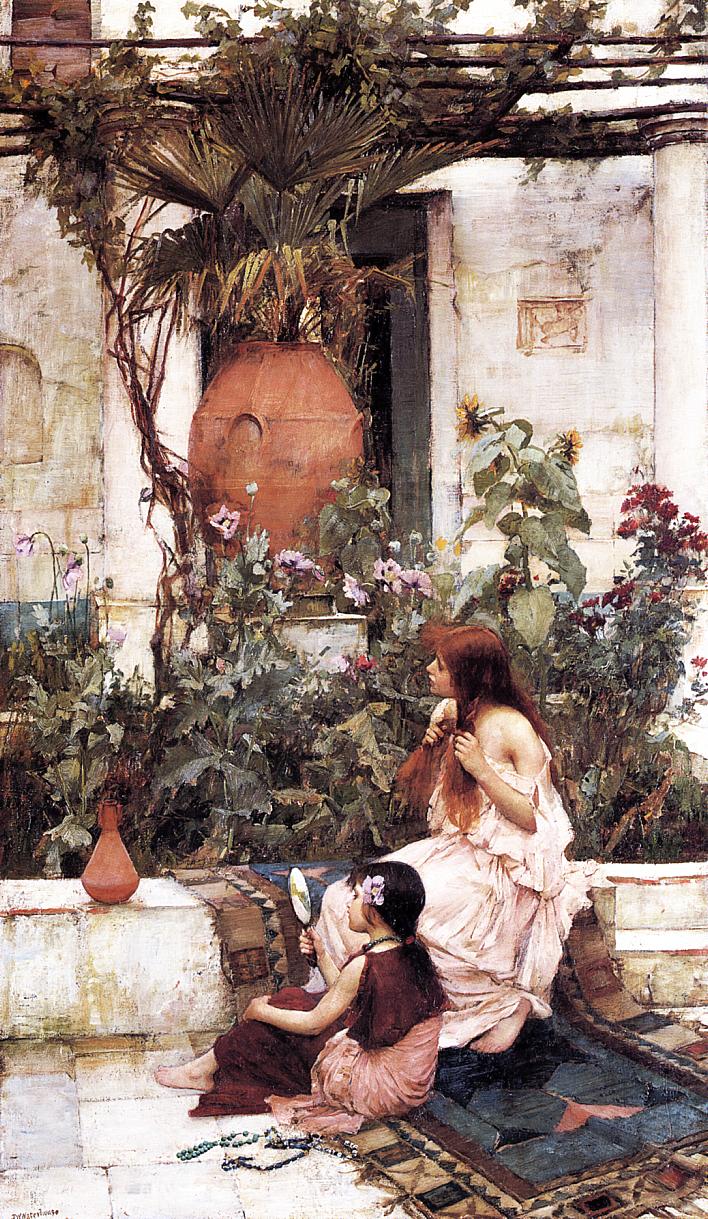
John William Waterhouse’s “The Toilet” (1889) greets you like an overheard moment, intimate but unguarded. Nothing “happens” in the loud sense. Two women pause in a courtyard space that feels both domestic and timeless, surrounded by layered greenery, pottery, and patterned textiles. Yet the stillness is charged with ritual. The title points to an everyday act of grooming, but Waterhouse turns that act into a small theater of attention, texture, and selfhood.
The scene is arranged so that your eye arrives at the women almost as if you have come upon them from the side. One figure with long auburn hair gathers it with both hands, her pale drapery slipping softly off one shoulder. The other, dark haired and seated slightly lower, holds a hand mirror angled upward, as though assisting, checking, or simply keeping company within the shared routine. A string of beads and small adornments lie on the pale ground in front of them, tangible evidence of a process underway. The painting’s emotional temperature is calm, but not empty. It is the calm of concentration, of a daily rite that becomes meaningful because it is repeated and because it is witnessed, even if only by another woman.
The meaning of the title and the Victorian fascination with toilette
In nineteenth century usage, “toilet” did not mean a bathroom. It referred to the act and the setting of dressing, arranging the hair, and preparing the body for the day or for appearance. Waterhouse’s title therefore frames the scene as preparation, not performance. The moment is private, but it is also a rehearsal for public life, a threshold between inwardness and display.
Victorian art and literature were deeply interested in thresholds like this. They offered a way to contemplate beauty, identity, and decorum without needing a mythic catastrophe or a grand historical event. A toilette scene permitted close looking: hair, fabric, skin, jewelry, reflective surfaces, flowers, pottery. It also carried an undertone of moral and psychological inquiry. Is the act vain, tender, meditative, communal, self possessed, or all of these at once? Waterhouse keeps the question open. He does not punish beauty, nor does he turn it into spectacle. Instead he invites you to notice the subtle social geometry: one woman prepares, another attends, and the space itself becomes an enclosing frame that makes their attention feel protected.
Composition and the architecture of enclosure
The composition is tall and layered, built like a shallow stage set with multiple screens. A pale wall occupies much of the upper right, its surface lightly marked, almost chalky, while a darker doorway recedes behind foliage. Above, a trellis or beam structure and trailing vines stretch horizontally, creating a canopy that compresses the sky and keeps the scene inward. In the center upper area, a large terracotta vessel sits nestled among leaves, anchoring the composition with a warm, earthy mass.
This architecture of enclosure matters. Rather than placing the figures in open landscape, Waterhouse situates them within a courtyard bounded by walls, plants, and textiles. The eye moves from the bright ground plane to the patterned rugs, then into the women’s drapery and hair, and finally up through foliage to the trellis line. The result is a gentle upward drift that never escapes the setting. Even the brightest areas feel filtered, as if the sun has been softened by shade and dust. The scene becomes a pocket of time, separated from urgency.
The two figures and the choreography of companionship
The toilette here is not solitary. Waterhouse makes the ritual social, a shared act that can be read as friendship, sisterhood, or quiet service. The auburn haired figure is positioned slightly higher and farther back, kneeling on layered textiles. Her posture turns inward. She gathers her hair, not toward the viewer but toward her own chest, as if focusing on the feel and weight of it. The gesture is practical, yet it looks ceremonial because Waterhouse gives it space and dignity.
The dark haired figure sits closer to the foreground, creating a bridge between viewer and action. She holds the mirror, an object that typically signals vanity or self absorption, but here it reads as assistance. The mirror’s face catches light and appears almost blank from this angle, emphasizing reflection as concept rather than as a literal portrait. The viewer is not granted a reflected face. That choice protects the women from being turned into a simple image of “looking at oneself.” Instead, the mirror becomes a tool within a relationship, an emblem of care and coordination.
The garden setting and the language of plants
The courtyard is lush, almost overgrown, with broad leaves, vines, and flowering stalks pushing against the architecture. Plants fill the middle of the painting like a living tapestry. Their density creates privacy, and their variety creates meaning. Tall blooms rise near the right, while clusters of smaller flowers dot the middle ground. The foliage is painted with an attention to irregular edges and layered shadows, giving the sense that the garden is not decorative wallpaper but a presence with weight and texture.
This living environment reframes the toilette as something close to nature rather than opposed to it. Grooming, arranging hair, and handling jewelry might suggest artifice, but the surrounding leaves and blossoms remind you that bodies are also organic, seasonal, and tactile. The women are not placed against sterile luxury. They are placed in a space where terracotta, soil, vine, and cloth coexist. Beauty appears as cultivation: the tending of plants and the tending of oneself become parallel activities.
Pottery, textiles, and the tactile realism of objects
Waterhouse is especially attentive to objects that record touch. The terracotta vessels feel porous and matte, their warm orange browns echoing the auburn hair and the warmer tones in the rugs. A smaller jug sits on the low wall at left, an accent that balances the larger vessel above. These pots are not only props. They are color anchors, stabilizing the palette and linking the human figures to the earthy material culture of the setting.
The textiles are equally important. The rugs beneath the women are patterned with geometric motifs and borders, suggesting careful craftsmanship and a taste for the decorative. Their arrangement is slightly irregular, as real rugs would be, and their folds create subtle ridges. The textiles form a comfortable island that separates the figures from the stark, pale ground. They also serve as a visual metaphor: the women’s ritual unfolds on a fabric of culture and pattern, a made world that sits atop stone.
Small adornments on the ground, including what appears to be a string of beads, bring the ritual down to a human scale. These items imply sequence. Something has been removed, set aside, and will be put on again. The painting becomes a narrative of process rather than of climax.
Color harmony: pale stone, warm clay, and muted roses
The color palette is restrained and harmonized. Pale stone and plaster dominate the architecture, creating a luminous backdrop that keeps the scene airy. Against that pale field, Waterhouse places muted roses, creams, and soft browns in the women’s drapery. The auburn hair provides a saturated accent without becoming garish. Greens occupy the middle zone in varied temperatures, from dusty olive to deeper, cooler shadow greens.
This harmony supports the mood. There are no sharp contrasts that would turn the scene dramatic. Instead, transitions are gradual. Even dark areas, like the doorway, feel softened by the surrounding plants. The result is a painting that invites sustained looking. Your attention can rest on subtle shifts: how a leaf edge catches light, how the folds of cloth move from warm highlight to cool shadow, how the terracotta vessel glows gently against foliage.
Light and the feeling of a sheltered hour
The light in “The Toilet” feels like daylight moderated by shade, perhaps filtered through the trellis and leaves above. The ground plane is bright but not glaring. The wall behind is illuminated in a way that reveals texture and minor imperfections, making it feel inhabited rather than pristine. The women’s skin and drapery catch light softly, emphasizing roundness and fabric thickness without sharp spotlight effects.
This moderated light strengthens the sense of a sheltered hour, a time in the day when tasks can be done slowly. It also aligns with the theme of preparation. Harsh light would suggest exposure and scrutiny. Soft light suggests permission, a private space where one can be in process.
Surface and brushwork: detail that stays atmospheric
Waterhouse balances specificity with atmosphere. Leaves, flowers, and patterned borders are described clearly enough to be recognized as individual forms, but they are not rendered with the hard precision of botanical illustration. Instead, edges often dissolve slightly into surrounding tones, allowing the scene to breathe. The wall is handled with broad, quiet passages that contrast with the busier foliage, giving the eye places to rest.
This balance matters for the psychological reading of the painting. Too much crispness would make the scene feel staged, like a diorama. Too little would make it vague. Waterhouse chooses a middle path that feels lived in: details are present, but they sit inside a coherent veil of light and air.
Classical atmosphere without a named myth
Although Waterhouse is often associated with myth and literature, “The Toilet” does not need a specific story to feel classical. The architecture, the courtyard enclosure, the terracotta vessels, and the draped garments evoke an imagined antiquity, a world adjacent to Rome or the Mediterranean, more poetic than archaeological. The painting offers the pleasures of the classical setting while keeping the narrative open.
This openness is part of the work’s appeal. You are not required to remember a legend. You are invited to inhabit a mood. The classical atmosphere acts like a distancing device, letting Victorian viewers contemplate intimacy, grooming, and feminine beauty at a safe remove. Yet for a modern viewer, that same atmosphere can feel like a timeless stage on which ordinary life becomes art.
Hair, mirror, and the symbolism of reflection
Hair is one of the painting’s central motifs. The auburn haired figure’s gesture emphasizes length and weight, making hair a material substance rather than a mere attribute. In nineteenth century art, hair often signaled vitality, sensuality, and identity. Here it also signals time. Hair takes time to care for. It requires patience and repetition. It is a daily reminder of the body’s continuity.
The mirror complicates this. Mirrors in art can suggest vanity, self knowledge, illusion, or the act of painting itself as a kind of reflection. Waterhouse’s mirror does not give us a clear reflected image, so it refuses a simple moral. Instead, reflection becomes relational. The mirror is held by one person for another, implying trust. The act of seeing oneself is not isolated; it is supported.
This is a subtle but powerful idea. It suggests that identity is not only self constructed but also shaped through companionship. The toilette becomes a shared practice of becoming presentable, but also of being seen kindly.
The gaze and the viewer’s position
One of the most delicate achievements of “The Toilet” is how it positions the viewer. The scene is intimate, yet the figures do not meet your eyes. Their attention is directed inward, toward hair, mirror, and each other. That choice prevents the painting from becoming a straightforward display. You are allowed to look, but you are not invited to intrude.
At the same time, the composition makes you aware of your own looking. The mirror, even when it does not show a face, reminds you of reflection and observation. The doorway behind suggests a private interior space beyond, a world the viewer cannot enter. The foliage acts like a screen. Together, these elements create a gentle tension: you are close enough to witness, but not close enough to possess.
Sensuality handled as atmosphere, not spectacle
The painting includes exposed skin and flowing drapery, but Waterhouse treats the body with restraint. The sensuality is primarily atmospheric, emerging from softness, warmth, and ease rather than from overt display. The women are absorbed in their own routine, which makes their physicality feel incidental and human rather than staged.
This is consistent with a broader aesthetic interest in the beauty of ordinary gestures. The fall of cloth, the curve of a shoulder, the act of brushing hair, the placement of beads on the ground, all become sites of quiet attention. The viewer is asked to appreciate the poetry of preparation rather than to consume a dramatic narrative.
Waterhouse in 1889: beauty, decoration, and inward narrative
Placed in 1889, “The Toilet” sits within Waterhouse’s mature engagement with female subjects and evocative settings. Even when he paints mythic or literary heroines, he often lingers on moments of contemplation rather than on action. Here, he removes the myth entirely and keeps the contemplative structure. The painting becomes a study of mood and material culture as much as a depiction of figures.
The work also reflects a late nineteenth century fascination with decorative environments. The patterned rugs, the pottery, and the layered plants show an artist attentive to design as an emotional language. Decoration is not superficial here. It becomes the very medium through which intimacy is expressed. A private ritual needs a private world, and Waterhouse builds that world through texture and pattern.
Why “The Toilet” still resonates
“The Toilet” endures because it captures something familiar in a setting that feels elevated. Everyone understands preparation, the quiet before the day, the slow arranging of self. Waterhouse turns that universal experience into a scene of companionship and calm, framed by a garden that seems to breathe around the figures. The painting offers rest. It offers an image of time not spent in urgency.
It also resonates because it respects its subjects. The women are not reduced to symbols or moral lessons. They are engaged in an ordinary act that becomes meaningful through attention and care. The painting suggests that beauty is not only an end result. It is a process, shared, tactile, and lived.