Image source: wikiart.org
A familiar tragedy, reimagined
Ophelia is one of the most recognizable figures in Western art because she sits at the crossroads of story, symbol, and emotion. In William Shakespeare’s Hamlet, she is a young woman crushed between private feeling and public power, pulled apart by forces she cannot control. When John William Waterhouse painted Ophelia in 1889, he was not simply illustrating a scene from literature. He was translating a psychological collapse into a visual language that late Victorian audiences understood instantly: the fallen flower, the abandoned body, the natural world that both cradles and erases human presence.
Waterhouse returns to Ophelia again and again across his career, and that repetition matters. It suggests the subject was not a one time commission or a passing literary fashion, but a lasting imaginative problem: how to picture innocence and desire, vulnerability and beauty, in a way that stays poetic rather than sentimental. This 1889 version approaches the theme with restraint. It does not rely on spectacle. Instead, it builds its impact through quiet staging, careful contrasts, and an atmosphere that feels heavy with paused time.
What you see first and why it works
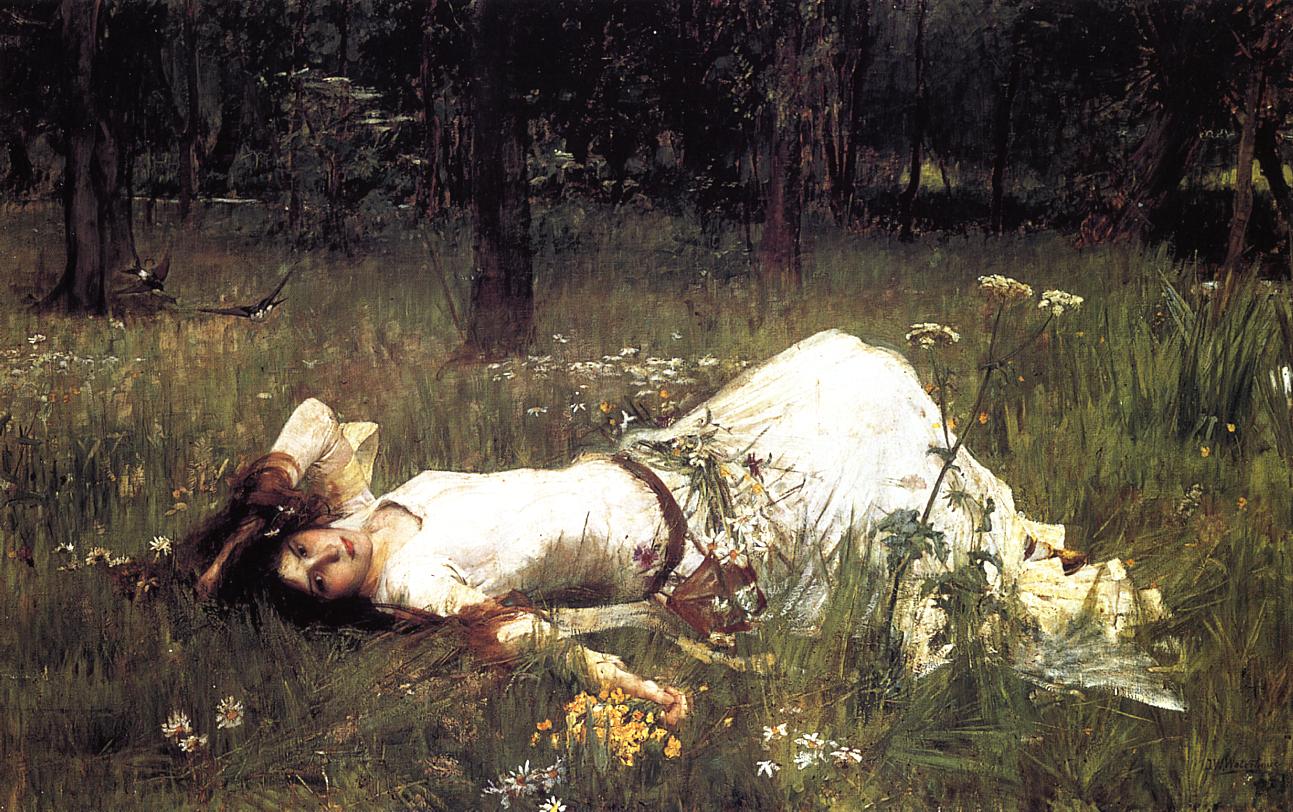
The painting’s immediate hook is the figure’s placement: Ophelia lies horizontally across the grass, close to the picture plane, so the viewer meets her at ground level. That compositional choice collapses distance. You are not watching a narrative unfold from a safe vantage point. You are almost beside her, as if you have come upon the scene by accident. The body becomes a landscape line, a pale band of fabric and skin cutting through darker greens and browns.
Her white dress is the primary light source of the picture. It catches and reflects brightness against the subdued field and the shadowed tree line behind. This is not just a technical decision. It is the painting’s emotional logic. The dress reads as bridal, ghostly, ceremonial, and vulnerable all at once, so the light it carries feels like something fragile that could be extinguished by the surrounding darkness.
Waterhouse uses the environment like a stage set that refuses to behave like a neutral background. The grasses and wildflowers are not decorative filler. They press into the figure, surround her, touch her, and visually claim her. Nature is presented as intimate and indifferent in the same breath. That tension is crucial to how Ophelia’s story has been pictured for centuries: the world is beautiful, and the world does not stop.
A pause between life and legend
Although the title cues tragedy, the scene itself is suspended. Ophelia is not shown in dramatic motion. She is not struggling, pleading, or performing for the viewer. The stillness is unsettling because it can be read in multiple ways. Is she exhausted? Fainted? Already beyond help? The ambiguity keeps the image from becoming a simple illustration of a plot point. It becomes a portrait of a threshold.
Her face is turned toward us, with a gaze that does not fully lock onto the viewer. That slight remove matters. A direct, sharp stare would create confrontation. A fully closed eye would lock the reading into finality. Waterhouse chooses the in between. The expression feels distant, as if consciousness is slipping away or retreating inward. The result is a mood of emotional quiet that can feel louder than melodrama.
This kind of controlled ambiguity is one reason Waterhouse’s women often feel modern. They are not only symbols. They also appear to have private inner lives that the viewer cannot fully access. Ophelia becomes both a character we recognize and a person we cannot entirely interpret.
The landscape as psychological space
The setting is not a picturesque meadow in bright daylight. It is a slightly wild, partially shadowed clearing where the background trees form a dark wall. That wall is important. It compresses depth and creates a sense of enclosure, as if the world is closing in. Even though the scene is outdoors, it does not feel open.
The ground plane is textured with small flowers and uneven grasses, suggesting an uncultivated edge rather than a garden arranged for pleasure. This choice aligns Ophelia with marginal spaces: not the court, not the interior, not the controlled social environment where rules apply, but the place where rules fade and consequences arrive.
Waterhouse also uses the landscape to pace the viewer’s looking. The eye moves from the bright dress to the softer tones of her hair and face, then out into the field of greens, then back again. The painting creates a slow loop rather than a single focal punch. That slow looking echoes the theme of drifting, of time stretching, of a mind unmooring.
Color, value, and the drama of whiteness
The palette is dominated by muted greens, earthy browns, and smoky shadows. Against that, the white dress becomes more than clothing. It becomes a visual event. Waterhouse modulates the whites carefully so they do not flatten into one tone. You can sense folds, weight, and fabric thickness. This gives the figure physical credibility, which in turn makes her vulnerability more convincing.
The whites also carry subtle hints of warm and cool shifts, letting the dress feel like it belongs to the environment rather than pasted on top. Where the fabric meets shadow, it picks up darker notes from the grass and earth. Where it catches light, it glows. That push and pull is the painting’s heartbeat.
Color also works symbolically. The surrounding greens can suggest life, growth, and renewal, while the encroaching darkness suggests forgetting and absorption. The figure sits between those forces, visually and narratively. The image never needs a literal emblem to tell you what is at stake because the values already speak.
Gesture, pose, and the body’s narrative
Ophelia’s pose reads as both graceful and undone. One arm bends back behind her head, a gesture that could belong to sleep or surrender. The other extends outward, hand relaxed, as if the last intention has drained away. The body is arranged in a way that retains beauty, but it is a beauty edged with discomfort because it is too still.
Waterhouse’s handling avoids sensationalism. The figure is clothed, the scene is modest, and the focus is not on shock. Yet the emotional charge remains strong because the painting emphasizes helplessness rather than violence. The tragedy is not presented as an external act inflicted in the moment, but as a state that has arrived and settled.
Her hair, darker and looser than the dress, frames the face and grounds it. The contrast between the dark hair and the pale fabric heightens the sense of fragility. It also echoes a common Victorian visual code where loose hair can imply emotional unraveling, a release from social containment.
Flowers as language, not decoration
Ophelia is famously tied to flowers in Hamlet, where plants become a kind of emotional vocabulary. Waterhouse leans into that tradition, but in a way that feels integrated rather than staged. The flowers scattered near her and around her body act like punctuation marks. They soften the scene while also hinting at memorial, offering, and loss.
Even if a viewer cannot name specific species, the effect still lands. Small blossoms imply delicacy. Wildflowers imply the untamed. A bouquet like cluster near her hand can suggest a dropped intention, something once held that is now released. In paintings of Ophelia, flowers often carry the double meaning of youth and perishability. They are beautiful precisely because they will not last.
Waterhouse’s subtlety is in scale and placement. The flowers do not compete with the figure. They support the narrative by keeping the mood tender rather than grim, and by connecting Ophelia to the rhythms of growth and decay that the landscape embodies.
Technique and the feel of paint
Waterhouse is often associated with the orbit of the Pre-Raphaelite Brotherhood and its afterlife, but he is not simply copying earlier methods. In this painting, the brushwork balances detail with softness. The figure’s face and dress receive more careful modeling, while the background trees dissolve into darker, looser strokes. That contrast guides attention and also builds atmosphere.
The surface suggests a painter interested in tactile realism without turning the image into a hard edged study. The grasses are suggested more than counted. The trees read as mass and shadow rather than botanical inventory. This approach supports the theme. Ophelia’s identity is becoming less fixed, less contained, and the world around her mirrors that by slipping into generalized dusk.
If you look at the transitions, you can sense Waterhouse’s control of edges. Some contours are crisp enough to feel present, while others blur into the ground, as if the figure is already being absorbed. That edge control is one of the most effective, and quiet, storytelling tools in the work.
Waterhouse, Victorian taste, and the appeal of doomed heroines
By 1889, literary subjects were a well established part of British painting culture. They allowed artists to combine respectability with emotion, because literature offered an approved framework for depicting passion, despair, and moral complexity. Ophelia fit perfectly. She was tragic, innocent, and poetically framed by Shakespeare’s authority.
Victorian audiences were also drawn to the idea of the sensitive heroine overwhelmed by circumstances. These figures functioned as both cautionary tales and objects of empathy. The cultural lens often romanticized female suffering, turning it into an aesthetic experience. Waterhouse participates in that tradition, but he also complicates it by giving Ophelia a presence that feels personal rather than purely emblematic.
The painting’s restraint is part of why it endures. It does not scream its message. It invites slow attention, and it allows viewers to feel sadness without being pushed into moralizing. That emotional openness helps the image travel across time, reaching modern viewers who may reject Victorian values yet still respond to the human vulnerability depicted.
Conversation with earlier Ophelias
Any painter tackling Ophelia steps into a visual conversation already in progress. The most famous earlier example is by John Everett Millais, which set a high bar for lush natural detail and dramatic poignancy. Waterhouse’s 1889 approach differs in emphasis. Instead of immersing Ophelia in water as a central spectacle, he foregrounds her as a body in a field, making earth and grass the immediate companions to her fate.
This shift changes the emotional temperature. Water can feel lyrical and ceremonial, a medium that carries the figure away. Grass feels quieter, closer, more ordinary, and that ordinariness can intensify the sadness. It implies that tragedy does not always arrive with theatrical flair. Sometimes it arrives like exhaustion, like a final stillness in a place that continues to grow.
By placing Ophelia on land, Waterhouse also heightens the sense of interruption. She seems caught before the story reaches its most widely known image. That “before” feeling keeps the painting poised, making it less about one definitive moment and more about the inevitable pull of the narrative closing in.
The painting’s emotional engine: tenderness under shadow
What makes this Ophelia persuasive is not only its subject, but its tone. Waterhouse paints her with tenderness. There is no cruelty in the gaze of the painter. The scene feels mournful rather than punitive. The darkness behind her does not mock her, but it does not rescue her either. It simply exists, a weight of atmosphere that the figure cannot overcome.
That balance between compassion and inevitability is hard to achieve. If the image becomes too sentimental, it collapses into sweetness. If it becomes too harsh, it loses its poetry. Waterhouse threads the needle by letting the beauty remain real while allowing the sadness to remain unresolved. The viewer is left with a feeling rather than a lesson.
This is also where the painting aligns with Ophelia’s role in Hamlet. She is not the engine of the plot. She is one of its casualties. Her tragedy exposes how power struggles damage the vulnerable. Waterhouse makes that vulnerability visible without turning it into spectacle, which is why the picture can feel haunting in a quiet way.
Why Ophelia still resonates
Ophelia persists because she speaks to experiences that are not confined to Shakespeare’s Denmark or to Victorian England. She represents the moment when a person’s inner life is overwhelmed by external demands, when language fails, when grief becomes private and isolating. Even viewers who do not know Hamlet can read the image as a story of collapse, exhaustion, or abandonment.
At the same time, the painting is undeniably beautiful. That beauty raises a difficult question that all tragic art raises: what does it mean to find aesthetic pleasure in scenes of suffering? Waterhouse does not answer that question. He presents the contradiction and allows it to remain. The viewer must hold both realities at once: the loveliness of paint and the sadness of the subject.
This tension is part of what makes Waterhouse a compelling artist for modern audiences, especially those drawn to emotionally charged figurative painting. Ophelia becomes a mirror. Some viewers see romance, others see warning, others see grief without romance at all. The painting’s openness is its strength.