Image source: wikiart.org
First impressions and the painting’s dramatic premise
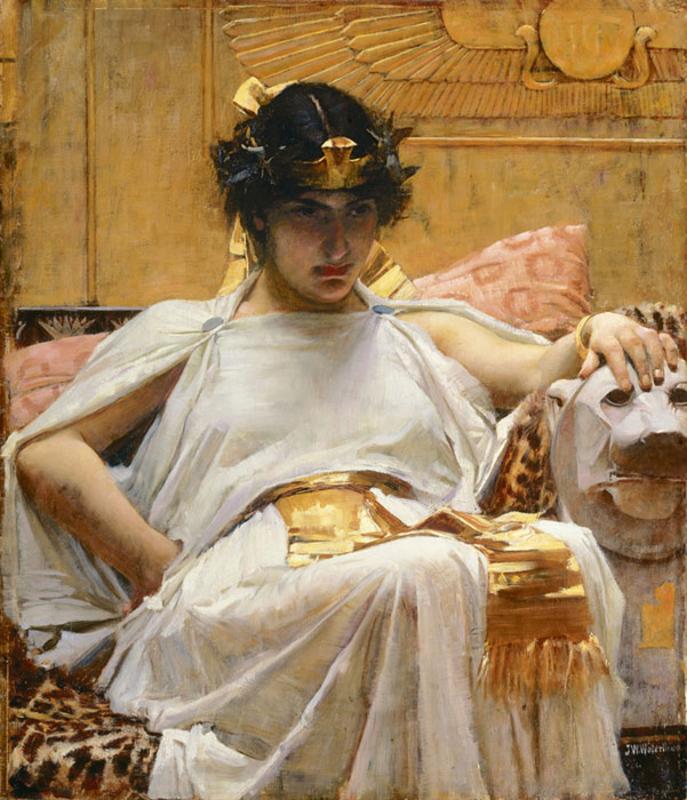
John William Waterhouse’s “Cleopatra” (1887) meets you with a paradox that feels deliberate. Cleopatra is presented as an icon of absolute authority, yet the mood is not triumphant. Instead, the scene turns on a kind of poised stillness, as if power has settled into the body and become heavy. Waterhouse places her in a richly appointed interior, framed by warm golds and sandy ochres that read as both luxurious and suffocating. The palette suggests sunlight filtered through stone, a world built to endure, and a ruler who must endure with it.
The immediate hook is psychological. Cleopatra reclines, not in languor but in command of space, with a posture that signals ownership of everything within reach. Her gaze is lowered and concentrated, withholding direct contact with the viewer. That refusal matters. In many Victorian imaginings, Cleopatra is a spectacle designed for consumption. Waterhouse instead gives her a private gravity. We are close enough to study the textures of her garments and the sheen of metal, but we are kept outside her thoughts. The painting’s tension grows from that gap between visual access and emotional distance.
Even the title alone carries a heavy load. Cleopatra is not just an individual but a story made from politics, desire, propaganda, and myth. By choosing her, Waterhouse steps into a long tradition of artists turning historical women into symbolic battlegrounds. His solution is not to illustrate a famous episode explicitly, but to craft an atmosphere in which the idea of Cleopatra, strategist, seductress, monarch, survivor, can be felt as a presence rather than narrated as a plot.
Waterhouse in 1887 and the Victorian imagination of antiquity
By 1887, Waterhouse was increasingly associated with subjects that blend narrative suggestion with sensuous surface. Although he is often grouped with Pre Raphaelite tendencies, his approach is not identical to the early Brotherhood’s microscopic brightness. Waterhouse is more interested in mood, in the soft diffusion of paint, and in the theatrical arrangement of figure and setting to imply a story that continues beyond the frame.
Victorian Britain was fascinated by antiquity, especially Egypt, Rome, and the Hellenistic world. Archaeological discoveries, museum culture, travel writing, and popular histories fed a public appetite for images that felt “authentic,” even when filtered through modern fantasies. Cleopatra, in particular, became a magnet for contradictions. She could be presented as dangerously foreign, irresistibly alluring, or tragically doomed. She could also be admired as a master of statecraft. This flexibility made her ideal for late nineteenth century painting, which often sought historical distance as a safe stage for contemporary anxieties about gender and authority.
Waterhouse’s Cleopatra belongs to that climate, but it does not simply repeat the era’s moralizing clichés. The painting holds its judgment in suspension. Cleopatra is neither punished nor redeemed within the image. She is simply there, occupying the scene with a quiet intensity that feels earned. The result is a portrait of power that does not need action to prove itself.
Composition and the choreography of control
The composition is built to make Cleopatra feel central even while she reclines. Waterhouse anchors her body diagonally across the canvas, a line that creates movement without requiring motion. The curve of her drapery, the bend of her arm, and the spread of fabric across her lap all guide the eye back to her face. The figure becomes a calm pivot point around which everything else turns.
Her throne or couch is not a neutral support. It is part of the language of rule. The seat is broad, elevated, and visually dense, with animal patterned textiles and sculptural details that hint at both luxury and dominance. These textures function like a visual chorus, repeating the theme of possession. Cleopatra rests on trophies of material culture, as if the environment itself has been arranged to affirm her supremacy.
Waterhouse also uses framing devices in the background to stabilize the scene. Large, flat planes of gold and stone create an architectural enclosure behind Cleopatra, preventing the composition from dispersing. This enclosure does more than provide context. It suggests a sealed world, courtly, ceremonial, and controlled. Within that controlled space, Cleopatra’s stillness reads as deliberate restraint rather than inertia.
Color, light, and the emotional temperature of gold
The painting’s color harmony leans heavily on gold, beige, and warm brown, punctuated by soft whites and occasional deeper accents. Gold dominates, not as glittering ornament but as a pervasive atmosphere. It evokes Egyptian iconography and royal splendor, but it also creates a sense of heat and closeness. The room feels airless, like a chamber where decisions are made and consequences linger.
Cleopatra’s white drapery becomes a crucial counterbalance. White here does not mean innocence. Instead, it functions as a luminous field that catches light and reveals the weight of fabric. Waterhouse lets the white cloth become a landscape of folds, shadows, and highlights, turning clothing into a display of painterly skill. The contrast between white fabric and gold surroundings intensifies her presence. She appears like a figure carved out of brightness, yet pressed against an environment that threatens to absorb her.
Light is handled with subtlety. Rather than a sharp, theatrical spotlight, the illumination feels ambient, as if the room itself glows. This choice softens edges and encourages a reading based on mood. Cleopatra’s face emerges from shadowed tones, which makes her expression more enigmatic. The more the setting gleams, the more her eyes retreat, and the painting’s emotional temperature becomes one of contained power.
Material surfaces and Waterhouse’s tactile storytelling
One of Waterhouse’s strengths is his ability to let surfaces carry meaning. In “Cleopatra,” paint becomes a way to distinguish categories of experience: the cool certainty of metal, the softness of fabric, the animal sensuality of patterned textiles, the solidity of carved structure. Each surface contributes to a portrait of a ruler surrounded by wealth, yet also bound to it.
The jewelry and metallic elements, including the crown like headpiece, are not merely decorative. They act as visual shorthand for sovereignty. But Waterhouse avoids making them too crisp or overly detailed. He suggests their sheen and weight through controlled highlights and warm reflections, integrating them into the overall tonal unity. Cleopatra’s power is not an accessory added on top of her body. It is fused with her presence.
The textiles are particularly expressive. The leopard or animal patterned cloth reads as a deliberate signal of luxury and dominance. Animal skins and exotic patterns have long been associated with conquest and prestige. Here they also echo Cleopatra’s reputation in Western imagination as a figure of dangerous allure. Yet the pattern is not sensationalized. It is part of the room’s vocabulary, a normal texture of rule in a world that celebrates display.
Cleopatra’s posture, expression, and the psychology of sovereignty
Cleopatra’s body language is the painting’s core. She reclines, but the posture is not passive. One arm braces, the other extends outward, suggesting ease that comes from authority. She occupies space without apology. The angle of her shoulders and the set of her head create an impression of someone who can afford stillness because she controls the pace of events.
Her expression is more complex than simple seduction. The lowered gaze suggests calculation, introspection, or guardedness. Waterhouse gives her an inward focus, which resists the viewer’s desire to reduce her to a symbol. This matters because Cleopatra has often been flattened into stereotypes. Here she feels like a person who has learned that power requires privacy.
There is also a sense of fatigue beneath the magnificence. Not physical exhaustion in any obvious way, but the fatigue of holding a role that never fully relaxes. The heavy gold surroundings, the ceremonial costume, the emblematic backdrop, all imply that Cleopatra’s identity is partly constructed by the state. Waterhouse captures the moment when the ruler is alone with the burden of being seen as the ruler.
Iconography and Egyptian echoes without literal narration
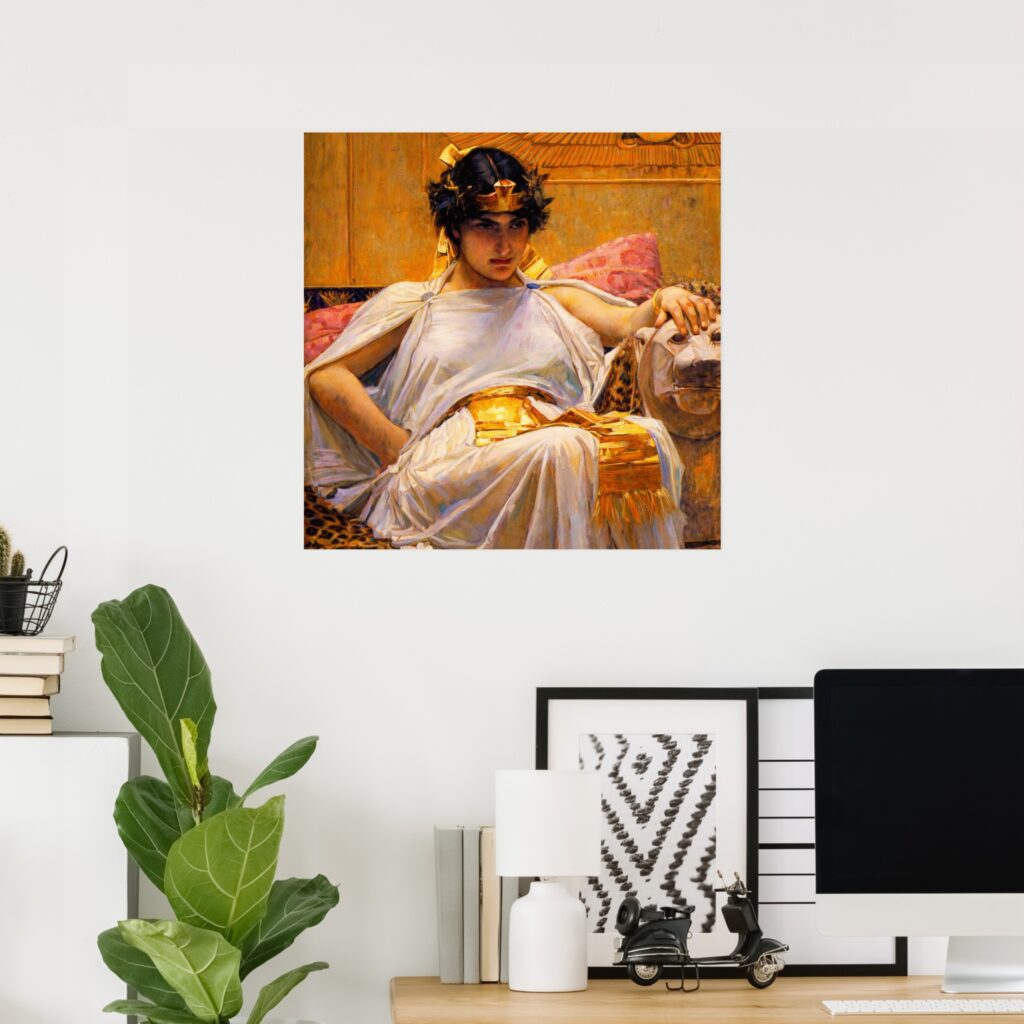
The background contains Egyptian motifs, including winged imagery that recalls temple reliefs and royal symbolism. Waterhouse uses these signs to place Cleopatra within a mythic framework, but he avoids turning the painting into an archaeological diagram. The effect is atmospheric authenticity rather than scholarly reconstruction.
The winged emblem above or behind Cleopatra works like a visual halo, but an imperial one rather than a spiritual one. It suggests divine legitimacy, a ruler aligned with cosmic order. In ancient Egyptian ideology, kingship was entwined with the sacred. Cleopatra, though historically Greek Macedonian by dynasty, ruled in an Egypt where royal imagery was deeply Egyptian in its claims. Waterhouse’s choice to include such motifs emphasizes her political intelligence. She is a ruler who understands the power of symbols and performs authority through them.
At the same time, the painting’s lack of a specific narrative episode makes the iconography feel psychological. These emblems surround her like thoughts or obligations. They are the architecture of her public identity, and they loom above her even in repose.
The Victorian “femme fatale” and Waterhouse’s subtler rewrite
Late nineteenth century art often framed powerful women as enchanting threats. The “femme fatale” archetype allowed artists to explore desire while also warning against it. Cleopatra was frequently absorbed into this pattern. She became a story about the dangers of female agency, told through the language of beauty and downfall.
Waterhouse borrows some of that vocabulary, luxurious setting, sensual textures, and an emphasis on magnetic presence, but he tempers the moral panic. Cleopatra is not presented mid seduction. She is not actively performing for a male viewer within the painting. Instead, she seems to be thinking, waiting, deciding. The drama is internal.
This internalization shifts the ethical center of the work. Rather than implying that Cleopatra’s power is purely erotic, Waterhouse suggests that her power is strategic and sovereign. Beauty is part of the image, but it is not the explanation of her rule. The painting becomes less a warning and more a study of a person who cannot be easily read.
Narrative suggestion and the feeling of an offstage world
Although the scene is quiet, it does not feel isolated. The arrangement implies an offstage court, a political situation, perhaps messengers, alliances, betrayals, negotiations. Waterhouse creates this sense through absence. There are no attendants, no obvious props of action, yet the setting is too ceremonial to be merely domestic. Cleopatra appears in a space that belongs to the state, not to private life.
That ambiguity invites the viewer to supply the story. Is she anticipating an audience, preparing a response, weighing a decision, recovering from an encounter, or rehearsing how she will appear when others enter? The painting’s strength is that any of these readings can fit. Cleopatra’s stillness becomes a pause in a larger narrative, and the viewer feels the pressure of what comes next.
This is a key reason “Cleopatra” remains compelling for modern audiences. It does not lock the figure into a single moral lesson. It keeps the story open, anchored in psychological realism rather than melodramatic illustration.
Technique, brushwork, and the balance between detail and haze
Waterhouse’s paint handling here supports the mood. He gives enough detail to make surfaces convincing, especially in fabric and metallic highlights, but he avoids over sharpening. Edges soften into surrounding tones, and the overall effect is cohesive, like a memory or a dream of antiquity rather than a literal snapshot.
This balance between specificity and softness helps the image feel intimate. Cleopatra’s face is not rendered with photographic precision. It is modeled through tone and shadow, letting expression remain elusive. The drapery, by contrast, receives more attention, because its folds carry light and shape, and because clothing functions as both costume and symbol.
The restrained brushwork also aligns with the painting’s psychological theme. Too much crispness might have turned Cleopatra into an object. Waterhouse’s gentler handling keeps her alive, present, and slightly unknowable.
Why this Cleopatra resonates today
“Cleopatra” endures because it offers a portrait of power that is neither celebratory nor condemning. Waterhouse captures an archetypal figure at a human scale, showing how authority can be both a privilege and a constraint. Cleopatra’s environment is magnificent, yet it presses in. Her posture is relaxed, yet vigilant. Her expression is calm, yet guarded.
For viewers interested in Waterhouse, the painting also expands the usual perception of him as a painter of romantic tragedy and mythic enchantment. Here, the romance is not the main engine. Instead, the central theme is sovereignty and self possession. It is a Cleopatra who does not need spectacle to be formidable.
For anyone searching for Cleopatra art, Waterhouse’s version offers a distinctive alternative to more overtly narrative treatments. It does not rely on famous props or explicit scenes. It relies on presence. The result is a painting that feels modern in its respect for interiority, even while it remains rooted in Victorian historical fantasy.