Image source: wikiart.org
Introduction to The Magic Circle (1886)
John William Waterhouse’s The Magic Circle (1886) is one of the most memorable images of ritual and mystery in Victorian painting. At first glance, it feels like a story paused at its most decisive instant: a solitary woman performs a spell outdoors, guarded by fire, smoke, and watchful birds. Yet the painting is not only about an occult moment. It is about control, performance, and the way belief becomes visible through gesture, atmosphere, and carefully staged detail. Waterhouse builds a scene that is easy to read as narrative, but hard to reduce to a single meaning. Are we witnessing protection, invocation, or warning? Is the figure a healer, a prophet, a “dangerous” enchantress, or simply a woman refusing to be interpreted by anyone except herself?
The lasting appeal of The Magic Circle comes from this balance between clarity and ambiguity. The ritual is legible: a circle is being drawn, a brazier burns, smoke rises like a column. At the same time, Waterhouse avoids the tidy moral labels that often cling to depictions of magic. Instead, he invites the viewer to linger on the textures of the act itself, the slow certainty of the figure’s posture, the hush of an open landscape that seems to be holding its breath. The result is a painting that reads like a myth, but feels like a psychological portrait.
A Close Visual Description of the Scene
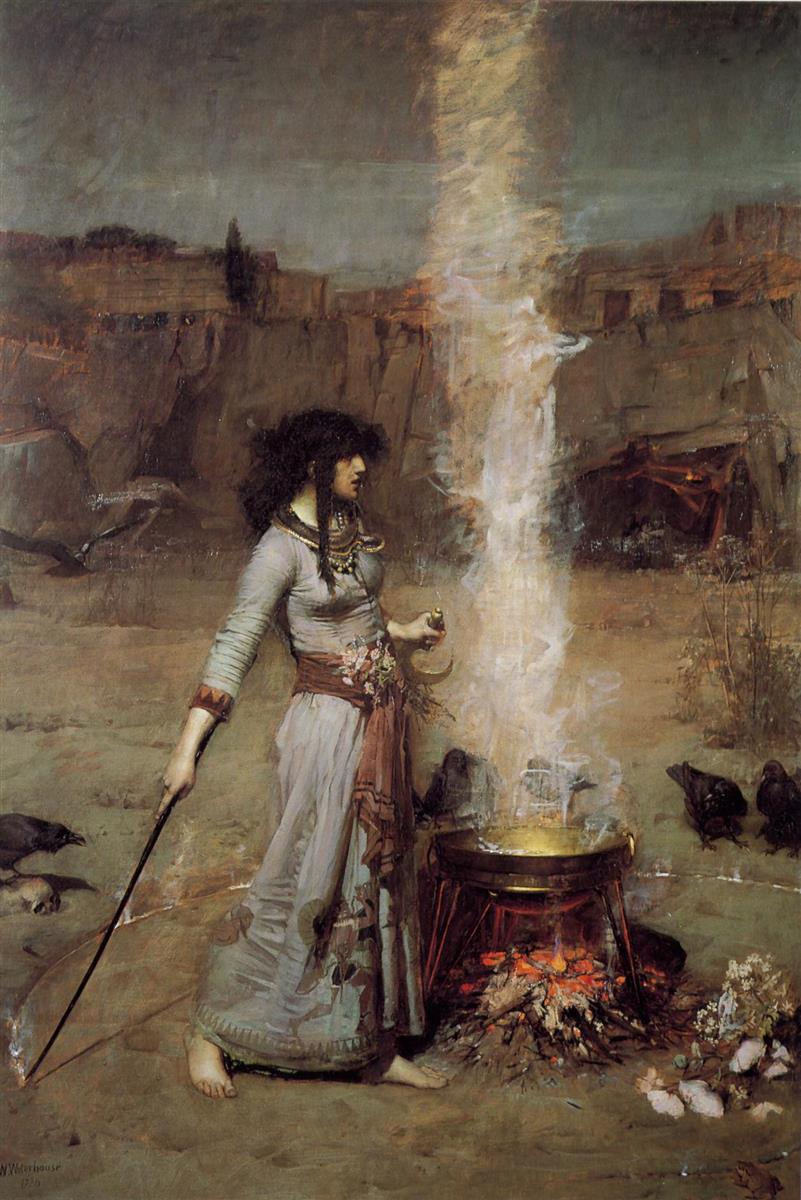
The composition centers on a barefoot woman standing beside a wide metal brazier or cauldron set over a fire. The flames glow at ground level, and a thick plume of pale smoke rises upward, twisting and expanding as it climbs. The smoke becomes an active vertical force in the painting, almost like a temporary pillar that divides the space and turns the air into a stage.
The woman wears a pale, close fitting dress with long sleeves and a reddish sash at the waist. Her dark hair falls in heavy waves, framing a profile that looks calm and intent rather than frantic or theatrical. Around her neck sit layered ornaments that suggest antique jewelry, adding to the sense that this is a scene from an imagined ancient world rather than contemporary Britain. In one hand she holds a thin staff or wand angled down toward the ground; with it, she traces a circle around the fire. In her other hand she carries a small vessel, as if it contains oil, incense, or a prepared mixture.
Around her, dark birds gather and hover at the edge of the action. They do not erupt into motion; they watch, as if they belong to the ritual’s perimeter. Behind, the landscape is dry and stony, with low ruins and rock faces under a muted sky. Nothing in the background competes with the central act, but everything supports it, making the world feel stripped down to essentials: earth, fire, smoke, and will.
Composition and the Geometry of Control
Waterhouse organizes The Magic Circle around a simple but powerful structure: a horizontal ground plane interrupted by a strong vertical column of smoke, with the woman as the human axis that negotiates between them. The smoke rises almost like a boundary line drawn in air, while the circle being traced on the ground creates a boundary line drawn on earth. One boundary is visible but unstable, always shifting; the other is invisible but conceptually firm, defined by belief and intention.
The figure’s placement is carefully calibrated. She stands slightly left of the brazier, not directly centered, which prevents the scene from becoming symmetrical and static. Her body turns toward the fire, but her head angles outward, suggesting attention that extends beyond the flame to the space she is claiming. The staff points down toward the circle, directing the viewer’s eye to the unseen line that matters most. The ritual, in other words, is not primarily “in” the cauldron. It is in the act of marking territory, of declaring where power begins and ends.
This is one reason the painting feels so composed and self possessed. Even the birds and scattered details are pulled into the orbit of the circle. Waterhouse uses geometry to communicate authority. The woman is not overwhelmed by supernatural chaos; she is the one establishing terms.
Light, Color, and the Weather of the Painting
The palette of The Magic Circle is restrained, dominated by soft browns, dusty ochres, smoky whites, and subdued grays. Against this muted world, the fire provides the painting’s warm core: orange embers, red heat, and a yellowish glow that reflects faintly in the metal rim. Waterhouse does not paint the flames as a spectacle. He paints them as a working heat, practical and real, like something you can feel on your skin.
The smoke is where the color strategy becomes especially expressive. It is not simply white; it carries cream, gray, and faint warmth, thickening near the source and thinning as it rises. The smoke’s shifting tones make it feel alive, and because it climbs into a darkening sky, it reads as a temporary bridge between human action and the larger, indifferent atmosphere. The sky itself is not dramatic in the sense of a storm at full violence, but it is heavy enough to make the ritual feel timely, as if the air is already charged.
These choices produce a specific mood: not horror, but tension and concentration. The world looks quiet, yet the lighting suggests that something is changing. Waterhouse paints magic not as a bright explosion but as a pressure in the air, a gradual conversion of ordinary elements into signs.
The Figure as Ritual Specialist Rather Than Fantasy Stereotype
Many depictions of sorcery lean on exaggerated expressions, frantic gestures, or overt menace. Waterhouse does something subtler. His central figure is composed, almost methodical. Her calm is the painting’s most unsettling element, because it suggests competence. She does not need to prove her power through spectacle. She is absorbed in procedure.
Her bare feet matter here. They connect her directly to the ground, implying intimacy with the earth and a willingness to be physically present in the act. The clothing, while evocative of antiquity, remains believable as fabric, draped and weighted, not costume in a cheap sense. This realism anchors the scene. It tells the viewer that the ritual is not an abstract symbol, but a practiced craft with tools, steps, and material choices.
Even her profile contributes to the impression of expertise. Waterhouse gives her a focused gaze that does not search for approval. She appears to be listening, measuring, or timing. In The Magic Circle, magic becomes a kind of knowledge. The painting does not ask, “Do you believe?” so much as it asks, “What does belief look like when someone truly acts on it?”
The Circle as Boundary, Protection, and Claim
The magic circle is the painting’s central idea, even though the circle itself is only implied by her motion and the staff’s path. This is a brilliant narrative decision. By not drawing a bold line for the viewer, Waterhouse forces us to participate imaginatively. We must “see” the boundary in our minds, which is exactly how symbolic boundaries function. They are real because people act as if they are real.
A circle can mean many things at once. It can be protection, a barrier that keeps danger out. It can be containment, a way of trapping or controlling what is summoned. It can also be a claim, a declaration of authority over a piece of ground. The painting does not lock the circle into one role; it lets the ambiguity enrich the scene. The woman’s stance is confident enough to support any of these meanings.
There is also a psychological layer. A circle is a way of defining the self against the world. In that sense, the ritual can be read as an image of inner concentration. The circle is the mental space of decision, drawn outward into the visible world through repeated, deliberate action. Waterhouse makes the invisible visible without needing any literal supernatural creature to appear.
Fire, Smoke, and the Material Language of Transformation
The brazier and its smoke do more than set the mood. They establish a theme of transformation. Fire changes whatever it touches. Smoke is proof of that change, the visible trace of a process you cannot fully grasp by sight alone. In this painting, smoke becomes the ritual’s “voice,” rising and curling as if it carries a message upward.
The metal vessel adds another layer: it suggests containment, chemistry, preparation. Whether the contents are herbs, resin, or something imagined, the form implies that magic is not purely spiritual. It is material practice. Waterhouse’s treatment of the fire, embers, and rimmed metal keeps the ritual grounded in the physical world. You can almost smell the burning, hear the faint crackle, feel the heat radiating into the cool air.
This material emphasis matters because it keeps The Magic Circle from becoming purely illustrative fantasy. Waterhouse is painting an experience, a sensory event, not just a storybook concept. The ritual is credible because it is tactile. The supernatural, if it exists here, arrives through the ordinary elements.
Birds, Watching Presences, and the Edges of the Spell
The dark birds clustered nearby function like a chorus. They intensify the feeling that the ritual is being observed, but not necessarily by human eyes. Birds often carry layered associations: omen, messenger, scavenger, witness. In The Magic Circle, they act as boundary markers. They hover near the action without crossing into it, reinforcing the idea that the circle establishes a zone with rules.
Their presence also creates a moral ambiguity. Birds can suggest death or ill fortune, but they can also suggest intelligence and adaptation. Waterhouse does not force the birds into a single symbolic job. Instead, he uses them to heighten alertness. Their stillness is not peaceful; it is attentive. They make the scene feel slightly off balance, like the world is pausing to see what happens next.
Importantly, the birds keep the painting from becoming sentimental. The figure may be beautiful and composed, but the birds prevent an easy romantic reading. They introduce a reminder that nature is not gentle. Nature watches, waits, and responds.
An Imagined Antiquity and Victorian Fascination with Myth
Although The Magic Circle was painted in 1886, its world feels displaced into an imagined ancient past. The rocky setting, the ruin-like structures, the costume, and the ritual all evoke a classicizing fantasy of antiquity. This was a fertile territory for Victorian art: a space where myth, archaeology, and imaginative reconstruction could blend.
Waterhouse was especially drawn to subjects that allowed him to combine narrative drama with sensual, painterly atmosphere. Rather than illustrating a single, named episode with strict accuracy, he often built scenes that feel like they could belong to many myths. That approach is visible here. The painting does not need a captioned story to work. It trades in archetypes: the enchantress, the boundary, the threshold moment, the charged air before consequence.
For a Victorian audience, such a subject carried multiple attractions. It offered the thrill of the forbidden in a socially acceptable form, because it was framed as art, history, or legend. It also allowed an exploration of power, especially female power, without placing it directly in the modern world. The ancient setting becomes a safe stage for dangerous questions.
Waterhouse’s Approach to Female Power and Narrative Suspense
One of Waterhouse’s most recognizable strengths is his ability to paint women as narrative centers, not decorative additions. In The Magic Circle, the woman is the agent of the scene. Everything else is secondary to her act. The landscape, the birds, the fire, and even the smoke exist to amplify her authority.
Yet Waterhouse does not simplify that authority into a clear moral message. The painting holds suspense. We do not know whether the ritual is benevolent or harmful, whether it is defensive or aggressive. That uncertainty is part of the work’s tension. The woman’s calm suggests that whatever happens next is not accidental. It will be the result of intention.
This is where the painting becomes psychologically modern. It is less about supernatural spectacle and more about the moment of choosing and committing. The circle is not just a magical tool; it is the visual sign of resolve. Waterhouse paints power as something enacted through attention and discipline, not only through beauty or threat.
Technique, Surface, and the Controlled Looseness of Paint
Waterhouse’s handling of paint in The Magic Circle balances refinement and looseness. The figure is modeled with careful transitions, especially in the face, hands, and dress folds, while the background and smoke are treated more broadly. This creates a hierarchy of focus. The world is present, but it is less sharply defined than the act at the center.
The smoke is a showcase of painterly intelligence. It is built through layered, semi opaque strokes that suggest thickness without turning into chalky flatness. The edges dissolve where the smoke meets the sky, giving a sense of movement and continuous change. Meanwhile, the fire is painted with small, decisive notes of warm color that punctuate the earth tones around it.
This technical contrast supports the painting’s meaning. The ritual is the point of clarity; everything else is atmosphere, context, and consequence. Waterhouse uses surface to guide interpretation, making the viewer feel that the act is real and immediate, even as the world around it slips into a dreamlike distance.
Why The Magic Circle Still Feels Modern
Despite its nineteenth century origin and its ancient setting, The Magic Circle speaks to modern viewers because it treats ritual as psychology made visible. The painting understands that “magic” can be read as a language for inner states: focus, desire, fear, protection, ambition. The woman’s circle is both literal and metaphorical. It is a boundary in the dirt and a boundary of intention.
The painting also resists easy categorization. It does not present the central figure as a simplistic villain or saint. Instead, it gives her dignity and complexity. That refusal to moralize is a big part of its power. We are left with questions rather than answers, and the scene remains open enough to hold new meanings across time.
Finally, Waterhouse’s control of mood is timeless. The hush of the landscape, the upward pull of smoke, the warm pulse of fire against cool earth tones, and the quiet vigilance of the birds combine into an atmosphere that feels almost cinematic. It is a frozen moment, but it vibrates with what might come next.