Image source: wikiart.org
Introduction to “Esther Kenworthy”
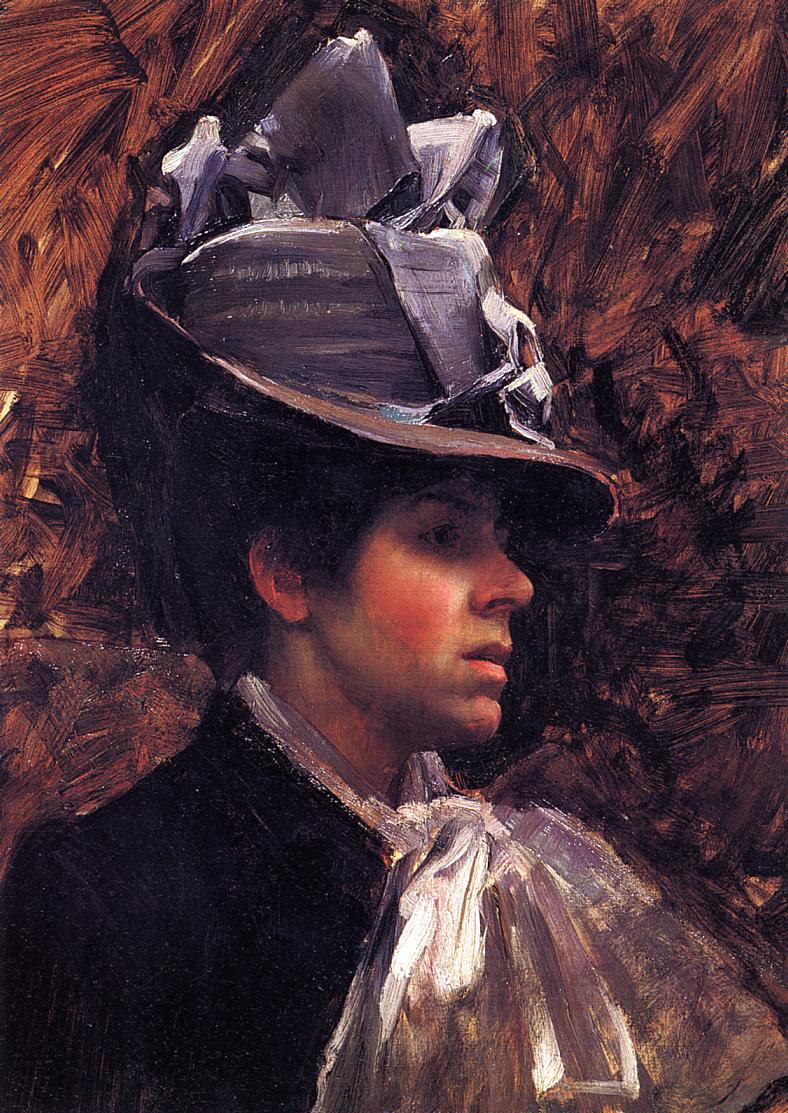
“Esther Kenworthy” (1885) presents a close, intimate portrait that feels both immediate and withholding. John William Waterhouse places the sitter in profile, turning her into a study of presence rather than a straightforward social likeness. We are close enough to notice the warmth in her cheek and the soft edge of her lips, yet the painting refuses the easy access of a direct gaze. Instead, it asks us to read character through posture, silhouette, and paint itself. The result is a portrait that behaves like a narrative fragment: it implies a larger life just outside the frame, but it never confirms what, exactly, is happening.
At first glance, the image seems simple: a young woman in a dark garment, a pale scarf or bow at her throat, and a commanding hat crowned with light fabric. But Waterhouse builds complexity through contrast. The face is quietly modeled and tender, while the background and much of the costume are handled with bold, energized brushwork. That push and pull creates a tension between refinement and rawness, between social surface and interior life. The painting becomes not only about Esther as a person, but also about how a person is seen, remembered, and shaped by painterly choices.
First Impression and the Power of the Profile
The decision to show Esther in profile immediately changes how we relate to her. A frontal portrait often invites evaluation: identity, beauty, status, mood. A profile, by contrast, suggests observation. We are not being addressed; we are watching. Waterhouse turns the viewer into a quiet witness, someone who has caught a moment of stillness. The profile also encourages sculptural thinking. The line of forehead, nose, and chin reads like a carved contour against the darker field behind her, giving her head a cameo-like clarity.
Yet the profile is not cold or purely formal. The slight parting of the lips and the softened transition at the jaw make her feel alive, as if she is about to speak or has just heard something that holds her attention. The expression is restrained, but not blank. It suggests concentration, perhaps a private thought, perhaps a polite patience expected in a posed sitting. Waterhouse uses this reserved angle to produce emotional ambiguity: we sense a mind at work, but we cannot pin down its content.
Composition and Cropping: Intimacy Without Sentimentality
The portrait is tightly framed. Esther’s head and shoulders dominate the canvas, and the hat rises high enough to become a compositional architecture of its own. This closeness creates intimacy, but Waterhouse avoids sentimentality by refusing the viewer a full scene. There is no detailed interior, no accessories to narrate her life, no overt symbols to define her role. Instead, the composition concentrates on essentials: the curve of the brim, the triangle of light fabric at the throat, the delicate modeling of skin, and the dark mass of clothing.
The brim of the hat forms a strong diagonal that leads the eye across the face and forward into the space she is looking toward. It is a clever device: the viewer follows the hat’s line the way one might follow a thought. The scarf or bow at her neck creates a bright counterweight, anchoring the lower part of the composition and preventing the eye from lingering only on the face. These two pale elements, hat trim and neck bow, serve as visual bookends for the portrait’s emotional center.
The cropping also heightens the sense of a “caught” moment. This does not feel like a full-length display meant to broadcast status. It feels like a concentrated encounter, almost like a remembered glimpse. That quality aligns the portrait with a more modern sensibility, where the goal is not merely description but immediacy.
Color and Tonal Drama: Warmth, Shadow, and Radiance
Waterhouse orchestrates the painting through a warm, earthy palette dominated by browns, umbers, and deep blacks, punctuated by cool, pale highlights. The background is a lively field of warm tones, worked with broad strokes that vary in direction and density. Against this, Esther’s dark clothing reads as a quieter, heavier shape, letting her face become the main zone of softness and light.
Her skin is the most delicately balanced passage. The cheek holds a muted flush, not a theatrical pink but a lived warmth that suggests blood beneath the surface. The transition from light to shadow along her cheek and jaw is subtle, which makes the face feel rounded and physically present. The ear glows slightly, adding a naturalistic note and pulling warmth into the shadow side.
The whites are not pure white. The hat’s light fabric and the neck bow are built from silvery grays, creamy off-whites, and hints of cooler tones. That restraint matters. It keeps the highlights integrated into the overall harmony, and it avoids turning the accessories into decorative noise. Instead, they become luminous accents that echo each other across the canvas, tying the top of the portrait to the lower center.
Brushwork and Surface: A Dialogue Between Finish and Freedom
One of the painting’s most compelling qualities is the way it shifts between controlled modeling and expressive paint. The face is handled with care, but even there Waterhouse does not polish away the brush. The skin is built in layers that remain perceptible, giving the flesh a breathing texture rather than a porcelain finish. This keeps Esther human, not idealized into an emblem.
In contrast, the background is openly painterly. The strokes are larger, more directional, and more independent. They create a roughened atmosphere that feels less like a literal setting and more like a stage of paint. This difference is not merely technical; it becomes psychological. The refined face suggests social visibility, the part of Esther that the world reads. The turbulent background suggests everything that cannot be neatly summarized: time, mood, memory, and the painter’s own energy.
The clothing and hat sit between these extremes. The dark garment is broadly stated, absorbing light and providing a stable mass. The hat’s structure is clearer, but it is also built from assertive strokes, especially along the brim and crown. This gives the hat authority. It is not a delicate accessory; it is an emblem of style and presence, almost architectural in how it defines her silhouette.
Costume as Character: Hat, Bow, and the Art of Suggestion
Waterhouse chooses details that communicate without overexplaining. The hat is the most dramatic element. Its wide brim frames Esther’s face and creates a protective shadow, like a visor. The added light fabric on top introduces a sense of ceremony or fashion, and its crisp angles contrast with the more fluid handling of the background. The hat becomes a statement of identity, but an identity we can only infer. Is it elegance, propriety, individuality, or a carefully composed public self? The painting keeps these readings in play.
The bow at the throat is equally telling. It is bright, soft, and loosely painted, with a sense of fabric catching and scattering light. Placed at the center of her chest, it draws attention to the boundary between face and body, between expression and presentation. It also introduces a note of tenderness. Even with the strong silhouette of the hat and the dark severity of the clothing, the bow adds vulnerability, an almost youthful softness.
Because the painting offers so few objects, each one becomes weighted with meaning. Waterhouse uses this economy to keep the portrait poised. Nothing distracts from Esther’s presence, yet the costume elements give the viewer enough to imagine a social world around her.
Expression, Gaze, and Psychological Distance
Esther’s gaze travels beyond the frame. This outward focus is crucial: it turns the portrait into a scene of attention. She seems to be listening, thinking, or waiting. The viewer becomes aware of time passing, a moment that is not fully resolved. The lips, slightly parted, heighten that sense of suspension. She might speak next. She might remain silent. The portrait holds the breath before action.
The emotional register is restrained. There is no overt smile, no theatrical melancholy. Instead, Waterhouse suggests complexity through understatement. The shadow under the brim creates a veil-like effect that partially obscures the eye area, reinforcing the idea that we do not fully “have” her. Even in a close portrait, she remains private.
This balance between closeness and distance is one reason the painting feels modern. It does not treat the sitter as an object to be fully read. It treats her as a person with an interior life that cannot be accessed simply by looking.
Background as Atmosphere: The Figure Emerging From Paint
The background is not a detailed environment, and that choice changes how the portrait works. Rather than placing Esther in a specific room or landscape, Waterhouse surrounds her with a field of painterly energy. The strokes create movement without narrative. They feel like air, like rustling fabric, like the residue of a room’s warmth. This ambiguity turns the painting into a psychological space rather than a literal one.
Because the background is warm and active, Esther’s face appears cooler and calmer by comparison, even though it contains warm notes. That optical effect heightens her clarity. She seems to emerge from the surrounding paint, as if the artist is conjuring her presence out of the medium itself.
This approach also focuses attention on the act of seeing. We become aware that portraiture is not just about the sitter, but about the painter’s decisions: where to describe, where to suggest, where to let paint remain paint.
Waterhouse in 1885: Portraiture and the Broader Imagination
Although Waterhouse is often associated with literary and mythic subjects, this portrait shows how his strengths translate into a more direct genre. Even without a narrative framework, he constructs a mood. He understands how a face can hold story without illustrating it. In 1885, his work is already marked by an interest in the poetic potential of a single figure, especially a figure positioned at the edge of an implied event.
Here, that sensibility appears as restraint. The painting does not dramatize Esther through symbolism; it dramatizes her through atmosphere and pose. The portrait becomes a quiet cousin to his more overtly narrative works: it offers the same feeling of a moment poised within a larger, unseen tale.
Themes of Identity: Public Self and Private Self
“Esther Kenworthy” can be read as a meditation on identity as performance and concealment. The hat functions like a constructed persona, a designed outline that the world sees first. The shadow it casts suggests privacy, perhaps protection. Meanwhile, the softly painted face offers a hint of vulnerability, or at least human unpredictability beneath the composed exterior.
The painting also engages with the idea of the “unspoken.” Because Esther does not look at us, we are excluded from the direct exchange that portraits often promise. That exclusion can feel respectful. It can also feel tantalizing. Either way, it suggests that the sitter retains agency. She is not simply there for our consumption; she is absorbed in her own direction.
This reading becomes stronger when we consider how the portrait withholds context. Without a setting, without props, without a clear story, identity becomes less about biography and more about presence, mood, and the way light meets skin.
Craft and Sensation: Why the Painting Feels Alive
Part of the portrait’s appeal is sensory. The hat and bow feel tactile. The background feels like thick paint laid down with confidence. The face feels like a careful convergence of tones. Waterhouse makes the viewer aware of different textures, not only as depicted surfaces but as painterly surfaces. The painting invites you to feel the difference between the soft transition on the cheek and the rough, energetic strokes behind her.
That variety keeps the image alive. A portrait can become static if everything is finished to the same degree. Here, the variation in finish creates movement. The eye travels from the face to the hat to the bow, then back into the background’s restless field, and returns again to the calm of the profile.
The portrait’s life also comes from its ambiguity. When a painting explains too much, the viewer’s imagination shuts down. When it offers a poised uncertainty, it stays open. “Esther Kenworthy” remains open in exactly that way.
Enduring Appeal: A Portrait That Suggests More Than It Shows
What makes this painting linger is its combination of intimacy and mystery. Waterhouse brings us close, but he does not let us possess the sitter. He offers a face shaped by light and shadow, framed by bold costume, held against a background that feels like emotion translated into paint. The portrait does not depend on spectacle. It depends on attention.
As a result, “Esther Kenworthy” continues to feel contemporary in its psychology. It respects the sitter’s interiority. It trusts the viewer to do interpretive work. And it demonstrates how portraiture can be both descriptive and poetic, rooted in an individual presence while also exploring the act of seeing itself.