Image source: wikiart.org
A quiet scene that feels like a whole neighborhood
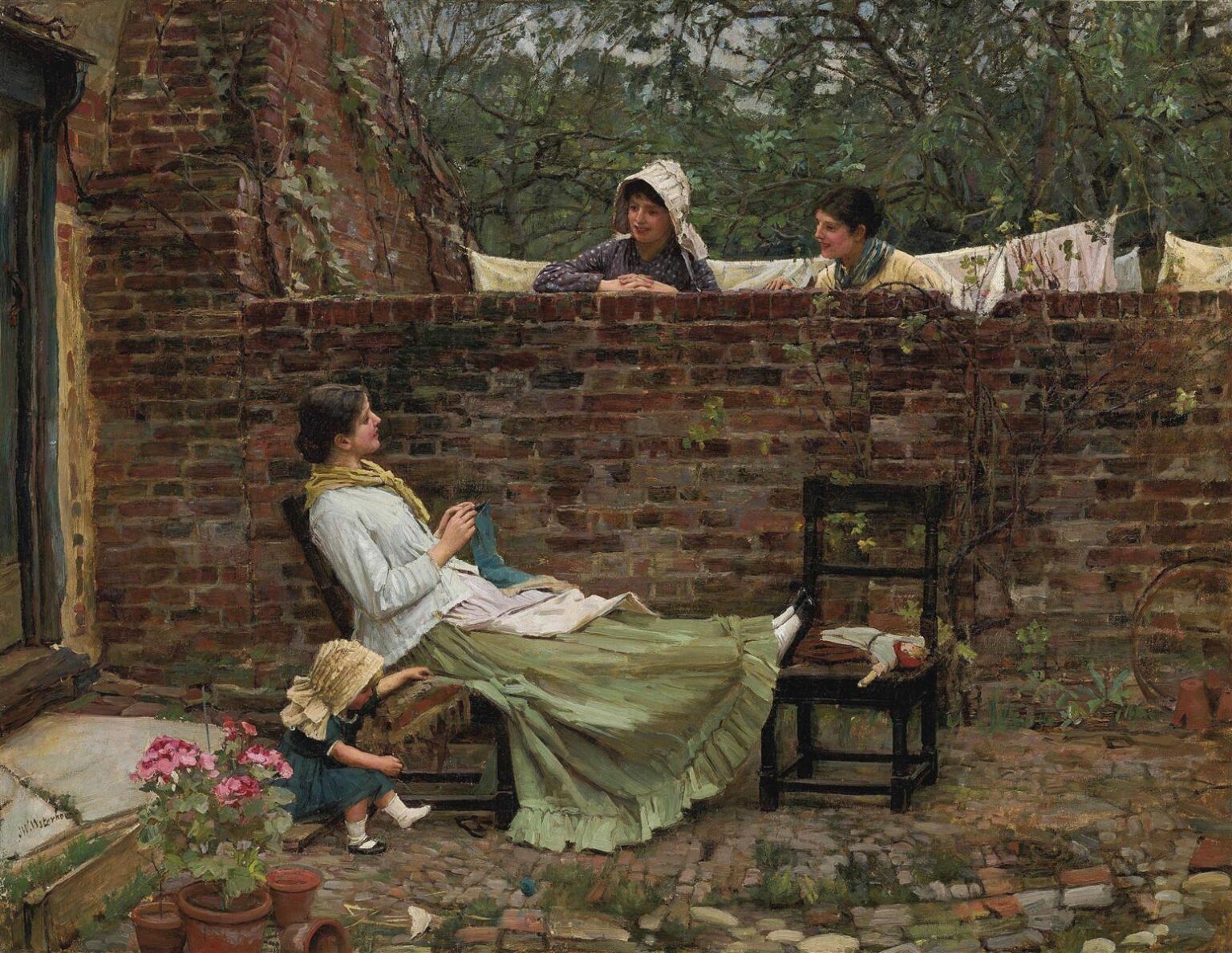
“Good neighbours” turns a small corner of everyday life into a carefully staged drama of attention. Nothing “big” happens, yet everything feels in motion. A woman reclines in a brick courtyard, absorbed in needlework, while a child hovers at her side. Above the wall, two neighboring women lean in, faces bright with curiosity, as if a conversation has just landed on the most interesting detail. Behind them, pale laundry stretches across the background like a soft banner, and beyond that, leafy trees press forward, closing the world into a private, lived-in enclosure.
John William Waterhouse builds the painting around a simple tension: rest versus interruption, privacy versus community, and the gentle pressure of being seen. It is domestic, but not isolated. It is calm, but not silent. The title points you toward warmth and familiarity, yet the image also suggests the complicated intimacy of neighbors, the way closeness can feel like comfort and surveillance at the same time.
Composition and the art of eavesdropping
The painting is organized by a strong horizontal barrier: the brick wall that runs almost the full width of the picture. It acts like a stage rail. Below it, the courtyard becomes a self-contained “home” zone, anchored by the reclining figure and the child. Above it, the neighborly world arrives as faces and shoulders, partial bodies that feel like visitors leaning into frame.
Waterhouse makes the wall do multiple jobs at once. Visually, it divides the painting into two bands, giving the scene immediate clarity. Narratively, it separates two social spheres: the private space of work and rest, and the semi-public space of conversation and observation. Emotionally, it becomes the surface where attention lands. The neighbors’ arms rest on the bricks, their heads tilt forward, and their gaze travels downward toward the woman below. The viewer’s eyes follow that same route, which means we are pulled into the role of onlooker too.
Even the courtyard objects participate in that directional flow. The long line of the reclining figure’s skirt stretches across the ground like an arrow. The chair on the right, with items laid upon it, creates a small secondary “still life” that points back into the center. The open space of cobbles between foreground and wall works like a quiet pause, a breath, before the “conversation” at the top edge takes over.
The courtyard as a small world
The setting is not grand, and that is part of its power. The courtyard is made of worn brick, uneven cobbles, and practical furniture. There are hints of gardening and housework, signs of a place maintained by daily effort rather than designed for display. The potted flowers in the lower left add a note of brightness and care, like a personal choice in a space ruled by routine. The laundry behind the wall reinforces that sense of ordinary labor, but it is rendered with such lightness that it also feels like atmosphere, almost like clouds or sails.
Waterhouse gives you the sensation of being tucked into a protected corner, a space that belongs to someone. The walls hold the scene in, and the trees beyond form a living canopy that softens the hard geometry of brick. That mix of enclosure and greenery matters thematically. It suggests a life shaped by boundaries, but still open to change, weather, seasons, and human contact.
The courtyard is also a place where tasks can be done at a slower tempo. The reclining posture and the needlework imply time that is structured yet not frantic, an interval between duties, or a moment stolen from them. It is a realistic kind of peace, not the peace of escape, but the peace of continuing.
The figures and their choreography of attention
The central woman reclines with a posture that feels both restful and purposeful. Her hands are occupied, her gaze angled upward and outward, as if she is listening while continuing her work. That combination is important: she is not portrayed as passive. Even at rest, she is making something, repairing something, shaping fabric into a usable form. The blue cloth in her hands becomes a small focal point, a jewel-like accent against the quieter tones of brick and greenery.
The child at her side brings a second rhythm into the scene. Children in paintings often function as sweetness or innocence, but here the child also acts like a measure of time and responsibility. The adult’s recline is not a complete surrender to leisure, because the child’s presence keeps the moment tethered to caregiving. The child’s stance, close to the bench and near the woman’s skirt, suggests attachment and waiting, as if the child is seeking reassurance or attention while the adults talk.
Above the wall, the two neighbors lean in with unmistakable interest. One wears a light bonnet that catches the brightest highlights in that upper band, making her face easy to read. The other, in a paler garment with a striped accent near the neck, smiles toward her companion, as if sharing commentary. They form a pair, and pairing matters: two voices become a small chorus, the beginning of “public opinion.” Waterhouse captures the moment when conversation becomes a social force, gentle but real.
The three adult women create a triangle of attention. The neighbors look down. The reclining woman looks up. The viewer looks across and through them all. This triangle makes the painting feel alive, because it stages a relationship rather than a pose.
The brick wall as boundary and bridge
A wall usually suggests separation, but here it also creates connection. It is precisely because there is a boundary that the neighbors must lean, and because they must lean, their bodies show effort, engagement, intention. The wall gives them a reason to pause at this spot, to rest their arms, to turn casual presence into a social visit.
At the same time, the wall protects. The reclining woman is in her own space. She is not out in the street. The neighbors cannot step fully into her courtyard, at least not in this moment. The wall allows for a kind of controlled access, conversation without full intrusion, companionship without total exposure. That is the emotional sweet spot of “good neighbors,” closeness with limits.
Yet Waterhouse does not let the wall feel purely comforting. Its long, uninterrupted surface also resembles a screen where life is watched. The neighbors’ faces emerging above it make the act of looking central to the painting. It asks an enduring question: when does friendly attention become pressure, and when does community become a system of quiet judgment?
Light, color, and the mood of an ordinary day
The light in the scene feels natural and slightly muted, as if filtered through clouds or leaves. It is not theatrical spotlighting. Instead, it is the kind of daylight that allows textures to show: brick, cloth, hair, foliage. This choice supports the painting’s theme. It does not elevate the moment into legend. It makes the moment believable.
The palette balances warm and cool tones. The bricks carry reds and browns, varied with darker patches and mossy hints, while the greenery behind and above introduces cooler, subdued greens. The reclining woman’s skirt, a soft green that spreads across the ground, acts like a calm lake of color in the lower half. The blue fabric in her hands punctuates that calm, giving the eye a crisp note to return to. Skin tones and light fabric, especially the bonnet above the wall, add gentle highlights that keep the scene from becoming too heavy.
Waterhouse uses color to suggest social temperature. The courtyard below feels earthy and grounded. The space above the wall, with the pale laundry and brighter headwear, feels lighter and more openly social. It is as if the painting visually distinguishes inner life from outer exchange.
Texture and the pleasure of close observation
One of the great satisfactions here is the way surfaces are described. The bricks are not a flat pattern. They show irregularities, stains, subtle shifts in mortar, and creeping plants that soften the structure. The cobbled ground is similarly varied, with small changes in tone and direction that imply years of use.
Clothing is treated with equal attention. The green skirt has weight and volume, falling in folds that read as fabric rather than mere shape. The white blouse catches light in a restrained way, describing softness without turning glossy. The neighbors’ garments and the laundry behind them expand that textile world, making the painting quietly about cloth and care: washing, sewing, wearing, maintaining.
That emphasis on material truth connects Waterhouse to the legacy of the Pre-Raphaelite Brotherhood, even when the subject is not medieval romance or myth. The impulse to honor detail, to make ordinary objects worth looking at, is part of the painting’s meaning. In a scene about watching and being watched, the painting itself becomes an argument for looking closely, but with patience rather than appetite.
Domestic labor, leisure, and the dignity of small tasks
Needlework is a loaded motif in nineteenth-century art. It can symbolize virtue, discipline, femininity, economic necessity, or quiet creativity. Waterhouse allows it to be several things at once. The woman’s sewing suggests practical labor, the kind that keeps a household functioning, but it is also a form of focus. Her hands give her something to do while she listens. Sewing becomes a way to manage social interaction, a shield and a rhythm.
The presence of laundry reinforces the theme of ongoing work. Clean sheets are evidence of effort, but they also become a background of brightness, making labor appear gentle and even beautiful. This does not mean the painting is naïve about work, but it does present labor as integrated into life rather than separate from it. The courtyard is a workspace that can also be a resting place.
The chair on the right, with its scattered items, adds to this sense of lived continuity. It implies that the moment we see is one slice of a longer day. Someone sat there, something was placed down, tasks were paused, conversation happened, then will resume. The painting’s calm depends on that realism.
The social psychology of “good neighbors”
What makes the scene feel modern is the recognizable social dynamic. Neighbors are a special category of relationship. They are not chosen in the same way friends are chosen, but they can become intimate through repeated proximity. They know your schedule, your habits, the sounds of your home, the people who come and go. That familiarity can be comforting, because it creates a net of belonging. It can also be intrusive, because it creates a sense that your life is always partially public.
Waterhouse paints that ambiguity without turning it into melodrama. The neighbors’ expressions do not look cruel. They look engaged, amused, curious. Their posture is relaxed. The reclining woman does not look alarmed. She looks attentive and composed. The mood is warm, but the structure of the image, especially the wall and the downward gaze, keeps a quiet edge.
The title encourages an optimistic reading: friendly conversation across a boundary, mutual recognition, shared life. But the painting also invites you to consider the cost of that recognition. Being seen is a kind of social glue, yet it can also be a kind of constraint. In this sense, “Good neighbours” is not only about community, it is about the performance of everyday respectability, the way domestic life becomes a story told by others.
Waterhouse and the choice to paint the everyday
Many people associate Waterhouse with later works drawn from myth, poetry, and tragic romance. This earlier genre scene shows another side of his imagination: an interest in contemporary life and the emotional drama of the ordinary. Instead of a legendary heroine, we get a woman with sewing in her hands. Instead of a perilous landscape, we get brick, laundry, and a small patch of flowers.
That choice is not smaller, it is simply different. The painting demonstrates how narrative can be found without spectacle. It also shows how a painter trained in academic tradition could bring compositional intelligence to humble subjects. The careful balance, the orchestrated gazes, and the attention to texture all suggest an artist thinking seriously about how meaning is built.
This kind of work also aligns with the exhibition culture of the period, including institutions like the Royal Academy of Arts, where scenes of recognizable life could resonate with viewers who wanted art that reflected their world, or at least a softened, idealized version of it.
Why the painting still works now
Part of the painting’s lasting appeal is its emotional accuracy. Most of us know what it feels like to be both inside and visible, to have a private moment that is not fully private. We know the comfort of familiar faces, and the slight tightening that comes when those familiar faces are also evaluators. We recognize the way small conversations shape reputations, and the way domestic spaces become theaters for social life.
The painting also offers a gentler fantasy: the possibility that community can be close without being harsh. The neighbors lean in, but they do not cross. The woman below listens, but she does not surrender her space. The wall holds. The day continues. There is a kind of hope in that equilibrium, the idea that boundaries and warmth can coexist.
Finally, the painting rewards slow looking. It makes everyday materials feel significant, and it shows how a single glance can carry story. In an age of constant exposure, the image feels quietly relevant, not because it predicts modern life, but because it understands something enduring about human attention.