Image source: wikiart.org
Introduction to The Household Gods
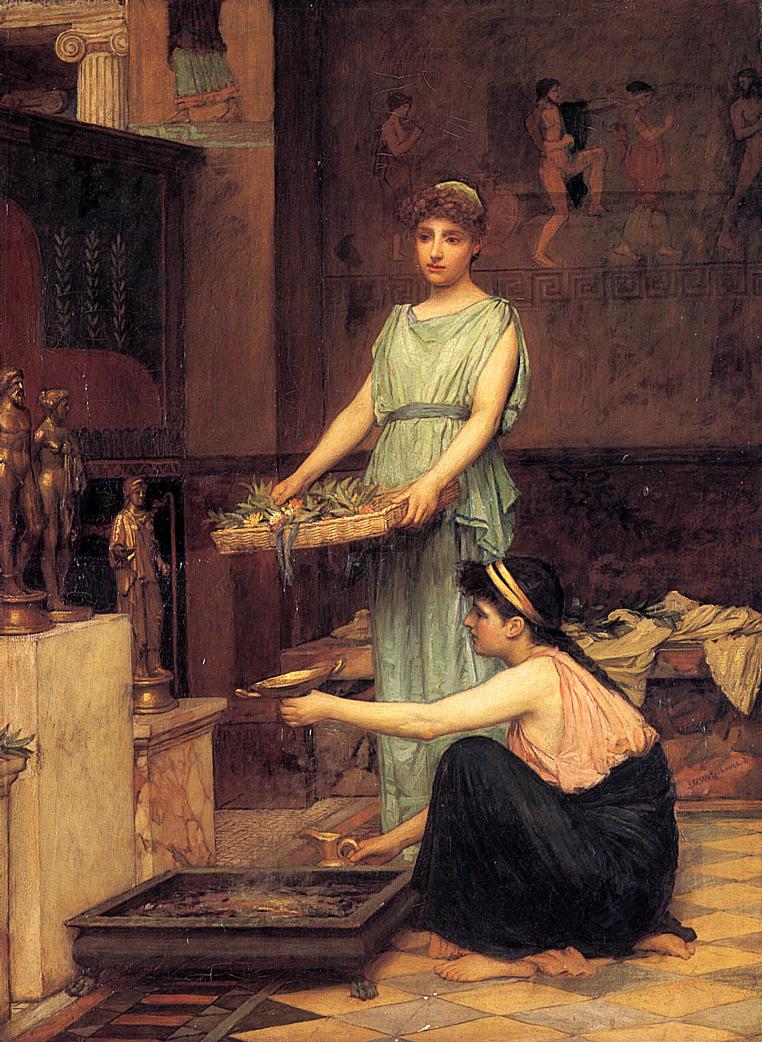
In The Household Gods (1880), John William Waterhouse stages a quiet act of devotion that feels both intimate and archaeological. Instead of grand temples or public spectacle, the painting turns inward, into the home, where belief is practiced as routine and care. Two women occupy a Roman interior: one standing, one kneeling, both intent on a small domestic rite. The scene is hushed, almost acoustically muted, as if the room itself is holding its breath while smoke lifts from an offering tray. Waterhouse’s achievement here is not only narrative clarity, but atmosphere: the sense that faith can be as ordinary as sweeping a floor, and as tender as preparing food.
The title points us toward ancient domestic religion, the protective presences that governed thresholds, storerooms, hearths, and family continuity. Yet Waterhouse does not paint doctrine. He paints behavior: hands holding, placing, pouring, and presenting. In that choice, he suggests that household gods are less about distant theology and more about the daily choreography that binds people to place, memory, and one another.
A Roman interior built from objects and surfaces
The setting reads as a carefully imagined classical room, constructed through a vocabulary of materials. The tiled floor forms a geometric foundation that feels cool and worn, its angled shapes leading the eye toward the ritual area. At left, a marble-faced altar or pedestal rises like a domestic monument, its stone veining rendered with a believable weight. Behind it, darker architecture and a recessed space create depth, while a hint of column and entablature at the top left evokes the language of temples translated into a private scale.
Waterhouse anchors the room with furniture-like elements that imply lived life rather than staged theatre. To the right, draped fabric lies in loose folds, suggesting a couch or bed and the unglamorous reality of textiles, laundry, or resting places. The space is not pristine. It feels inhabited, and that matters: domestic worship is not separated from domestic mess. In this room, reverence shares air with the ordinary.
The far wall carries a painted frieze or mural of lightly drawn figures, like a memory of public art transferred indoors. These faded silhouettes expand the time of the room, implying that life here is layered: present action in the foreground, ancestral or cultural imagery behind, and stone and plaster holding it all together.
The ritual moment as narrative
The painting’s story is legible within seconds, but it deepens the longer you stay. The kneeling woman extends a shallow dish toward the altar, her arm a straight line of intention. Smoke rises from a low rectangular tray on little feet, set on the floor like a portable hearth. In her other hand she holds a small handled vessel, ready for pouring, as if the sequence of the rite is unfolding step by step: heat and embers, then incense or offering, then libation. It is a narrative of actions rather than expressions.
The standing woman supports the rite with a basket brimming with greenery and small blossoms. The basket is not merely a prop; it is evidence of preparation. Someone has gathered, cut, carried. The offerings are fresh, and freshness implies time: this ritual was planned, not improvised. Waterhouse emphasizes cooperation, too. One figure kneels close to the smoke and heat; the other stands back with supplies. Their positions describe a shared labor that mirrors the shared labor of keeping a household running.
Because the women’s gestures are restrained, the scene avoids melodrama. It suggests a religion of steady repetition, where meaning accumulates through practice. The gods in the title may be invisible presences, but the humans are vividly present, and their care is what makes the sacred tangible.
The household gods and the power of small statues
At the left edge, the painted world includes a cluster of small bronzes or statuettes on the altar. Their metallic sheen catches light differently than stone or cloth, making them feel like concentrated points of significance. They are sized for the hand, for the shelf, for the private corner. This scale is the key: these are not the colossal gods of civic architecture. They belong to the family.
Waterhouse positions the statuettes so they read as witnesses. They stand slightly above the women’s hands, as if receiving what is offered. The altar becomes a stage for the smallest kind of drama: not conquest or tragedy, but continuity. In a modern viewer’s terms, the statues can resemble heirlooms, icons, or keepsakes, objects that gather meaning because they remain while people change.
Their materiality is crucial to the painting’s realism. Belief here is object-based. The sacred is not abstract; it is brass and stone and smoke. By painting these objects with care, Waterhouse makes devotion plausible. The viewer understands how faith could live in a corner of a room, because the corner is rendered as something you could touch.
Composition and the choreography of bodies
The composition is built from a dialogue of vertical and horizontal lines. The standing woman forms a central column, her pale green dress establishing a calm axis. The kneeling woman creates a diagonal, her extended arm projecting toward the altar and pulling the viewer into the rite. The basket, the dish, and the offering tray align like beats in a sentence, guiding the eye in a measured rhythm.
Waterhouse also balances weight and tension through posture. The standing figure is steady, almost statuesque, but not stiff; her arms are gently lowered, holding the basket at a workable height. The kneeling figure, by contrast, is all forward intent. Her body compresses into a crouch that looks physically demanding, yet controlled. This contrast makes the moment feel real: someone stands ready, someone performs the difficult portion, and both contribute.
Importantly, the figures do not look at each other. Their attention is directed toward the ritual space, which creates a feeling of shared focus rather than interpersonal conversation. The household, in this instant, is defined by a common task. Waterhouse uses that shared focus to make the scene feel solemn without turning it into spectacle.
Color, light, and the emotional temperature of the room
The palette is largely warm, built from browns, umbers, and muted reds that suggest wood, plaster, and age. Into that warmth Waterhouse introduces the cool green of the standing woman’s dress, a color that reads as cleansing and calming, like water or leaves. The kneeling woman’s pale pink top adds another note: human warmth, flesh-adjacent, tender. These cooler hues set the women apart from the room, letting them appear like living presences inside a historical space.
Light in the scene feels indirect, as if coming from an unseen opening to the left. It brushes the marble, catches the bronze, and touches skin gently rather than theatrically. The brightest areas are not the faces, but the surfaces that describe the ritual: the altar edge, the dish, the basket, the pale fabric. That choice keeps emotion quiet. The painting’s intensity comes from the act, not from facial drama.
Smoke adds a final tonal layer. It softens the air, blurring edges and turning the ritual into something sensed rather than sharply defined. The room becomes a vessel of atmosphere, and the viewer can almost imagine the scent of resin, herbs, or burning offering.
Costume as history and symbolism
Waterhouse’s costumes are classical in spirit: draped garments, belted waist, bare arms, hair restrained with a band. The clothing helps locate the scene in antiquity, but it also communicates meaning. These are not armored heroes or ceremonial priests. They are women dressed for the home. The simplicity of their attire reinforces the theme that domestic devotion is part of everyday life.
The standing woman’s green garment is especially important. Green ties her to the basket of leaves and flowers, making her appear like the human extension of the offering itself. She becomes a bridge between garden and altar, between the living world and the sacred corner. The kneeling woman’s darker skirt grounds her, literally and symbolically, in the work of the floor and the fire. Her bare feet and crouched posture emphasize contact with the household’s physical reality.
Waterhouse’s approach avoids exoticism. The clothing is graceful, but not theatrical. It supports the painting’s central claim: the sacred is credible when it looks like something people could actually do.
Texture and technique: smoke, stone, and skin
A major pleasure of the painting is how it differentiates textures. Marble is crisp and cool, with veining that suggests depth beneath the surface. Bronze reads as smooth and reflective, its highlights tight and concentrated. Cloth behaves differently in each garment: the green dress falls in long soft folds, while the pink fabric gathers and creases with the kneeling figure’s movement. Skin is rendered with a gentle solidity, neither idealized into porcelain nor roughened into heavy realism.
The offering tray is painted as a practical object, dark and sturdy, with a rim that contains embers and ash. Its physicality matters because it turns the ritual into a process with steps, heat, and residue. Devotion leaves traces. The smoke, painted in thin veils, becomes the scene’s most transient element, the part that refuses to stay still. Waterhouse uses it as a metaphor without forcing it: belief rises, disperses, and still shapes the space it moves through.
Domestic religion as a portrait of care
The most compelling idea in The Household Gods is that faith functions like maintenance. The rite resembles tending a hearth or preparing a meal, activities that protect and sustain a household. The women’s concentration reads as responsibility. They are not asking for spectacle. They are ensuring continuity.
This is where the title gains emotional depth. Household gods are guardians of boundaries: the threshold, the storeroom, the family’s future. Waterhouse translates that guardianship into a human image of guarding. The women guard the home by performing a ritual that acknowledges dependence on forces beyond the self, whether those forces are divine, ancestral, or simply the fragile unpredictability of life.
Even if a viewer does not share the belief system implied, the emotional structure is recognizable. People create rituals to stabilize uncertainty. They mark time. They honor what came before. They ask for protection over what they cannot fully control. Waterhouse makes that impulse visible through a scene of preparation, offering, and smoke.
Gender, labor, and the invisible work of the home
Waterhouse’s choice to place women at the center of domestic worship is not incidental. In the visual logic of the painting, women are the keepers of the interior world, the ones who manage both the practical and the symbolic life of the household. The kneeling posture, the extended arm, the careful handling of vessels, all resemble the gestures of cleaning, serving, and tending. The painting quietly links piety to labor.
This is not necessarily an argument about historical accuracy as much as it is a Victorian meditation on the home. The late nineteenth century often idealized domestic virtue and the moral influence of women within the household. By projecting the theme into ancient Rome, Waterhouse gives it the prestige of classical distance. Antiquity becomes a mirror that reflects nineteenth-century ideas about home, duty, and feminine responsibility.
Yet the painting also resists simplistic idealization. The work looks real. Kneeling on tile is uncomfortable. Smoke stings. Offerings must be gathered. Waterhouse shows devotion as effort, and in doing so he honors the seriousness of domestic labor rather than romanticizing it into ease.
The mural in the background and the layering of time
The faint figures on the back wall are easy to miss at first, but they enrich the painting’s sense of history. They look like dancers or celebrants, sketched in a darker register, half erased by time. This creates a double vision: living women in the foreground performing a rite now, and ghostly figures behind suggesting past ceremonies, cultural memory, or a larger world outside the room.
This layering turns the painting into a meditation on continuity. Domestic ritual is not invented fresh each day. It is inherited. The mural feels like tradition made visible, a reminder that what happens in a household is shaped by what a culture has already imagined. Even the room itself seems to remember.
Waterhouse uses this effect to deepen the mood. The scene becomes less like a snapshot and more like a quiet threshold between eras, where the present is always accompanied by echoes.
Waterhouse’s classical imagination in 1880
Painted in 1880, The Household Gods belongs to a moment when classical subjects offered artists a way to explore beauty, morality, and psychology under the dignified veil of antiquity. Waterhouse approaches the classical world not as a battlefield of heroes, but as a lived environment where emotion is contained and meaning is carried by objects. His classicism is domestic, not imperial.
The painting also demonstrates his ability to merge narrative with atmosphere. Nothing here is overstated, yet everything is intentional. The altar is placed so we understand the rite. The objects are selected so the ritual feels plausible. The gestures are readable but not theatrical. This is a kind of storytelling that respects silence.
Waterhouse would later become known for more overtly poetic and mythic subjects, but this earlier work already shows his signature interest in inwardness: the moment when a figure’s stillness reveals a larger emotional world.
How the painting guides the viewer’s experience
Standing before this image, the viewer is positioned like an observer at the edge of a private act. The women do not invite us in with eye contact. Instead, we are asked to look quietly, to notice the sequence of objects, to follow the smoke, to respect the stillness. That viewing posture becomes part of the painting’s meaning. We become witnesses, like the statuettes, to a rite that does not need an audience.
The painting’s calmness is also deceptive. The longer you look, the more you sense the stakes. Household gods imply vulnerability: the need for protection, the fear of loss, the hope for abundance. Waterhouse keeps those stakes understated, allowing the viewer to supply them from lived experience. That is one reason the painting remains compelling. It turns an ancient ritual into a timeless human pattern: the desire to keep what matters safe.
Enduring themes and why The Household Gods still resonates
Modern viewers may approach the subject with curiosity rather than belief, but the painting’s core themes translate easily. The idea that a home has a spiritual or emotional center is widely recognizable, even in secular forms. People still light candles, keep photos on shelves, preserve heirlooms, cook ritual meals, and repeat gestures that make a space feel protected. Waterhouse’s scene becomes a metaphor for all the quiet practices that turn a building into a home.
The painting also resonates because it dignifies small moments. It insists that meaning does not require spectacle. A basket of leaves, a shallow dish, a curl of smoke, and a steady hand can carry the weight of hope. In a world that often equates importance with scale, The Household Gods offers another logic: that devotion, care, and continuity are built from small repeated acts.
Finally, the painting endures because it is sensuous in a restrained way. The surfaces are beautiful, but they serve the story. The room feels real, but it remains poetic. The figures are specific, but they stand for something larger. Waterhouse creates a scene that is both historically imagined and emotionally immediate, a quiet classicism that speaks across time.