Image source: wikiart.org
First impressions and the painting’s quiet proposition
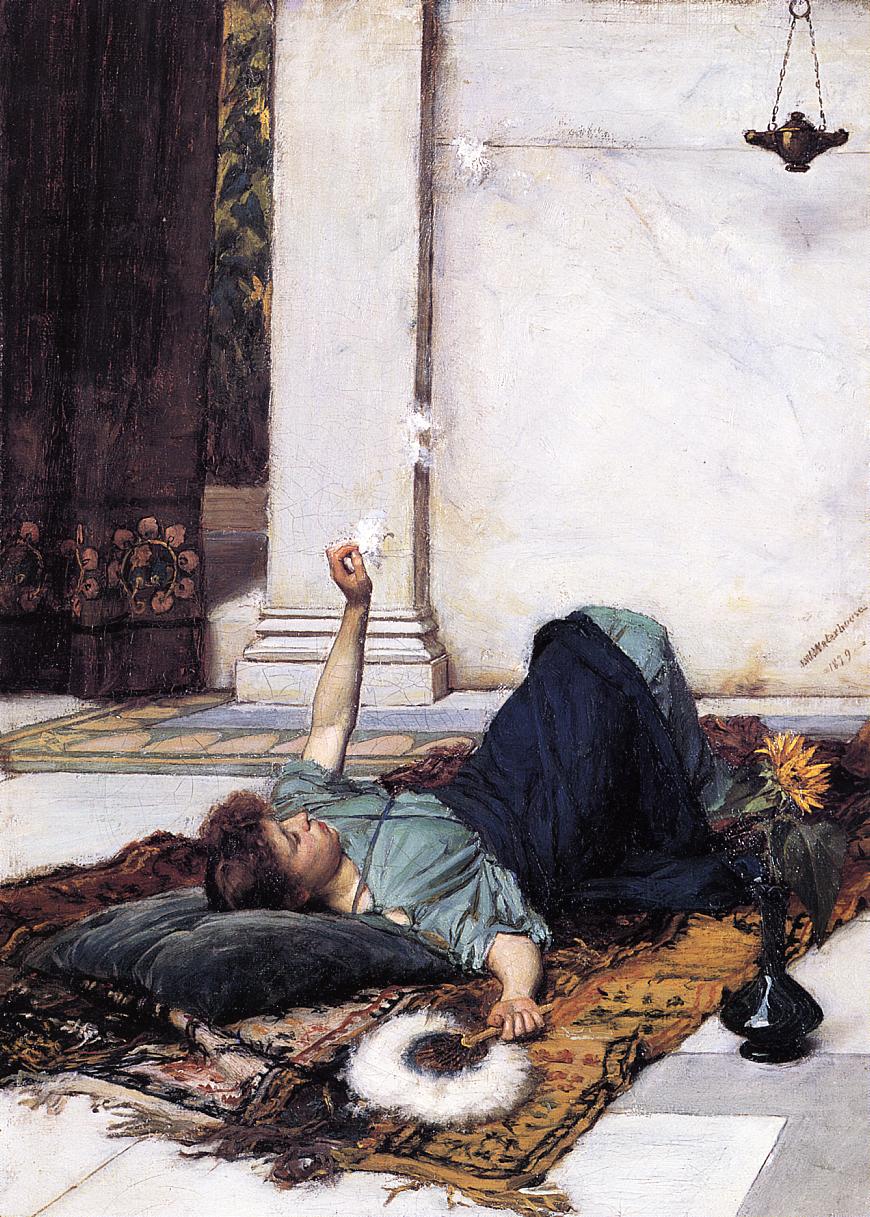
John William Waterhouse’s It’s Sweet Doing Nothing (1879) presents a scene that feels almost like a held breath. A young woman lies across layered rugs on a pale tiled floor, her body angled diagonally as if she has simply let herself fall into comfort. The title frames what we see as a small philosophy: not idleness as failure, but rest as pleasure, and perhaps as a private kind of power.
The mood is conspicuously unhurried. Nothing dramatic is happening, yet the painting is full of sensation: the weight of fabric over bent knees, the softness of a cushion, the faint curl of smoke, the gentle glow of a sunflower. Waterhouse builds an image in which the smallest gestures become the whole event. The subject’s raised hand, holding a cigarette, is the most active thing in the composition, and even that action is barely an action at all. It is simply time passing, visible.
Composition and the authority of negative space
One of the most striking decisions in this work is how much of the canvas is “empty.” The upper half is dominated by a pale wall, a column, and a small hanging lamp. That space is not wasted. It functions like silence in music, shaping everything beneath it. The woman’s body occupies the lower portion, grounded and tactile, while the wall above expands the sense of stillness, as if the room itself is pausing with her.
This negative space also changes how we read the figure. Rather than crowding the subject with narrative clues, Waterhouse isolates her in a calm, architectural hush. The scene feels private, even when we are clearly positioned as observers. The emptiness creates a buffer between viewer and model, a kind of emotional distance that keeps the moment from turning into spectacle.
The composition is balanced through contrasts: dark textiles and drapery on the left, pale plaster and floor on the right; the dense pattern of rugs below, the nearly blank wall above. The body becomes the hinge between these halves. Her bent legs form a compact mass of dark fabric, while her blouse and exposed forearm lift lighter tones into the center. The result is a stable structure that still feels relaxed, like a pose that has found its most comfortable equilibrium.
The figure as gesture, weight, and lived comfort
Waterhouse paints the woman less as an idealized emblem and more as a believable body at rest. Her posture is not posed for elegance. Her head sinks into a deep cushion, her torso reclines, and her legs fold in a way that suggests settling, adjusting, letting muscles go slack. The face, turned slightly upward, reads as tired or dreamy rather than flirtatious. It is a portrait of sensation more than a portrait of personality.
The raised arm is crucial. It lifts the smallest detail, a cigarette with a faint trail of smoke, into an almost ceremonial position. Yet the gesture is casual, the wrist loose, the hand neither tense nor performative. In many paintings, an elevated hand implies declaration, command, or drama. Here it implies the opposite: the simple fact of being unbothered.
Her clothing reinforces that atmosphere. The blouse looks soft and wearable, with folds that gather naturally at the waist and sleeve. The skirt is darker, heavier, and it pools with weight. Waterhouse makes fabric do narrative work. Light cloth suggests ease and breath, dark cloth suggests gravity and warmth. Together they convey the physical comfort that makes “doing nothing” feel sweet.
Interior setting, modern taste, and the aesthetic of leisure
The room is spare in architecture but rich in surfaces. A heavy dark curtain hangs to the left, and below it, a suggestion of patterned upholstery or decorative detail adds a note of refinement. On the floor, the rugs create an island of warmth against the cool geometry of tiles. This contrast is part of the painting’s psychology: the world can be hard, angular, and bright, but leisure creates its own softer territory.
The objects around the woman hint at cultivated taste. The layered textiles suggest collecting, travel, or at least an appetite for exotic pattern and tactile luxury. The hanging lamp, small and distant, contributes atmosphere without dominating the scene. It feels like a quiet ornament rather than a functional necessity, a sign that the room is arranged for mood as much as for use.
Most vivid is the sunflower in a dark vase near the figure’s legs. It is a burst of gold against muted surroundings, and it reads like a deliberate note of style. The flower’s presence makes the scene feel curated, as if beauty itself is part of the leisure being practiced. It is not just rest, it is rest in a space arranged to make resting feel like art.
Even the presence of the cigarette participates in this modernity. Smoking becomes a visual shorthand for time taken for oneself, and for a certain social confidence. The smoke is transient, delicate, and almost ornamental, a fleeting pattern that mirrors the rugs, but in air rather than fabric.
Color, light, and the choreography of restraint
The palette is controlled and quietly dramatic. Waterhouse relies on a limited range of tones, especially in the wall and floor, to heighten the richness of the textiles. The pale wall is not flat; it carries subtle shifts, scuffs, and warmth that make it feel real, but it remains understated. That restraint gives the lower portion its intensity. The deep browns, reds, and golds of the rugs feel even more saturated because the architecture refuses to compete.
Light appears soft and indirect, as if entering from outside the frame. It does not carve sharp shadows. Instead it drifts across surfaces, picking out the sheen of tiles, the softness of the pillow, the slight highlight along the woman’s arm. This kind of light supports the theme: it is not spotlight illumination, it is ambient presence, the sort of light you notice only when you are already still.
The sunflower becomes a focal point not through scale but through chroma. It is small compared to the wall, yet it holds the eye because it is one of the few places where bright color asserts itself. Waterhouse uses that brightness sparingly, making it feel precious. The flower’s glow seems to echo the sweetness promised by the title, a visual taste of pleasure.
Texture and material as the painting’s true subject
If the narrative is minimal, the material world is abundant. Waterhouse seems deeply interested in how things feel: the nap of the cushion, the heavy drape of the skirt, the coarse weave and fringe of rugs, the cool hardness of tile. The painting invites a viewer to imagine touch, not just sight.
The rugs are especially important. They are not a simple backdrop but a layered stage that defines the woman’s comfort. Their patterns are intricate yet softened by painterly handling, which keeps them from becoming decorative noise. Their edges, with fringes and folds, suggest real use. This is not a showroom arrangement. It is a lived surface, a place where someone has actually chosen to lie down.
The smoke is the most ephemeral texture. It curls upward in pale threads, almost dissolving into the wall. That near disappearance is meaningful. It visualizes how time vanishes during rest. The body is heavy and grounded, the smoke is light and temporary. Together they form a gentle meditation on presence and passing.
The vase, glossy and dark, provides another material contrast. It anchors the sunflower with weight and reflection, a small vertical punctuation at the right edge. Without it, the composition might drift too far into horizontals. With it, Waterhouse quietly stabilizes the scene.
Meaning, mood, and the subtle edge of ambiguity
At first glance, the painting seems simply celebratory: leisure is pleasant, rest is deserved, and stillness can be beautiful. But Waterhouse leaves room for ambiguity. The woman’s posture could be interpreted as serene contentment, but it could also suggest boredom, fatigue, or a kind of elegant ennui. The blankness of the wall, so calming, can also feel isolating. The room’s spacious quietness could be peace, or it could be emptiness.
That ambiguity is part of the work’s lasting appeal. The painting refuses to tell us exactly what “doing nothing” means for this person. Is she savoring freedom, escaping responsibility, waiting for something, or simply enjoying a rare pause? The viewer has to supply the emotional narrative, and different viewers will bring different answers.
The title nudges us toward approval, calling the experience “sweet,” but sweetness can be indulgent as well as wholesome. The cigarette, in particular, adds an adult note of self possession. It suggests choice, habit, and private ritual. The figure’s comfort is not childlike innocence. It is a more complex, self directed kind of ease.
Waterhouse also stages this moment without overt moral judgment. There is no scolding symbolism, no background drama, no looming consequence. That lack of punishment is significant. The painting treats rest as a worthy subject in itself, not merely a pause between meaningful actions. In doing so, it makes leisure feel almost radical, a declaration that the inner life matters even when nothing “productive” is happening.
Waterhouse in 1879 and the bridge to his later sensibility
Although many people associate John William Waterhouse with romantic myth and literary heroines, this earlier work shows his strength in quieter, more observational scenes. The painting demonstrates a disciplined understanding of composition, tone, and mood, and it also reveals his interest in figures who feel psychologically present rather than purely emblematic.
The handling here suggests a painter attentive to the theater of everyday life, and to how setting can express emotion without overt storytelling. The architectural simplicity, the rich textiles, the careful placement of a single flower, these are choices that create atmosphere through design rather than plot. That sensibility connects naturally to Waterhouse’s later paintings, where mood often carries as much weight as narrative.
In It’s Sweet Doing Nothing, you can sense an artist exploring how to make a figure magnetic without turning her into a dramatic character. The woman does not perform for us, yet the image holds us. That is an achievement of craft and of empathy. Waterhouse paints stillness as a state worth looking at for a long time.
Why the painting stays with you
The lasting power of this work is its honesty about the appeal of stopping. Many images of leisure turn rest into luxury, flirtation, or spectacle. Waterhouse instead offers rest as a human need, rendered with care and seriousness. The painting feels intimate without being intrusive, sensual without being loud, simple without being empty.
Its composition trains the viewer to slow down. The large quiet wall, the soft light, the weight of fabric, the almost invisible smoke, all of it pulls attention away from dramatic interpretation and toward attentive looking. The longer you sit with it, the more it becomes a portrait of time itself, stretched out on rugs, unhurried, not asking permission.
In the end, “doing nothing” here is not a void. It is a full experience: the feel of textiles, the warmth of a flower’s color, the calm of an uncluttered room, the small ritual of a cigarette, the body’s right to rest. Waterhouse makes that experience visible, and in doing so, he turns a quiet moment into something enduring.