Image source: wikiart.org
Introduction to A Flower Stall (1880)
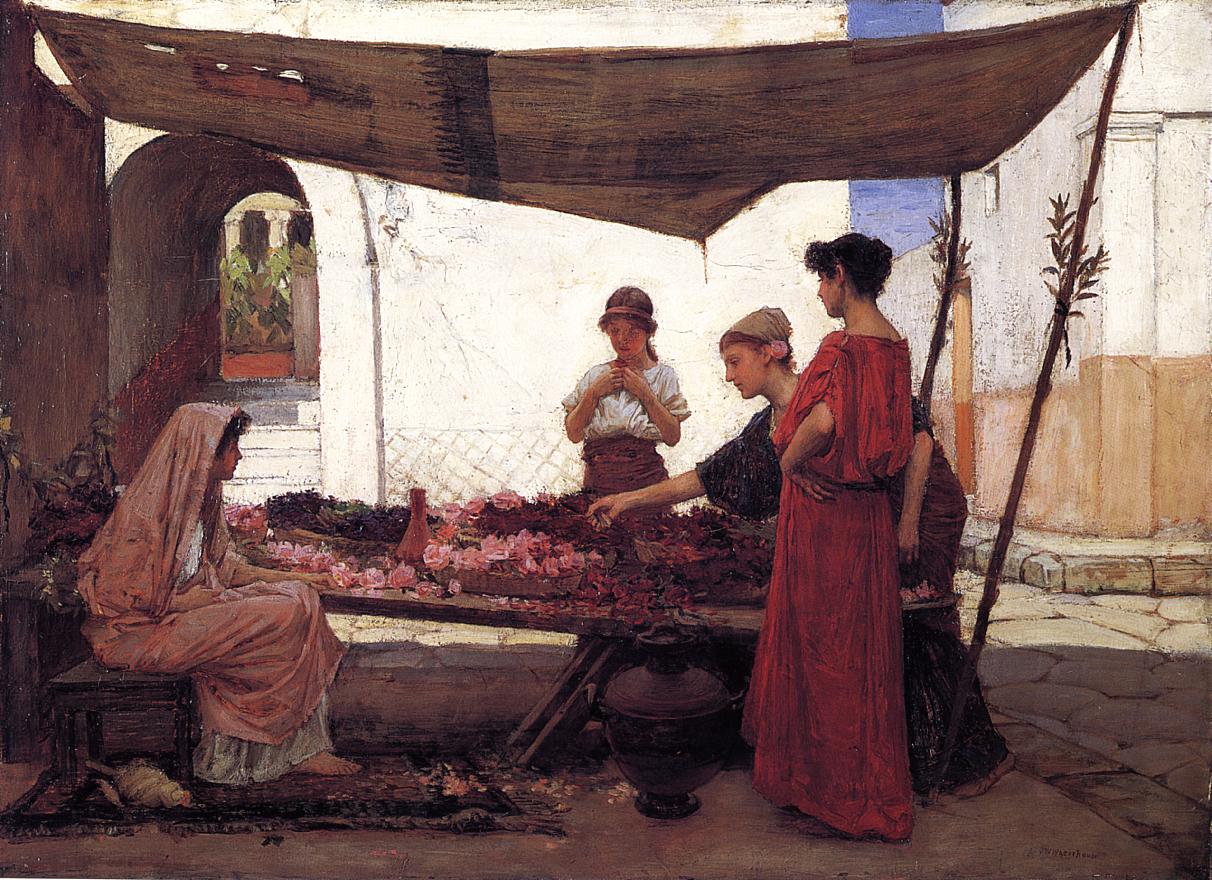
In A Flower Stall (1880), John William Waterhouse turns an everyday act of buying flowers into a quietly theatrical scene. The subject is simple: a small market table heaped with blossoms, a seated vendor, and a few figures pausing to choose and consider. Yet the painting feels carefully staged, as if the courtyard itself has been arranged to heighten the mood of selection, hesitation, and human exchange. Waterhouse does not push drama through overt expression or grand incident. Instead, he builds it through posture, distance, light, and the soft pressure of attention as one woman leans in to pick a bloom while another stands back, weighing the moment.
This is one of the pleasures of Waterhouse’s early work: he can make stillness feel eventful. Even when the figures appear calm, the image is full of decision. A flower is not just a flower here. It is a choice, a gift, a message, a private intention carried into public space. By focusing on a stall rather than a garden, Waterhouse shifts nature into the realm of commerce and ritual. The blossoms are no longer only ornamental. They become objects that pass between hands, and that passage becomes the painting’s real subject.
The Courtyard Setting and the Sense of Place
The setting is a whitewashed courtyard enclosed by sunlit walls, with a shadowed archway on the left and a canopy stretched overhead. The architecture feels Mediterranean, with its bright plaster, hard edges, and strong contrasts between light and shade. Waterhouse uses the courtyard not as a detailed portrait of a specific location, but as a convincing stage that holds the figures in a believable climate. The heat seems present even when it is not stated, suggested by the cloth canopy that protects the stall and by the way the figures gather in the shaded band beneath it.
The background is spare and intentionally uncluttered. A patch of blue sky appears above the wall, and a few plants are visible through the archway, hinting at a world beyond this small transaction. The courtyard’s minimalism does important work: it makes the flowers feel abundant. Against pale walls and sun-bleached stone, the clustered pinks and reds gain intensity and weight. The location also implies movement through space. The archway invites the viewer to imagine someone arriving, someone leaving, or someone passing by without stopping, which makes the stall’s momentary pause feel more poignant.
Composition and the Painting’s Quiet Geometry
Waterhouse organizes the scene with a strong horizontal structure. The flower table runs across the center like a shallow altar of color, separating the seated vendor from the buyers. Above it, the canopy forms another broad horizontal plane, darker and heavier, pressing down gently on the figures and creating a sheltered zone that feels intimate despite being outdoors.
Within this calm framework, Waterhouse places his figures in a measured rhythm from left to right. The seated vendor on the left anchors the composition with stillness and low posture. The boy behind the table lifts the center slightly, acting as a vertical pause between the vendor and the customers. On the right, two women create the painting’s main action: one leans forward to select flowers while the other stands upright in a red dress, her posture more guarded and self-possessed.
The eye travels naturally along the table’s edge, across the blossoms, and toward the reaching hand. Waterhouse makes that hand the hinge of the narrative. It is where attention concentrates, where the choice is made. The large pot in the foreground, partly shadowed, adds weight at the bottom of the picture and prevents the composition from feeling too airy. Everything is balanced, but the balance is not rigid. It feels like a moment caught mid-breath.
Light, Shade, and the Canopy’s Soft Drama
The painting’s emotional tone depends heavily on light. Waterhouse gives us a sunlit courtyard but places the key interaction under shade. This contrast creates a natural spotlight effect without theatrical exaggeration. The white walls reflect daylight, making the environment luminous, while the canopy filters and darkens the space beneath, cooling the scene and slowing it down.
The canopy itself is more than a practical detail. It introduces a sense of protection and privacy. Under it, faces soften, colors deepen, and gestures seem more confidential. The dark cloth also frames the figures’ heads, especially those on the right, emphasizing profile and silhouette. Small imperfections and thin patches in the fabric hint at wear, which quietly grounds the scene in everyday life rather than ideal fantasy.
The brightest light falls on the courtyard surfaces and portions of clothing, but Waterhouse avoids harsh glare. Even the sunlit areas retain a gentle, chalky softness. That restraint keeps the painting’s mood contemplative. The scene is not about bustling trade. It is about the hush that can settle over a simple purchase when meaning is attached to what is being bought.
Color Relationships and the Power of Red
Color is the painting’s most immediate language. Waterhouse orchestrates a dialogue between muted architecture and vivid fabric, between pale garments and saturated blooms. The most commanding note is the standing woman’s red dress on the right. It does not simply draw attention; it establishes a standard against which all other colors are measured. The reds in the fabric echo the deeper tones in the flowers and in the shadows, linking figure and still life into one system.
Opposite that intensity, the seated vendor wears soft pinks and pale neutrals, with a veil that turns her into a quiet, sheltered presence. Her palette feels powdery and restrained, as if she belongs to the shaded side of the world. Between these extremes, Waterhouse introduces earthy browns, terracotta tones, and stone grays that hold the composition steady. The flowers, largely pink, become a bridge between the two poles: they share kinship with the vendor’s clothing but also rise toward the vividness of the red dress.
Waterhouse’s color choices also shape the social atmosphere. Red can suggest confidence, visibility, and self-command. Pale pink can suggest modesty, patience, and reserve. The painting does not force these meanings, but it lets them hover as possibilities, enriching the scene without turning it into a moral statement.
Figures, Gestures, and the Social Microdrama
The narrative is carried through small gestures rather than facial expression. The buyer who leans forward concentrates on the flowers with careful attention. Her hand reaches into the mass of blossoms, implying touch, choice, and evaluation. This is the most active gesture in the painting, yet it is gentle, almost reverent. The act resembles picking from a garden, even though it is a market stall. Waterhouse blurs the line between commerce and intimacy.
The standing woman in red feels like a counterpoint. Her posture is upright and slightly turned, with her arms and stance suggesting a pause rather than participation. She might be waiting for the choice to be made, supervising it, or judging it. Her distance creates tension, not hostility, but a sense of social awareness. She is fully present, yet not fully engaged.
The boy behind the table, hands near his chest, adds another layer of observation. He looks like a witness to adult intention, someone learning how value is assigned to beauty. The seated vendor remains calm, almost inward. She is close to the flowers yet does not dominate them. Her stillness suggests endurance and routine. The buyers’ deliberation is temporary; the vendor’s relationship to the stall is continuous.
The Flower Stall as Still Life and as Threshold
The table of flowers functions like a still life embedded within a genre scene. Waterhouse paints the blossoms as a textured mass rather than as botanically isolated specimens. They are presented as abundance, as a field harvested into a pile. That choice matters. It makes the flowers feel physical and touchable, emphasizing petals as material rather than as symbol alone.
At the same time, the stall is a threshold between people. It separates the vendor from the buyers, and it creates a socially acceptable distance that still allows exchange. Across the table, private desire becomes public transaction. A person can reach for a bloom, then pull back, then choose again, all within a small safe space of etiquette. Waterhouse seems interested in that choreography, the way the stall permits intimacy without requiring it.
The stall also marks time. Flowers are brief by nature. Buying them is a form of acknowledging impermanence, whether the buyer thinks of it consciously or not. A flower stall, more than a jewelry shop or a fabric merchant, sells something that will fade. That quiet fact gives the painting a faint melancholy beneath its calm surface.
Classical Atmosphere and Waterhouse’s Italianate Imagination
Although the scene is not overtly mythological, it carries a classical atmosphere. The draped garments, the courtyard architecture, the simplified setting, and the measured poses all recall an imagined Mediterranean past. Waterhouse often moved between everyday realism and historical reverie, and here the two blend smoothly. The figures seem both ordinary and timeless, as if they could belong to the nineteenth century or to a dream of antiquity.
This classical feeling does not depend on specific archaeological detail. Instead, it is built through restraint and clarity. The walls are pale and planar, the space is cleanly organized, and the figures are posed with a sculptural calm. Waterhouse uses classicism as a mood rather than a costume drama. The result is a scene that feels elevated without becoming unreal.
That elevation is important for how we read the act of buying flowers. In a purely modern urban setting, the purchase might feel casual or hurried. In this sunlit courtyard, under a canopy that resembles a simple tent, the choice feels like a ritual. The classical atmosphere turns a small exchange into something almost ceremonial.
Themes of Femininity, Work, and Quiet Power
A Flower Stall is populated by women, and the painting is attentive to different forms of presence. The seated vendor represents labor that is steady and understated. She is not romanticized as a tragic figure, nor turned into a mere decorative note. Her posture suggests patience and a kind of grounded authority within her space. She does not need to perform. The stall exists because she exists.
The buyers represent another kind of power: the power to choose. The leaning woman’s gesture is delicate, but it is decisive. The standing woman’s posture is firm, even if she is not acting. Together they show a spectrum of agency. One engages directly with the object. The other controls the moment through stance and attention.
Waterhouse avoids turning this into a simplistic contrast between wealth and poverty, or leisure and labor. The scene is too quiet for caricature. Instead, it suggests how beauty circulates through different hands. The vendor handles flowers as inventory and routine. The buyers handle flowers as meaning. Both relationships are real, and Waterhouse lets them coexist.
Texture, Brushwork, and the Painting’s Sensory Appeal
Waterhouse’s handling of paint contributes to the sense of lived reality. The stone surfaces feel dry and sun-worn, the canopy looks heavy and slightly frayed, and the flowers form a textured field of petals. The brushwork is controlled but not fussy. Edges soften where they should, especially in shaded areas and fabric folds, while the overall scene remains legible and carefully constructed.
Fabric is especially important. The red dress has weight and fall, not just color. The pale veil on the seated vendor is handled with softness, allowing it to suggest thin cloth catching light. These textures help distinguish social roles and emotional temperatures. The red dress asserts. The veil shelters. The dark garments of the leaning buyer absorb light, keeping her face and hand more prominent.
The flowers, painted as a dense surface, provide a tactile contrast to the smooth walls. They are the painting’s richest material zone. Waterhouse makes them feel abundant enough that choosing from them seems both pleasurable and difficult, like selecting a single word from many.
Interpreting the Mood: A Scene About Choice and Transience
The painting can be read as a meditation on small decisions that carry private meanings. The buyer’s hand hovering over blossoms suggests thoughtfulness. The stall becomes a place where a person pauses, considers, and selects something that will later be given away, displayed, or kept close. That future is not shown, which makes the moment more intriguing. We are left with anticipation rather than conclusion.
There is also a gentle awareness of time. The flowers will fade. The shade will shift. The buyers will leave. The vendor will remain. Waterhouse does not insist on sadness, but he lets transience breathe through the image. The quietness is not emptiness. It is the quietness of a moment that will not last long.
The painting’s restraint invites the viewer to slow down. It asks for attention to subtle posture, to the way shade changes color, to the relationship between a hand and a cluster of petals. That patient viewing mirrors the subject itself: choosing flowers carefully, not grabbing them quickly.
Waterhouse in 1880 and the Appeal of Everyday Classicism
Created in 1880, A Flower Stall sits within Waterhouse’s early period, when he often explored scenes that combine realism with classical flavor. Rather than presenting a myth outright, he suggests a world shaped by classical ideals of form and calm. This approach allowed him to paint contemporary tastes for antiquity while still focusing on recognizable human behavior.
The painting’s success lies in its balance. It offers beauty without spectacle, narrative without melodrama, and historical atmosphere without heavy symbolism. For viewers drawn to John William Waterhouse, it provides a different kind of pleasure than his later, more overtly literary or mythic works. It shows that his sensitivity to mood and figure was already present, even when the subject was a simple market stall.
In the end, A Flower Stall feels like a portrait of attention itself. It captures how people look when they are quietly intent, how a small object can gather significance, and how light and shade can turn an ordinary courtyard into a space of contemplation.