Image source: wikiart.org
First impressions and the quiet drama of work
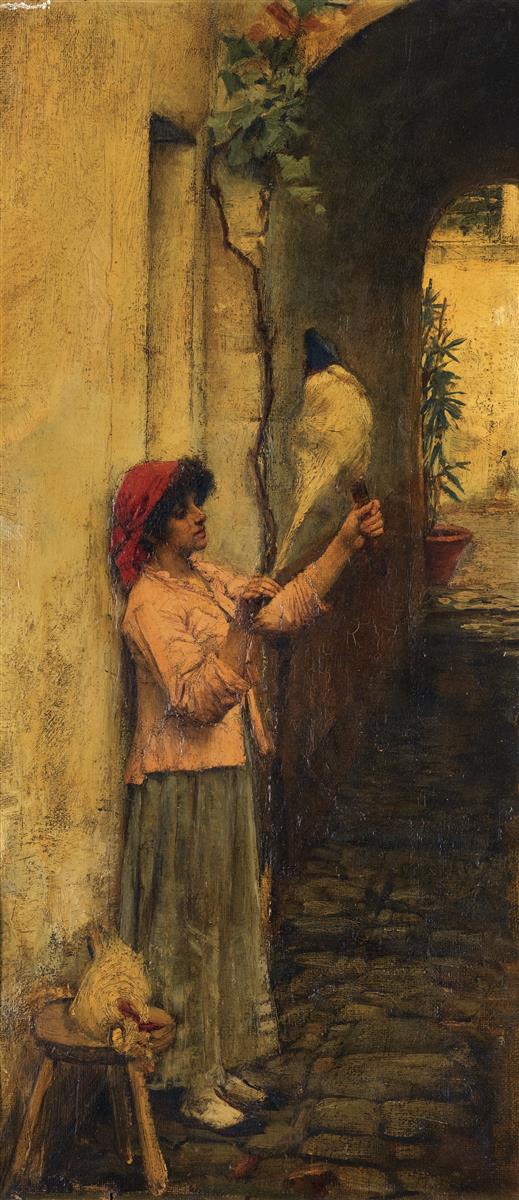
John William Waterhouse’s A Neapolitan Flax Spinner (1877) is the kind of painting that feels modest at first glance, then slowly reveals how carefully it has been staged. Nothing “big” happens in the usual narrative sense. A young woman stands in a narrow passageway and performs a task that is repetitive, skilled, and ordinary: preparing flax for spinning. Yet Waterhouse turns this everyday action into a moment of calm intensity. The figure is absorbed, her attention fixed on the pale mass of fiber she holds up, as if she is checking its quality, separating strands, or readying it to be drawn into thread. The stillness is not empty. It is purposeful.
What makes the scene compelling is the balance between intimacy and distance. The spinner is close enough for us to read her profile and her concentration, but she is also enclosed by architecture and shadow, as if her work is tucked into the margins of a busy world. Waterhouse uses that enclosure to slow time down. The painting becomes less about a “story” and more about the dignity of a single human action repeated day after day.
The subject: a Neapolitan spinner as portrait and type
The title identifies the woman not by name but by place and occupation. “Neapolitan” signals Naples and its surrounding culture, with all the nineteenth-century fascination for southern Italian life, costume, and street scenes. “Flax spinner” anchors her identity in labor and craft. Waterhouse treats her as both an individual and a representative figure, someone specific and observed, yet also an emblem of traditional handwork.
Her clothing supports that double role. The red headscarf is instantly striking, framing dark hair and drawing attention to her face. The pale blouse, slightly rumpled and softly lit, suggests everyday wear rather than posed finery. The muted green skirt falls in heavy folds, practical and unshowy. Even her white shoes, bright against the darker ground, feel like an honest detail from life rather than a theatrical accessory. She reads as real, but composed with enough clarity that she also becomes a recognizable “type” within Victorian genre painting: the working woman, the local craft, the southern setting.
Setting and architecture: a passageway that shapes the mood
The spinner stands beside a worn plaster wall under an arch. This architectural framing is not just background; it is a device that controls the entire emotional register of the image. The wall on the left is warm and sunlit, its surface mottled with age. The arch and the corridor to the right deepen into shadow, creating a sheltered pocket where the woman can work. Beyond that shadow, a brighter courtyard or open space appears, with a potted plant and hints of greenery. This contrast between enclosure and openness becomes one of the painting’s main themes.
The passageway feels like a threshold. It is neither fully interior nor fully exterior, neither private nor public. That in-between space suits the act of spinning, which is domestic in its association but often carried out near doorways, courtyards, and communal edges where light is good and air moves. Waterhouse makes the threshold a metaphor for attention itself: the spinner’s mind is turned inward toward her task even as the world remains just beyond.
Composition and the vertical format: simplicity with intent
The composition is tall and narrow, emphasizing a full-length figure within a confined architectural slice. This format heightens the sense that we are glimpsing a real corner of life rather than a grand stage. The woman’s body forms a gentle diagonal, with her head angled left and her arms reaching right toward the flax. That reach is the painting’s main action, and it creates a quiet tension across the space, like a stretched thread before it is drawn.
Waterhouse keeps the arrangement uncluttered. The spinner is placed slightly left of center, anchored by the wall. The darker archway on the right acts as counterweight, creating a strong vertical division between light and shadow. At the bottom left, a simple stool holds a bundle of flax, reinforcing the theme of work and materials. Above, a climbing vine traces the wall, introducing a natural, irregular line that softens the geometry of plaster and stone.
This is restraint as a compositional strategy. With so few elements, every shape matters: the oval of the headscarf, the pale mass of flax, the curve of the arch, the scattered pattern of cobblestones. The eye is guided without feeling forced.
Light and color: warm plaster, cool shadow, and a flare of red
The palette is built on warm earth tones and sunbaked neutrals. The plaster wall glows with yellows, ochres, and creamy whites, evoking Mediterranean heat and age. The passageway and arch are cooler and deeper, with browns and grays that feel dampened by shade. Into this restrained scheme Waterhouse introduces two key color accents: the red headscarf and the soft pink of the blouse.
The red is the emotional spark. It pulls attention immediately to the spinner’s head and, by extension, to her focused gaze. It is not a decorative red for its own sake, but a structural red, placed where it can organize the painting. The pale flax plays a different role. Its near-white tone catches light and becomes a second focal point, echoing the brightness of the wall while standing out against the shadowed arch. The viewer’s attention moves naturally between face and fiber, person and task.
Light here is not dramatic in the theatrical sense. It is descriptive and atmospheric. It tells us the time of day and the quality of the air. The spinner is lit enough to be legible, but not spotlighted. She belongs to the space.
The craft of flax: material meaning and tactile realism
Flax is an especially evocative material for painting because it carries both texture and symbolism. Visually, it is a cloud of pale fibers, soft but slightly coarse, with strands that can be suggested through flicks of paint rather than tight linework. Waterhouse uses the flax as a texture contrast to almost everything else: the rough plaster wall, the hard stones underfoot, the heavier fabric of the skirt. The fiber looks airy and light, as if it could drift if she loosened her grip.
The act of preparing flax also implies knowledge. Spinning is not merely “holding” the fiber; it involves sorting, teasing, and aligning strands so they can be drawn out evenly. Waterhouse does not over-explain the process, but he gives just enough posture and gesture to suggest competence. Her arms are extended with purpose, not posing. Her face is attentive, not sentimental.
In a broader cultural sense, flax points to domestic economies and the long history of textiles as both necessity and artistry. Thread and cloth sit at the intersection of survival, tradition, and identity. By choosing flax rather than, say, a more picturesque prop, Waterhouse aligns beauty with utility.
Texture and surface: weathered walls, worn stones, lived-in life
A major pleasure of this painting is how “used” the world feels. The wall is not a clean backdrop. It is stained, scratched, and uneven, bearing the marks of time. The corridor is paved with irregular stones that catch light in small facets. The arch is darkened, as if soot, moisture, or sheer age has deepened its tone. Even the vine climbing the wall feels opportunistic and real, a small insistence of nature against architecture.
This weathering matters because it places the spinner in a believable environment. The craft of spinning is ancient and repetitive, and the setting echoes that continuity. The surfaces suggest generations. Waterhouse is not simply painting a figure in costume; he is painting a place with memory.
Waterhouse in 1877: early direction, not yet the famous mythmaker
When people think of John William Waterhouse, they often picture later works inspired by myth, literature, and tragic heroines. In A Neapolitan Flax Spinner, made in 1877, we see a different emphasis: close observation, genre subject matter, and an interest in everyday life. The painting still carries Waterhouse’s gift for atmosphere and figure presence, but it channels those strengths into realism rather than legend.
That early direction is important for understanding the painting’s tone. There is no melodrama here, no overt allegory announced by props. Instead, the artist seems interested in how a human being occupies a space, how work shapes posture, how light falls on cloth, how a single color can organize a whole scene. The result is quieter than his later canvases, but not lesser. It shows discipline and sensitivity, the ability to make the ordinary hold attention.
Naples as imagined and observed: travel, taste, and the appeal of the South
The choice of a Neapolitan subject reflects a nineteenth-century British appetite for Italian settings, especially the perceived authenticity and picturesque character of southern life. Naples could be framed as vibrant, traditional, and visually rich, full of narrow streets, courtyards, local costume, and artisanal labor. Paintings like this offered viewers a controlled encounter with that world: intimate enough to feel “real,” composed enough to be legible and aesthetically pleasing.
Yet the painting does not turn the spinner into spectacle. Waterhouse avoids exaggerating poverty or turning labor into theatrical hardship. He also avoids transforming her into a flirtatious “street beauty” meant purely for display. Her expression is serious, her body language practical. The setting is charming, but not candy-coated. This balance suggests an artist trying to respect what he depicts, even while working within a market that enjoyed foreign genre scenes.
The psychology of attention: a face turned toward the task
The spinner’s profile is one of the painting’s emotional anchors. She is not smiling at the viewer. She does not invite conversation. Her gaze is directed toward the flax, and her mouth is set in a neutral, slightly concentrated line. This choice matters because it shifts the painting away from performance and toward interiority. We are allowed to watch, but we are not the reason she exists in the scene.
That psychological distance can feel modern. It grants her autonomy. She is not merely an object of picturesque interest; she is a person with a job to do. The painting’s calm comes from that self-contained focus. In a world of images that often demand attention, this one portrays attention itself as a form of quiet power.
The stool and the bundle: a still life of labor
At the lower left, the small stool with a bundle of flax functions like a miniature still life embedded in the scene. It reinforces the material reality of the spinner’s work. The bundle’s pale fibers echo the flax in her hands, creating repetition and rhythm. The red tie or accent in the bundle subtly answers the red headscarf above, linking top and bottom of the composition and strengthening the vertical flow.
This detail also grounds the scene economically. The stool suggests a makeshift workstation, portable and informal. The work is not romantic leisure. It is production, however small-scale. The painting invites the viewer to notice how the simplest objects become meaningful when placed in relation to human activity.
Nature in the margins: vine and potted plant as soft counterpoints
The vine climbing the wall and the potted plant in the brighter background do more than add local flavor. They provide a counterpoint to the spinner’s task. Spinning turns a plant into fiber, then into thread, then into cloth. The presence of living greenery quietly reminds us of the origin of materials. The plant forms also soften the architecture’s hardness, suggesting that life persists in cracks and corners.
Visually, the vine’s irregular line breaks up the large expanse of wall and prevents the background from becoming a flat monotone. The potted plant in the distance introduces depth, signaling that beyond the shadowed passage is an open, sunlit space. That contrast enhances the spinner’s sheltered concentration. She works in shade, with brightness nearby.
Themes of time, tradition, and the making of essentials
Spinning is an action tied to time. It is slow. It requires patience. It transforms raw material into something useful through repeated motion and learned control. By freezing a single moment of that process, Waterhouse invites reflection on the hidden labor behind everyday necessities. Cloth is everywhere, but its making can be invisible in modern life. This painting pulls that making back into view.
There is also a theme of continuity. Traditional crafts pass through hands and generations. The weathered wall, the old stones, the vine, the simple stool, all support the idea that this is not a one-off scene but part of a long routine. The spinner is both present and part of a larger history, one that connects human bodies to materials, tools, and places.
Why the painting holds attention today
A Neapolitan Flax Spinner endures because it offers a kind of respect that viewers can feel. It does not shout. It does not demand a grand interpretation. It simply shows a person working, rendered with care and atmosphere, in a setting that feels lived-in and true. The beauty is not separate from labor; it is found inside labor, in the harmony of gesture, light, and material.
For admirers of Waterhouse, the painting is also a valuable glimpse of his range. It shows him before the later, iconic heroines, already capable of giving a figure presence without melodrama. For anyone drawn to nineteenth-century painting, it is a reminder that genre scenes can be profound when the artist takes the ordinary seriously.