Image Source: wikiart.org
Opening the scene
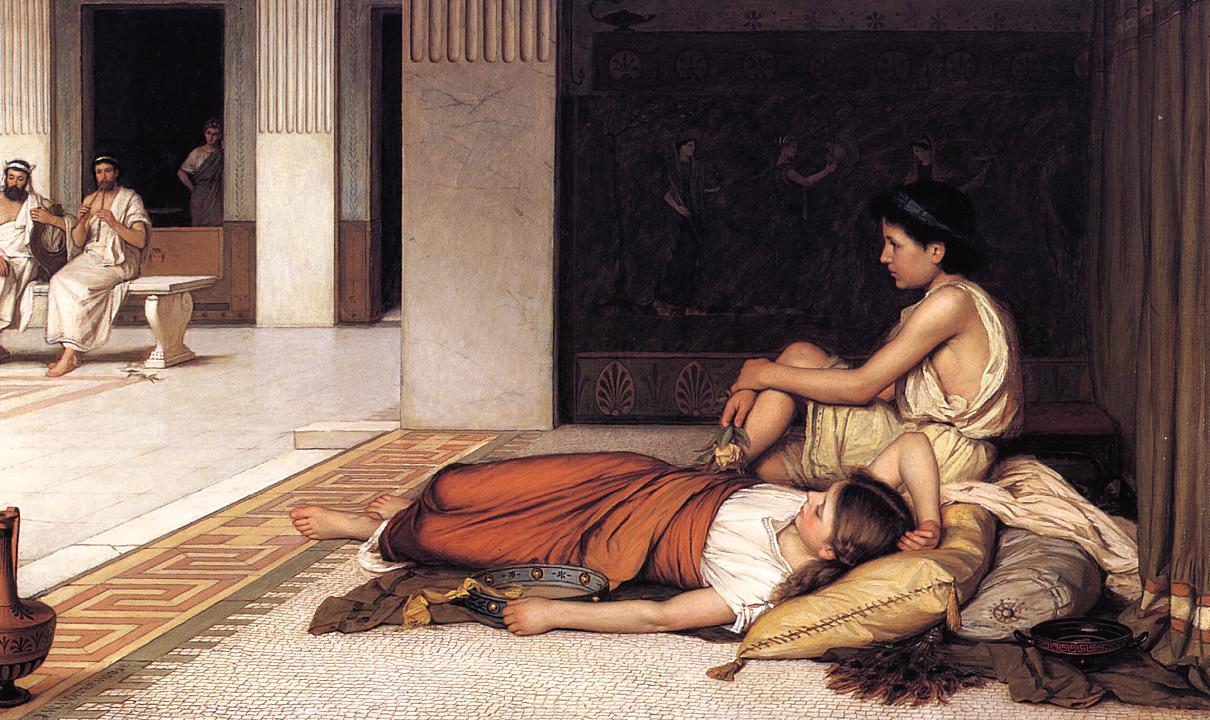
In After the Dance (1876), Waterhouse stages a quiet moment that arrives when music has faded but the body still remembers its rhythm. The painting shows a young woman stretched out on cushions at the edge of an interior space, her posture loose with fatigue, her gaze softened and unfocused. Beside her sits another young woman, upright and watchful, knees drawn up, as if pausing between tasks. Across the open marble floor to the left, two male musicians remain seated, one holding a wind instrument, the other positioned as a companion to the performance. A standing female figure appears in the background doorway, half in shadow, a witness rather than a participant.
Nothing dramatic “happens” in the usual narrative sense, yet the picture is full of story. The title does most of the plot work, turning physical tiredness into aftermath, implying movement that has already occurred and a social setting that continues beyond the frame. Waterhouse invites you to read what remains: the scattered objects, the loosened clothing, the slack hand, the spacing between bodies, and the way architecture divides public spectacle from private recovery.
Composition and the choreography of stillness
The most striking compositional choice is the long diagonal formed by the reclining figure. Her body runs from the lower right toward the center left, turning the foreground into a kind of stage where exhaustion becomes the new performance. The diagonal is countered by strong verticals: the pale column, the wall, and the doorway. Those upright architectural forms feel stable and official, like the rules of the household, while the woman’s sprawled pose reads as temporary freedom, permitted only because the dance is over.
Waterhouse also splits the image into two emotional climates. The left side is open, bright, and cool, filled with polished marble and distance. The right side is darker, warmer, and intimate, defined by textiles, shadow, and the closeness of bodies. This division makes the viewer feel a shift from public to private without moving a single character. The painting’s “action” is the transition itself: from display to recovery, from social role to bodily reality.
Even small design decisions reinforce this. The patterned border of the floor pulls your eye inward like a threshold line, while the broad pale tiles on the left act almost like silence, a visual pause after sound. The right side is dense with objects and texture, like an exhale. The whole scene behaves like a musical cadence: a final note, then stillness, then the lingering vibration.
The figures and what their poses imply
The reclining woman is not merely resting; she is surrendered to gravity. One arm reaches outward, the other bends near her head, and her legs extend in a way that suggests she no longer needs to hold herself “correctly.” That looseness is crucial. In most classical or academic paintings, a sprawled figure risks looking careless, even improper. Waterhouse handles it with tact, making the pose readable as natural fatigue rather than spectacle. Her face is calm, not inviting, not performative. She looks like someone who has spent her energy and is simply letting the moment happen.
The seated attendant’s posture is the opposite. She sits upright, knees gathered, shoulders set, eyes directed outward. Her body is tense enough to imply responsibility. In narrative terms, she is the one who remains “on duty.” If the reclining figure represents the human cost of performance, the seated figure represents the structure that surrounds performance: care, service, supervision, routine. Importantly, Waterhouse does not turn her into a caricature. She is not cold or cruel. She is quiet, present, and attentive, a person with her own interiority.
The musicians are distant but psychologically loud. They embody the social world that produced the dance and continues to exist whether the dancer can keep up or not. Their separation across the marble floor makes them feel like a different class or a different realm of activity. The standing figure in the doorway adds another layer: observation. Someone is always watching, even after the dance.
Setting, surfaces, and the staged antiquity
The painting uses classical architecture and décor to establish an ancient setting, likely evoking Ancient Rome without locking into a single identifiable historical incident. The interior reads as affluent: marble flooring, columns, decorated walls, carefully designed patterns. This is not a rustic scene but a cultivated one, an environment built to host leisure.
Yet Waterhouse’s antiquity is not the outdoors-and-temples cliché. It is domestic, enclosed, and designed for comfort and display. The cushions, textiles, and personal items in the foreground bring the viewer close to the daily reality behind grand architecture. The painted frieze along the back wall, where small figures appear to dance, becomes a subtle echo of the title. It is as if the room itself remembers dancing, even while the real dancers have stopped.
This is one reason the scene feels believable rather than theatrical. The classical setting is not just a costume; it is a social machine. The room organizes who is visible and who is not, who is centered and who is peripheral. The viewer is placed low, near the cushions, almost as if invited into the private corner where the aftermath collects.
Color, light, and the emotional temperature
Waterhouse controls mood through a restrained, intelligent palette. Warm terracotta and russet tones dominate the drapery over the reclining figure, setting her apart from the cool whites and pale grays of the marble floor. That warmth reads as bodily and immediate. It is the color of skin, cloth, heat, fatigue. The left side’s cooler tones feel removed and institutional, like the formal face of the household.
Light behaves differently in each zone. On the left, it spreads evenly across stone, emphasizing cleanliness and openness. On the right, it is softer and more selective, touching fabric and flesh in a way that feels intimate. The seated woman’s profile is lit enough to show her concentration, while the darker wall behind her deepens the sense of enclosure. Shadow is not used for drama here but for privacy.
These choices create a gentle psychological pull. The viewer’s eye goes first to the resting figure because of the warm color and the long diagonal, then to the attendant, then outward to the musicians, and finally back again. The painting keeps returning you to the foreground, as if insisting that the true subject is not entertainment, but what entertainment does to a person.
Objects as clues to narrative
The foreground is scattered with items that read like evidence. A handheld instrument lies near the reclining figure, suggesting she may have participated actively in the music and dance, not merely listened. There are hints of adornment and costume: fabric pooled on the floor, a fan-like object, and a sense of clothing loosened from performance into rest. These details function like the aftermath of any long night: the practical residue that remains once the social mask has slipped.
Waterhouse arranges these objects carefully so they do not become clutter. They occupy the lowest part of the image, where the viewer naturally scans. The result is a quiet form of storytelling. Rather than showing the dance, he shows what the dance leaves behind: weight, mess, warmth, stillness.
The contrast between the carefully patterned floor and the casual placement of these belongings also matters. The house is ordered, geometric, controlled. The human aftermath is irregular, soft, and slightly untidy. That tension animates the scene.
Performance, fatigue, and the human cost of beauty
The title points you toward time. This is not “The Dance,” with all the expected glamour, motion, and social brightness. It is after, which means the painting is about what society rarely stages. The dancer’s work is already completed. What remains is the body, and the body is not symbolic, it is simply tired.
That emphasis gives the work a surprisingly modern emotional register. Many paintings glamorize performance, turning dancers into icons of grace and energy. Here, the most honest moment is the collapse, the slackening of muscle, the loosening of pose. Waterhouse suggests that beauty is not only in motion, but in the unguarded state that follows motion.
The attendant reinforces this theme by showing that even rest can be structured. Someone must help, watch, wait, manage. The dancer may be the visible product, but the surrounding labor, both artistic and domestic, makes the event possible. The painting quietly acknowledges systems: the system of entertainment, the system of status, the system of the household.
Class, intimacy, and distance inside one room
One of the painting’s smartest moves is how it uses space to describe relationships. The musicians are far away, separated by the bright expanse of marble. The dancer and attendant are close, pressed into the darker corner. This spatial arrangement implies that intimacy and closeness are not always privileges. Sometimes they are the condition of service, of being kept out of the public area except when needed.
The dancer’s position is ambiguous in a compelling way. She is placed in the foreground, which grants importance, yet she is also low to the ground, which can signal vulnerability. The attendant’s upright posture suggests competence and readiness, but she is not centered socially. Waterhouse lets these tensions remain unresolved, which is why viewers keep reading and rereading the scene.
Even the doorway figure participates in this social geometry. Her placement suggests oversight, the idea that private corners are never fully private in a hierarchical household. The dancer’s exhaustion may be sincere, but it exists within a world that observes, evaluates, and controls.
Waterhouse’s early classicism and the painting’s appeal
As an early work, After the Dance shows Waterhouse’s talent for combining academic structure with emotional storytelling. The drawing is controlled, the architecture convincing, the surfaces carefully differentiated. Stone looks like stone, fabric looks like fabric, skin has softness without becoming overly polished. That technical credibility is what allows the subtle narrative to land. You believe the room, so you believe the people inside it.
At the same time, the painting hints at what would make Waterhouse especially popular later: an interest in women as complex protagonists, not just decorative presences. The reclining woman is not a mythic symbol, yet she is treated with the gravity often reserved for myth. The attendant is not merely background, yet she is not forced into melodrama. Waterhouse trusts the viewer to feel the story rather than be told.
The classical setting also contributes to its lasting popularity online. Ancient interiors, marble floors, and antique costume carry a built in visual romance, while the human emotion remains accessible. It is easy to imagine a viewer encountering this image in search results and pausing because it looks serene, then staying because it feels psychologically real.
Why the painting still resonates
The core experience here is universal: the comedown after a social performance. Most people recognize the feeling of being “done” after having to be on, whether that “on” is literal dancing, socializing, working a shift, performing for an audience, or simply holding yourself together in public. Waterhouse captures the instant when the body insists on truth.
There is also a quiet empathy embedded in the scene. The dancer is not mocked for her fatigue. The attendant is not reduced to a stereotype. The musicians are not villains. Everyone occupies their role, and the painting invites you to notice how roles shape feeling. That is why the work can be read in many ways: as a gentle domestic scene, as a reflection on labor, as a study of class, as a meditation on performance, or simply as a beautifully observed moment of rest.