Image source: wikiart.org
An island moment caught in stillness
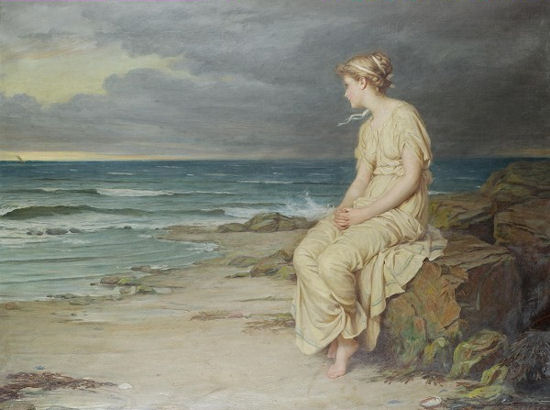
In Miranda, the shoreline feels less like a setting and more like a state of mind. A young woman sits on a rock at the edge of sea and sand, turned in profile, her attention fixed on the horizon. Nothing dramatic “happens” in the usual sense, yet the painting is charged with quiet suspense. The sky is heavy with weather, the water rolls in measured bands, and the figure holds herself with a composure that looks practiced, as if she has learned to be patient in a world that offers little certainty. John William Waterhouse places us beside her, close enough to notice the soft gathering of fabric at her waist and the bare feet resting near the damp line of the beach, but far enough to feel the distance she is staring into.
What makes the scene so compelling is its restraint. The beach is wide and pale, the sea cool and steady, the clouds pressed low. The palette avoids spectacle, yet it never becomes dull. Instead, the painting works like a held breath. Miranda’s gaze suggests a narrative just beyond the frame, as if something is approaching from the left, carried by wind and tide. Even if you do not know the literary reference behind her name, the image reads clearly: a solitary figure on a margin, caught between land and water, between safety and the unknown.
Miranda and the idea of waiting
Miranda is not simply a portrait subject. Her name turns the painting into a scene, and that scene is built on expectation. In The Tempest, Miranda’s life is shaped by isolation and sudden revelation. She is defined by what she has not seen, and by the emotional intensity of first encounters. Waterhouse does not show a cast of characters or a specific theatrical moment. Instead, he distills Miranda into an emblem: the watcher on the shore, the person whose inner life is stirred by forces arriving from elsewhere.
That choice matters because it shifts the focus from plot to psychology. The sea becomes a metaphor for the outside world, immense and impersonal, while the beach becomes a threshold space where new realities can wash in. Miranda’s posture is modest and contained. Her hands rest together, clasped gently, not in prayer but in a habitual, self-comforting stillness. Her head inclines slightly forward, giving her attention a solemn sincerity. She does not look curious in a playful way. She looks intent, as if she senses consequence.
The emotional temperature is heightened by how alone she appears. There are no companions on the sand, no bustling ship close by, no obvious signs of habitation. The isolation does not feel romanticized. It feels real, even a little austere. This is a Miranda who has spent long hours with the sea as her horizon and her boundary, and the painting invites you to feel the slow accumulation of those hours.
The composition and the pull of the horizon
The structure of the painting is simple, and that simplicity is strategic. The figure sits on the right side, anchored by the rock formation that rises behind and beneath her. The ocean stretches leftward, opening into space. This creates a directional tension: Miranda’s body is stable and grounded, but her attention points outward, and the composition honors that outward pull.
The horizon line sits relatively high, giving the sea a broad presence without overwhelming the foreground. The beach, pale and gently sloped, occupies a large area at the bottom of the canvas. That empty sand functions like silence in music. It slows the eye, it builds anticipation, and it makes the figure’s stillness feel more pronounced. When your gaze moves from the empty expanse to the seated woman, you feel the narrative sharpen.
Waterhouse also uses the shoreline as a subtle guide. The edge where water meets sand curves and breaks around small rocks, leading the eye in a quiet zigzag toward the distance. The waves come in layered, horizontal bands that echo the horizon and emphasize calm persistence. Even the clouds participate in this geometry, forming soft planes that mirror the sea’s broad strips of tone.
This kind of composition is effective because it creates emotional clarity. You are not distracted by elaborate detail. You are placed in a situation: a person sits, the world approaches, and time stretches.
Light, weather, and the mood of a changing sky
The sky is the painting’s emotional engine. It is not a bright, celebratory atmosphere. It is the sky of a day when weather can turn quickly, when light is filtered and uncertain. Dark cloud masses gather overhead, but near the horizon there is a lighter band, a thin opening that hints at sun behind cloud or at a break in the storm.
That contrast between heaviness above and brightness far away creates a psychological effect. The present moment feels weighty, but the distance offers possibility. It is the visual equivalent of mixed feelings: worry and hope held at the same time. The light is not theatrical, yet it is purposeful. It touches Miranda’s dress and skin with a muted clarity, allowing her to stand out against the cool blues and grays of the seascape.
The sea itself is painted with restraint. It is not a violent storm, but it is not perfectly placid either. The wave tops are lightly broken, and there is a small burst of spray near the rocks, a brief, bright flicker that punctuates the calm. That flicker matters because it keeps the painting from becoming static. Nature is moving, even if Miranda is not.
Color harmony and the quiet power of neutrals
At first glance the palette seems subdued: creams, grays, blue-greens, slate tones. Yet the harmony is carefully tuned. The beach is a warm, sandy off-white that keeps the foreground luminous. The sea shifts through cool bands, sometimes greenish near the shallows, sometimes deeper blue farther out. The sky carries smoky grays with hints of muted yellow where light breaks through.
Miranda’s dress sits at the center of this harmony. Its pale, warm tone bridges the beach and the figure, making her feel like part of the coastal environment rather than an ornament placed on top of it. The rock beneath her introduces earthy browns and mossy greens, grounding the right side with richer pigment and texture.
This reliance on neutrals is not merely a stylistic preference. It supports the theme. A loud palette would turn Miranda into a spectacle. Here, she becomes a presence. The quiet color design encourages contemplation, as if the painting is asking you to listen rather than be dazzled.
The figure, the costume, and the language of restraint
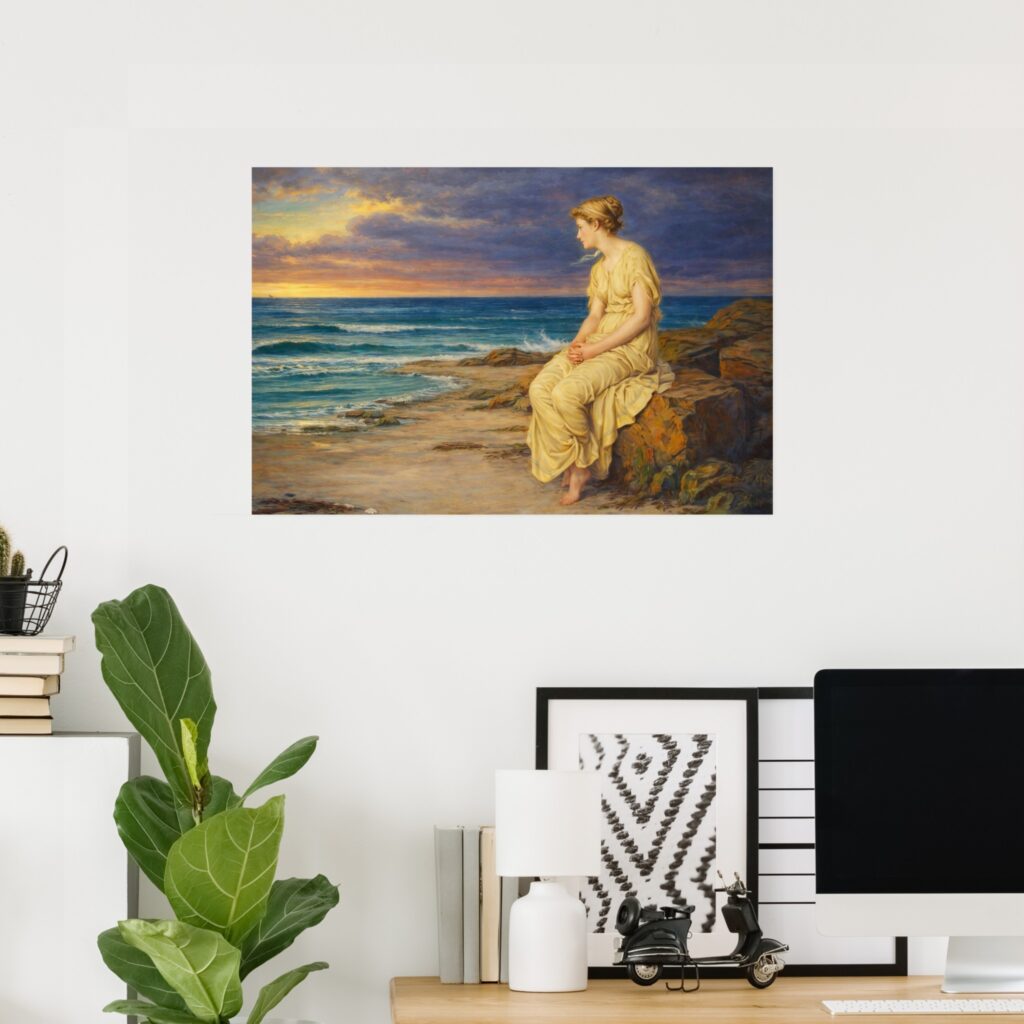
Miranda’s clothing reads as classical and modest, with soft drapery that gathers naturally at the waist and falls in long folds. The fabric looks light, but not sheer, and Waterhouse uses the folds to communicate gravity and calm. The dress is not a fashion statement. It is a costume that places Miranda in a timeless register, somewhere between Shakespearean drama and an idealized classical past.
Her hair is pulled back and secured, practical and neat, reinforcing the impression of composure. Her profile is delicate, but not sentimentalized. The pose is dignified: shoulders relaxed, hands together, spine upright but not stiff. She appears thoughtful, perhaps guarded.
The bare feet are especially telling. They emphasize her closeness to the natural world, her lack of courtly protection, and her vulnerability. Bare feet also suggest immediacy. She is not posed for a formal portrait. She is present in a real place, feeling the cool air and the dampness near the tide line.
Her expression is understated, and that understatement is part of the painting’s strength. Waterhouse does not force an emotion. Instead, he creates the conditions for emotion: the weather, the distance, the emptiness, the watchful posture. The viewer completes the feeling.
Shoreline details and the realism of small things
The foreground includes small natural elements that quietly enrich the scene: seaweed scattered near the sand, stones embedded along the waterline, and shell-like forms near the bottom right. These details do not compete with the figure. They simply affirm the place.
This realism is important because it keeps the painting from drifting into pure allegory. Miranda may be a literary figure, but she is sitting on a believable coast. The sand has subtle tonal variation, the shallow water has transparency and a greenish tint, and the waves break with a softness that feels observed.
The rock formation on the right provides an interesting contrast of texture. It is layered, weathered, and mottled with earthy color. Against it, Miranda’s dress looks even softer. The pairing of hard rock and delicate fabric becomes a quiet visual metaphor: the world is rough and enduring; the human presence is tender and temporary.
Symbolism in sea, stone, and distance
The painting’s symbols are not coded in a complicated way. They are elemental. Sea, sky, sand, rock, figure. Because these elements are universal, the scene can hold multiple meanings without becoming confusing.
The sea often stands for change, fate, and the unknown. Here, it also stands for arrival. Miranda looks outward as if watching for something that will transform her life. The horizon is not just a line. It is a promise of contact with what lies beyond her experience.
The rock can be read as stability or confinement. It supports her physically, yet it also ties her to this place. She is seated, not standing. She is not moving toward the water, not running along the shore. She is paused. That pause can feel protective, like safety, but it can also feel like limitation, like a life of waiting.
The sky brings emotional complexity. Its weight suggests uncertainty, even foreboding, while the lighter band near the horizon suggests hope. Waterhouse lets these meanings coexist. The scene becomes psychologically accurate because real anticipation often feels like that: excitement threaded with fear.
John William Waterhouse in 1875 and the early shaping of a sensibility
Painted in 1875, Miranda sits early in Waterhouse’s career, and it reveals a sensibility already drawn to narrative femininity, poetic atmosphere, and the tension between interior feeling and exterior world. The figure is not depicted as a mere accessory to landscape. She is the emotional center, and everything else serves her state of mind.
What is striking is how mature the tone feels. The painting does not rely on elaborate historical props. It relies on mood, on careful observation, on compositional intelligence. Waterhouse’s later work is often associated with richly detailed myth and literature, but here he shows that even with a limited stage, he can build a compelling psychological space.
There is also a quiet confidence in the way he balances realism and idealization. The beach and sea feel observed, yet the overall scene feels arranged to carry meaning. Miranda is both a believable young woman and a symbolic presence. That duality is one of Waterhouse’s enduring strengths, and Miranda offers an early glimpse of it.
The emotional arc: innocence, recognition, and the edge of change
Even without explicit storytelling, the painting suggests an emotional arc. Miranda appears to be at the edge of something. Her gaze implies awareness, her posture implies restraint, and the weather implies a turning point. The scene feels like the moment before an arrival, the moment before a meeting, the moment before a life becomes larger than it has been.
That is why the painting can feel so relatable. Most people know the sensation of waiting for news, for someone, for a change they cannot fully control. Waterhouse gives that sensation a body and a landscape. The sea becomes time. The horizon becomes possibility. The figure becomes the human act of holding steady while everything else shifts.
There is also tenderness in the way Miranda is portrayed. She is not shown as dramatic or seductive. She is shown as attentive and sincere. That sincerity can read as innocence, but it also reads as seriousness. She is not naive. She is simply untested by the wider world, and the painting honors the dignity of that state.
Why Miranda continues to resonate
The appeal of Miranda lies in its clarity. It offers a single figure, a single viewpoint, and a single mood, and it lets that mood deepen rather than scatter. The scene is quiet enough to invite projection, but specific enough to feel lived in. Viewers can bring their own narratives to it, and the painting accommodates them.
It also resonates because it captures a universal threshold: the line between familiarity and discovery. The beach is literally a border between land and sea, and Miranda is poised on that border emotionally as well. She is not yet in motion, but she is not at rest either. She is awake to the world’s approach.
The painting’s understatement is part of its longevity. It does not shout. It holds. It asks you to look, then to look again, and each return to the image makes the same simple elements feel slightly different. The clouds feel heavier or lighter. The sea feels nearer or farther. Miranda’s stillness feels calm or tense. That variability is the mark of a work that stays alive in the mind.