Image source: wikiart.org
Introduction
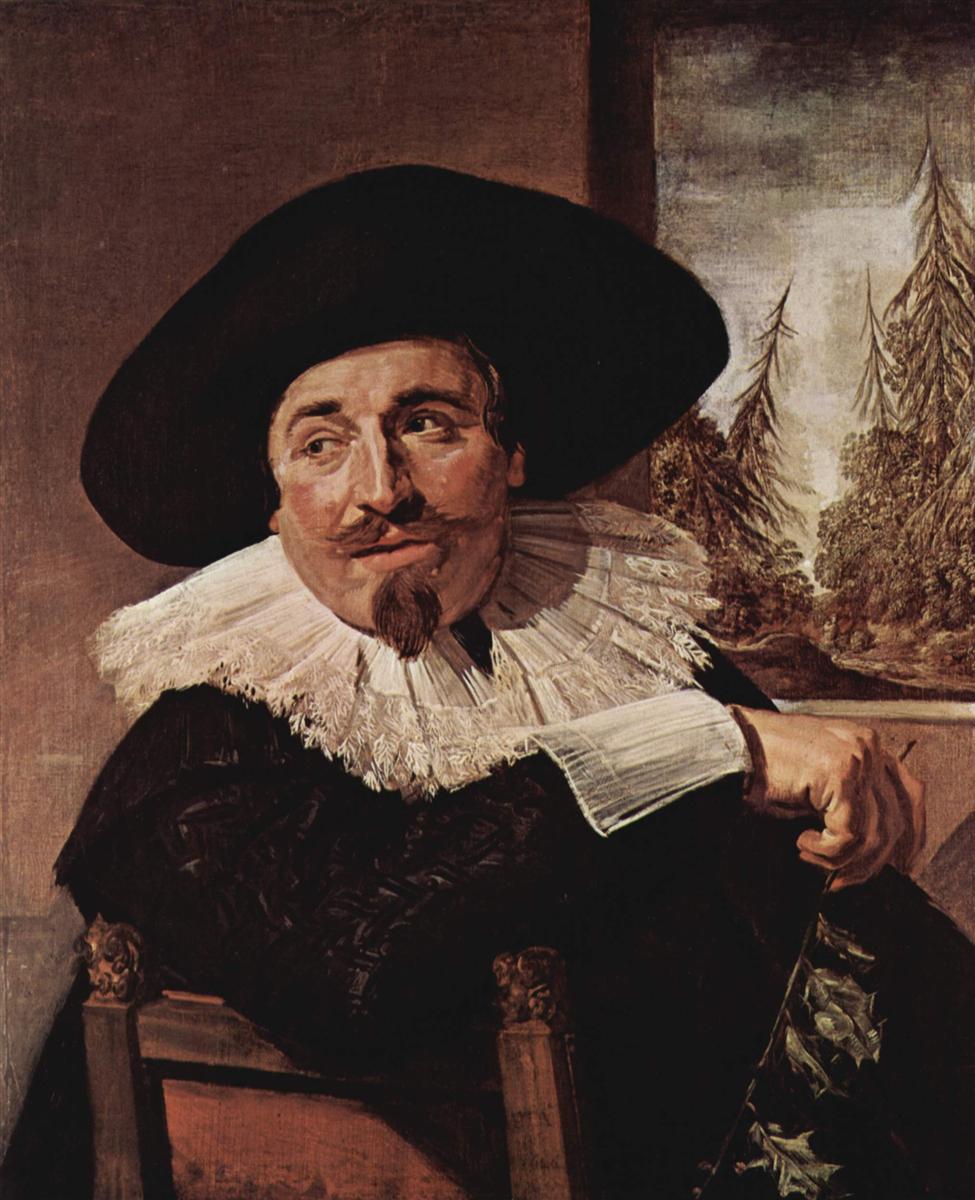
Frans Hals’s Portrait of Isaak Abrahamsz Massa (1626) feels like a conversation caught mid-turn. The sitter is not posed in rigid frontality, nor does he present himself as a silent emblem of status. Instead, he turns to the side with a quick, knowing look, his mouth slightly parted as if he has just spoken or is about to. His body relaxes into the chair, one arm draped with casual authority, while his wide-brimmed hat and crisp ruff assert his social standing. Behind him, a landscape opens unexpectedly, a window-like slice of nature that complicates the portrait’s mood. Hals uses this combination of informality and refinement to create something rare: a portrait that communicates not only who someone is, but how they move through a room, how they hold attention, and how they let their personality leak into public image.
This painting is often discussed as one of Hals’s most psychologically engaging single portraits, and the reason becomes clear within seconds of looking. The sitter projects confidence, but it is not the stiff confidence of a ceremonial pose. It is the confidence of ease. Hals captures the kind of social charisma that does not need to insist on itself. The portrait feels contemporary because it treats the sitter as a living presence, someone with a private sense of humor and a public identity that he knows how to manage.
Frans Hals in 1626: Ease as a High Achievement
By the mid 1620s, Hals had mastered an approach to portraiture that balanced precision with immediacy. He could paint the expensive signals of status, lace, black cloth, a fashionable hat, without letting them become the whole point. He could also suggest spontaneity without sacrificing control. In Portrait of Isaak Abrahamsz Massa, this balance becomes the theme. Hals paints a sitter who appears to have stepped into the pose rather than being arranged into it. The result feels less like a commission executed to satisfy convention and more like an encounter shaped by mutual understanding between painter and subject.
This sense of relaxed intelligence is not accidental. In Dutch elite culture, self-control and respectability were prized, but social success also depended on wit, adaptability, and personal presence. Hals’s portraiture often reveals the performative edge of respectability, the way people present themselves as composed while allowing a trace of personality to remain visible. Here, that trace is vivid. It is the difference between a mask and a face.
The Sitter’s Pose and the Language of Informality
The sitter’s posture is one of the portrait’s defining features. He sits sideways, leaning back, with his arm draped across the chair back in a manner that feels unforced. This is not the pose of someone bracing for posterity. It is the pose of someone comfortable being observed. The body angle creates a sense of movement, as if he has turned toward a voice off to the side. That implied interaction gives the painting narrative energy without needing props or action.
Hals also uses the chair as a stage for character. The sitter does not sit upright in a formal, frontal display. He occupies the chair as if it belongs to him, as if he is at home in his position. The draped arm suggests ownership of space and a kind of social dominance that is expressed through ease rather than force. This is an important nuance. In a culture where modesty and restraint were publicly valued, the most persuasive sign of confidence could be relaxed control.
The pose also creates intimacy. The viewer feels slightly behind the sitter’s line of sight, watching him react to something we cannot see. That makes the portrait feel alive, because it suggests a world beyond the canvas.
Expression: The Half-Spoken Moment
The face carries the portrait’s most delicate psychological work. The sitter’s eyes glance sideways with alertness and amusement. The mouth is not fully closed, which suggests speech, laughter, or a soft intake of breath. Hals paints a transitional expression, the kind of expression that exists for a second in real life and then changes. That choice is key to the portrait’s immediacy. We are not shown a fixed public face. We are shown a person caught between gestures.
The moustache and small pointed beard add to the sitter’s stylish presence. They sharpen the face and frame the mouth, making the slight parting of the lips more noticeable. These details also communicate fashion and self-care, but Hals does not linger on them as mere ornament. He uses them to heighten expression. The moustache’s curve echoes the curve of the sitter’s smile, turning wit into a visible shape.
The eyes are painted with subtle highlights that suggest moisture and movement. The gaze does not meet the viewer directly. Instead, it aims into the implied space beyond the frame, which makes the sitter feel engaged with someone else. The viewer becomes a witness to a social exchange, not the sole recipient of attention.
Costume: Black as Luxury, Ruff as Structure
The sitter’s clothing appears predominantly black, a choice that signals restraint and respectability while also indicating wealth. In the Dutch Republic, black could function as a form of understated luxury. Deep blacks were difficult to achieve and maintain, and the absence of bright color could itself communicate confidence and seriousness. Hals paints the black garments with subtle variation, letting light skim across folds and textures so the costume remains materially alive rather than a flat silhouette.
The ruff is more than an accessory. It is an architectural structure around the face, a ring of white that frames expression and amplifies contrast. Hals paints it with remarkable dexterity, using lively strokes that suggest lace and pleats without making the fabric feel stiff. The ruff creates a halo-like emphasis on the sitter’s head, but in a secular, social sense. It marks him as a man of standing, someone who participates in the visible codes of the elite.
Hals balances the ruff’s brightness with the hat’s dark mass. The hat’s broad brim creates a strong shape that anchors the upper portion of the portrait, while also casting a gentle shadow that adds depth to the eyes and cheekbones. The interplay of hat, ruff, and black cloth creates a controlled drama of light and dark, giving the sitter both clarity and mystery.
The Landscape Background and Its Unusual Role
One of the most intriguing aspects of this portrait is the landscape visible behind the sitter. Many Dutch portraits favor neutral backgrounds to keep attention on the face and costume. Here, the opening into nature introduces a different kind of meaning. The trees and sky suggest distance, space, and perhaps travel or worldly engagement. The sitter appears positioned near a window or an opening, as if he belongs both to interior civic life and to a broader world beyond it.
The landscape also functions as a counterbalance to the portrait’s intimacy. While the sitter is close, present, and socially engaged, the background suggests quiet expansiveness. This contrast can be read in several ways. It can imply a connection to the outdoors, a taste for estate life, or the symbolic idea of perspective, a reminder that the sitter’s identity extends beyond clothing and room-bound formality.
Visually, the landscape offers relief from the dense black clothing. Its lighter tones and textured tree forms break up the composition and keep the portrait from feeling too enclosed. It adds air to the painting, making the sitter’s relaxed posture feel even more natural, as if he is not confined by convention.
Brushwork: Energy Under Control
Hals’s brushwork is often described as lively, but in this painting it is especially strategic. Different surfaces receive different kinds of handling. The ruff is painted with brisk, fluttering strokes that capture light and texture. The face is painted with more controlled transitions, preserving the softness of flesh and the subtlety of expression. The black costume is built from broader, darker passages punctuated by small highlights that indicate sheen and fold.
This variation produces realism not through meticulous description of every detail, but through convincing sensory cues. The viewer reads lace as lace because the paint behaves like lace, breaking and catching light. The viewer reads cloth as cloth because the highlights appear where cloth would crease and reflect. Hals understands perception, and he paints in a way that guides it.
The brushwork also contributes to psychological presence. A portrait with overly polished finish can feel sealed off, like a surface meant to be admired but not approached. Hals’s paint remains active, and that activity suggests life. It makes the sitter feel as if he could shift position, blink, or speak.
Light and Color: Warm Flesh Against Cool Restraint
The palette is restrained, dominated by blacks, whites, and earth tones, but Hals uses this restraint to heighten warmth where it matters. The face carries a healthy flush, and the light across the cheek and forehead suggests vitality. This warmth prevents the sitter from becoming severe. Even though he wears black and presents a composed social image, the flesh tones reveal a living person beneath.
Light falls in a way that emphasizes structure without harshness. The hat provides a gentle shade, the ruff reflects brightness upward, and the face becomes a balanced field of light and shadow. The result feels natural, as if the sitter is positioned near a window. That naturalism supports the painting’s conversational mood.
The background landscape introduces cooler and lighter tones, creating depth and contrast. This helps the face and ruff stand out while giving the composition breathing room. Hals’s control of tonal relationships is part of what makes the portrait feel so effortlessly coherent.
Social Identity and the Performance of Ease
Portraiture in the seventeenth-century Dutch Republic was deeply tied to social identity. Sitters used portraits to assert their place in civic and economic life, to display respectability, and to participate in a culture of visible success. Yet within that framework, subtle differences mattered. A stiff pose could imply solemnity or lack of warmth. A more relaxed pose could imply confidence, social intelligence, and a sense of personal authority.
This portrait leans strongly toward the second mode. The sitter’s ease communicates that he does not need to prove himself through rigidity. He appears to belong naturally to his position. That kind of self-assurance is persuasive, because it reads as internal rather than performed for the viewer. Of course it is still performance, but Hals makes it the kind of performance that looks like authenticity.
The portrait’s charm lies in this ambiguity. The sitter is both a constructed image and a believable person. The sideways glance suggests privacy, as if the viewer has caught him mid-thought. The relaxed arm suggests public mastery, as if he knows he is being seen and enjoys the control that comes with it.
The Chair, the Space, and the Sense of a Room
The chair back and the sitter’s draped arm create a strong sense of interior space. The portrait does not float in an abstract background. It feels like a room, a setting where social life unfolds. The chair is not heavily decorative, but it is present enough to make the sitter’s pose believable. The sitter occupies space rather than merely filling a canvas.
This spatial realism enhances the portrait’s psychological realism. We can imagine the sitter arriving, sitting, turning. The painting suggests movement and time. Hals turns a static format into a moment of lived presence.
The opening to the landscape adds another spatial layer, suggesting a room with a view, or a symbolic bridge between interior identity and exterior world. The sitter becomes someone who belongs to both spaces, someone whose life extends beyond the frame.
Enduring Appeal: Why This Portrait Feels Modern
What makes Portrait of Isaak Abrahamsz Massa feel strikingly modern is its ability to capture an in-between moment. Many portraits aim for a timeless, composed mask. Hals aims for the moment when the mask slips just enough to reveal a personality. The sitter’s expression feels like an exchange rather than a statement. He seems responsive, quick, intelligent, and slightly amused. That responsiveness is what makes him feel real.
The painting also feels modern because it treats social identity as something lived, not only displayed. The sitter’s clothing signals status, but the posture signals character. The ruff and hat place him in a historical world, yet the glance and half-open mouth make him feel familiar. Hals achieves a rare balance: historical specificity without emotional distance.
The portrait’s endurance also lies in its painterly confidence. Hals does not over-explain. He suggests, he implies, he lets the viewer complete the scene. That openness invites repeated viewing, because the expression never fully settles. Each time you look, it can feel slightly different, as if the sitter’s mood shifts depending on your own.
Conclusion
Frans Hals’s Portrait of Isaak Abrahamsz Massa (1626) is a portrait built on ease, and that ease is its highest sophistication. Through a relaxed pose, a sideways glance, and a composition that blends interior intimacy with a glimpse of landscape, Hals creates an image of a man who is both socially confident and psychologically alive. The sitter’s status is clear, but what lingers is not the ruff or the hat. What lingers is the sense of presence: the feeling that you have entered a room mid-conversation and caught someone at the exact moment when personality becomes visible.
Hals’s genius here is his ability to make paint behave like life. The brushwork, the light, and the subtle transitions of expression all contribute to a portrait that feels less like a formal document and more like a meeting. The painting remains compelling because it captures what portraiture so often seeks and so rarely achieves: not only how a person looks, but how a person exists.