Image source: wikiart.org
A Portrait That Feels Like an Encounter
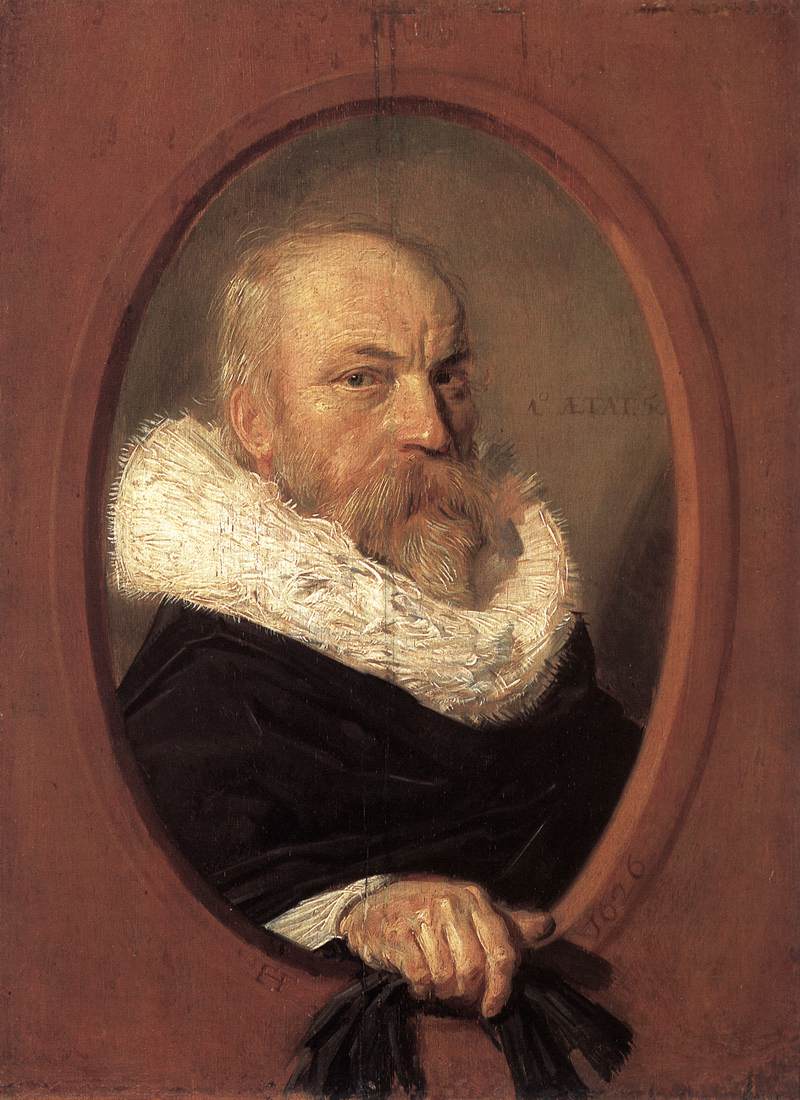
Frans Hals’s Petrus Scriverius (1626) does not behave like a conventional portrait that politely sits back and waits to be admired. It leans toward you. The sitter’s head turns sharply over his shoulder, his eyes lock onto the viewer, and his hand projects forward with such physical conviction that it seems to cross the boundary between painted space and real space. Even before you start reading details, you feel the painting’s intention: this is a meeting, not a display.
Hals achieves that immediacy through a brilliant staged illusion. Scriverius appears to occupy an oval opening as if he were emerging from a frame, window, or niche. The painted surround functions like architecture, turning the portrait into a trompe l’oeil performance. The device is playful, but it is also serious, because it gives Hals a way to dramatize presence. Scriverius is not simply represented; he is staged as a person arriving into view, caught in the act of turning, noticing, and responding.
The result is a portrait that compresses scholarship and charisma into one vivid moment. Scriverius was a learned figure, and Hals could have painted him with the calm, bookish reserve often used for intellectuals. Instead, Hals gives him alertness and a kind of tough clarity. This is learning with backbone, a mind that stands its ground.
The Oval Illusion and the Theater of the Frame
The painting’s most distinctive feature is its illusionistic structure. Scriverius is framed by an oval aperture set within a broader field of warm reddish brown. The oval reads like a carved opening, a portal. It creates the sensation that the sitter occupies a separate space behind the surface, while his hand and arm press into our world.
This device does several things at once. It concentrates attention, much like a spotlight in a theater. It also lends the sitter a sculptural presence, as if he were a bust set into a wall. But Hals undermines that sculptural expectation by making Scriverius animate. He is not frozen like stone. He is turning, and his gaze is alive.
The oval also heightens psychological tension. A rectangle can feel stable. An oval feels tighter and more enclosing, which makes the sitter’s movement more dramatic. Scriverius is not comfortably settled into a wide pictorial space; he is contained, and the containment makes his turn feel more forceful. The portrait becomes an argument about vitality within limits: a human presence pushing against the boundaries of the image.
The broader reddish surround, which reads as a painted panel or architectural surface, adds to the illusion. It suggests that the portrait is an object within an interior, something mounted, something that belongs to a room. Hals is playing with the idea of portraiture as a physical presence in a home or civic setting. You do not just look at Scriverius; you feel as if he is installed in your environment.
Pose and Gesture as a Declaration of Authority
Scriverius’s pose is designed to communicate self possession. His body turns away, but his face turns back. This twist creates a sense of alertness, as if he has been called and answers immediately. The movement is controlled rather than startled. He looks like someone who responds quickly because he is used to being addressed.
The hand at the bottom of the oval is especially important. It rests on a ledge and grips an object that looks like gloves. The placement is deliberate. By bringing the hand forward, Hals makes the sitter’s body feel near. The hand becomes a bridge, a visual cue that collapses distance.
There is also a subtle note of command in the gesture. The hand is not relaxed in a careless way. It is firm, and the fingers are placed with intention. Even if the sitter is not literally gesturing, the overall effect reads as a statement: this man has agency. He is not passively offered to the viewer. He meets the viewer on equal terms.
The pose also harmonizes with the oval illusion. If the portrait is a window, then Scriverius is leaning into it. He becomes a presence at the threshold, half in, half out. That liminal positioning is psychologically potent. It suggests a person who belongs to the world of ideas and letters, yet remains engaged with the world of social encounter.
Face, Gaze, and the Sharpness of Personality
Hals paints Scriverius’s face with a kind of disciplined bluntness. The sitter is older, with a high forehead, thinning hair, and a strong beard and moustache that define the lower half of the face. The skin is rendered with honesty, showing age and texture without cruelty. The face is not softened into a flattering mask.
The eyes are the portrait’s emotional anchor. They meet the viewer directly, slightly narrowed, carrying a look that can be read as skeptical, inquisitive, or quietly assertive. It is not an inviting gaze, but it is not hostile. It feels like the gaze of a person who measures what he sees. That quality suits an intellectual: someone trained to evaluate, to question, to judge evidence.
The set of the mouth reinforces this. The lips are firm beneath the moustache, and the expression suggests restraint. Hals does not grant him the easy charm of a laughing figure. Instead, he grants him intensity. Scriverius appears like someone whose wit is sharp and whose patience is limited. That impression may be more artistic invention than biography, but it is consistent with the portrait’s overall rhetoric: seriousness, presence, and self command.
What makes this portrait so effective is that the sitter’s personality is not reduced to a single mood. The gaze is complex. There is confidence, but also watchfulness. There is authority, but also the suggestion that the sitter is ready to challenge you if you approach with nonsense. Hals paints intelligence as something active and slightly dangerous.
The Ruff as Light and Architecture
The large white ruff is a major compositional and symbolic element. It frames the head like a luminous halo, but it is a secular halo, made of linen and fashion. In Dutch portraiture, immaculate white linen often served as a sign of order, wealth, and discipline. Here it also serves as a visual amplifier, pushing the head forward and separating it from the darker clothing.
Hals paints the ruff with bold, energetic strokes that suggest layers and stiffness without turning into dry description. It reads as fabric, but it also reads as paint. The ruff’s brightness creates a sharp contrast with the black garment, making the sitter’s face appear even more present.
The ruff also becomes a kind of architecture within the oval. Its circular rhythm echoes the oval frame, creating a harmony of curves. This repetition reinforces the portrait’s overall design. The oval opening, the rounded ruff, and the beard’s curved volume all build a coherent structure around the face, making the sitter’s head feel like the portrait’s unshakeable core.
Black Clothing and the Language of Restraint
Scriverius’s clothing is dark and understated, especially compared with portraits that use elaborate patterned fabrics. Yet this understatement is itself meaningful. Black clothing in the Dutch context often conveyed sober respectability and refined status. It suggests a man aligned with seriousness rather than display.
Hals uses subtle tonal variation to keep the black from becoming dull. The garment has depth, with gentle shifts that describe form and folds. The darkness also serves the painting’s psychological purpose. It makes the face and ruff dominate, directing attention to intellect and presence rather than to costume.
This restraint aligns with the sitter’s demeanor. The portrait suggests a man who does not need ornament to establish authority. The ruff is enough, and even the ruff reads as discipline rather than vanity. The overall impression is of controlled power, expressed through economy.
Color and the Warmth of the Surround
The reddish brown surround is not merely a frame. It contributes to the painting’s mood. It feels like wood, paneling, or a warm interior surface. That warmth counters the cool austerity of black and white, giving the portrait an approachable physical presence. It reminds the viewer that this is a painted object meant to hang in a lived space.
The warm surround also enhances the illusionistic effect. Against that reddish field, the oval opening looks like a cutout. It makes the portrait feel like an object that has depth, like a niche holding a living figure. Hals uses color to support spatial trickery, and the trickery supports the painting’s theme of encounter.
Within the oval, the background behind the sitter is subdued and grayish, a neutral that keeps attention on the face. This contrast between warm surround and cool interior space helps separate the illusion levels: the “wall” outside, the “air” inside. Hals, in other words, builds a small stage with distinct zones.
Brushwork and the Sense of a Mind in Motion
Hals’s brushwork often conveys speed, but here it conveys decisiveness. The ruff is painted with flickering strokes that suggest crispness and thickness. The beard is built with layered touches that give it weight and texture. The face is modeled with a balance of softness and sharp accents, especially around the eyes and nose.
The most impressive part is how Hals avoids stiffness despite the formal structure. The oval frame could easily lead to a static, medallion like portrait. Hals resists that by emphasizing the twist of the neck, the angle of the shoulders, and the forward placement of the hand. The paint itself participates in this vitality. It is not heavily smoothed. It remains responsive, as if it still holds the energy of its making.
This responsiveness suits the sitter’s identity as a scholar. It suggests a mind that is active, not sleepy. The portrait does not depict study through books or writing tools. It depicts study through the character of the face, the readiness of the body, and the intensity of the gaze.
Intellectual Portraiture Without Props
One of the portrait’s boldest choices is what it leaves out. There are no books, no desk, no quill, no library. Hals does not rely on objects to define Scriverius as a learned man. He relies on the person.
This is more difficult, but it is also more powerful. Props can become clichés. A book can announce scholarship, but it can also flatten the sitter into a type. By stripping away external markers, Hals allows Scriverius to remain complex. The viewer must read learning in the eyes and the expression, not in a convenient symbol.
The inscription that indicates age and date hints at identity, but the painting largely insists that personality is the primary evidence. This approach also fits Hals’s broader strength as a portraitist. He is less interested in allegory than in presence. Even when he uses theatrical devices like the oval opening, he uses them to intensify the encounter, not to distract from it.
The Social Meaning of Being Seen
Portraits like this were not private indulgences alone. They were social instruments. They confirmed status, asserted respectability, and shaped how a person might be remembered. The oval illusion, in this context, becomes more than playful technique. It becomes a claim that the sitter’s presence deserves to be felt.
Scriverius appears not as a distant authority but as an accessible one, close enough to confront you. That closeness could have been valuable in a civic culture where reputation and networks mattered. The portrait projects a man who is engaged, alert, and not easily dismissed.
At the same time, the portrait’s restraint signals seriousness. The sitter is not performing charm. He is performing credibility. Hals understands that credibility can be visual. It can be expressed through steadiness, through an unwavering gaze, through a body that occupies space with confidence.
The Psychological Drama of the Turn
The most memorable element remains the turn of the head. Turning implies interruption. It implies that something has happened to make the sitter shift attention. That implied event is never shown, which creates narrative tension. We become the cause. The viewer becomes the voice that called his name.
This dynamic makes the portrait unusually interactive. It does not simply show a man. It stages a relationship between viewer and sitter. Scriverius is caught at the moment he notices you, and his expression suggests he is already forming a judgment.
Hals’s ability to invent this drama without exaggeration is remarkable. The portrait remains plausible. The turn is natural. The gaze is direct. The hand rests on the ledge as if it belongs there. The illusion works because it is psychologically convincing, not because it is mechanically perfect.
Conclusion: A Scholar Painted as a Force of Presence
Petrus Scriverius stands as one of Frans Hals’s most compelling statements about portraiture’s power to create encounter. Through the oval illusion, the forward thrust of the hand, and the sharp directness of the gaze, Hals turns a painted likeness into a living confrontation. The sitter’s authority is conveyed not through props or grand symbols, but through the disciplined intensity of his face and the quiet command of his posture.
The portrait is also a celebration of restraint. Black clothing, warm surround, and a luminous ruff create a focused world where personality dominates. Hals invites us to recognize Scriverius not only as a historical figure, but as a presence, someone who still seems capable of looking back, measuring, and responding. In doing so, Hals makes the portrait feel less like an artifact and more like a continuing conversation across time.