Image source: wikiart.org
A Portrait Built for Presence
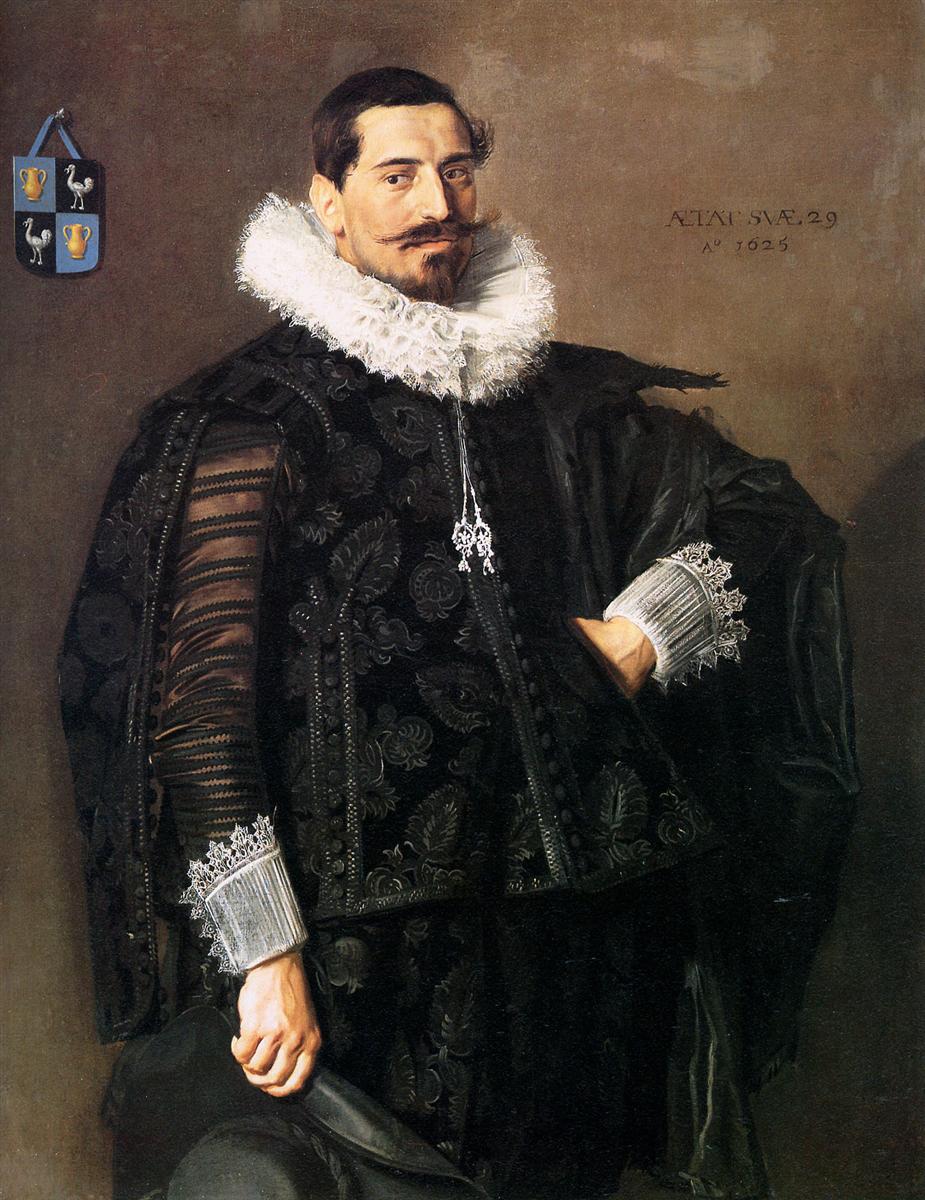
Frans Hals’s Portrait of Jacob Pietersz Olycan (1625) is the kind of painting that announces a person before it explains him. The sitter stands with controlled ease, dressed in an almost theatrical black that absorbs light, yet never becomes flat. His stance is confident but not aggressive. He looks outward with a steady gaze, as if meeting the viewer in the same room, fully aware of the impression he makes and comfortable with that fact.
Hals gives this portrait a paradoxical character: it is formal, even ceremonial, but it feels alive. The sitter’s posture is arranged, his clothing meticulously chosen, and the heraldic sign in the corner insists on lineage. Yet nothing about the face feels embalmed. The expression is alert, slightly amused, and extremely self possessed. It is the look of someone who understands social performance and can perform it without strain.
The painting also carries the clarity of a milestone. The inscription notes his age, and the date situates the portrait at a moment when Haarlem portraiture was becoming a sophisticated language of identity. Hals makes that language speak fluently, not through stiff symbolism, but through gesture, texture, and the subtle theater of looking.
Composition and the Quiet Force of the Pose
The portrait is arranged to make authority feel natural. Jacob Pietersz Olycan is placed slightly off center, with his torso turned and his head angled back toward the viewer. This creates a gentle twist that adds movement without sacrificing stability. One arm bends at the elbow, the hand set at his waist, forming a classic sign of assurance. The other hand holds a dark accessory, likely gloves or a hat, which introduces a grounded, tactile note at the lower edge of the composition.
The ruff frames the head like a white burst. It is both fashion and architecture, a luminous collar that forces attention upward. Hals uses it as a compositional hinge. The eye moves from the face into the ruff’s radiating folds, then down along the black garment where light catches on embroidery, cuffs, and sleeve structure.
The background is restrained, a warm neutral field that keeps the figure dominant. It is not a void; it is a shallow space that allows the sitter to feel anchored rather than pasted. The coat of arms in the upper left and the inscription on the right provide balance, giving the composition an almost triangular stability: heraldry, identity text, and human presence.
The Face as Social Intelligence
Hals’s gift is his ability to paint a face that feels like it contains a mind at work. Olycan’s expression suggests composure with an edge of personality. The eyes engage directly, and the mouth, shaped under a precise moustache, hints at control rather than softness. The small goatee and careful facial hair styling reinforce an image of cultivated masculinity.
The most persuasive detail is the calmness. This is not a face strained by the effort of being portrayed. Hals often gives sitters a sense of being caught mid breath, but here the breath is steady. The sitter seems to hold his pose easily, implying a person accustomed to public roles, business dealings, or civic prominence.
Age matters too. The inscription indicates he is still young, yet the portrait does not read as youthful uncertainty. Instead it projects early mastery, a man already formed into his social shape. Hals communicates that not through exaggerated sternness, but through the sitter’s confident stillness.
Black as Luxury, Black as a Challenge
The dominant impression of the painting is black, but it is not a single black. Hals builds a wardrobe of dark tones that range from soft charcoal to deep velvet like shadow. This variety is crucial because black clothing in Dutch portraiture often served as a display of refined wealth. Expensive black dye and fine black fabrics could signal status as effectively as bright color, especially when paired with immaculate white linen.
Hals turns that cultural code into a technical performance. He differentiates surfaces within the darkness: the sheen of satin, the dullness of heavier cloth, the subtle patterning of embroidery. The result is a portrait where richness is expressed through restraint. The sitter’s luxury is not shouted. It is proven in the ability of the garment to catch and release light.
This is also where Hals’s painterly confidence becomes obvious. Painting black on black is an invitation to monotony, yet he avoids it by relying on texture and direction of stroke. Highlights appear where the fabric folds, where cuffs flare, where the shoulder catches light. The dark garment becomes a landscape of controlled variation, and the viewer’s eye learns to read that landscape the way one reads terrain.
Lace, Linen, and the Sharpness of White
If black is the portrait’s field, white is its spark. The ruff and cuffs are painted as bright notes that cut through the darkness. Hals treats the ruff not as a stiff, diagrammatic object, but as a lively construction of folds. The white is not simply painted white. It carries shadow, warmth, and subtle shifts that suggest thickness, starch, and layered fabric.
The cuffs, trimmed with delicate lace, perform a similar function. They mark the wrists as points of refinement, and they also highlight the sitter’s hands, which are essential to the portrait’s rhetoric. Hals lets the lace read as lace without obsessing over every thread. He offers enough detail to convince the eye, then lets brushwork do the rest.
These whites also frame the face. The ruff acts like a reflector, brightening the sitter’s features, giving the skin a warm presence against the cool, rich clothing. This interplay is one reason the portrait feels immediate. The lighting and costume collaborate to make the head emerge with clarity.
The Hands and the Language of Control
The portrait’s authority is expressed through the hands as much as the face. The hand set at the waist creates a sense of ownership over space. It says the sitter belongs here and occupies this stance by right. The other hand, holding a dark accessory, adds realism and a hint of action. He is not merely posed; he is equipped.
Hands in portraiture often reveal an artist’s priorities. Hals does not paint them as polished sculptures. He paints them as living forms with warmth, slight irregularity, and practical presence. The fingers curl naturally, and the wrist emerges from the cuff with believable structure.
The accessory, whether gloves or hat, also suggests social ritual. Gloves imply status and civility, and they suggest movement between public and private roles. A hat can suggest similar ideas, a symbol of a gentleman’s outward presentation. Hals includes it quietly, letting it enrich the narrative without turning it into a loud emblem.
Heraldry and Inscription as Self Declaration
The coat of arms in the upper left corner is not decorative filler. It is a condensed statement of lineage and identity, a visual signature of family standing. In Dutch portrait culture, such heraldic symbols could function as claims of respectability, continuity, and civic legitimacy. Hals places it where it can be noticed without competing with the sitter’s face.
The inscription on the right adds a different kind of authority. It declares age and date, turning the portrait into a documented moment. This textual element gives the painting a time stamp, a reminder that portraiture is not only about likeness, but about recording status at a particular stage of life.
Together, coat of arms and inscription frame the sitter as a person both individual and historical. The viewer is meant to recognize not only the man’s presence, but his position within a family narrative. Hals’s genius is that these additions never feel like substitutes for personality. They support it. The sitter’s gaze still dominates.
Brushwork and the Hals Signature of Liveliness
Hals is often associated with speed and spontaneity, but in this portrait the liveliness is controlled. The brushwork is confident, visible in places, yet never careless. The face is modeled with a blend of soft transitions and crisp accents, particularly around the eyes and moustache, where character can be lost if the paint becomes vague.
In the clothing, Hals allows the brush to describe rather than outline. Embroidered patterns are suggested through tonal shifts and short strokes that catch light. This is an important point: the illusion of detail is created not by drawing every motif, but by painting how the motif behaves in light. The viewer perceives richness because the garment behaves richly.
The background also shows Hals’s subtlety. It is not a dead plane. It has a worked surface that feels atmospheric, providing depth without distraction. That surface keeps the portrait from turning into a cutout, and it makes the sitter feel as if he occupies real air.
Light, Warmth, and the Human Scale of Grandeur
The lighting in the portrait is neither dramatic nor flat. It is angled and gentle, creating a naturalistic sense of depth. The face catches the most light, then the ruff and cuffs, then selected areas of the garment. This hierarchy guides the viewer’s attention in a way that feels intuitive.
The skin tones are warm and believable. Hals avoids the porcelain effect that can turn portraits into mannequins. Instead, he gives the sitter a sense of blood beneath skin, a living warmth that humanizes the formal costume. The warmth is especially noticeable in the cheeks and around the nose, where light creates soft highlights.
This balance between grandeur and human scale is one reason Hals remains so compelling. The sitter is clearly someone of standing, yet he does not become distant. The portrait communicates power, but it does so through realism and personality rather than through exaggerated symbolism.
Fashion as Identity and Performance
Clothing in this portrait is not simply clothing. It is a public statement. The elaborate black outfit with patterned surfaces and structured sleeves signals wealth, taste, and the ability to participate in elite culture. The ruff, crisp and radiant, signals discipline and refinement. Such garments required maintenance, and maintenance itself could be a form of status, proof that one has time, servants, and resources.
Hals captures the performative nature of fashion without mocking it. He neither satirizes nor idealizes. He paints it as a language the sitter speaks fluently. The sitter’s relaxed confidence suggests he is comfortable in these clothes, not trapped by them. That comfort is itself a marker of social ease.
There is also a sense of international sophistication. The style, facial hair, and posture carry a broader European courtly influence, filtered through the Dutch context. Hals often paints Haarlem citizens who appear worldly, and this portrait participates in that impression.
The Portrait as Relationship Between Viewer and Sitter
A portrait is always a negotiated relationship. The sitter wants to be seen in a certain way, and the painter translates that desire into paint. Here, the negotiation feels harmonious. Olycan appears as someone who wants dignity, authority, and elegance, but not coldness. Hals gives him exactly that.
The direct gaze is crucial. It creates a feeling of encounter. We are not looking at someone unaware of being observed. We are being met. This establishes a dynamic where the viewer is invited to recognize the sitter’s standing. The portrait does not demand submission, but it expects acknowledgement.
The slight lift of the brows and the calm set of the mouth prevent the portrait from becoming severe. There is an undertone of charisma. This is the type of presence that can influence a room without raising a voice. Hals captures that kind of authority better than almost anyone.
Haarlem Portraiture and the Culture of Civic Success
In 1625, Haarlem was a prosperous city, and portraiture functioned as both personal record and social proof. Men who commissioned portraits were often tied to trade, civic institutions, and networks of influence. A portrait like this would have served as a visible statement of legitimacy, not only for the sitter but for the family line.
Hals was especially skilled at making civic identity feel vivid. Even when painting regents or militia officers, he avoided turning people into static symbols. He painted the social world as a world of personalities. In that sense, this portrait is not just about one man, but about a culture that valued individual character as part of public life.
The presence of heraldry reinforces this. It suggests a desire to link personal success to inherited standing. Yet the portrait also shows something distinctly Dutch: the idea that wealth and respectability can be displayed through disciplined restraint, through black fabrics and immaculate linen, rather than through flamboyant color.
Conclusion: Authority Made Lifelike
Portrait of Jacob Pietersz Olycan succeeds because it fuses status with presence. The sitter’s clothing, heraldry, and inscription establish him within a social framework of lineage and success, but Hals refuses to let those elements replace the human being. The face remains alert, the posture remains relaxed, and the painting’s surfaces remain alive with painterly intelligence.
Hals turns black fabric into a demonstration of nuance, and he turns formal posing into a believable encounter. The portrait does not merely commemorate a man at age twenty nine. It presents a personality capable of carrying the weight of that commemoration. The result is a work where authority feels earned rather than imposed, and where elegance is inseparable from the vivid fact of being alive.