Image source: wikiart.org
First Impression and the Portrait’s Theatrical Confidence
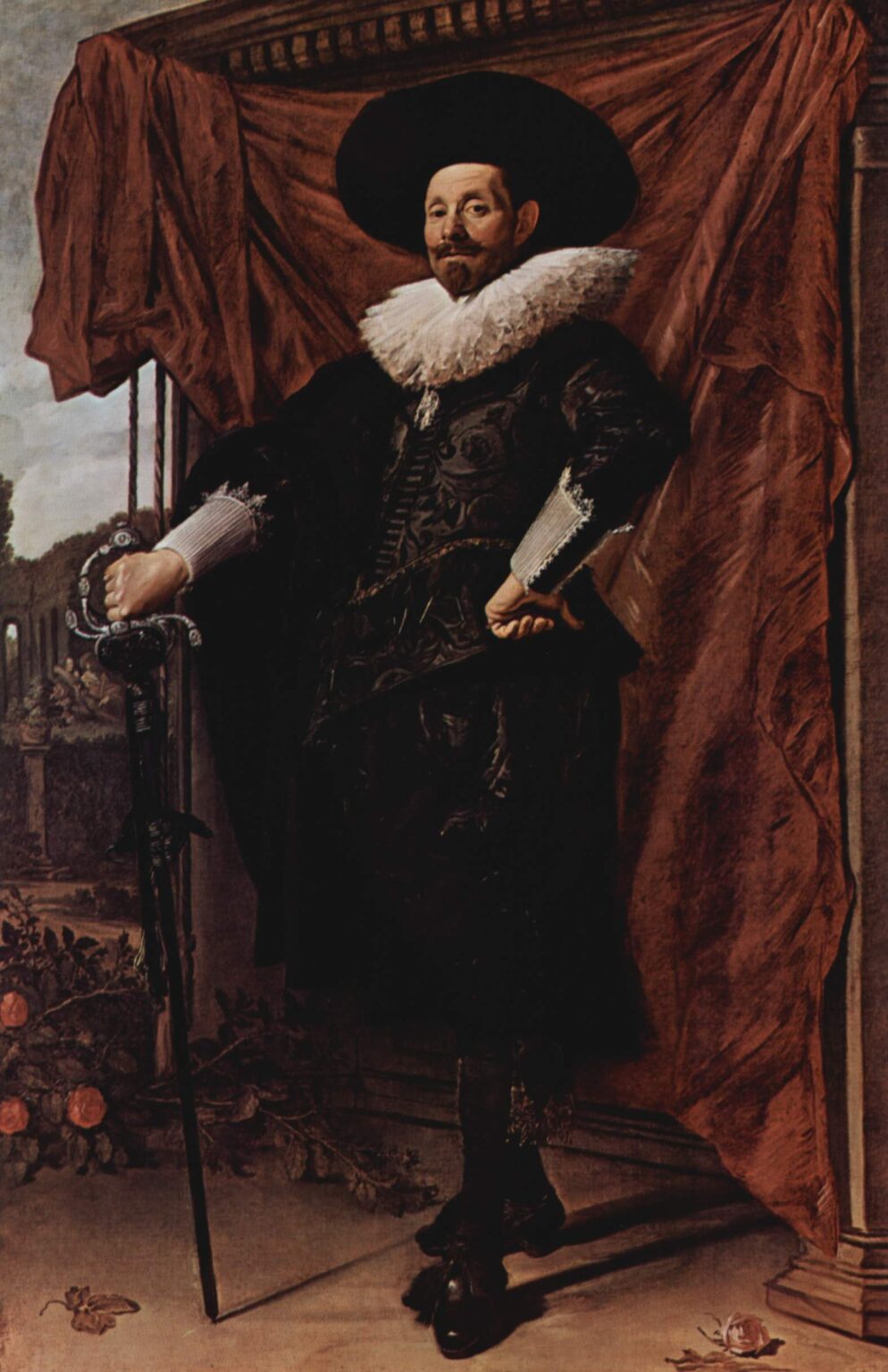
Frans Hals’s Willem Van Heythuyzen (1625) is a portrait that feels like an entrance. The sitter does not merely appear; he arrives. Everything about the image communicates controlled display: the sweeping hat, the brilliant ruff, the dramatic drapery, the poised stance, and the cane that reads as both accessory and emblem. Hals frames Willem as a man who understands how to be seen, and who enjoys the fact that he is being seen. The portrait is not only a record of features but a carefully staged statement of character and position.
At first glance, the composition is dominated by contrast. Willem’s dark clothing forms a dense mass against the warm red curtain, while his white ruff and cuffs flash like bursts of light. Hals uses that contrast to create a sense of immediacy: the sitter seems to step forward out of shadow. Yet the mood is not harsh. It is warm, confident, even slightly amused. Willem’s expression, with its faint smile and direct gaze, suggests a man comfortable with his own authority.
The painting is also unusually kinetic for a formal portrait. The body angle, the placement of the legs, and the diagonal cane all imply movement. Hals captures the sitter in a pose that feels temporary, like a moment chosen from a longer sequence of gestures. That is one of Hals’s great gifts: he makes portraiture feel like life rather than ceremony.
Composition and Stance: A Portrait Built Like a Stage Scene
The portrait’s structure is theatrical by design. Willem stands near a column and a heavy curtain, architectural and textile props that create the sense of an interior stage opening onto an outdoor view. This format was popular among elite portraiture because it allowed the sitter to occupy a space of cultivated grandeur. The column implies stability, heritage, and classical authority. The curtain implies reveal, presentation, and spectacle. Together, they turn the act of portraiture into an event.
Willem’s stance is one of the painting’s most striking features. His weight shifts subtly, his legs positioned in a way that suggests both elegance and casual command. One arm rests with assurance, the other hand anchors itself at the hip. The pose feels practiced, as if Willem is adopting a fashionable attitude associated with aristocratic portraiture, but Hals makes it believable rather than stiff. The energy of the pose suggests personality, not just convention.
The cane functions as a compositional spine. It runs vertically but at a slight diagonal, echoing the sitter’s body angle and adding structural clarity to the lower half of the painting. It also creates a visual path: from the ornate handle near Willem’s hand down toward the floor, where it anchors him physically in space. Hals uses this object to connect refinement with grounded presence.
The Drapery’s Role: Warm Red as Power and Atmosphere
The massive red curtain is not background decoration. It is a major actor in the portrait’s drama. Its warm color contrasts powerfully with Willem’s dark attire, and its folds create a sense of motion, as if the fabric has been recently pulled aside. This makes the sitter feel revealed, presented, introduced.
Red drapery carries associations of status and luxury, but Hals deploys it with painterly intelligence. The cloth’s folds are broad and weighty, suggesting thickness and cost. It also creates a warm atmosphere that flatters the sitter’s complexion and counters the cool austerity that black clothing might otherwise project. The portrait balances restraint and richness: Willem’s outfit is dark and controlled, yet the surroundings glow with warmth.
The curtain also helps Hals manage space. It blocks off parts of the background, creating a large plane that keeps attention on the sitter. At the same time, its diagonal folds echo the sitter’s angles, reinforcing the painting’s rhythm. Rather than sitting behind Willem like wallpaper, the drapery participates in the portrait’s movement.
Costume and Display: Black Luxury, White Brilliance
Willem’s clothing is a statement of wealth expressed through restraint. In seventeenth century Dutch culture, black could be among the most expensive colors because achieving a deep, rich black required high-quality dye and cloth. Hals paints Willem’s outfit as a complex black, not a flat void. There are subtle variations of sheen and tone that suggest patterned fabric, perhaps velvet or another richly textured material.
Against this darkness, the white ruff becomes spectacular. It frames Willem’s face like a luminous collar of status, increasing the sitter’s visual prominence. Ruff collars required care, expense, and social knowledge. They were signs not only of wealth but of discipline, because maintaining them demanded time and servants or personal labor. Hals paints the ruff with crisp energy, letting light pick out its folds and edges so it reads as both tactile and radiant.
The cuffs echo the ruff, creating a repeated white motif that punctuates the composition. These white accents are strategically placed: near the face, and near the hands. Hals understands that viewers look to faces and hands for identity. By brightening those areas, he ensures Willem’s personality and gestures hold the painting’s focus.
The Hat and the Face: Charm, Authority, and a Hint of Play
The oversized black hat is one of the portrait’s most memorable elements. It gives Willem a silhouette that feels bold and slightly theatrical, as if he is adopting a fashionable swagger. Hats in portraiture can signify rank, wealth, and confidence, but they can also communicate individual style. In this case, the hat feels like an extension of Willem’s personality: assertive, self-assured, and a little dramatic.
Yet the face remains the true center. Hals paints Willem’s expression with a blend of calm and wit. There is a slight upward curve at the mouth, a relaxed steadiness in the eyes, and a sense of knowing presence. Willem looks at the viewer directly, but not aggressively. The gaze reads as confident social engagement, like someone accustomed to being observed and to managing impressions.
This is where Hals’s psychological skill shines. He does not make Willem into a stiff emblem of status. He makes him seem like a man with a particular temperament. The portrait suggests someone who enjoys display but retains control, someone who understands fashion and power but remains personable.
Gesture and the Cane: Objects as Extensions of Character
The cane is both practical and symbolic. Practically, it may suggest refinement and fashionable masculinity, a gentleman’s accessory. Symbolically, it resembles a staff of authority, turning Willem’s stance into something closer to command. Hals makes the cane’s ornate handle a point of interest, indicating craftsmanship and expense.
Willem’s grip on it is relaxed. He is not leaning heavily. That matters: it suggests that the cane is not a sign of weakness but of style. It is a chosen accessory that reinforces the sitter’s self-presentation. Hals often uses such objects to indicate how a person wants to be understood. Here the cane supports an image of cultivated confidence.
The other hand, placed at the hip, intensifies the pose’s swagger. That gesture reads as deliberate, a sign of ownership over space. Willem takes up room in the painting, both physically and socially. Hals gives him a stance that feels like a claim.
Setting and the Outdoor View: Wealth, Taste, and the World Beyond
Behind Willem, the composition opens to a landscape view. This small window into the outdoors suggests land, property, and the broader world of wealth. In elite portrait traditions, a landscape often implies status through association with estates, travel, or cultivated taste. Even if the landscape is not a literal depiction of Willem’s property, it functions as a symbol of connection to the world beyond the interior.
The garden-like elements near the bottom, including flowers, contribute to this impression of cultivated environment. Flowers can suggest refinement, transience, or the pleasures of nature shaped by human care. Here they also enrich the lower part of the composition, preventing the portrait from becoming too heavy in its darkness.
The setting as a whole feels like a curated stage of identity. Architecture, curtain, landscape, and flora combine to place Willem in a world that signals prosperity and sophistication.
Light and Paint Handling: Hals’s Control of Darkness
Painting black clothing is a technical challenge because it can easily become monotonous. Hals solves this by treating black as a field of subtle variation. He uses reflected light, textured brushwork, and slight tonal shifts to suggest patterned fabric and depth. The result is a costume that feels luxurious rather than flat.
The lighting is designed to highlight key signals: the face, the ruff, the cuffs, and parts of the hands. Hals does not illuminate the entire figure evenly. Instead he creates a hierarchy of attention. The viewer’s eye is drawn first to Willem’s expression, then to the ruff’s brilliance, then down to the cane and the gesture of the hands. This controlled lighting turns the portrait into a guided experience.
The paint handling is confident but disciplined. Hals is famous for lively brushwork, and here it appears in the energetic depiction of lace and ruff, as well as in the quick transitions in the face. But the overall finish remains suitable for a formal portrait. Hals balances spontaneity with polish, allowing the sitter to feel alive without undermining dignity.
The Portrait as Social Performance: Haarlem, Wealth, and Self-Fashioning
In 1625, portraiture in the Dutch Republic was deeply tied to self-fashioning. A portrait was not just a private keepsake; it was a public statement. It could be displayed in a home and seen by guests, family, business partners, and rivals. It announced stability, success, and social standing.
Willem’s portrait is especially performative. The dramatic curtain, the column, the confident stance, and the elegant accessories all suggest a sitter who wants to be understood as a man of stature. Yet Hals avoids making the portrait cold. The slight smile and relaxed gaze ensure that Willem reads as approachable. This balance would have been socially advantageous: authority without hostility, wealth without arrogance.
The portrait also reflects a broader Dutch negotiation between modesty and display. Dutch culture often valued sobriety, yet successful people still wanted visible proof of their success. Hals achieves that through controlled luxury: expensive black cloth, crisp white lace, fine objects, and a grand setting, all presented with a tone of confident restraint.
Masculinity and Fashion: The Body as Statement
Willem’s pose and clothing participate in a visual language of masculinity that emphasizes control, elegance, and presence. The wide-brimmed hat enlarges the silhouette, making him appear bigger and more imposing. The ruff creates a strong boundary between face and body, almost like armor made of fabric. The cane suggests command. The stance suggests ease and readiness.
At the same time, there is refinement. The lace cuffs and carefully rendered textures show attention to detail. This masculinity is not rugged labor. It is cultivated status. Willem appears as someone who belongs to the world of wealth and social maneuvering, where appearance is a tool and self-presentation is a skill.
Hals’s genius is that he makes this feel like a real person, not a mannequin in expensive clothing. The face carries warmth, and the pose carries individuality. Willem is fashionable, but he is not swallowed by fashion.
Why the Painting Still Feels Modern
Many portraits from the era can feel distant because they emphasize status at the expense of personality. Hals resists that. He gives Willem a presence that feels like a meeting. The direct gaze and slight smile create an exchange between sitter and viewer, and the dynamic stance makes the image feel caught in time rather than frozen.
The painting also feels modern because it understands identity as performance. Willem is clearly presenting himself in a chosen way, and Hals makes the viewer aware of that presentation without reducing it to vanity. The portrait becomes a study of how people craft their public selves, a theme that remains relevant in any era.
Finally, the painting’s visual drama still works. The contrast of black and white against the red curtain is bold and memorable, the silhouette is striking, and the composition directs the eye with confident clarity. Hals builds a portrait that functions both as social document and as compelling image.
Conclusion: A Portrait of Presence, Style, and Controlled Power
Willem Van Heythuyzen is a portrait that demonstrates Frans Hals’s ability to merge grandeur with immediacy. It offers a sitter framed by the symbols of status, yet alive with personality. Willem stands not as a distant emblem but as a confident human presence, poised between display and individuality.
The painting’s success lies in its orchestration of contrasts: dark luxury against warm red, structured ruff against relaxed expression, theatrical setting against believable stance. Hals uses these contrasts to build an image that communicates wealth and authority while remaining engaging and human.
In the end, the portrait endures because it feels like a moment of self-possession preserved. Willem’s gaze, stance, and style declare that he knows who he is and how he wishes to be seen. Hals, with his unmatched sensitivity to character, makes that declaration feel not merely impressive, but vividly real.