Image source: wikiart.org
A First Encounter With Confidence Set in Stone
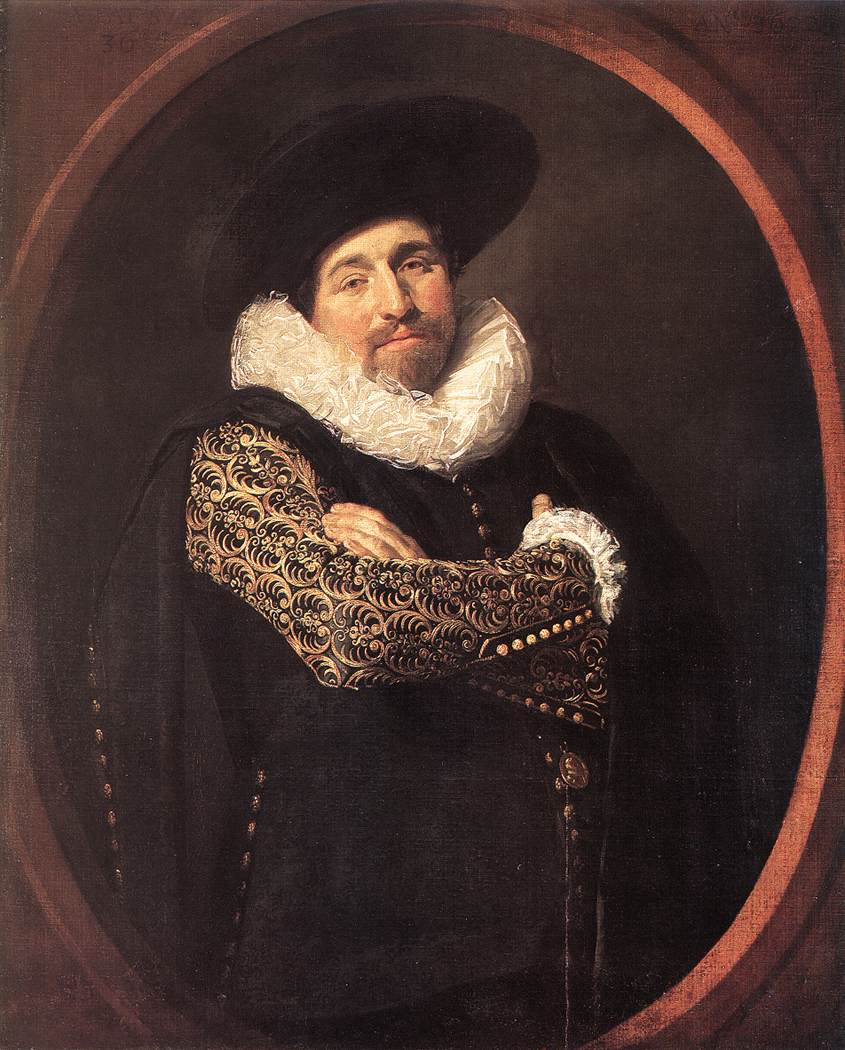
Frans Hals’s “Portrait of a Man” (1622) presents a sitter who seems to have mastered the art of self-possession. From the very first glance, the image communicates assurance, not through exaggerated drama, but through a calm, almost amused solidity. The man stands within an oval frame, his arms folded across his chest, his head slightly tilted, his gaze directed outward with a quiet sense of control. Everything about the pose suggests that he is accustomed to being observed and judged, and that he has learned how to turn that scrutiny into an advantage.
The painting is built on an intriguing contradiction. The oval framing device creates the impression of confinement, as if the sitter is contained within a niche or a medallion-like opening. Yet the man’s posture resists any feeling of limitation. Folded arms can be defensive, but here they read as settled and sovereign, an expression of confidence that does not need to prove itself. Hals turns the portrait into a meeting with a personality that seems fully formed, a presence that fills the frame and makes the oval feel less like a boundary and more like a stage.
The Oval Frame as Theater and Social Device
The oval frame is not merely a decorative choice. It changes the portrait’s entire psychology. It encourages the viewer to read the sitter as a figure presented in a formal, curated way, like a cameo enlarged to life scale. At the same time, it intensifies intimacy. By narrowing the visual field, the oval forces the viewer closer, directing attention toward face, ruff, and gesture.
This device also strengthens the portrait’s sense of monumentality. The sitter is not placed in a recognizable room that might distract with furniture or symbolic props. Instead, he is placed in a timeless, abstracted space where the only subject is his identity. The oval suggests permanence, as if the sitter is meant to endure like an emblem. That sense of endurance aligns perfectly with the man’s posture. He appears not only confident in the moment, but confident in the long arc of reputation, as if the portrait is designed to outlast him and keep his presence alive.
The Pose and the Language of Folded Arms
Few gestures in portraiture are as immediately legible as folded arms. It can signal defensiveness, skepticism, impatience, or authority, depending on context. Hals uses it here as a sign of self-assured stability. The sitter’s arms are folded without tension. The shoulders remain relaxed. The head tilts slightly, the mouth softens into a hint of a smile, and the eyes carry an expression that feels knowing rather than confrontational.
This combination turns the gesture into a statement: the sitter does not need to perform openness to be respected. He is comfortable with boundaries. He is comfortable with withholding. Yet the portrait does not read as unfriendly. The faint smile and relaxed posture keep it from becoming rigid. Hals captures a man who projects control while remaining socially agile, capable of warmth without surrendering authority.
The folded arms also create a strong compositional block. They form a horizontal mass across the chest, stabilizing the figure and giving the portrait an architectural firmness. This solidity is crucial within the oval format. The viewer experiences the sitter as a concentrated presence, dense with identity.
A Face That Balances Ease and Calculation
The sitter’s face is the portrait’s emotional center. Hals paints a subtle expression that sits between friendliness and reserve. The man’s eyes meet the viewer, but not with intense scrutiny. The gaze feels relaxed, almost conversational. The mouth curves slightly, suggesting humor or mild amusement, the kind of expression that implies confidence because it does not need to insist on seriousness.
This is a carefully calibrated portrait psychology. A fully stern expression might have signaled authority but risked harshness. A broad smile might have signaled warmth but risked frivolity. Hals chooses the middle path. He gives the sitter a face that suggests he is intelligent, socially adept, and secure enough to allow a hint of charm.
The head’s slight angle contributes to this effect. The tilt introduces liveliness, as if the sitter has responded to something just said. It implies a moment of interaction rather than a static pose. Hals excels at this, making portraits that feel like exchanges rather than masks.
Light and Shadow as Tools of Emphasis
The portrait relies on a controlled interplay of light and shadow. The face and ruff receive the clearest illumination, while much of the clothing recedes into deep black. This contrast creates an immediate hierarchy of attention. We see identity first in the face, refinement in the ruff, and then the broader social body in the dark costume that surrounds them.
Hals’s shadows are not empty. They contain subtle variations that suggest fabric and form. The cloak or cape absorbs light, creating depth, while the embroidered sleeve catches highlights that shimmer against the darkness. The background remains subdued, allowing the sitter to emerge as a figure of concentrated presence.
Light also shapes the sitter’s expression. By softly modeling the cheekbones and the bridge of the nose, Hals gives the face structure without harshness. The result is a portrait that feels firm but not severe, echoing the balance of the folded-arm pose.
The Ruff as a Collar of Prestige and Craft
The white ruff is both a compositional anchor and a social signal. It frames the sitter’s face, creating a bright halo that separates flesh from dark clothing. This immediately draws the eye upward and emphasizes the man’s gaze. But the ruff also speaks a language of status. Such collars required careful laundering, starching, and shaping. Their crisp whiteness implied a household capable of sustaining that labor, which in turn implied wealth and order.
Hals paints the ruff with a lively sense of texture. It does not look like a stiff ornament pasted onto the figure. It looks worn and inhabited, responding to the sitter’s posture. The ruff’s folds catch light in small rhythms, giving it depth and motion. In a portrait dominated by dark tones, the ruff becomes a brilliant sculptural form, a sign of refinement that feels almost architectural.
Embroidered Sleeves and the Luxury of Detail
The sitter’s sleeve is one of the painting’s most visually arresting elements. The embroidery, rendered in intricate gold-like patterning, provides a lavish counterpoint to the otherwise sober black costume. Hals uses this sleeve strategically. It sits near the center of the portrait and is emphasized by the folded-arm pose, which brings the decorated fabric into prominent view.
This detail communicates wealth, but it also communicates taste. The luxury is not scattered across the painting. It is concentrated, disciplined. The sitter chooses to present himself mostly in black, a color associated with restraint and seriousness, yet he allows one area of ornament to speak. That ornament becomes a controlled announcement of prosperity, suggesting that he can afford splendor but does not depend on it for status.
The embroidery also demonstrates Hals’s technical ability. He captures the sense of patterned fabric without turning it into a rigid diagram. The sleeve feels like cloth that bends and folds, with ornament that follows the form. This is crucial: the pattern serves the body, not the other way around. The sitter remains a person, not a mannequin for decoration.
The Hat and the Silhouette of Authority
The sitter’s wide-brimmed hat adds to his commanding presence. It expands the silhouette, giving the figure a broader, more imposing outline within the oval. The hat also introduces a sense of fashion and worldly confidence. In portraiture, hats can function as markers of social rank and personal style. Here, it reinforces the impression that the sitter is comfortable in public life and knows how to present himself as a man of standing.
The hat’s dark mass also participates in the portrait’s larger pattern of contrast. It frames the face from above, echoing the ruff’s framing from below. Together, hat and ruff create a visual enclosure around the sitter’s expression, focusing attention on the eyes and mouth. This enclosure heightens the psychological intensity. The viewer feels guided toward the face, where the portrait’s subtle charm resides.
Black Fabric and the Challenge of Painting Darkness
Hals’s handling of black fabric deserves attention because it is a quiet form of virtuosity. Black is difficult to paint convincingly because it can easily become flat and lifeless. Hals avoids this through tonal nuance. The dark clothing contains shifts that suggest folds, weight, and different textures. The cloak reads differently from the embroidered sleeve, and both read differently from the hat. Each black has its own personality.
This complexity prevents the portrait from becoming a simple contrast between white ruff and black costume. Instead, the painting becomes a study in variations of darkness, with light grazing surfaces and revealing subtle structure. This makes the sitter feel physically present, not just visually striking. You can sense the weight of cloth, the thickness of layers, and the way expensive materials hold shape.
The Oval Space and the Illusion of a Painted Niche
The oval framing suggests that the sitter exists in a shallow, defined space, like a niche carved into a wall. This illusion adds a sculptural quality to the portrait. It also enhances the sense that the sitter is being presented as an emblem of identity, like a figure commemorated for family, civic, or social reasons.
At the same time, the sitter’s relaxed expression undermines any stiffness that this format might impose. The portrait becomes a clever negotiation between formal presentation and lifelike immediacy. Hals uses the oval to intensify focus, but he uses expression and posture to keep the image human.
This combination may explain why Hals’s portraits feel so modern. They understand that social identity is constructed, yet they also insist that a living person exists within that construction. The oval becomes a visual metaphor for that tension: a boundary that both contains and displays.
Frans Hals in 1622 and the Growth of His Portrait Language
By 1622, Hals was increasingly recognized for portraits that felt energetic and personal. This painting reveals his ability to balance the demands of elite representation with the desire to capture individuality. The sitter is clearly wealthy and socially prominent, yet Hals refuses to make him a generic type. He gives him a specific expression, a particular posture, and a hint of character that feels more revealing than traditional formality might allow.
The portrait also demonstrates Hals’s interest in the momentary. The slight tilt of the head and the relaxed set of the mouth suggest that the sitter is caught in a living instant, not frozen into a symbolic pose. Hals makes the portrait feel like a meeting, as if the sitter could shift his weight or speak at any moment. That sensation is not accidental. It is the product of an artist who understands that realism is not only about accurate features, but about capturing how a person occupies time.
Status, Personality, and the Art of Being Seen
Ultimately, the portrait is a study in how a man chooses to appear. Everything in the painting contributes to a carefully shaped public image: the black costume signals seriousness, the ruff signals refinement, the embroidered sleeve signals wealth, the hat signals worldly confidence, and the folded arms signal self-assurance. Yet Hals does not let these signals become hollow. He animates them with expression, making the sitter’s personality feel present behind the costume.
This is what separates great portraiture from mere documentation. The painting does not only show what the sitter owned or wore. It shows how he inhabited his own status. He appears to understand the world of appearances and to navigate it with ease. Hals captures that ease as a form of charisma.
The portrait also invites the viewer to consider their own role. We are not passive observers. The sitter’s gaze and posture suggest an awareness of being watched, an awareness that turns the viewer into a participant in the portrait’s social exchange. We are asked to recognize him, to accept his self-presentation, and perhaps to be slightly charmed by it.
Why the Painting Still Captivates
The enduring strength of “Portrait of a Man” lies in its combination of restraint and personality. The painting is visually controlled, built on dark tones and clear structure, yet it contains a spark of humor and humanity in the sitter’s expression. The portrait does not overwhelm with narrative or setting. It concentrates on presence, and it does so with remarkable clarity.
Hals creates a figure who feels at once distant and near: distant because of his wealth, his formal costume, and the emblematic oval framing; near because of the slight smile, the relaxed tilt of the head, and the sense that he is truly looking back at us. That paradox is what makes the portrait memorable. It preserves the sitter as a social statement, but it also preserves him as a person.