Image source: wikiart.org
First Impressions of a Portrait Built on Confidence
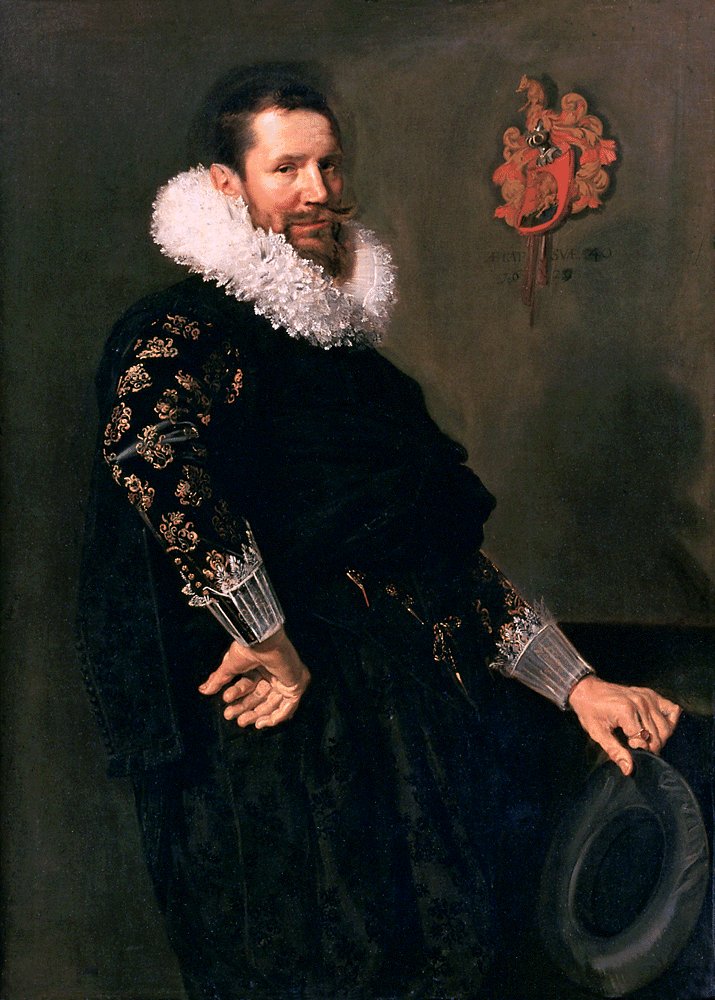
Frans Hals’ “Paulus van Beresteyn” (1620) presents a man who seems to know exactly how he wants to be seen. He stands in a three-quarter pose, body angled, head turned toward the viewer with a calm, slightly amused expression. The stance is relaxed yet deliberate, as if Paulus has paused for a moment while still holding the energy of movement in his posture. One hand rests behind his back, the other holds a broad-brimmed hat low at his side, a gesture that feels both courteous and self-assured.
This portrait is not about inward melancholy or distant grandeur. It is about presence. Hals constructs that presence through pose, clothing, and the subtle psychology of the face. The sitter does not look away in contemplation. He meets the viewer with a steady gaze that implies social ease. This is a man comfortable in public spaces, comfortable being observed, and perhaps even entertained by the act of being painted.
The Power of Pose and the Language of Gesture
The pose is one of the painting’s most persuasive features. Paulus’ body forms a gentle diagonal that animates the composition. His weight seems shifted onto one leg, creating a natural curve through the torso and shoulders. This is a controlled informality, a posture that signals status precisely because it does not need stiffness to prove itself.
The hat held in the sitter’s right hand operates like a prop in a social ritual. Removing or holding a hat could signal respect, greeting, or readiness to engage. Yet Paulus does not hold it with nervous deference. He holds it casually, as though the gesture belongs to him rather than being imposed by etiquette. Hals uses this small detail to suggest character: confidence that feels practiced, not arrogant.
The left hand placed behind the back reinforces the sense of composure. It prevents the portrait from becoming overly theatrical. The gesture suggests a man who has mastered the art of appearing at ease. Hals turns this mastery into a central theme. You are not only seeing a likeness. You are seeing a cultivated way of inhabiting the body.
Clothing as a Display of Wealth Without Loudness
Paulus’ clothing is lavish, but it is lavish in a Dutch way: rich materials and intricate detail expressed through restraint rather than flamboyant color. The dominant impression is deep black fabric, heavy and absorbing, shaped into a cloak-like mass that gives the figure weight and authority. Against that darkness, the white ruff bursts outward around the neck, forming a soft, bright halo that frames the face.
The embroidered sleeves are the portrait’s most decorative feature. Gold patterns curl across the dark fabric, creating a subtle shimmer that catches the eye without overwhelming the composition. This embroidery communicates wealth and refinement, and also a certain taste for measured luxury. It is not reckless display. It is controlled ornament, carefully positioned where it can be seen and admired.
The cuffs, striped and pale, provide another bright counterpoint. Hals builds the costume as a rhythm of dark and light: black cloak, white ruff, patterned sleeves, pale cuffs, then the muted gray of the hat. This rhythm guides the viewer’s eye across the figure, ensuring that the portrait feels coherent rather than scattered.
The Ruff as Architecture Around the Face
The ruff is more than a collar here. It is a structural device, almost an architectural frame around the sitter’s head. Hals paints it with enough crispness to convey its starched form, yet he keeps it from looking rigid by allowing soft transitions and slight irregularities in the folds. The ruff functions like a luminous boundary between Paulus and the surrounding darkness.
This boundary is psychologically important. It creates a sense of elevation, separating the face from the heavy black garment below. The viewer is drawn to the face as the site of identity, and the ruff becomes a visual trumpet that announces the sitter’s presence. It also reinforces social meaning. Ruff collars were expensive and labor-intensive to maintain. Their whiteness signals both wealth and discipline, the ability to keep fabric immaculate.
Hals makes the ruff feel tactile. You can almost imagine its stiffness and the way it would restrict certain movements. Yet Paulus’ relaxed pose suggests that he has learned to inhabit such clothing comfortably. The portrait becomes a subtle performance of ease within constraint, a theme that resonates through the entire image.
Face, Expression, and the Suggestion of Personality
Paulus’ expression is one of quiet assurance. The mouth is gently shaped, neither smiling broadly nor set sternly. The eyes look outward with a calm attentiveness, as if Paulus is listening while being watched. The overall effect is a man who is socially fluent, able to hold a gaze without strain.
Hals paints the flesh with warmth and subtle modeling. The cheeks are slightly flushed, giving the face vitality against the cool darkness of the clothing. The beard and mustache are handled with confident strokes, suggesting texture without excessive precision. Hals is not counting hairs. He is constructing presence.
What makes the face particularly compelling is its mixture of reserve and play. Paulus appears dignified, but there is a hint of amusement, as if he understands the portrait as a social tool and is quietly enjoying the process. Hals often excels at this kind of psychological balance. He avoids turning sitters into remote icons. Instead, he suggests that they are thinking, responding, and aware of being seen.
Background, Heraldry, and Identity Made Official
The background is largely plain, a dark field that keeps attention on the figure. Yet Hals introduces a crucial element: a coat of arms on the wall to the right. This heraldic emblem serves as a formal anchor of identity. It locates Paulus within lineage, status, and documented social standing. In portraits of the period, such devices can function like a visual signature of legitimacy, confirming that this is not simply a man, but a man with recognized place.
Hals integrates the heraldry without letting it dominate. It sits off to the side, balanced against the sitter’s head and ruff. The emblem adds color to the otherwise restrained palette, with warm reddish tones that echo the flesh and provide a small spark of intensity. It also deepens the portrait’s purpose. This is not only about capturing appearance. It is about preserving a social identity in paint.
The plainness of the background makes the emblem feel even more intentional. There is nothing else competing for attention. The viewer understands that the essential information is the man, his bearing, and the sign of his standing.
The Figure’s Silhouette and the Sculptural Weight of Black
The black cloak creates a powerful silhouette. Hals uses it to give Paulus a sense of mass, turning him into a dark, solid form against the background. This sculptural effect makes the portrait feel monumental without becoming stiff. The man’s body is present as a shape, a volume, a physical entity, not only a face floating above clothing.
The cloak also creates an elegant simplicity. It allows the embroidered sleeves and cuffs to stand out as controlled highlights. Hals is designing the figure like a visual hierarchy: the face and ruff first, then the sleeves, then the gesture of the hands, then the broader cloak mass that supports everything.
This hierarchy mirrors social logic. The sitter’s identity is in his face and bearing. His wealth is in the details of clothing. His authority is in the overall impression of solidity and composure. Hals makes that logic visible.
Hands, Hat, and the Ritual of Public Courtesy
The hat is a fascinating object in the portrait because it occupies a space between practicality and symbolism. It is a real accessory, but it also implies social behavior. Holding a hat can suggest greeting, respect, or readiness to enter conversation. Paulus’ hat is large and dark, echoing the cloak and extending the portrait’s theme of deep tones punctuated by lighter highlights.
The way Paulus holds the hat reinforces the feeling of controlled informality. He is not raising it dramatically. He is not clutching it anxiously. He holds it as a natural extension of his body, a sign that he belongs in polite society and knows its codes.
The hands themselves are painted with care. Hals gives them a sense of physical weight and bone structure. The fingers are not overly refined. They feel human, functional, and real. This realism grounds the portrait. Even amid luxury, the sitter remains a body with hands that act in the world.
Brushwork and Hals’ Early Mastery of Lifelikeness
In 1620, Hals was already developing the painterly confidence that would make him famous. In this portrait, the brushwork balances control and liveliness. The face is modeled with enough smoothness to create flesh, yet the paint remains visible, reminding the viewer that presence is constructed through strokes. The ruff is handled with crisp highlights and shadows that suggest folds without becoming mechanical. The embroidered sleeves are especially impressive: Hals implies intricate patterning through selective detail rather than laborious precision.
The cloak’s broad dark areas could easily become flat, but Hals avoids that by introducing subtle tonal variation. The black is alive. It suggests folds, depth, and the way light dies gently on heavy fabric. This handling of black is one of Hals’ strengths. He makes darkness articulate.
The portrait feels immediate because Hals does not overwork it into static perfection. He keeps the surface responsive. That responsiveness is what makes the sitter feel as if he could shift his weight, lift his hat, and speak.
Social Ambition and the Portrait as Self-Construction
Portraits like this often functioned as statements of social standing and aspiration. Paulus van Beresteyn is presented not only as a man of means, but as a man of refined self-control. Every element supports that image: the expensive ruff, the embroidered sleeves, the heraldry, the poised stance, the confident gaze.
Yet Hals also makes room for individuality within that constructed identity. The sitter’s expression feels personal rather than generic. The slight warmth in the face and the relaxed handling of the hat suggest a real temperament behind the social mask. This is where Hals’ portraiture becomes especially compelling. He paints the social performance of status while still letting the sitter appear human.
The painting therefore becomes a study of how identity is built. It shows the intersection of clothing, gesture, and psychological presence. Paulus is not simply recorded. He is composed, in both senses: composed in demeanor and composed by the painter into an image meant to endure.
The Portrait’s Lasting Appeal
“Paulus van Beresteyn” remains striking because it captures a type of confidence that feels recognizable across centuries. It is the confidence of someone who knows the rules of his world and can play within them gracefully. Hals communicates this through subtle means rather than dramatic symbolism. The portrait does not shout. It convinces.
The restrained palette, the powerful silhouette, the bright ruff, and the embroidered detail all contribute to a feeling of contained luxury. The heraldry adds a note of official identity, while the sitter’s gaze maintains intimacy. The combination creates a portrait that is both public and personal: public in its statement of status, personal in its suggestion of character.
Hals’ achievement here is to make dignity feel alive. He does not trap Paulus inside the conventions of portraiture. He uses those conventions as a framework for presence. The viewer comes away not only remembering the costume and the emblem, but remembering the man’s attitude, the sense of poised ease that turns a painted figure into a believable person.