Image source: wikiart.org
First Impressions and the Power of Stillness
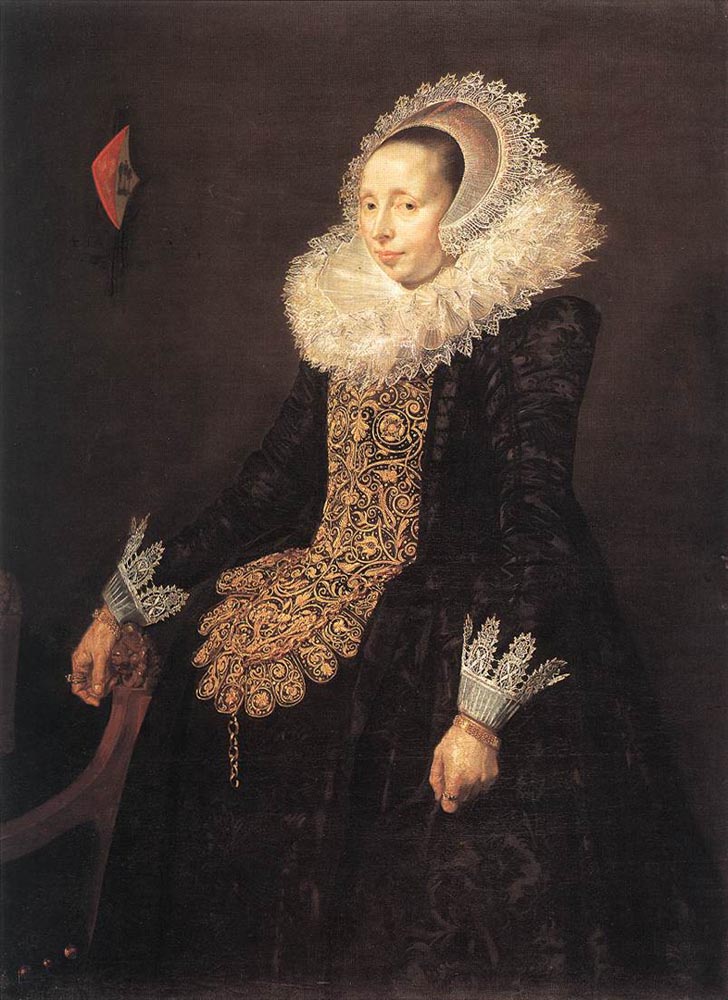
Frans Hals’s Catarina Both van der Eem (1620) offers a kind of quiet authority that does not depend on theatrical gesture. The sitter stands full length against a dark, nearly featureless background, her figure emerging with controlled clarity. She is dressed in a sumptuous black gown with a richly patterned gold bodice and an elaborate lace ruff that blooms around her neck like a halo of textile architecture. The overall effect is both restrained and radiant. The palette is sober, yet the portrait feels luminous because Hals places brilliance exactly where it matters: in the face, the lace, and the intricate ornament that signals wealth and social standing.
The portrait’s stillness is not emptiness. It is a strategy. Hals presents Catarina as composed, self possessed, and carefully framed by the visual language of early seventeenth century Dutch respectability. She does not need to act to be noticed. Her presence is established through posture, costume, and a calm gaze that meets the viewer with steady awareness. This is a portrait of social identity, but it is also a portrait of temperament, suggesting a woman who understands her position and controls how it is displayed.
The Full Length Format and the Ceremony of Presentation
A full length portrait is an event in itself. It expands the painter’s task from capturing a likeness to staging a whole image of rank, demeanor, and material culture. Hals uses the format to present Catarina as a complete figure rather than a fragment of face and shoulders. Her body becomes part of the message, especially through the silhouette of the gown, the placement of her hands, and the relationship between her figure and the dark space around her.
The dark background amplifies the ceremonial effect. With little environmental detail, there is no competing narrative. The portrait becomes a focused presentation, as if Catarina stands on a stage where the only important story is her identity. The emptiness behind her is not a lack of invention. It is a deliberate choice that gives her maximum visual authority. The figure feels isolated and elevated, not in a lonely way, but in a formal way, as if she belongs to the realm of portraiture’s public record.
Even her slight turn, neither fully frontal nor fully profile, helps the portrait’s balance. It allows Hals to model her face gently and to show the gown’s structure and ornament. This angle creates depth while keeping the overall pose stable and dignified.
Catarina’s Gaze and the Controlled Psychology of Portraiture
The psychological charge of the portrait rests largely in Catarina’s face. Hals paints her expression with restraint. She appears calm, composed, and faintly reserved. Her eyes do not challenge the viewer, but they do not retreat either. The gaze feels practiced, the kind of gaze one learns when being seen is part of social life. It suggests that Catarina understands the portrait’s purpose and participates in it consciously.
There is also a subtle softness in the mouth and cheeks that prevents the portrait from feeling severe. Hals does not harden her into an icon of status. He keeps her human. The realism of her features, the gentle modeling of the skin, and the quiet alertness of her eyes give the impression of a person who could speak, listen, and respond, even if the painting asks her to remain still.
This balance between distance and presence is one of Hals’s strengths. He can convey individuality without turning portraiture into intimate confession. Catarina remains private, but she is not generic. The viewer senses personality in the steadiness of her expression and in the dignity of her posture.
Costume as Identity: Black, Gold, and the Architecture of Lace
In early seventeenth century Dutch society, clothing was a language, and Catarina’s attire speaks fluently. The black gown suggests sobriety and status at once. Black was not merely a practical color. It was expensive to achieve richly and evenly, and it carried associations of seriousness, propriety, and wealth. The dark fabric absorbs light, turning her figure into a powerful mass, a visual statement of controlled elegance.
Against this darkness, the gold patterned bodice becomes the portrait’s primary decorative crescendo. Its intricate design reads as both luxurious and disciplined, a dense field of ornament that signals refined taste and significant means. Hals paints the gold with enough variation to suggest texture, embroidery, and depth. It does not appear flat. It appears built, layered, crafted, and costly.
The lace elements bring the whole ensemble to life. The ruff is especially commanding. It frames Catarina’s face like a sculptural collar, catching light in a lacework of pale highlights and soft shadows. Lace in this period was not simply adornment. It required time, labor, and maintenance. In portraiture, it often functions as an emblem of both wealth and virtue, since immaculate whiteness implies order, care, and domestic discipline. Hals exploits this symbolism while also enjoying the painterly challenge of rendering lace’s complex edges.
Her cuffs, delicate and crisp, echo the ruff and connect the face to the hands. These white accents act like punctuation marks in the composition, guiding the eye through the figure and ensuring that the viewer does not lose her hands in the darkness of the gown.
Hands, Jewelry, and the Subtle Theater of Detail
Catarina’s hands are crucial because they humanize the portrait and articulate her social identity. Hals places them low and calm, avoiding dramatic gestures. The hands appear relaxed, suggesting composure rather than animation. Yet they are not incidental. They display fine details: lace cuffs, rings, and the careful positioning of fingers. Such elements communicate wealth in a discreet way. Jewelry is present, but not ostentatious. It complements the overall message of controlled status.
The hands also reinforce the sitter’s role within the portrait’s social code. A woman’s portrait in this context often balanced display and propriety. Too much gesture could imply informality. Too little could imply stiffness. Hals finds a middle ground where the hands offer life without disrupting dignity. They allow the viewer to sense the sitter’s physical presence while keeping the portrait’s tone formal.
The downward sweep of the dress and the positioning of the hands near its folds also emphasize the garment’s structure. The portrait becomes, in part, a celebration of textiles as cultural capital. In a society built on trade and material goods, clothing could symbolize not only personal wealth but participation in broader networks of commerce and craft.
Composition, Space, and the Luxury of Restraint
The composition is deliberately simple: figure against darkness, accentuated by lace and gold. Yet within that simplicity, Hals builds a sophisticated visual rhythm. The brightest values, the ruff and cuffs, form a triangle around the face and upper body. The gold bodice provides a central vertical emphasis that leads the eye downward, while the black gown creates a broad base that stabilizes the figure.
The background remains a deep, neutral field, but it contains a small red and white element, possibly a folded fabric, ribbon, or emblem, near the upper left. This tiny accent punctures the darkness and adds a note of color contrast. It also subtly balances the warmth of the gold and the flesh tones. Hals does not let the color accent dominate. He uses it like a quiet visual counterweight, a small spark in the surrounding shadow.
The space around Catarina feels carefully measured. She is not cramped, but she is not floating. The dark ground gives her room, making her appear self contained and complete. The portrait’s restraint becomes a form of luxury. Instead of overwhelming the viewer with props and settings, it concentrates value in the sitter herself and in the refined surfaces that surround her.
Light and the Craft of Presence
Hals uses light to define hierarchy. The face receives gentle illumination that reveals form without harshness. The ruff catches stronger highlights, emphasizing its crisp structure. The gold bodice reflects warm light, adding richness and depth. The gown remains darker, with only minimal indications of texture. This distribution directs attention upward, toward identity and expression, and then downward through ornament and gesture.
The lighting also produces a sense of atmosphere. The portrait feels like it exists in a quiet interior, where light is controlled and subdued. That atmosphere supports the sitter’s demeanor. Catarina looks like someone who belongs to a world of order, where appearance is curated and time is measured.
Hals’s ability to render white lace against darkness is particularly effective here. The lace does not look like a flat white paint. It looks like fabric with air between folds. That illusion of air is what makes the portrait feel physically convincing. It gives the sitter a three dimensional presence, as if she could step forward from the darkness.
Femininity, Status, and the Social Narrative of the Portrait
Although the portrait offers no explicit story, it still communicates a social narrative. Catarina is presented as a woman of high standing, likely connected to wealth, family networks, and the civic culture of her environment. Her portrait participates in the same broader function as male portraits of the period: to record identity, advertise respectability, and secure memory.
Yet female portraiture often carried additional pressures. Women were expected to embody virtue, modesty, and domestic order, while also representing the prosperity and refinement of the household. Catarina’s costume and composure express this dual role. The lavish lace and gold suggest wealth, but the black gown and controlled posture suggest restraint. The portrait says: here is prosperity without excess, elegance without impropriety, presence without performance.
The sitter’s calm expression reinforces this message. She does not appear flirtatious or theatrical. She appears dignified and self controlled. Hals gives her a quiet charisma that depends on confidence rather than display.
Frans Hals in 1620 and the Evolution of His Portrait Language
By 1620, Hals was developing a portrait style marked by immediacy and vitality, often associated with lively expressions and energetic brushwork. In this work, that vitality is present but disciplined. The painting is not one of his more exuberant group scenes or laughing figures. It is a formal portrait, and its energy is contained within subtleties: the realism of the face, the convincing textures of lace and fabric, and the sense that the sitter occupies space naturally.
Hals’s brushwork here supports the portrait’s message. He does not over polish the surfaces into rigid perfection. He allows a painterly liveliness to remain, especially in the lace and in the modeling of the face. This approach keeps the portrait from feeling frozen. It preserves the sense that Catarina is a living person, not a carved effigy.
At the same time, Hals respects the demands of elite portraiture. The image remains composed and balanced. The sitter’s dignity is never threatened by painterly spontaneity. Instead, spontaneity appears as a sign of confidence, the confidence of an artist who can suggest complexity with a seemingly effortless hand.
The Portrait as Memory and the Ethics of Looking
A portrait like this is an object of memory, but it is also an object of looking, and looking carries its own ethics. The painting invites attention to Catarina’s face, her clothing, her status, and her calm presence. It offers her to the viewer in a controlled form. Yet it also suggests boundaries. The sitter’s expression does not reveal everything. The dark background holds back narrative. The overall effect is that of a person seen clearly but not fully possessed by the viewer’s gaze.
This tension is part of the portrait’s lasting appeal. It makes the viewer aware that portraiture is both revelation and construction. Catarina is presented through choices: what she wears, how she stands, what details are emphasized, how light falls. Hals becomes the mediator of these choices, translating social identity into paint.
The portrait also asks the viewer to consider what is preserved. Clothing fades, fashions change, and contexts vanish, but the painted presence remains. Catarina’s steady gaze becomes the thread that binds past and present. In that sense, the portrait succeeds not only as an artifact of status but as a human encounter that continues across centuries.
Why This Painting Holds Attention Today
Catarina Both van der Eem remains compelling because it achieves richness through restraint. Its palette is limited, its setting minimal, and its pose controlled, yet the portrait feels luxurious and alive. Hals draws the viewer in through contrasts: white lace against black fabric, gold ornament against darkness, calm expression against the silent intensity of the format.
The painting also offers a powerful study of how identity can be constructed without narrative props. Catarina does not need a domestic interior, a landscape, or symbolic objects to tell her story. Her story is in the disciplined elegance of her attire and the composure of her presence. The portrait becomes a meditation on social self presentation, revealing how dignity can be painted through stillness.
Above all, Hals makes Catarina feel present. The lace has air, the face has warmth, the gaze has intelligence, and the posture has control. The painting does not beg for attention through drama. It holds attention through quiet certainty, the certainty of a person and an artist who understood that the most lasting impression can be made without raising the voice.