Image source: wikiart.org
Meeting Pieter Cornelisz. Van der Morsch in a Half-Shadowed Room
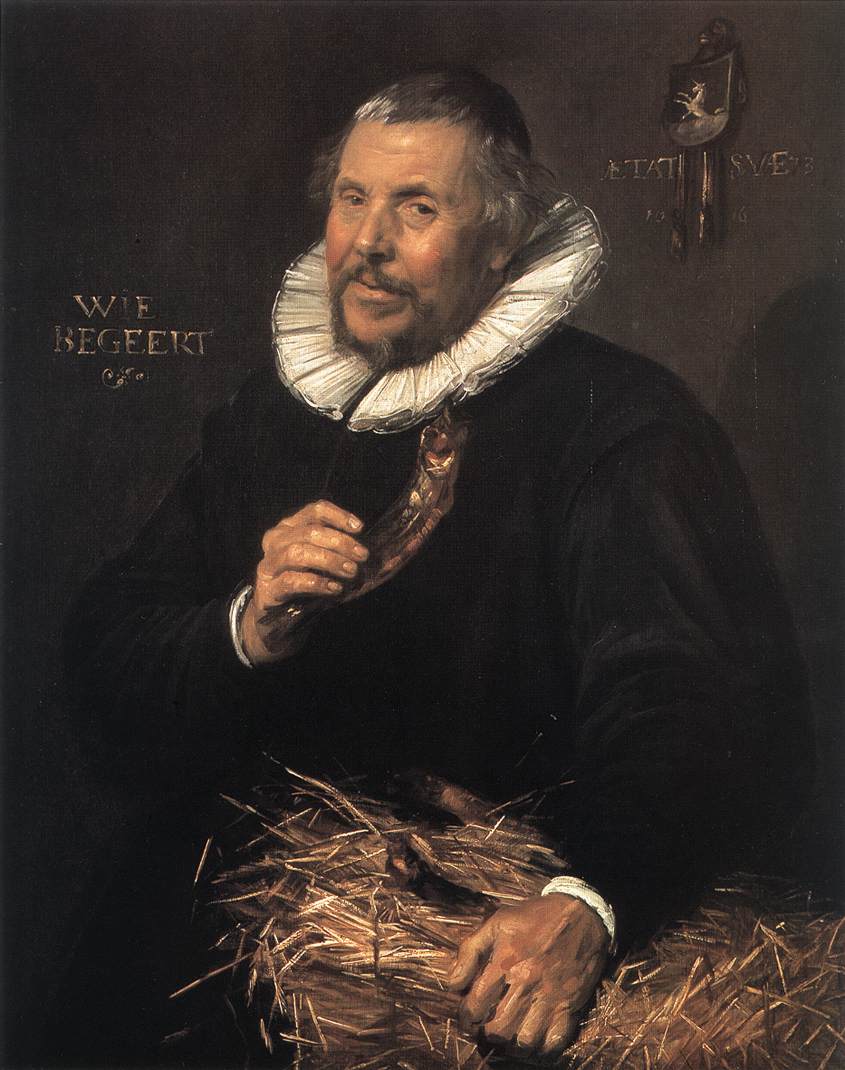
Frans Hals’ “Pieter Cornelisz. Van der Morsch” (1616) feels like a private encounter staged with just enough light to reveal a personality. The sitter sits angled toward the viewer, his body turned slightly while his head tilts back with relaxed assurance. He does not present himself as stiffly ceremonial. Instead, he appears comfortably installed in his own presence, as if the portrait has caught him mid-conversation rather than mid-pose. The dark background presses close, pushing attention forward onto face, hands, and the crisp ring of the ruff.
What immediately distinguishes this painting is its blend of elegance and earthy specificity. The sitter wears the expected black clothing of Dutch civic respectability, and the starched white ruff frames his face like a badge of status. Yet Hals counters that formality with a surprisingly tactile, almost rustic element: the thick mass of straw beneath the sitter’s arm and across the lower portion of the composition. This contrast sets the tone for the entire portrait. It is a painting about public identity, but also about a lived body, a man grounded in everyday textures and habits.
The Portrait’s Unusual Prop and Why It Changes Everything
The straw is not a minor accessory. It dominates the lower half of the image with a bristling, golden energy that feels alive against the surrounding darkness. Portrait props often signal profession, wealth, or learning, but straw is a different kind of sign. It suggests a physical environment and a kind of earthy practicality. It could point toward an association with militia life, travel, or a temporary lodging, and it certainly suggests the sitter’s willingness to be portrayed with something less polished than velvet or marble.
This detail alters how the viewer reads the man. Without it, the portrait would still be compelling, but it might settle into familiar categories of Dutch elite portraiture. With it, the image becomes more narrative, more idiosyncratic, and more character-driven. The straw reads as evidence of a story that extends beyond the frame. It implies movement, activity, and perhaps a certain swagger, as if the sitter’s identity includes the roughness of action as well as the refinement of rank.
Hals uses this tension to make the portrait memorable. The sitter is both dignified and approachable, both polished and textured. The straw becomes a visual metaphor for that duality.
Composition and the Art of Relaxed Control
Hals structures the portrait around diagonals that keep the pose from becoming static. The sitter’s shoulders slope downward into the straw, while the angle of his head and the placement of his hands create a gentle counter-rhythm. One hand rests into the straw with a sense of weight and ownership. The other rises toward his chest, holding a small object with a casual precision that suggests habitual confidence. These gestures feel natural, not invented, which is a major part of Hals’ gift.
The background is dark and spare, but it is not empty. It functions like a stage curtain, focusing attention on the illuminated surfaces while allowing the figure to appear as if he emerges from shadow. The placement of inscriptions on the wall, including the phrase “WIE BEGEERT,” adds a second register to the composition. Text becomes a quiet companion to gesture, suggesting that this portrait is not only about appearance, but also about self-presentation and message.
The overall balance is masterful. The bright ruff and the warm straw anchor the painting’s two strongest visual notes, white and gold. Between them, the sitter’s face acts as the emotional center, holding the viewer with a steady, slightly amused gaze.
Light and the Psychological Power of a Subtle Gaze
The lighting in this portrait is selective and intelligent. Hals illuminates the sitter’s face with enough clarity to convey expression, but he avoids harsh theatrical spotlighting. The cheeks carry warmth, the forehead catches a soft sheen, and the eyes hold small highlights that keep them alert. This is a face that seems to think while being observed. The expression is not stern, and it is not openly friendly either. It hovers in a space of confident composure, a mild smirk at the corner of the mouth suggesting humor or self-knowledge.
The ruff’s white folds amplify this psychological effect. Its crisp brightness frames the sitter’s head and forces the viewer to linger at the boundary between costume and skin. Hals paints the ruff as a structure, not a decorative blur. The ridges and shadows feel sharp enough to be tactile. That sharpness, contrasted with the softer modeling of flesh, makes the sitter’s humanity more vivid. You sense the difference between the social armor of dress and the vulnerable reality of skin.
The darkness behind him deepens the intimacy. It isolates the man from context, then reintroduces context through props and text. The viewer is left with a concentrated impression of character.
Color and Texture: Black Cloth, White Ruff, Golden Straw
The palette is both limited and expressive. Black dominates the clothing and background, but Hals ensures that this blackness is not a void. It carries subtle tonal shifts, suggesting folds, weight, and the absorbent quality of cloth. The black outfit signals formality and status, yet it also functions as a visual foundation for the painting’s brighter accents.
The ruff provides the most immediate contrast. Its whites are not uniform. They carry gray shadows and warm reflections that keep the fabric dimensional. Hals turns starch and linen into architecture, and that architecture shapes the viewer’s attention toward the sitter’s face.
Then there is the straw, a cascade of warm ochres and pale golds. Hals paints it with quick, directional marks that suggest the scratchy irregularity of dried stems. The straw is simultaneously messy and carefully observed. It introduces a lively texture that feels almost audible, like a faint rustle beneath a resting arm. Color-wise, it warms the entire painting. Psychologically, it makes the sitter feel closer to everyday life, less sealed behind formality.
This trio of textures, cloth, linen, straw, becomes the portrait’s main language. Hals shows how a person can be read through materials as much as through facial features.
Hands and Objects: The Portrait’s Small Drama
The sitter’s hands are one of the portrait’s quiet triumphs. They are not hidden or minimized. One hand lies in the straw, fingers spread with relaxed authority, as if claiming space without effort. The other hand rises toward his chest, holding a small object that reads like a personal accessory, possibly a glove, a strap, or a token. Whatever the object’s exact identity, Hals paints it as something handled comfortably, not ceremonially displayed.
Hands in portraiture are often where truth creeps in. Faces can be trained to perform, but hands reveal habit. Here the hands suggest ease, familiarity with social presence, and a confidence that does not need to prove itself. The raised hand also creates a conversational rhythm. It resembles the gesture of someone emphasizing a point, or pausing mid-sentence with a knowing look. This is one reason the portrait feels alive. It does not show a man frozen in time, but a man paused in motion.
The straw beneath the lower hand amplifies this sense of immediacy. The hand presses into the rough texture, creating a believable relationship between skin and object. Hals makes you feel that weight is real, not symbolic.
The Inscriptions and the Idea of Persona
The text “WIE BEGEERT” on the left side of the background introduces a layer of meaning that goes beyond likeness. It reads like a motto, a fragment of speech, or a prompt aimed at the viewer. The phrase can feel playful or challenging, depending on how you interpret it. It invites the idea that the sitter is not only being portrayed, but also projecting a stance, perhaps a philosophy of desire, ambition, or appetite for life.
On the right, additional inscription and a small emblem reinforce the portrait’s documentary aspect. These elements link the painting to identity and record-keeping, turning it into a visual document of a person at a particular age and status. Hals often plays in that space between portrait as private image and portrait as public statement. Here, the inscriptions make that dual function explicit.
The combination of motto-like text and confident pose suggests a carefully crafted persona. This is not accidental. It indicates a sitter who understands the portrait’s power, who wants to be remembered in a certain light. Hals collaborates with that ambition while also making the persona feel human rather than purely constructed.
The result is a portrait that feels both personal and performative, which is often the most compelling kind.
Humor, Confidence, and the Dutch Taste for Lifelike Presence
One of Hals’ signature strengths is his ability to infuse portraits with a hint of humor or liveliness without undermining dignity. In this painting, that liveliness is subtle. It lives in the slight lift of the cheek, the relaxed mouth, the sideways angle of the head, the easy occupation of space. The sitter seems comfortable being seen. He does not look anxious or overly guarded. He looks as if he has stories, and as if he expects the viewer to recognize that.
This relates to a broader Dutch taste in the early seventeenth century for portraits that felt honest and present rather than remote and idealized. The most effective portraits in that culture often balanced respectability with individuality. Hals leans into individuality. He allows the sitter to feel specific, almost conversational, while still honoring the conventions of dress and status.
The straw is part of that cultural taste too. It introduces a touch of genre realism into formal portraiture, a willingness to mix the high and the everyday. Hals excels at such mixtures. He makes them feel natural, not gimmicky, because he ties them to the sitter’s bodily comfort and expression rather than treating them as mere symbols.
Brushwork and the Sense of a Moment Captured
Hals’ paint handling here supports the portrait’s emotional tone. The face is modeled with enough control to convey structure and age, but the brushwork remains visible enough to suggest immediacy. The ruff is painted with crisp highlights and decisive shadows, giving it a sculptural firmness. The straw is looser, built from energetic strokes that mimic disorder while still describing form.
This contrast in handling is not only technical. It is expressive. The crispness of the ruff suggests social discipline and public formality. The looseness of straw suggests physical reality and the messiness of life. Hals uses paint texture to echo the portrait’s psychological theme: a man of status who remains rooted in lived experience.
The background is handled with restraint, a dark field that avoids drawing attention to itself. Yet it is not dead. It has subtle variations that keep the space breathable. Hals knows that a background should support the illusion of presence without competing for it.
Overall, the brushwork gives the impression of a moment held in suspension. The sitter seems as if he could shift, speak, or smile a little more if the painting continued for another second.
Social Identity and the Portrait’s Balancing Act
This painting can be read as a negotiation between different aspects of identity. The sitter’s clothing and ruff position him within a world of civic respectability and formal power. The inscriptions and emblem reinforce that he is someone with a documented name and status. Yet the straw and the relaxed pose complicate the impression. They suggest that this man’s authority is not only bureaucratic. It may also be practical, physical, and tied to lived environments outside the polished interior.
The portrait’s charisma depends on that balance. If the sitter were portrayed as purely formal, he might feel distant. If he were portrayed as purely rustic, he might feel like a type rather than a person of rank. Hals blends the registers. He gives the sitter enough elegance to signal standing, and enough informality to signal personality.
This is also why the portrait feels modern in its psychology. People rarely experience themselves as one thing. They are composed of roles, contexts, and moods. Hals paints that complexity without forcing an explicit narrative. He lets the materials and gestures do the work.
The sitter’s gaze is the final anchor. It holds the painting together, suggesting that behind all signs of status and story is a person who knows exactly how he wants to be seen.
Why the Portrait Remains So Memorable
“Pieter Cornelisz. Van der Morsch” endures because it confirms what great portraiture can do. It can preserve the surface of a face, but it can also preserve a social atmosphere, a posture of confidence, and a sense of physical reality. Hals achieves this through contrasts that feel purposeful rather than decorative: dark against light, crisp linen against rough straw, documentary inscription against lively expression.
The painting also lingers because it is slightly unusual. The straw disrupts expectations and adds a tactile surprise, making the image difficult to forget. Yet Hals does not rely on novelty alone. He integrates the detail into the sitter’s presence so convincingly that it feels inevitable, as if the portrait could not exist without it.
At heart, this is an image of self-assurance. The sitter’s relaxed occupation of space, the controlled humor in his expression, and the subtle invitation of the motto create a portrait that feels confident in its own world. The viewer is invited to look closely, not only at the man, but at the way he has been constructed in paint as a social being.
Hals gives you a portrait that is dignified without stiffness, intimate without sentimentality, and vivid without chaos. It is a lesson in how presence is built, one brushstroke and one texture at a time.