Image source: wikiart.org
First Impressions and the Quiet Power of Presence
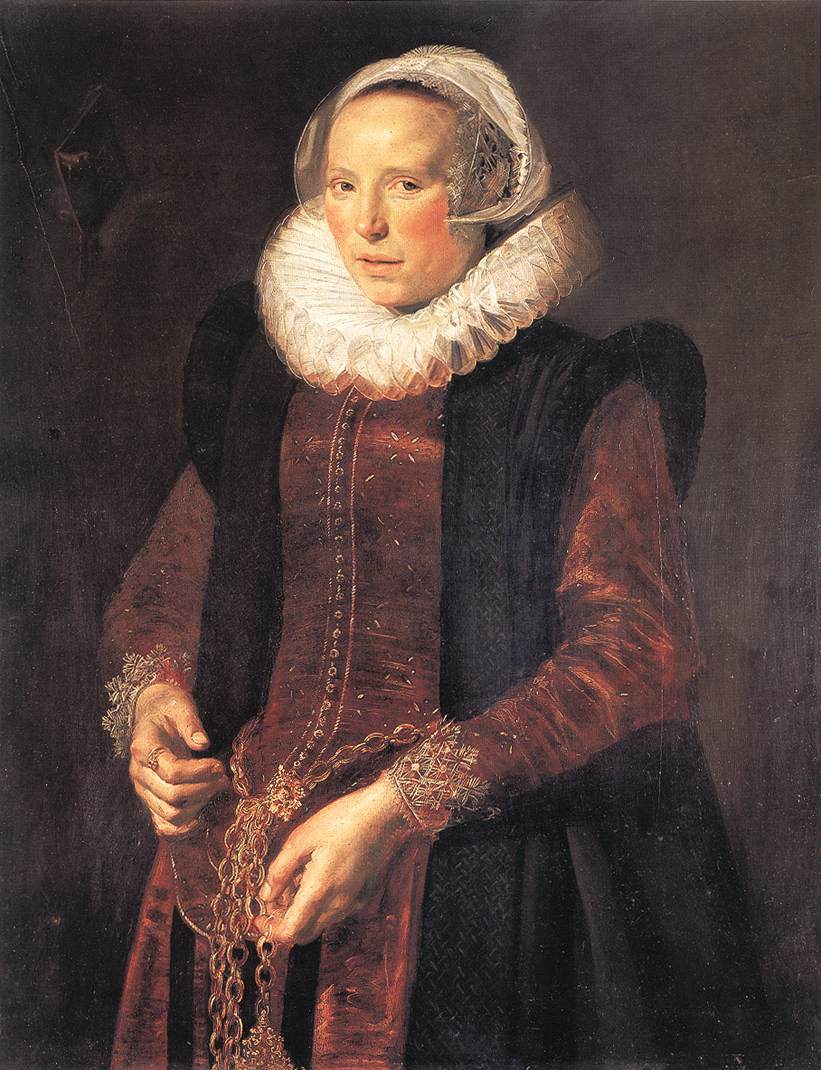
Frans Hals’s “Portrait of a Woman” (1611) meets the viewer with an effect that is both immediate and strangely reserved. The sitter is not arranged as an ornament in a decorative interior, nor posed in the theatrically elegant style common to many aristocratic portraits of the period. Instead, she stands before a dark, neutral background that refuses distraction. The composition concentrates attention on what matters most: the face, the hands, and the richly textured language of clothing. Hals does not need narrative props to suggest character. He builds a sense of identity through posture, gaze, and the precise tension between luxury and restraint.
At first glance, the portrait seems governed by calm. The woman’s expression is composed, her lips relaxed, her eyes steady. Yet the longer you look, the more you sense an inner firmness. She is not smiling, not pleading for admiration, not softened into a generalized “ideal.” The painting asks you to recognize her as a specific person with social standing, discipline, and a private life beyond the frame. Hals’s great skill here is that he can suggest individuality without dramatizing it. The portrait is dignified, but not cold. It is proud, but not flamboyant. That balance is where its power lives.
Composition and the Architecture of the Figure
The portrait is structured with a practical clarity that supports the sitter’s authority. Hals places her in a three quarter view, turning slightly rather than facing straight on. This subtle angle creates depth and keeps the figure from becoming a flat emblem. Her upper body fills most of the frame, and the cropping is close enough to emphasize immediacy while still leaving room for her hands and the chain she holds, which becomes an important compositional and symbolic element.
The dark background functions like a stage of pure contrast. It does not describe a room or landscape, which means the sitter’s silhouette becomes the central geometry. The white ruff collar forms a bright circular shape near the top of the composition, almost like a halo of status and propriety. Beneath it, the darker cape and bodice create a strong vertical mass. The warm red tones of the dress introduce a centered band of color that leads the eye down to the hands, where the chain loops and glints. The whole portrait is organized as a controlled descent: face, ruff, bodice, hands, chain. It is an elegant visual argument for steadiness and order.
Light, Shadow, and the Drama of Restraint
Hals uses light sparingly and with intelligence. The illumination appears to come from the upper left, catching the sitter’s forehead, cheekbones, and the bridge of the nose. This light does not flood the scene; it reveals selectively. The face is modeled with gentle transitions, avoiding harsh theatrical shadow. This moderation suits the portrait’s mood. The sitter is presented as someone whose life is guided by discipline, and the lighting echoes that discipline.
The ruff is the most luminous element, a bright white structure that seems to hold and frame the head. Its folds catch light in a rhythm of small highlights, creating a crisp texture that contrasts with the velvety darkness of the cape. Hals lets shadow pool in the background and in the deeper recesses of the clothing, not to create mystery for its own sake, but to emphasize material differences. Light becomes a tool for social and tactile information. You can sense linen versus wool, skin versus lace, metal versus fabric, not because the scene is brightly lit, but because the artist calibrates light with precision.
Color and the Emotional Temperature of the Portrait
The palette is restrained, yet it is not monochrome. Black dominates, but it is not a flat black. It carries subtle variations, softening into brownish undertones in places and deepening into near void in others. This range gives the cape and background a sense of atmosphere rather than emptiness. Against this darkness, the sitter’s pale skin and white ruff become luminous, signaling both refinement and cleanliness, values that were socially meaningful in the Dutch Republic.
The red-brown dress provides warmth and depth. It introduces an earthy richness that prevents the portrait from becoming purely austere. This is not a bright ceremonial red; it is a darker, mature tone that suggests wealth without showiness. Hals also uses small accents, such as the delicate lace at the cuffs and the metallic highlights of the chain, to create points of visual sparkle. These accents do not compete with the face. They support it, like quiet punctuation in a carefully written sentence.
Clothing as Social Language and Self-Definition
In early seventeenth century Dutch portraiture, clothing is never “just clothing.” It is a public statement about class, religion, morality, and taste. The sitter’s outfit conveys prosperity, but it also communicates restraint. The prominent white ruff is both fashionable and symbolic. It frames the head like a constructed emblem of order. Maintaining such linen required labor, expense, and constant care. That care translates into status. The ruff also creates distance between the sitter and the viewer, acting like a barrier of etiquette. It tells you that this person belongs to a world of rules.
Her cap is similarly practical and meaningful. It signals modesty and decorum, while its crisp whiteness reinforces the theme of disciplined presentation. The dark cape and structured sleeves give the figure weight and seriousness. The dress appears carefully tailored, and the lace at the cuffs offers a controlled touch of luxury. Hals captures these textures with evident interest, but he never lets them become mere decoration. They function as the sitter’s public face, a deliberate construction of identity.
The Chain and the Hands as a Second Portrait
The hands are crucial. Many portraits of this period include hands almost as an afterthought, but here they matter. The sitter holds a chain that loops and drapes in a substantial tangle. This chain is not casually included. It draws the eye, and it invites interpretation. It may indicate wealth, marriage, or household authority, depending on its function and the customs of the sitter’s milieu. Regardless of its specific meaning, the chain communicates possession and control. It is not worn purely for display; it is handled, held, managed. The gesture suggests capability and steadiness.
Hals paints the hands with a balance of realism and delicacy. They are not idealized into soft perfection. They look functional, like hands that belong to a real person, yet they retain elegance. The way the fingers interact with the metal gives the chain a physical presence. Light catches on the links in small flashes, turning the jewelry into a subtle demonstration of craft and value. In portraiture, hands often reveal temperament. These hands suggest composure and purpose, reinforcing the character implied by the face.
The Face, the Gaze, and the Psychology of Self-Possession
The sitter’s expression is the portrait’s emotional center. Hals avoids exaggeration. There is no theatrical sorrow, no exaggerated sweetness, no overt seduction. Instead, the face conveys self-possession. The eyes meet the viewer with a calm seriousness that feels practiced, as if the sitter understands how she should be seen and chooses to be seen that way. Yet the expression is not empty. There is a faint softness in the cheeks and mouth that hints at inner life. The portrait suggests a person who can be both private and socially skilled.
What makes Hals compelling is his ability to suggest a living presence without turning the painting into a performance. The gaze feels direct, but not aggressive. The sitter does not seem to demand admiration; she seems to expect respect. This is a subtle distinction, and it is one of the reasons the portrait feels modern. It does not treat the viewer as a servant or a worshipper. It treats the viewer as a witness.
Frans Hals in 1611 and the Early Shape of His Style
Hals is often celebrated for later portraits full of energy, loose brushwork, and vivid spontaneity. In 1611, his approach can appear more controlled, aligning with the conventions expected of formal portraiture. Yet even within this restraint, you can sense the qualities that would later define him: the attention to character, the insistence on presence, and the ability to make paint feel alive in fabric and skin.
The portrait shows a careful handling of surfaces. The ruff is articulated with crisp folds, and the lace cuffs are described with sensitivity. The transitions in the face are smooth and convincing. At the same time, the painting avoids the stiff, overly polished effect that can make some early seventeenth century portraits feel static. There is a gentle vitality in the sitter’s posture and a naturalism in the way the clothing sits on the body. Hals seems interested in the person inside the costume, not only the costume itself.
Dutch Society, Portraiture, and the Ethics of Display
The Dutch Republic in the early seventeenth century was a society in which wealth and identity were increasingly shaped by trade, civic life, and a Protestant-inflected culture of restraint. Portraits played a major role in expressing status, but the style of display often differed from more courtly traditions. Instead of lavish symbolic backgrounds, sitters frequently chose sober settings and clothing that communicated prosperity through quality rather than extravagance.
This portrait fits that cultural mood. The sitter’s elegance is undeniable, but it is disciplined. The painting suggests that social authority can be expressed through control, cleanliness, and quiet richness. Hals’s neutral background is part of that logic. It minimizes theatricality and focuses on the sitter as a moral and social subject. The portrait becomes not only a record of appearance but a statement about how one should exist in public: composed, respectable, and quietly secure.
Texture, Materials, and the Pleasure of Close Looking
One of the great satisfactions of the painting is how it invites slow looking. Each material is treated as its own world. Linen behaves differently than lace, and lace behaves differently than wool. The ruff has a crisp, structured bounce, while the cape reads as heavier and more absorbent of light. The red-brown bodice has a density that suggests sturdy fabric, possibly with subtle decorative stitching. The chain offers a different pleasure: hard, reflective, and irregular in the way it catches light.
Hals’s technique here is not about showing off brushwork for its own sake. It is about using paint to translate touch. The viewer can almost feel the stiffness of the ruff, the softness of the cuffs, the weight of the chain. That tactile realism strengthens the portrait’s psychological realism. A person’s world is made of things, and Hals makes those things feel real, thus making the person feel more real too.
The Portrait’s Quiet Narrative
Even without an explicit story, the portrait implies a narrative of identity. The sitter appears neither youthful nor elderly, suggesting adulthood and settled status. The clothing implies prosperity and social positioning. The chain suggests ownership, responsibility, or marital association. The calm gaze suggests a person accustomed to being seen and evaluated. From these elements, the viewer can infer a life shaped by social obligations and private convictions.
The portrait’s narrative is not dramatic; it is structural. It tells the story of how a person presents themselves to the world, and what values that presentation communicates. In that sense, the painting is not only about one woman in 1611. It is about a larger human theme: the way identity is formed at the intersection of inner life and public expectation.
Lasting Impact and Why the Painting Still Feels Present
The endurance of Hals’s portraiture comes from this ability to combine social precision with human immediacy. Even in a restrained early work like this, the sitter does not feel like a distant historical mannequin. She feels like a person paused mid-life, caught in a moment of controlled revelation. You can imagine her voice, her manner, her authority within her household or community, even though the painting never tells you explicitly.
The portrait also endures because it respects its subject. Hals does not reduce her to a type. He does not sentimentalize her. He gives her the dignity of complexity. That is why the painting holds attention across centuries. It is not only a document of fashion or status. It is a meeting.