Image source: wikiart.org
Introduction to Francisco de Zurbaran’s Flight into Egypt
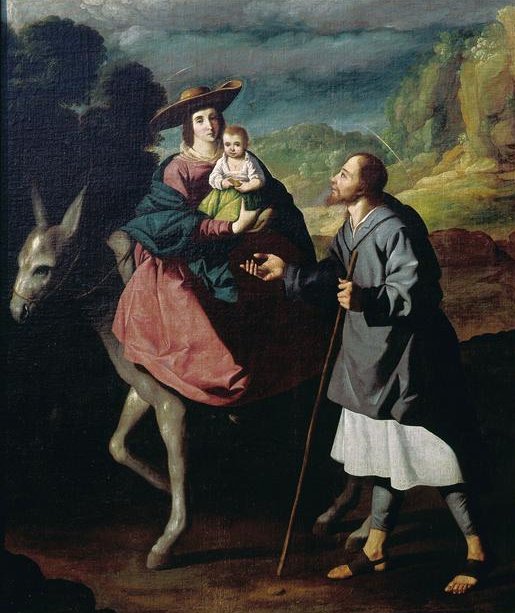
“Flight into Egypt” by Francisco de Zurbaran presents a quiet yet emotionally charged interpretation of one of the most familiar stories from the life of Christ. Instead of depicting dramatic movement or terror, Zurbaran chooses a moment of calm during the Holy Family’s dangerous journey, when the threat is unseen and the sense of protection feels almost tangible.
Mary rides a donkey, cradling the Christ Child in her arms, while Joseph walks beside them as guide and guardian. The landscape stretches into the distance under a heavy sky, suggesting both the length of the road ahead and the uncertainty of exile. Painted with Zurbaran’s characteristic clarity of form and deep spiritual concentration, this work transforms a biblical narrative into an intimate meditation on trust, care and divine guidance.
The Biblical Story Behind the Flight into Egypt
The subject comes from the Gospel of Matthew, which recounts how Joseph was warned in a dream that King Herod intended to kill the newborn Jesus. Obeying the angelic message, Joseph took Mary and the Child by night and fled into Egypt, where they remained until the danger had passed. The episode presented artists with opportunities for dramatic storytelling, such as hurried departure, perilous travel, or miraculous events along the way.
Zurbaran, however, focuses on an in between moment: neither the instant of flight nor the joyous return, but the long road itself. In this version of the story there are no soldiers in pursuit, no overt miracles, and no crowded entourage. The Holy Family advances quietly through a sparsely populated landscape. By stripping away spectacle, Zurbaran turns the narrative into a reflection on steady perseverance and the daily labor of trust.
A Balanced and Intimate Composition
The composition is carefully arranged to highlight the relationship between the three protagonists. Mary, seated on the donkey, occupies the left side of the canvas and forms a central vertical axis with the Christ Child in her arms. Joseph walks on the right, staff in one hand and the other extended in a gesture of conversation or reassurance. Their bodies form a gentle diagonal from the donkey’s head, through Mary and the Child, to Joseph’s face and hand.
Although they are traveling, Zurbaran freezes them in a nearly static pose, as if they have paused for a brief exchange. The donkey’s lifted front leg suggests motion, but Mary and Joseph appear grounded, focused on each other rather than on the road ahead. This stillness invites the viewer to step into the scene and share in the quiet dialogue that seems to be taking place between husband and wife, mother and protector.
The background landscape frames the figures without overwhelming them. On the right, rocky outcrops and distant hills recede into atmosphere. On the left, dark foliage and stormy clouds intensify the contrast behind Mary, whose red and green garments stand out vividly. The horizon line sits relatively high, giving the figures large, solid presence in the foreground, which emphasizes their human scale and emotional accessibility.
Light as a Sign of Guidance and Protection
Light plays a central role in giving the painting its spiritual tone. It falls most strongly on the faces of Mary and Joseph and on the small body of the Child, who is wrapped in pale cloth. Their illuminated skin contrasts sharply with the darker surroundings, especially the deep shadows behind Mary and the donkey. The effect is almost theatrical, as if an unseen spotlight picks them out on a dimly lit stage.
This light can easily be read symbolically. In the biblical story Christ is described as the light coming into a darkened world. Here, the light that rests on the Holy Family appears to travel with them, reassuring the viewer that even in exile they remain under divine protection. At the same time, the shadows and heavy clouds hint at trials and uncertainty. The interplay between bright and dark creates visual tension that mirrors the mixture of fear and trust embedded in the story.
Interestingly, Zurbaran does not use a brilliant, supernatural glow. The illumination feels like natural daylight filtered through a passing storm. This choice reinforces the sense that divine grace operates within ordinary reality, not apart from it. The Holy Family does not glide through a golden, otherworldly space but walks along a recognizable dirt road under a moody sky, much like any traveler in seventeenth century Spain might have done.
Mary as Mother and Pilgrim
Zurbaran’s Mary is at once majestic and remarkably human. She wears a broad brimmed hat and a voluminous cloak wrapped around her shoulders, clothing that recalls contemporary travel garments. Her red dress, green mantle and blue accents echo traditional Marian colors, yet the style makes her feel close to Zurbaran’s own time.
She holds the Child securely yet lightly, cradling him with an air of experienced tenderness. Her gaze meets Joseph’s, and the slight tilt of her head and relaxed shoulders suggest trust rather than anxiety. She is aware of danger but not paralyzed by it. Mary’s role as pilgrimage companion is foregrounded. She does not appear as a distant queen but as a young woman on the road, adapting to hardship while nurturing a child.
The donkey beneath her reinforces this humble dignity. Far from being idealized, the animal is rendered with straightforward naturalism. Its head protrudes from the left edge of the painting, eyes soft, ears pricked. The simplicity of the donkey’s form underlines Mary’s acceptance of ordinary means of travel and modest circumstances. In this way, Zurbaran aligns the Mother of God with the poverty and endurance of everyday people.
The Christ Child and the Meaning of Exile
The Christ Child, seated on Mary’s lap, becomes a focus of both visual and theological significance. Dressed in pale fabric that catches the light, he looks outward toward the viewer rather than at his parents. His small hands rest calmly, and his expression is serious but not distressed.
In the theological imagination of the time, the Flight into Egypt symbolized both the vulnerability of Christ and the beginning of his solidarity with all who suffer persecution or displacement. Zurbaran’s depiction captures this dual meaning. The Child is clearly dependent on Mary and Joseph for protection, yet his outward gaze suggests a quiet awareness that his mission extends beyond the intimate circle of the family. Even as an infant he is portrayed as the center of the scene, the one for whom the journey is undertaken.
The fact that he appears secure and almost serene hints that the exile, however painful, is part of a larger providential plan. For devout viewers, this would have offered comfort when facing their own hardships. Like the Child carried through foreign lands, they too could trust that their difficulties were not meaningless, even when the road ahead seemed uncertain.
Joseph as Protector, Guide and Listener
Joseph often receives understated treatment in traditional art, but Zurbaran gives him unusual presence. Walking with staff in hand, he leans slightly toward Mary, his face turned up to meet hers. His expression is alert and attentive, as though he is listening carefully or offering gentle reassurance.
His clothing is simple: a grey outer garment with a white tunic beneath and leggings suited to rough terrain. Barefoot or wearing thin sandals, he appears ready for long, difficult miles. Joseph embodies the virtues of obedience, prudence and practical care. According to the gospel story, he is the one who hears the angel’s warning and acts immediately. Zurbaran captures that sense of decisiveness and steady responsibility.
The gesture of Joseph’s extended hand is especially important. It directs attention toward Mary and the Child while also inviting the viewer into the relational triangle. The open palm could signal dialogue, a request for reassurance, or a subtle blessing. In any case, Joseph’s body language communicates that the journey is not only physical but also relational. The Holy Family travels as a unit bound together by mutual trust.
Landscape as Emotional Backdrop
Zurbaran’s landscape surrounding the Holy Family is more than a neutral background. It functions as an emotional and symbolic environment. On the right, rocky formations rise steeply, suggesting obstacles and the harshness of wilderness travel. In the distance, however, we glimpse softer hills and a pale strip of sky that opens toward a calmer horizon.
The clouds above are dark and heavy near Mary and Joseph but become lighter in the far distance. This gradation of sky can be read as a metaphor for the trajectory of their journey. The present moment may be overshadowed by danger and fatigue, yet the future holds the promise of clearer skies and safety.
The dirt path beneath their feet reinforces the sense of lengthy travel. It is not a paved road but a simple track, perhaps evoking rural routes familiar to Zurbaran’s Spanish audience. By setting the Flight into Egypt in a landscape that resembles southern Spain, the painter subtly connects biblical history with the world of his viewers, inviting them to see their own journeys mirrored in the Holy Family’s pilgrimage.
Zurbaran’s Visual Language of Simplicity
Francisco de Zurbaran is renowned for his ability to combine austere simplicity with intense spiritual focus. In “Flight into Egypt” he applies that language to a narrative subject. The figures are large and clearly modeled, without the swirling complexity often found in Italian Baroque compositions. Drapery falls in heavy, sculptural folds. The color range is rich but restrained, dominated by deep reds, greens and blues that stand out against darker browns and greys.
This simplicity does not equal emptiness. Instead, it creates visual clarity that allows the viewer to concentrate on relationships, expressions and symbolic details. The viewer does not have to search through busy crowds or elaborate architecture to find the meaning. It is present in the way Mary holds the Child, in Joseph’s attentive posture, and in the path winding underfoot.
Zurbaran’s brushwork reinforces this clarity. While some passages of landscape are handled broadly, the faces and hands receive careful refinement. The contrast between the smooth modeling of skin and the rougher textures of cloth and rock further isolates the human drama from its environment, highlighting the spiritual bond that sustains the family amidst external hardship.
Spiritual Themes of Trust and Providence
The spiritual message of “Flight into Egypt” centers on trust in divine providence. The Holy Family does not know exactly what awaits them in Egypt, yet they move forward together, guided by Joseph’s obedience to the divine warning. Their expressions reveal concern but not panic, responsibility but not despair.
For seventeenth century viewers living through war, poverty and religious tension, this image would have offered a model of faithful perseverance. The painting suggests that divine guidance often takes the form of a path rather than a fixed destination. Like Mary and Joseph, believers are invited to take the next step without full certainty, relying on the quiet light that falls on their way even when the larger landscape remains dark.
At the same time, the painting emphasizes the value of human care within that divine guidance. God protects the Child through the daily labors of Joseph and the nurturing love of Mary. The spiritual and the ordinary are interwoven. The road to Egypt is walked not by angels but by very human feet.
Relevance for Modern Viewers
Today “Flight into Egypt” continues to resonate because the experience of displacement, migration and uncertainty is as present as ever. Families across the world flee violence, poverty or persecution, carrying children into unknown futures. Zurbaran’s painting can speak to these realities, not through direct political commentary but by honoring the dignity and courage of people who travel under pressure.
The work also offers a contemplative alternative to fast moving, spectacle driven images. Its slow, deliberate gestures and quiet color allow room for reflection. Viewers are invited to consider their own journeys, the relationships that sustain them, and the ways in which trust and responsibility operate in their lives.
By depicting the Holy Family in a moment of simple travel rather than in a throne room or a temple, Zurbaran suggests that sacred history unfolds along ordinary roads. The divine presence can be encountered not only in extraordinary miracles but also in the daily act of taking the next step with love and faith.