Image source: wikiart.org
Introduction
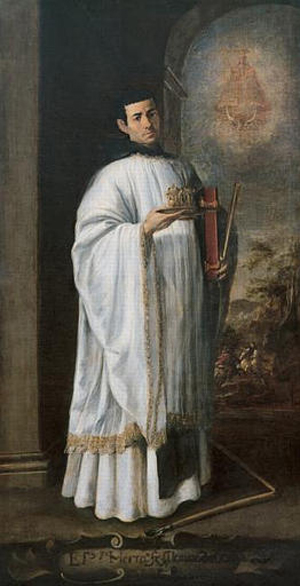
“Brother Alonso de Ocana” by Francisco de Zurbaran is a quietly powerful portrait that merges individual likeness with spiritual vocation. The figure stands in a shallow architectural space, robed in luminous white and holding a crown and book, while behind him an indistinct sacred scene glows within an arched frame. At first glance it reads as a dignified likeness of a cleric, yet the longer you look, the more it feels like a devotional image that celebrates the hidden heroism of religious life.
Zurbaran was a master at transforming monks and friars into monumental presences. In this painting he does not show a famous saint from distant history, but a contemporary religious figure who embodies the ideals of humility, loyalty to the Church, and selfless service. The portrait becomes both a record of a real person and a visual manifesto of the spiritual values that shaped seventeenth century Spanish Catholicism.
Historical And Religious Context
The painting belongs to the world of Counter Reformation Spain, where religious orders played a central role in education, charity, and spiritual renewal. Portraits of clergy were not simply private mementos. They often functioned as edifying examples for other members of the community and for lay patrons who supported the convents and monasteries.
Brother Alonso de Ocana is shown in liturgical vestments rather than secular clothing. This choice immediately tells us that his identity is defined by his religious office. The crown and book he holds, as well as the scene visible behind him, likely refer to a particular devotion or miracle associated with his order or his life. Zurbaran’s audience would have recognized these references and read the painting as a statement about fidelity, sacrifice, and the reward promised in heaven.
During this period Spanish painters were encouraged to produce works that combined realism with clear moral messages. Zurbaran excelled at this fusion. His religious portraits are never purely decorative. They are visual sermons, using clothing, gesture, and setting to preach about virtue, obedience, and the glory of God.
First Impressions And Overall Composition
The composition of “Brother Alonso de Ocana” is both simple and carefully balanced. The figure stands almost full length, slightly off center, oriented toward the right, with his head tipped to one side as if listening or reflecting. The vertical lines of his body, the column behind him, and the arched niche create an orderly framework that stabilizes the entire image.
The lower edge of the painting is anchored by the wide hem of his alb as it brushes the floor. The soft folds of fabric swell outward, giving weight to the figure and a sense of grounded presence. His upper body leans gently back, introducing a mild diagonal that keeps the pose from feeling rigid. This diagonal is echoed by the staff or crozier he holds and by the perspective of the niche behind.
Zurbaran uses the background architecture to frame Brother Alonso without overwhelming him. A column on the left and an arch behind create a kind of painted chapel within the picture. Inside that arch we glimpse another image, perhaps a scene from the life of the Virgin or an emblem relating to his community. This nested composition reinforces the idea that the brother lives within a world of sacred images and liturgy.
The Figure Of Brother Alonso De Ocana
The most striking feature of the figure is his calm, focused expression. Brother Alonso does not look directly at the viewer. Instead his gaze is slightly averted, as if directed toward someone just outside the frame or toward a spiritual reality only he can see. This gives the portrait an introspective tone.
His facial features are rendered with respectful realism: dark hair, trimmed beard, solid jaw, and steady eyes. There is nothing idealized or theatrical in his expression. He appears thoughtful, perhaps somewhat serious, but not severe. Zurbaran suggests a man accustomed to responsibility, conscious of his duties yet inwardly composed.
His hands are central to the characterization. One hand supports the book and crown from below, while the other holds them gently at the side. The fingers are careful and precise. This is not a triumphant display but an offering, as though the brother presents these symbols not as personal trophies but as gifts entrusted to his care. The controlled gesture conveys humility and reverence.
Vestments, Crown, And Book
The white liturgical garment that envelops Brother Alonso is one of the painting’s most memorable elements. Zurbaran delights in the way light plays over its folds, creating waves of soft shadow and delicate highlights along the edges of the sleeves and hem. The fabric feels weighty yet supple, falling in long vertical pleats that echo the architecture behind him.
Fine gold trim runs along the borders of the vestment, adding a subtle elegance. This detail signals the solemnity of his role during mass or other sacred ceremonies. Yet the overall impression remains restrained. The garment is grand without being ostentatious, reflecting the ideal of dignified modesty expected of clergy.
The crown Brother Alonso holds is small and carefully modeled, with tiny points and jewels suggested by touches of bright color and light. It may symbolize the heavenly crown promised to the faithful or refer to a particular devotion related to the Virgin or a royal patron. Resting against the book, it links spiritual authority with learning. The book itself points to Scripture or theological study, essential foundations for preaching and pastoral work.
Together, the vestment, crown, and book form a kind of visual sermon on the virtues of disciplined service. The priestly robe represents liturgical duty, the crown hints at eternal reward, and the book stands for the wisdom that guides both. Brother Alonso is portrayed not as an isolated individual but as a vessel carrying these spiritual responsibilities.
Light, Color, And Texture
Light in this painting has both descriptive and symbolic functions. It falls mainly from the left, illuminating the front of Brother Alonso’s body and casting gentle shadows behind him. The white of his garment becomes the primary reflector of this light, glowing softly against the darker tones of the background.
Zurbaran modulates the whites with subtle variations of cream, gray, and pale yellow. This avoids a flat, chalky surface and instead suggests thick, tangible cloth. The gold trim catches slightly stronger highlights, drawing the eye along the contours of the robe.
The background is composed of muted browns and grays, with cooler tones near the niche and architectural elements. This subdued palette prevents competition with the luminous white of the figure. It also creates an atmosphere of quiet interior space, perhaps a church or sacristy, without describing it in detail.
The textures in the painting are remarkably varied. The soft weave of the vestment, the hard gleam of the crown, the smooth surface of the book’s cover, and the stone-like solidity of the column all show Zurbaran’s observational skill. Yet he uses these textures economically. None are rendered with decorative excess. Instead, each surface serves the overall mood of solemnity and reverence.
Architecture, Niche, And Background Scene
Behind Brother Alonso rises an arched niche or opening, inside which a smaller image appears. The edges of the arch are softly defined, so the viewer perceives it as part window, part altarpiece. Within this space, warm light diffuses over a distant landscape and a sacred emblem, perhaps a flaming heart, monogram, or Marian symbol. The details are intentionally hazy, encouraging the viewer to sense its meaning rather than read it literally.
This secondary image works like a painting within a painting. It situates Brother Alonso within an explicitly religious context, suggesting that his entire life is framed by devotional imagery and liturgical space. It may allude to a specific vision or miracle associated with him, or refer to the spiritual patronage under which he served.
The column and architectural base on the left provide a strong vertical counterweight to the figure. They also evoke the stability and permanence of the Church as institution. Whereas human beings are mortal and changeable, the stone architecture symbolizes a tradition meant to endure. Brother Alonso stands between architecture and vision, between the earthly structure of the Church and the heavenly realities it proclaims.
Psychological Depth And Human Presence
Although the painting is highly composed and symbolic, it still offers a convincing sense of human personality. Brother Alonso’s head is slightly tilted, his expression alert yet introspective. There is a quiet intelligence in his gaze, as if he is carefully considering the responsibilities represented by the crown and the book.
His posture is dignified rather than relaxed. One foot steps slightly forward, suggesting readiness or service. The weight of the robe prevents rapid movement, but the stance implies that he is prepared to act when called. This combination of stillness and potential action reflects the ideal of a cleric who is rooted in contemplation yet available for ministry.
Zurbaran avoids overt emotional drama. There are no tears, no extreme gestures of ecstasy. Instead, the emotion is interior, communicated through subtle tilt of the head and the care with which the hands support the sacred objects. That restraint is part of the painting’s enduring strength. It allows viewers from different centuries to bring their own reflections and feelings to the image.
Zurbaran’s Portraiture And The Elevation Of Everyday Sanctity
“Brother Alonso de Ocana” fits within Zurbaran’s broader project of elevating seemingly ordinary religious figures to the level of monumental art. He frequently painted monks, friars, and theologians not as remote, idealized saints but as people whose holiness grows out of daily discipline and duty.
In this portrait, Brother Alonso does not perform a miracle or stand in the midst of dramatic action. He simply holds the symbols of his office and looks toward a source of light that we do not see. That is precisely what makes the image so effective as a spiritual portrait. Holiness here is shown to consist less in extraordinary feats than in steady fidelity.
The vertical format and life sized scale add to the sense of presence. Standing before the painting, a viewer might feel almost as if Brother Alonso is sharing the same space. This closeness encourages identification. The viewer is invited to imagine a similar posture of service in their own life, regardless of vocation.
Meaning For Contemporary Viewers
For modern audiences, “Brother Alonso de Ocana” can be appreciated on several levels. As a historical document, it reveals how seventeenth century Spain honored its clergy and visually expressed loyalty to the Church. As a work of art, it showcases Zurbaran’s mastery of light, texture, and quiet psychological nuance.
On a more personal level, the painting offers a meditation on vocation and responsibility. Brother Alonso stands at the boundary between the everyday world and the sacred scene behind him. He carries the crown and the book not as personal possessions but as symbols of a mission given to him. His posture suggests that true dignity is found in service, not self display.
The image also invites reflection on the role of silence and simplicity. In a culture that often celebrates noise and spectacle, Zurbaran’s restrained composition feels almost radical. The painting communicates that interior depth and moral seriousness can shine more brightly than outward extravagance.
Conclusion
“Brother Alonso de Ocana” by Francisco de Zurbaran is a refined and deeply thoughtful portrait that unites realism with spiritual symbolism. Through a standing cleric in white vestments, framed by architecture and a distant sacred vision, Zurbaran explores themes of vocation, humility, and the quiet heroism of religious life.
The luminous garment, the carefully rendered crown and book, the calm yet searching gaze, and the understated background all contribute to a mood of contemplative dignity. The painting embodies the Spanish Baroque ideal of art as a vehicle for inner transformation, inviting viewers to consider their own responsibilities and to see ordinary duty as a path to sanctity.
Seen today, the work continues to speak across centuries. It shows how a single figure, portrayed with restraint and reverence, can convey a whole world of faith, tradition, and personal commitment. “Brother Alonso de Ocana” stands as a testament to Zurbaran’s ability to make spiritual depth visible through the most modest and disciplined means.