Image source: wikiart.org
Introduction to Saint Margaret of Antioch
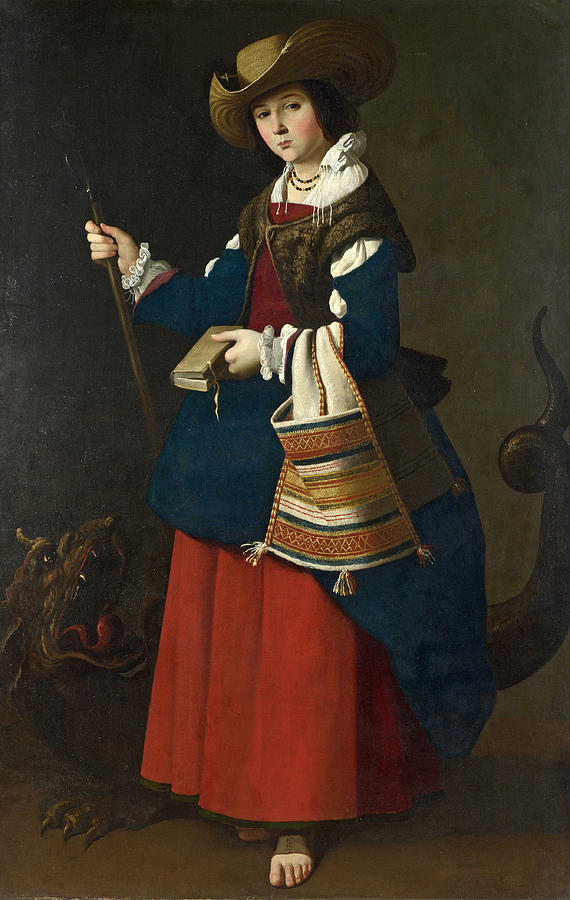
Francisco de Zurbaran’s “Saint Margaret of Antioch” presents one of the most striking female saints in seventeenth century Spanish painting. Instead of a distant martyr in antique robes, Zurbaran shows Margaret as a contemporary Spanish maiden, dressed in rich rural costume, confidently standing above a defeated dragon. She holds a slender staff in one hand and a book in the other, while a woven shepherd’s bag hangs at her side. At first glance she could be mistaken for a fashionable shepherdess from a pastoral play, yet the dragon and her calm, direct gaze reveal that this is a heroic saint who has triumphed over evil.
The painting belongs to a celebrated group of female martyrs that Zurbaran painted for religious patrons in Spain and the New World. In these works he translated traditional saints into the visual language of his own time, dressing them like noblewomen from Andalusia. “Saint Margaret of Antioch” is one of the most memorable examples in the series, combining theatrical costume, quiet mysticism and sharp naturalism.
The Legend of Saint Margaret and Its Symbols
According to medieval legend, Margaret of Antioch was a shepherdess and the daughter of a pagan priest. When she refused to renounce her Christian faith and marry a powerful Roman official, she was imprisoned and tortured. During her captivity she fought a demon who appeared in the form of a dragon. In some versions the dragon swallowed her, but she escaped alive when the sign of the cross split open the monster’s belly. Because of this story, Margaret became a patron saint of women in childbirth and an emblem of steadfast faith.
Zurbaran condenses this complex legend into a few key symbols. The dragon crouches at the lower left, its open mouth revealing sharp teeth and a fiery tongue. Its position at her feet signals defeat. Saint Margaret’s staff recalls the shepherd’s crook associated with her early life and also hints at the spear of spiritual combat. The book she holds close to her chest evokes the Scriptures and the inner word of faith that sustained her through persecution.
By placing the dragon partly in shadow and giving it a grimacing, almost snarling expression, Zurbaran turns it into a physical manifestation of evil and temptation. Margaret, in contrast, remains composed and luminous. Her dominance of the space and her unruffled demeanor describe the victory of inner conviction over external threat.
Costume and Identity
One of the most eye catching aspects of the painting is Margaret’s clothing. She wears a broad brimmed hat that could belong to a Spanish caballero, a fur lined vest, a blue cloak, a red skirt and a richly patterned shoulder bag with tassels. Pearls decorate her neck and ears, and lace ruffles trim her sleeves. The garments are rendered with painstaking detail. We see the weight of the wool cloak, the sheen of the fur, the pattern of the woven bag and the crisp folds of the linen.
This costume blends rustic and aristocratic elements. The bag and staff refer to the shepherdess tradition, while the pearls, fur and refined tailoring belong to the world of noblewomen. In seventeenth century Spain this mixture would have evoked the popular theatrical type of the shepherdess princess, a character seen in courtly plays and pastoral poetry. Zurbaran draws on this familiar cultural image to make Margaret vivid and relatable to his patrons.
At the same time, the outfit subtly reinterprets her martyrdom. Instead of showing the wounds and tortures described in her legend, Zurbaran gives her luxurious yet modest clothing and a calm expression. Sanctity is expressed through inner dignity rather than physical suffering. This approach was particularly attractive in Counter Reformation Spain, where religious images were expected to inspire devotion through clarity and decorum.
Composition and Posing
The composition is simple and vertical. Saint Margaret stands almost frontally, slightly turned to one side so that her body creates a gentle S curve from head to feet. This elegant stance gives the figure a sense of ease and youthfulness, while also allowing Zurbaran to display the different textures of her costume. Her head is tilted just enough to suggest reflection rather than stiffness.
Her right hand holds the staff diagonally across the space, leading the viewer’s eye upward from the dragon to her face. Her left hand holds the book horizontally, forming a subtle counterpoint. The woven bag hangs at hip level, its stripes echoing the horizontal line of the book. Together these elements create a rhythm of diagonals and horizontals that stabilizes the figure and anchors her in the otherwise dark space.
The dragon occupies the lower left corner, its head craning upward in a grotesque grimace. Its placement, partly out of the light and lower than Margaret’s feet, reinforces its subordination. The only other major form intruding into the space is the curling tail of the beast on the right. This tail acts as a dark counterweight to the figure’s cloak and skirt, framing her within a shallow stage like setting.
Light, Shadow and Zurbaran’s Dramatic Naturalism
Zurbaran is famous for his mastery of light and shadow, and “Saint Margaret of Antioch” is a textbook example. A strong, focused light falls from the left, illuminating the saint’s face, hands and the front planes of her clothing. The background remains a deep, neutral tone, allowing the brightly lit figure to emerge in high relief.
This dramatic lighting gives the painting a contemplative stillness. Margaret’s features are softly modelled, with gentle transitions between light and shadow, while the dragon’s head is described with sharper contrasts. The result is a subtle hierarchy of attention. We notice the creature’s snarling mouth, but our gaze returns quickly to the quiet face of the saint.
The play of light on textures is remarkable. The hat’s brim casts a delicate shadow over her forehead. Pearls catch tiny glints of illumination. The fur vest absorbs light, appearing soft and dense. The woven bag reflects a matte glow that emphasizes its structure. Such effects make the saint feel almost tangible, encouraging viewers to imaginatively step closer, as if they could touch the fabrics and accessories.
The Psychology of the Saint
Although the painting is filled with symbolic objects, Zurbaran never loses sight of Margaret as a person. Her face is youthful, with flushed cheeks and dark eyes framed by soft hair. She does not look directly at viewers but slightly past them, as though absorbed in thought. There is a hint of melancholy or introspection in her expression that deepens the saint’s character.
Unlike more theatrical representations of female martyrs, Zurbaran does not depict ecstatic emotion or dramatic gestures. Margaret’s heroism is quiet and inward. Her grip on the staff is firm but relaxed. Her posture is upright yet unstrained. These choices suggest a personality marked by resolve and gentle reserve, qualities that seventeenth century viewers would have admired in a Christian woman.
The book she holds close to her chest reinforces this sense of interior life. It functions not only as a symbol of scripture but also as a metaphor for her own hidden story, the narrative of faith written in her soul. The calmness of her face in the presence of the dragon hints that she has already come through suffering and emerged victorious. What remains is the contemplative memory of that struggle.
Gender, Heroism and Social Ideals
“Saint Margaret of Antioch” also reveals how Zurbaran and his patrons imagined female sanctity. By dressing the saint like a noble shepherdess, the painter aligns her with ideals of modesty, service and pastoral simplicity. Yet he also grants her agency and power. She has defeated a dragon, holds a symbol of authority in her staff and stands with the poise of a heroine.
The contrast between her delicate face and the dangerous creature at her feet dramatizes the idea that apparent weakness can conceal spiritual strength. For early modern viewers, especially women in cloistered communities, Margaret would have embodied the possibility of inner victory over sin, fear and social pressure.
At the same time, the painting reflects broader courtly tastes. The pastoral costume evokes fashionable entertainments and court masques in which nobles played shepherds on stage. By borrowing this style, the painting bridges sacred devotion and aristocratic culture. It suggests that holiness can be lived within the world of contemporary society, not only in distant biblical times.
Zurbaran’s Series of Female Saints
This work belongs to a larger group in which Zurbaran painted Saint Catherine, Saint Ursula, Saint Agnes and other young martyrs as elegantly dressed women standing in dark spaces. Collectively, these paintings show his fascination with individual character and costume. Each saint has distinctive attributes, yet they share a clarity of design and a serious, meditative mood.
Within this series, Saint Margaret is one of the most narrative. The dragon gives a direct link to her legend, whereas some other saints are identified mainly by small attributes like a sword or wheel. In Margaret’s case, the monstrous animal transforms the painting into a compressed drama. With minimal elements, Zurbaran suggests an entire story of confrontation, danger and triumph.
The consistency across the series suggests that such images may have been commissioned for convents or private chapels, where they would stand as role models for young nuns or laywomen. Their mixture of beauty, status and piety communicated that sanctity does not erase individuality but elevates it.
Surface, Detail and Painterly Technique
A closer look at the painting reveals Zurbaran’s careful yet restrained technique. He does not indulge in flashy brushwork. Instead he uses smooth, controlled strokes that emphasize solidity and clarity. The folds of the skirt are constructed through broad planes of color with subtle modulation, giving them the weight and volume of real fabric.
Details such as the fringe of the bag, the lace cuffs and the dragon’s teeth are carefully rendered but never allowed to overwhelm the whole. The artist strikes a balance between close observation of material reality and an overall simplicity that keeps attention focused on the saint.
The surface quality of the painting enhances its devotional function. The dark ground and strong contours help the figure stand out even in dim light, such as in a candle lit chapel. The calm, even texture avoids distraction, allowing viewers to meditate on the saint’s spiritual message.
Emotional and Spiritual Impact
What makes “Saint Margaret of Antioch” compelling is the contrast between its quiet appearance and the dramatic story it contains. Rather than showing the violence of martyrdom or the horror of the dragon’s attack, Zurbaran chooses the moment after victory. The saint stands at rest, the beast snarling but subdued.
This choice invites viewers to reflect on their own struggles with temptation and fear. The painting does not frighten; instead, it reassures. Evil is real and visible, but it can be overcome through steadfast faith. Margaret’s composed face and unhurried posture embody this confidence.
The work also has a tender human dimension. The youthfulness of the saint, her bare foot peeking from beneath the skirt and the faint blush on her cheeks remind us that she was a young woman who faced danger at an early age. This vulnerability makes her courage all the more impressive.
Legacy and Modern Appreciation
Today, “Saint Margaret of Antioch” is admired both for its artistic excellence and for its insight into seventeenth century spirituality. Modern audiences may be drawn first by the exotic costume and the surprising combination of shepherdess and dragon, yet the painting rewards deeper contemplation. Its subtle psychological portrait, refined lighting and balanced composition reveal Zurbaran at the height of his powers.
The work also challenges contemporary viewers to reconsider stereotypical images of female saints. Margaret is neither sentimental nor passive. She is composed, self aware and ready for action. Through her, Zurbaran offers a vision of holiness that is intelligent, courageous and fully engaged with the world.
Placed alongside his other depictions of saints, this painting testifies to Zurbaran’s ability to make spiritual realities visible through carefully observed human figures. By giving Saint Margaret of Antioch the presence of a living person and surrounding her with eloquent symbols, he transforms an ancient legend into an enduring image of interior strength and victorious faith.
