Image source: wikiart.org
Introduction to Christ crowning Saint Joseph
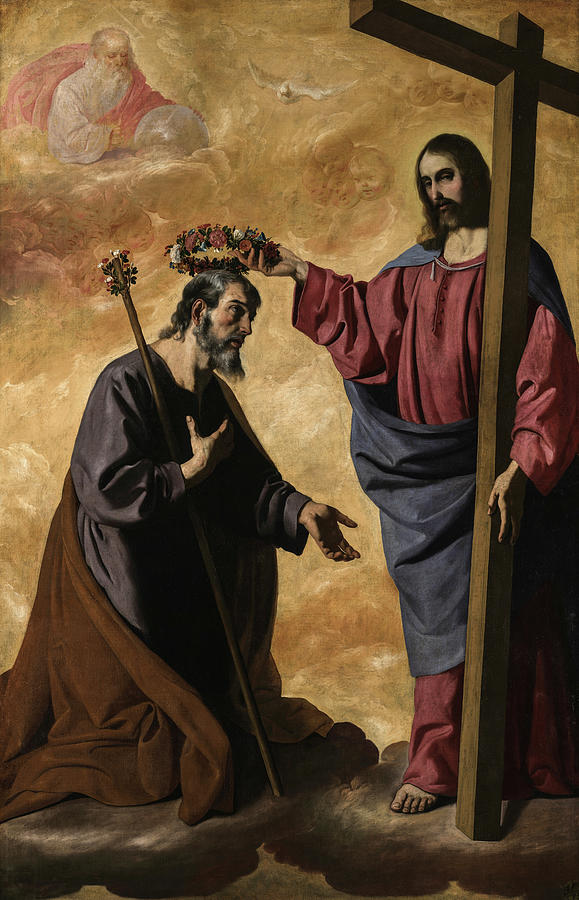
“Christ crowning Saint Joseph” by Francisco de Zurbaran is an unusual and deeply moving vision of heavenly reward. Instead of showing Joseph as the quiet guardian of the Nativity, Zurbaran presents him at the culmination of his earthly mission, kneeling before the risen Christ in a luminous cloudscape. Christ holds a tall wooden cross, visual proof of the completed work of redemption, while placing a crown of flowers upon Joseph’s head. High above, God the Father appears in the clouds and the Holy Spirit hovers as a dove, turning the scene into a Trinitarian vision.
The painting belongs to Zurbaran’s mature religious output, where he combines monumental figures with sober compositions and a powerful sense of inner devotion. The work transforms a relatively modest saint into a majestic intercessor and model of contemplative humility, reflecting the growing devotion to Saint Joseph in seventeenth century Spain.
Subject and Iconography
The subject unites two strands of Catholic imagery. On one hand there is the iconography of Saint Joseph, the foster father of Jesus, normally shown with a staff of lilies as a symbol of his purity and his role as guardian of the Holy Family. On the other hand there is the theme of celestial coronation, more commonly associated with the Virgin Mary. By giving Joseph his own coronation, Zurbaran emphasizes the dignity of his hidden life and his closeness to Christ.
Joseph kneels in the clouds, suggesting that the scene takes place after his death, in the realm of glory. He holds a flowering staff, recalling the legend that his staff bloomed to indicate his divine election as Mary’s spouse. Christ, standing calmly beside him, uses his right hand to place a garland of flowers upon Joseph’s head, while his left hand grips the upright of the cross. This juxtaposition is crucial. The crown symbolizes the reward of virtue, but the cross reminds viewers that all sanctity flows from Christ’s sacrifice.
Above, God the Father, rendered as an elderly, white bearded figure, looks down with benevolence. Between Father and Son, a white dove glides, representing the Holy Spirit. Together, these elements make the painting a celebration not only of Joseph’s fidelity but also of the whole Christian mystery of salvation.
Composition and Spatial Organization
Zurbaran constructs the composition around a diagonal relationship between the kneeling Joseph and the upright Christ. Joseph occupies the left side of the lower canvas. His kneeling body forms a compact mass of brown drapery, out of which rise his hands, face and staff. Christ stands to the right, taller and more vertical, echoing the upright of the cross he holds. The line from Joseph’s bowed head up to Christ’s hand and further to the cross leads the viewer’s gaze from humility to redemption.
The figures are set against a swirling background of golden clouds. There is no earthly landscape, no architectural frame. Instead, the clouds function as both ground and sky, supporting the figures and enveloping them in a softly luminous atmosphere. This gives the scene a visionary quality, as if we are witnessing an apparition seen through the eyes of faith.
God the Father appears in the upper left, visually balancing the cross at the right. The dove of the Holy Spirit hovers between them, slightly above the central axis of the painting. This arrangement subtly forms a triangle, a compositional echo of Trinitarian theology. The viewer’s eye travels in a circular movement from Joseph to Christ, upward to the Father, then back through the dove and down again, reinforcing the sense of divine harmony.
Light, Color and Atmosphere
Light in this painting does not come from a single obvious source. Instead it seems to emanate from the clouds themselves, creating a soft yet intense illumination. The golden sky behind the figures acts almost like a giant halo, suffusing the scene with warmth. This glow frames Christ and Joseph, separating them from the darker lower edge of the canvas and enhancing the impression that they have been lifted above earthly shadows.
Zurbaran’s color palette is rich but controlled. Christ’s garments combine a deep rose tunic with a saturated blue cloak, a familiar pairing in depictions of the Savior that associates him with both human blood and divine transcendence. Joseph wears more muted tones: a brownish mantle over darker garments, emphasizing his humility and closeness to the earth. Yet the subtle red and green hints in his clothing harmonize with Christ’s palette, underscoring their spiritual kinship.
The floral crown is painted with small touches of intense red and green, a miniature garden that crowns Joseph’s brow. These bright accents draw attention to the act of coronation, the pivotal moment of the scene. At the same time, the pale dove and the faint pinks and creams of the distant cherub faces blend into the golden air, contributing to the overall feeling of gentle radiance.
The Figure of Christ
Zurbaran presents Christ as serene and authoritative, yet approachable. He stands barefoot on the clouds, his weight resting confidently on one leg as he leans slightly toward Joseph. The pose is both stable and tender. His head tilts gently, and his expression is calm, almost contemplative, as he focuses on the crown he is placing. There is no overt drama, no theatrical gesture. In keeping with Zurbaran’s restrained style, Christ’s authority is expressed through quiet assurance rather than overt display.
The cross that Christ holds is rendered as a solid, angular structure. It rises beyond the upper edge of the canvas, suggesting an extension into realms beyond our sight. The stark geometry of its straight lines contrasts with the soft folds of Christ’s clothing and the amorphous clouds, reminding us of the harsh reality of the Passion. Yet here the cross is not an instrument of torture but a scepter of victory, a sign that the suffering has been transformed into glory.
Christ’s choice of gesture is significant. He does not place a golden crown of jewels on Joseph’s head but a wreath of flowers. This floral crown evokes martyrdom and spiritual victory, while also hinting at the simple, domestic world in which Joseph lived. The intimacy of the act expresses Christ’s gratitude towards the saint who cared for him in his human childhood.
The Image of Saint Joseph
Saint Joseph is portrayed as an elderly man with a grey beard, but his features retain a strong, dignified structure. Zurbaran avoids presenting him as frail or bent; instead, Joseph appears robust and grounded, his kneeling posture intentional rather than weak. His gaze is lifted toward Christ with a mixture of humility, surprise and gratitude. The left hand placed on his chest accentuates this emotional state, conveying both wonder at the honor he receives and recognition that all grace is unearned.
The staff in Joseph’s right hand is crowned with blossoms. In traditional iconography this motif refers to the miraculous flowering of his rod, a sign from God that he was chosen above other suitors to be Mary’s spouse. Zurbaran’s inclusion of this attribute connects the celestial moment of coronation back to the saint’s life on earth, where divine choice already marked him.
Joseph’s garments are voluminous and somewhat heavy, anchoring him visually in contrast to Christ’s more fluid drapery. The deep brown mantle symbolizes his humble work as a carpenter and provider. At the same time, the careful modelling of the folds and the way the fabric is warmed by the surrounding light give his figure a quiet nobility. He is the man of silence, now finally addressed and honored in the open by Christ himself.
Trinitarian Vision and Theological Meaning
One of the most remarkable aspects of this painting is its explicit Trinitarian structure. Christ dominates the central area, Joseph kneeling before him in the foreground. Above and behind, God the Father gazes down from the clouds, while the Holy Spirit as a dove glides between Father and Son. This configuration places Joseph squarely within the heart of the Trinity’s loving gaze.
Theologically, the scene dramatizes the idea that Joseph’s life has been fully conformed to the will of God. He accepted his role as guardian of Jesus and Mary, embraced hardship, exile and obscurity, and now receives his reward. Christ, who knew Joseph’s daily sacrifices, personally crowns him. The Father’s presence affirms this recognition, and the Spirit’s hovering suggests that Joseph’s virtues were always the work of grace.
For viewers, the message is that quiet fidelity in ordinary tasks can lead to extraordinary glory. There are no scenes of miracles or public preaching in Joseph’s life. Yet Zurbaran shows him receiving a crown from Christ in heaven. The imagery would have resonated deeply with monastic communities and lay believers who saw in Joseph a model of hidden holiness.
Zurbaran’s Style and Spiritual Realism
Francisco de Zurbaran is known for his spare compositions, strong lighting and profound spiritual realism. In “Christ crowning Saint Joseph,” these qualities are fully present. The figures are monumental, yet they remain psychologically convincing. Christ’s calm concentration, Joseph’s humble amazement and the Father’s quiet watchfulness all feel sincere, not theatrical.
The use of a neutral, cloud filled background is typical for Zurbaran’s devotional works. By eliminating distracting landscape details, he directs focus toward the inner drama of the souls portrayed. The clouds serve as a stage on which spiritual realities can be made visible.
At the same time, Zurbaran never abandons naturalism. The anatomy of the hands, the fall of the drapery, the texture of hair and beard are carefully observed. This combination of realism and abstraction gives the painting a timeless quality. It speaks both to the physical humanity of Christ and Joseph and to the transcendent realm into which they have entered.
Emotional Resonance and Devotional Use
The emotional effect of the painting is gentle yet powerful. There is no violent movement or harsh contrast. Instead, viewers encounter a quiet scene of recognition and love. The kneeling saint and the standing Christ form a kind of intimate dialogue that viewers are invited to witness.
In a devotional context, such an image would encourage believers to place themselves spiritually in Joseph’s position, kneeling before Christ and receiving his grace. The floral crown becomes a symbol not just of Joseph’s reward but of the hope offered to all who follow Christ faithfully. The work therefore functions as both narrative image and visual prayer, ideal for contemplation in a chapel or monastery.
Legacy and Contemporary Appreciation
Today “Christ crowning Saint Joseph” continues to fascinate viewers for its unique subject and serene beauty. It offers a rare glimpse of Joseph not as a peripheral figure in Nativity scenes but as a central protagonist in the story of salvation, honored by Christ and the Trinity.
The painting also illuminates Zurbaran’s ability to transform complex theological ideas into clear, accessible imagery. In a single view he unites themes of the Passion, resurrection, heavenly reward, Trinitarian theology and the sanctity of family life. The quiet glow of the clouds, the solid forms of the figures and the tender exchange between Christ and Joseph combine to create a deeply consoling work.
For art historians, the painting reveals how Spanish Baroque artists responded to new currents of devotion, especially the increasing veneration of Saint Joseph. For contemporary viewers, regardless of religious background, it remains a powerful meditation on gratitude, recognition and the dignity of unspectacular faithfulness.
By portraying Christ as the one who crowns and Joseph as the one who receives, Zurbaran invites every viewer to reflect on the relationship between divine grace and human cooperation. The painting does not shout, yet its message is clear. In the quiet fidelity of Joseph, honored at last in the radiance of heaven, we glimpse the hope that ordinary lives lived with love can be crowned in ways beyond imagining.
