Image source: wikiart.org
Introduction to Portrait of Santa Casilda
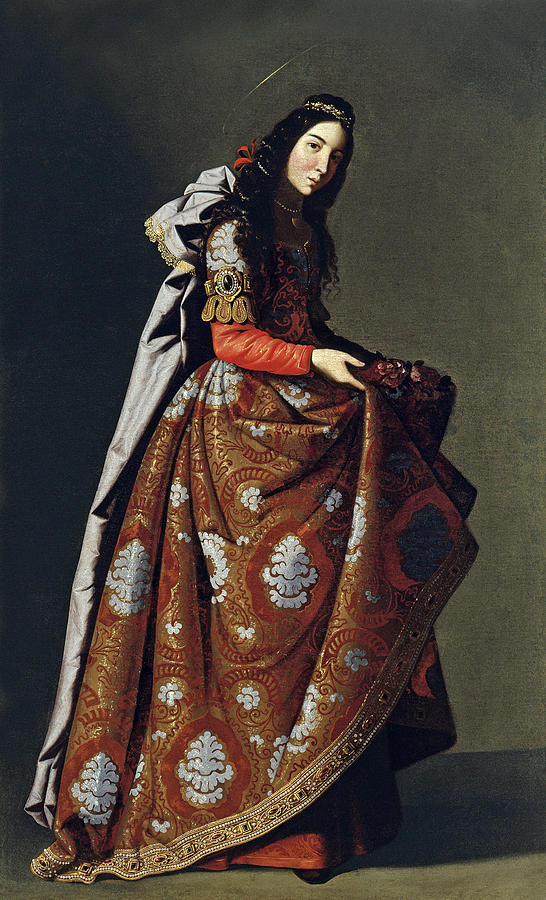
Francisco de Zurbaran’s “Portrait of Santa Casilda” presents one of the most captivating female saints of the Spanish Baroque. The painting shows a young woman dressed in richly patterned courtly clothes, her body turned in a graceful twist as she gathers the folds of her heavy skirt. At first glance it may appear to be a secular portrait of an aristocratic lady, yet the faint halo around her head and the roses she gathers in her lap reveal her true identity as Saint Casilda, a medieval princess associated with charity and a famous miracle.
Zurbaran was a master at combining devotional content with monumental realism. In this work he transforms a popular saint of medieval legend into a fashionably dressed noblewoman of seventeenth century Spain. The result is a painting that works as both sacred image and luxurious portrait, inviting the viewer to meditate on Casilda’s holiness while admiring the textures, colors and elegance of her figure.
The Legend of Saint Casilda
To understand Zurbaran’s choices in this portrait, it is useful to recall the legend of Casilda of Toledo. According to tradition, she was the daughter of a Muslim king in northern Spain during the early centuries of the Christian Reconquista. Moved by compassion for Christian prisoners held by her father, Casilda secretly carried bread to them, hiding the loaves in the folds of her dress.
One day she was confronted and ordered to reveal what she was carrying. When she opened her skirt, the bread miraculously turned into roses, protecting her from punishment. Later she converted to Christianity and lived a life of penance and prayer. Her story became popular in Spain, where she was venerated as a model of charity, courage and quiet resistance.
In the painting Zurbaran does not depict the dramatic moment of the miracle. Instead he offers a more introspective image. Casilda stands alone against a neutral background, separated from narrative context. Yet her slightly gathered skirt, her hands positioned as if to cradle something, and the small roses near the hem of her dress all point to the famous episode that made her a saint.
Composition and Pose
Zurbaran composes the figure as a tall, elegant column that fills the vertical format of the canvas. Santa Casilda is placed slightly off center, leaning gently toward the right, which gives a sense of movement. Her body is turned in three quarter view while her face turns toward the viewer. This twist in the torso allows the artist to display the full expanse of her embroidered dress and the sweeping line of the cloak that falls behind her.
The saint’s pose is refined but not stiff. One hand lightly gathers the heavy fabric of her skirt, as if she is about to step forward. The other hand supports a cluster of roses near her hip. Her head is inclined with a subtle, almost private expression. She seems absorbed in her own thoughts yet remains aware of the viewer’s presence. This combination of reserve and openness is characteristic of Zurbaran’s saints, who often appear caught in a moment of silent contemplation rather than dramatic action.
The painting’s background is a plain, softly toned field that shifts from darker gray at the top to lighter near the bottom. There is no architectural frame, no landscape, no narrative environment. The absence of setting isolates Casilda in a timeless, contemplative space. All attention goes to the figure herself, her clothes and her gentle gesture. This compositional austerity is typical of Zurbaran and contributes to the powerful immediacy of his religious images.
The Splendor of the Dress
One of the most striking aspects of “Portrait of Santa Casilda” is the sumptuousness of the saint’s dress. Zurbaran devotes extraordinary care to the rendering of the brocade fabric that covers most of the canvas. The voluminous skirt displays an intricate repeating pattern of stylized floral motifs in silver and pale blue against a warm reddish ground. The hem is bordered with elaborate gold trim decorated with small geometric elements and jewels.
The pattern is painted with meticulous precision yet also with a sense of the fabric’s weight and movement. Light glances off the metallic threads, creating subtle shifts in tone that suggest the way the material catches and reflects illumination. The folds of the skirt rise and fall like slow waves, giving the dress a sculptural presence. Even the inner layers of the gown, glimpsed where the fabric lifts, reveal rich reds and complementary tones.
By clothing Casilda in such finery, Zurbaran follows a broader Spanish Baroque tradition of representing female saints as richly dressed noblewomen. This practice may seem surprising given the emphasis on humility in Christian spirituality. Yet for seventeenth century viewers, the luxurious garments symbolized the soul’s spiritual riches, the royal dignity of sanctity and the triumph of virtue. Casilda’s dress does not suggest vanity but the honor granted to her by God.
Color Harmony and Symbolic Hues
The painting’s color scheme centers on a harmonious interplay between deep warm reds, cool grays and soft golds. The brocaded skirt dominates in rusty red and copper tones, enlivened by silvery motifs. Over her shoulders falls a large cloak in a pale lavender gray that contrasts beautifully with the warmth of the dress. The sleeves of her undergarment are a strong red that echoes the main color of the skirt and ties the upper and lower parts of the figure together.
The greenish gray background provides a quiet stage against which the bright colors of the clothing stand out. This subdued backdrop prevents the rich garments from overwhelming the composition while also creating a sense of atmospheric depth. Casilda’s pale face, framed by dark hair, becomes a focal point amid this tapestry of hues.
Symbolically, the red of her dress can be associated with charity and martyrdom. In Casilda’s case it evokes her loving sacrifice for the prisoners and perhaps the inner suffering involved in converting away from her family’s faith. The white and silver motifs may suggest purity and divine light. The faint golden halo above her head completes the color narrative, marking her as sanctified without breaking the naturalism of the scene.
The Delicate Drapery of the Cloak
While the brocade skirt attracts immediate attention, the cloak that falls from Casilda’s shoulders is equally important. Painted in cool gray with touches of lilac, it counters the heavy ornamentation of the dress with broad, soft folds. The cloak’s edge is lined with gold embroidery, but its main effect is one of smooth simplicity.
The way Zurbaran arranges this cloak demonstrates his mastery of drapery. It gathers at the shoulder in bulky folds, falls diagonally across the back and then descends in a long cascade toward the floor. Light touches the upper planes, leaving other areas in deep shadow. This play of highlights and shade not only indicates the volume of the fabric but also helps to model the saint’s body beneath it.
The cloak has a symbolic role as well. Draped like a mantle, it gives Casilda a noble and protective aura. It can be read as a visual metaphor for divine grace that surrounds and supports her. The contrast between the strict geometry of the richly patterned dress and the looser flow of the cloak mirrors the tension between Casilda’s noble birth and her spiritual vocation.
The Face and Expression of Santa Casilda
At the heart of the portrait is Casilda’s face. Zurbaran paints her as a young woman with delicate features, slightly parted lips and large, dark eyes. Her skin is luminous and smooth, with gentle modeling that suggests youthful softness rather than dramatic chiaroscuro. The artist’s use of light around the face is subtle. Shadows define the nose and cheeks, yet the overall impression remains serene and clear.
Her expression is one of gentle introspection. The tilt of her head and the slight parting of her lips invite multiple interpretations. She may be listening to an inner voice, acknowledging a divine command or simply lost in thought about the charity she is about to perform. Crucially, she does not look directly at the viewer. Her gaze passes just to the side, which gives the portrait a contemplative intimacy. The viewer becomes a respectful witness rather than an active participant in her world.
Small details around the head complete the image of sanctity and status. A thin golden line suggests a halo, so faint that it could almost be a delicate circlet. This restraint is typical of Zurbaran, who often avoids overly emphatic supernatural signs. Casilda’s dark hair falls in long curls, decorated with a jeweled headband and a red ribbon. These ornaments root her in noble culture while also enhancing the graceful rhythm of the composition.
Hands, Roses and the Miracle Allusion
Casilda’s hands play a central narrative role. The right hand gently lifts the heavy skirt, creating a fold that functions both as a compositional curve and as a container for the flowers. The left hand, more relaxed, rests near a cluster of roses. These roses are the key to identifying the saint and understanding the painting’s underlying story.
Zurbaran does not show the bread transforming into flowers, nor the suspicious guards of the legend. Instead he offers a quiet aftermath. The roses are already present, resting in the rich folds of the dress as if in a natural bouquet. The viewer familiar with the story connects the dots, imagining the unseen prisoners, the secret mission of charity and the divine intervention that turned bread into blossoms.
This understated approach reflects Zurbaran’s tendency to suggest narrative through symbolic objects rather than explicit action. The saint appears poised between the court and the prison, between her royal environment and the call of mercy. The roses become visual shorthand for generosity, risk and the wonder of grace working within everyday gestures.
Light, Shadow and the Baroque Atmosphere
As in many of Zurbaran’s works, light and shadow are used to sculpt the figure and create a contemplative mood. The illumination falls from the left, highlighting Casilda’s face, the upper part of her dress and the near side of the cloak. The far side of the figure sinks into shadow, which emphasizes the three dimensional solidity of her presence.
The background remains mostly dark but never completely black. It has a subtle gradation that prevents the figure from appearing cut out. Instead she seems to emerge from a soft penumbra, as if stepping onto a stage of spiritual awareness. This effect is characteristic of the Spanish Baroque, with its taste for dramatic lighting employed not only for spectacle but for spiritual intensity.
The handling of light on the brocade is particularly sophisticated. Small bright accents follow the pattern of the metallic threads, giving the impression of a fabric that shimmers and moves as Casilda shifts her weight. Yet the overall tonal balance remains controlled. Zurbaran prevents the ornament from becoming chaotic by organizing the pattern into large, legible forms that echo the oval shape of the skirt.
Santa Casilda and Zurbaran’s Series of Female Saints
“Portrait of Santa Casilda” belongs to a larger group of paintings in which Zurbaran depicted female martyrs and virgin saints dressed in luxurious contemporary clothing. These works were often commissioned for convents, where nuns saw in them exemplary models of feminine sanctity. By presenting the saints as noble ladies, Zurbaran allowed religious women of his time to imagine holiness within the context of their own culture and social expectations.
Within this series, Santa Casilda stands out for the richness of her costume and the quiet, self contained quality of her pose. Some other saints in the group carry obvious instruments of martyrdom such as swords or palms. Casilda’s attribute, the roses, is more delicate and poetic. Her story centers not on dramatic physical suffering but on hidden compassion and interior conversion. Zurbaran’s portrayal captures this tone with its calm atmosphere and inward looking expression.
The painting also shows the artist’s ability to merge portrait conventions with devotional imagery. Casilda could be mistaken for a real aristocratic sitter whose identity has been overlaid with saintly attributes. This ambiguity may have appealed to patrons who wanted images that were both beautiful and spiritually edifying.
Contemporary Resonance and Viewing Experience
For today’s viewer, “Portrait of Santa Casilda” continues to fascinate for its beauty and psychological depth. The lavish textile work speaks to the Spanish Golden Age’s global trade networks, which brought luxurious fabrics to Iberia from Italy and beyond. The saint’s quiet determination and humble charity carry a timeless message about social justice and compassion for the marginalized.
The painting invites slow looking. As the eye travels from the delicate ornamentation of the sleeve to the sheen of the gold border, then to the cluster of roses and finally to Casilda’s reflective face, a narrative unfolds without words. One senses the tension between privilege and conscience, between the comfortable life of the palace and the suffering of prisoners outside its walls. Zurbaran’s saint embodies the decision to use privilege in service of mercy.
In a museum or on the screen, the isolated figure against a neutral background also creates a personal encounter. Viewers may feel that Casilda steps out of history and stands before them as a living presence. Her gaze that moves just past us, her poised step and her gathered skirt all contribute to this illusion of immediacy. The painting thus continues to fulfill its original purpose as a devotional image that leads the mind and heart toward contemplation.
Conclusion
Francisco de Zurbaran’s “Portrait of Santa Casilda” is far more than a display of Baroque fashion. It is a meditative exploration of sanctity, identity and compassion. Through a masterful use of composition, color and light, Zurbaran transforms the legend of a medieval princess into a compelling visual presence. Santa Casilda’s sumptuous dress and jewels honor the spiritual nobility of her charitable acts, while the roses folded in her skirts quietly recall the miracle that protected her as she served the imprisoned and poor.
The painting stands at the crossroads of portraiture and devotional art, combining the realism of a contemporary noblewoman with the symbolism of a revered saint. Even centuries after its creation, it speaks to viewers about the power of hidden kindness, the dignity of conscience and the beauty that arises when inner virtue and outward presence unite.