Image source: wikiart.org
Introduction to Francisco de Zurbaran’s “Saint Eufemia”
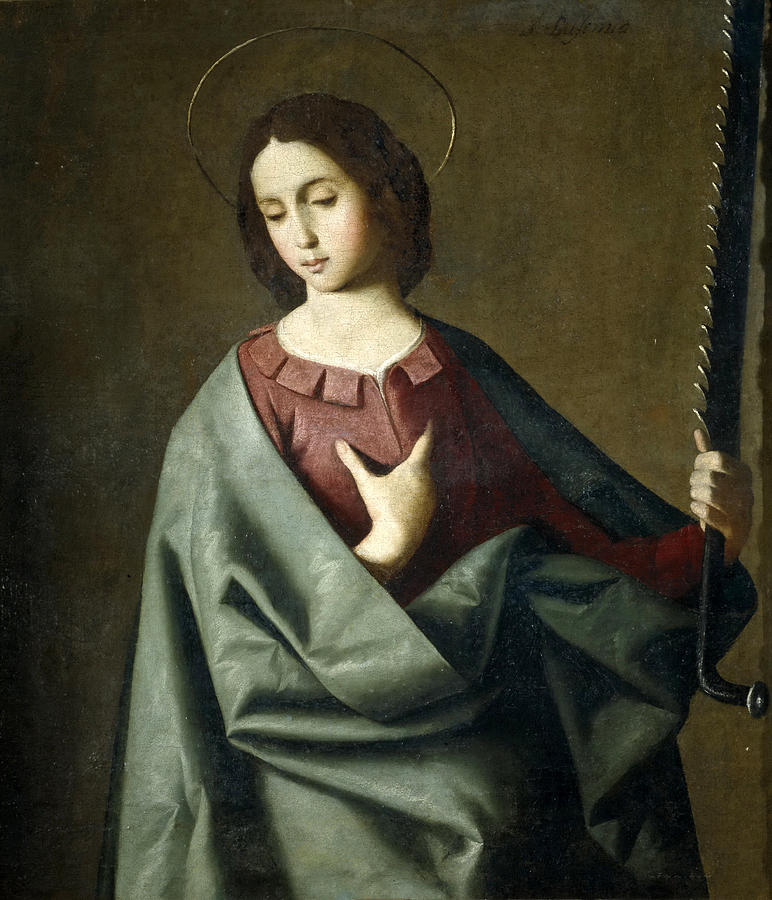
“Saint Eufemia” by Francisco de Zurbaran presents a quietly radiant image of a young martyr from the early Christian tradition. Rather than dramatizing scenes of violence or miracle, Zurbaran chooses a moment of introspective calm. The saint stands against a dark, neutral background, wrapped in a heavy green mantle that falls in sculptural folds around her body. She lowers her eyes in gentle contemplation, one hand resting over her heart while the other holds the instrument of her martyrdom, a long toothed saw.
This painting belongs to Zurbaran’s broader series of female martyrs and virgin saints. These works were highly prized in seventeenth century Spain for their combination of aesthetic refinement and moral instruction. In “Saint Eufemia” the artist distills the idea of heroic faith into a single serene figure. There is no narrative setting and no crowd of witnesses. The entire spiritual drama is expressed through pose, gesture, and light.
Saint Eufemia in Christian Tradition
Saint Eufemia, sometimes spelled Euphemia, is venerated as a virgin martyr who refused to renounce her faith during persecution. Although specific legendary details vary, she is celebrated for her unwavering fidelity to Christ and her willingness to suffer torture rather than abandon her beliefs. In devotional art, martyrs are often identified by the instruments associated with their death.
Here the saint holds a large saw as if it were both a weapon and a staff. The saw immediately announces her status as a martyr, yet Zurbaran softens its horror. It is painted with clarity, but it does not dominate the scene. The saint’s face and gesture remain central. This approach reflects Counter Reformation sensibilities, which sought to inspire the faithful through examples of courage and virtue rather than through sensational depictions of violence.
By presenting Eufemia as a youthful, almost girlish figure, Zurbaran emphasizes the paradox of Christian martyrdom. She appears fragile and modest, yet her inner strength is extraordinary. The painting invites viewers to contemplate how grace can transform weakness into courage.
Composition and the Power of Simplicity
The composition of “Saint Eufemia” is deliberately restrained. The saint occupies most of the canvas, positioned slightly off center to the right, allowing space for the sweep of her mantle to expand across the lower half. The background is a muted, warm brown that gradually darkens toward the edges. There are no architectural frames or landscape elements. This simplicity forces the viewer to concentrate on the figure alone.
Eufemia’s head tilts gently downward and toward her left. This diagonal movement counterbalances the vertical of the saw that rises along the right edge of the painting. Her hand over the heart creates another diagonal rhythm from the shoulder to the center of the chest. Together these lines give the composition a subtle dynamism while maintaining overall stability.
The halo around her head forms a delicate circle that punctuates the otherwise angular arrangement of drapery and saw. It is rendered as a thin ring of light rather than a heavy golden disc, reinforcing the painting’s understated tone. By keeping the visual vocabulary minimal, Zurbaran ensures that every element carries expressive weight.
Drapery, Texture, and the Sculptural Presence of the Saint
One of the most striking features of the painting is the monumental green mantle that envelops Eufemia. Zurbaran was renowned for his ability to paint fabric with almost tangible solidity, and here he turns the mantle into a kind of sculpted surface. Broad planes of color alternate with sharp creases and deep folds, catching light on the ridges while plunging into darkness in the recesses.
The mantle not only protects the saint’s body, it also announces her spiritual dignity. Its weight and volume contrast with the delicate oval of her face and the narrowness of her shoulders. This contrast heightens the impression that a small, vulnerable person is wrapped in a mantle of divine grace. The mantle becomes a visual metaphor for the protective presence of God that surrounds those who suffer for the faith.
Underneath, a red tunic peeks out around the neckline and at the right sleeve. Its warm tone glows against the cooler green of the mantle and the neutral background. Red often symbolizes love and sacrifice, so its placement at the heart and arm underscores Eufemia’s willingness to offer her life. Zurbaran balances this symbolic richness with a naturalistic handling of fabric that respects weight, gravity, and texture.
The Face of Saint Eufemia and the Expression of Inner Life
The emotional core of the painting lies in the face of Saint Eufemia. She is shown with soft, rounded features, closed or downcast eyes, and a faint smile that hovers between sadness and peace. Her skin is pale and luminous, modeled by gentle shadows around the nose, eyelids, and chin. The overall impression is one of purity and introspection.
Unlike more dramatic Baroque portraits that rely on intense eye contact, Zurbaran’s saint does not look at the viewer. Instead she withdraws into herself, in a state of prayerful recollection. This inward focus invites viewers to adopt a similar posture of contemplation. Rather than confronting them with her suffering, she quietly meditates on it, offering an example of interior surrender rather than outward defiance.
The slight tilt of her head contributes to a sense of gracefulness. It suggests not defeat but willing acceptance. Combined with the hand resting on her chest, the pose communicates a silent “yes” to the will of God. In this way, the painting communicates theology through body language.
Light, Chiaroscuro, and Atmosphere
Light in “Saint Eufemia” is soft and directional, entering from the upper left and bathing the saint’s face, neck, and upper torso. It fades gradually over the mantle and leaves the background in shadow. This controlled use of chiaroscuro creates a luminous focus on the saint’s inner life while maintaining an overall mood of quiet solemnity.
The halo appears not as a separate piece of ornament but as a natural extension of this light. It is simply the brightest ring in a surrounding field of subtle illumination. The atmosphere feels almost like the interior of a chapel, where a single window or candle quietly reveals the presence of the sacred.
The background’s darkness is not oppressive. Instead, it serves as a neutral field that allows the delicate modeling of the figure to stand out. There is enough variation in tone to avoid flatness, yet no distracting detail. The effect is similar to that of Zurbaran’s monastic portraits, where solitary figures emerge from shadow as embodiments of spiritual concentration.
The Saw as Attribute and Symbol
The saw held in Eufemia’s right hand is a key iconographic element. Its long blade and sharp teeth are clearly visible, but Zurbaran resists the temptation to sensationalize it. The saint’s hand grips the handle firmly yet calmly. She does not brandish the saw or direct it toward herself. Instead, it stands like a vertical staff, echoing the shape of a palm branch, another traditional symbol of martyrdom.
By integrating the saw so gracefully into the composition, Zurbaran transforms a brutal instrument into a sign of triumph. For Christian viewers, martyrdom is not merely a tragedy, it is a passage into glory. The saw thus becomes a paradoxical emblem of victory over fear and death.
The saint’s hand on her heart, parallel to the hand that holds the saw, suggests a link between interior consent and external suffering. She accepts the instrument in the same way she accepts God’s will, uniting courage and gentleness. The painting thus encourages viewers to rethink the meaning of sacrifice.
Zurbaran’s Representation of Female Sanctity
“Saint Eufemia” offers insight into Zurbaran’s broader approach to female sanctity. In many of his paintings of holy women, he emphasizes modesty, introspection, and quiet strength. The figures are often richly but soberly dressed, with little display of vanity. Their beauty is gentle and unforced.
In this painting, Eufemia’s femininity is expressed through the softness of her features and the delicate fall of hair around her face. However, she is not portrayed as passive or powerless. The firm grip on the saw, the upright posture, and the calm expression all communicate moral authority. She is a subject, not an ornament.
This balance reflects Counter Reformation ideals that presented holy women as models of spiritual courage and contemplative devotion. Zurbaran’s contribution is his ability to embody these virtues in visually compelling yet understated images that continue to resonate with modern viewers.
Devotional Function and Viewing Experience
For seventeenth century viewers, “Saint Eufemia” would have functioned as a devotional painting. It may have hung in a church, convent, or private home, where the faithful could pause before it to pray and seek inspiration. The painting’s intimate scale and subdued mood make it particularly suitable for personal meditation.
Standing before the canvas, the viewer is invited into a silent exchange with the saint. Her lowered eyes and inward gaze do not demand attention, but they gently draw the viewer into an atmosphere of prayer. The painting encourages a slow, contemplative looking, during which the small details of expression and drapery gradually reveal deeper meanings.
The viewer might reflect on his or her own willingness to accept hardship out of love for God or neighbor. Eufemia’s quiet courage becomes a mirror for the viewer’s conscience. Zurbaran’s technical command of light, color, and form serves this spiritual purpose, making aesthetic pleasure and devotional feeling reinforce one another.
Legacy and Contemporary Relevance
Today “Saint Eufemia” can be appreciated both as a masterpiece of Spanish Baroque painting and as a timeless image of resilience. In a world often captivated by noise and spectacle, Zurbaran’s saint stands as an emblem of the power of interior life. Her strength is not aggressive; it comes from conviction, humility, and trust.
From an art historical perspective, the painting demonstrates how Zurbaran adapted Caravaggesque chiaroscuro to a more contemplative mood. The sculptural drapery, the restrained palette, and the psychological depth of the figure all reveal his unique synthesis of drama and stillness.
For viewers of any background, the painting offers a meditation on how individuals respond to trials. The saw can symbolize any instrument of suffering, whether physical, emotional, or spiritual. Eufemia’s serene acceptance suggests that dignity is possible even in the face of painful circumstances, and that courage often appears in quiet forms.
Conclusion
Francisco de Zurbaran’s “Saint Eufemia” is a masterful example of how a seemingly simple portrait can convey profound spiritual meaning. Through a restrained composition, sculptural drapery, subtle light, and a delicately modeled face, Zurbaran presents a young martyr whose inner life shines with calm courage.
The saw she holds, the hand over her heart, and the luminous halo together communicate the paradox of Christian martyrdom, where suffering becomes a path to glory. The painting invites slow contemplation and offers a gentle yet powerful challenge to viewers to consider their own response to hardship and faith.
By uniting technical excellence with spiritual depth, “Saint Eufemia” continues to speak across centuries as a moving testament to the quiet heroism of sanctity and to Zurbaran’s genius as a painter of the soul.